Education
5 min read

Medicare Bulk Billing Consent Forms: A 2026 Guide for Practices
Published on
September 2, 2026
Contributors
Lyrebird Health
Subscribe to our newsletter
Read about our privacy policy.
Thank you! Your submission has been received!
Oops! Something went wrong while submitting the form.

A Medicare bulk billing consent form is formally an assignment of benefit agreement. The rules and forms changed on 1 July 2026, leaving practices to choose between pre-service, post-service and enduring agreements while older instructions still circulate. A workable six-step process starts with the current government form, the correct data fields and a clear link between the agreement and claim.

What the Medicare bulk billing consent form does

When a service is bulk billed, an eligible person assigns the right to the Medicare benefit to the professional. The professional accepts that benefit as full payment for the service. The patient cannot be charged an additional gap for the same service.

The form records that agreement. It is a billing document, separate from consent to clinical treatment, a privacy collection notice or any consent used for an ambient AI scribe. Our guide to patient consent for AI scribes explains that separate workflow.

An assignment agreement must be completed before the claim is submitted, although an episodic agreement can be entered into before or after the service. Since 1 July 2026, there is no prescribed form. A practice can use paper, an electronic workflow, an updated Services Australia form or its own format if the agreement meets the requirements. The Services Australia guidance sets out the claiming process, while the Department of Health, Disability and Ageing explains the new agreement framework.

Choose the right official form

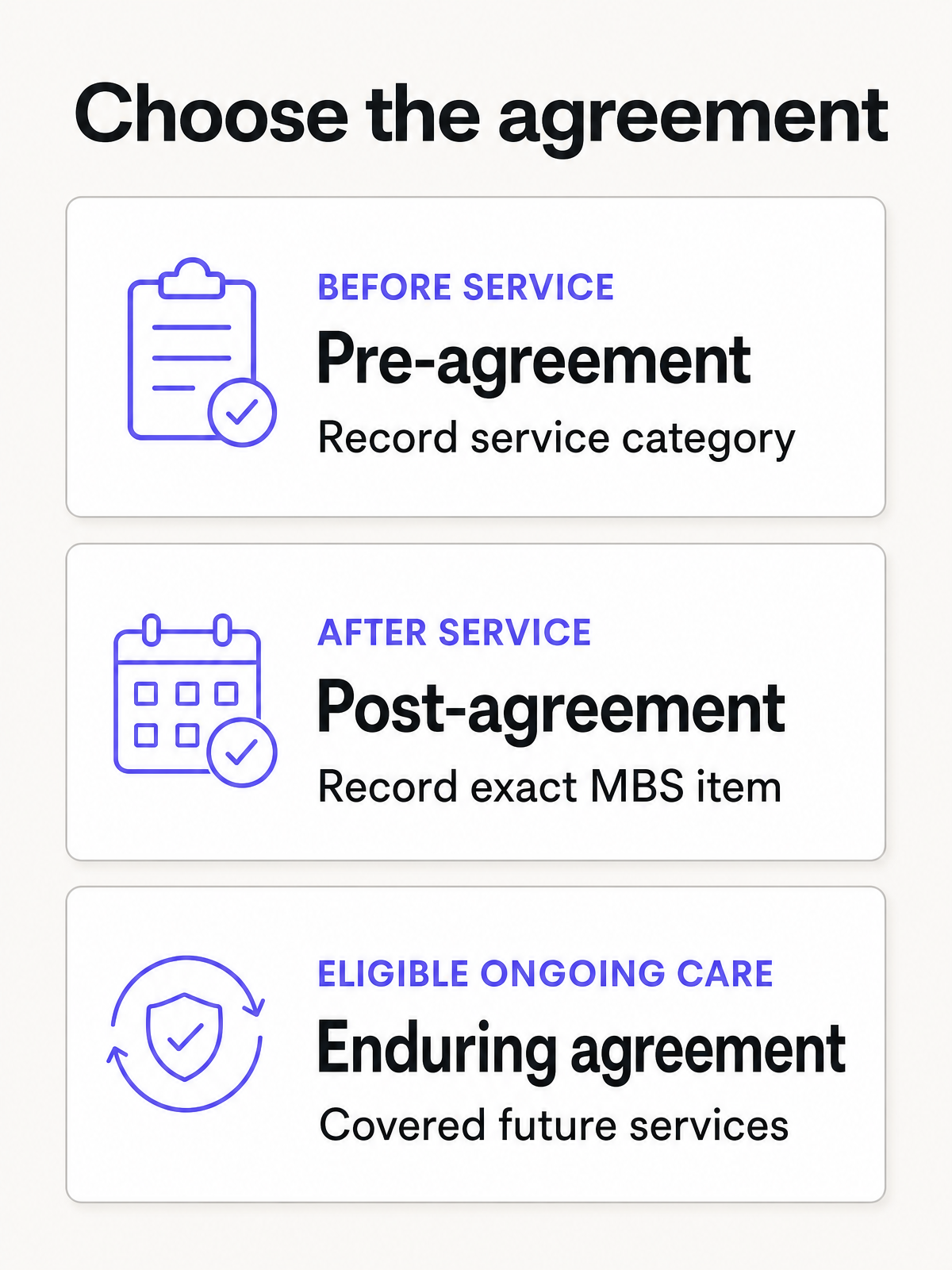
The right form depends on when the agreement is made, how the claim is lodged and whether the patient is eligible for an enduring agreement.

Three Medicare assignment paths: pre-agreement before service, post-agreement after service and enduring agreement for eligible ongoing care

Situation Agreement type Current government form
The agreement is made after the service and the claim is transmitted electronically Episodic post-agreement DB4E bulk bill voucher
The agreement is made after the service for an HPOS Bulk Bill Webclaim Episodic post-agreement DB020 Webclaim form
The agreement is made before one or more general MBS services Episodic pre-agreement Pre-agreement for all MBS services
The agreement is made before diagnostic imaging Episodic pre-agreement Diagnostic imaging pre-agreement
A MyMedicare-registered patient makes an ongoing agreement with an eligible GP at the registered practice Enduring agreement MyMedicare patient agreement
An eligible residential aged care home patient makes an ongoing agreement Enduring agreement Residential aged care agreement
A patient of an Aboriginal Community Controlled Health Organisation or Aboriginal Medical Service makes an ongoing agreement Enduring agreement ACCHO and AMS patient agreement

These templates are optional, but they are the clearest starting point for a manual workflow. DB4E and DB020 were updated for the new arrangements. Replace copies downloaded before July 2026 with the versions available through the linked Services Australia pages.

Practice management software can also capture the agreement. The software record still needs the prescribed information, evidence of agreement and a retrievable copy. A tick beside “bulk bill” on its own is not the agreement.

What an episodic agreement must contain

For a general practice service that is neither pathology nor diagnostic imaging, both pre-service and post-service agreements need:

  • the name of the person receiving the service
  • the date the agreement is proposed to be entered into
  • a statement that it is an episodic pre-agreement or episodic post-agreement
  • the professional's name and practice address, or the relevant provider number
  • the service date or dates
  • whether the assignor is the patient
  • terms assigning the Medicare benefit to the professional as full payment
  • the assignor's signature and date, unless the temporary verbal agreement rules are used.

The professional does not need to sign the agreement. The signature requirement applies to the assignor after the verbal transition ends.

The service field changes according to timing:

If agreement occurs The service information must identify
Before the service The category for each service, such as GP short, GP standard, GP long, GP care planning and health assessments, or GP other
After the service The exact MBS item number for each service already rendered

The service categories and mapped MBS items are set by the 2026 determination as amended. The July Updates 2026 amendment was registered on 25 August 2026 and took effect on 26 August 2026, updating the item mappings for several categories. This distinction matters. A pre-service form should describe the permitted service category rather than guess the final item number before the consult. A post-service form records the item that follows from the service actually delivered.

An episodic pre-agreement can cover more than one described service to be rendered during the six-month period beginning on the agreement date. An episodic post-agreement can cover more than one service, provided every service was already rendered before the agreement was offered. These rules are set out in the episodic agreement amendments.

Pathology and diagnostic imaging have different data fields, including specimen or procedure dates and service-specific descriptions. Use the relevant official workflow rather than adapting the general-practice checklist. The complete data set sits in section 65C of the Health Insurance Regulations.

How verbal agreement works until 30 June 2027

From 1 July 2026 to 30 June 2027, the assignor can agree verbally in all settings. The temporary rule removes the need for the assignor to sign and date the agreement. It does not remove the written record.

When verbal agreement is used, the paper or electronic agreement must still contain the required data and must state:

  • that verbal agreement was provided
  • the date on which it was provided.

These transitional requirements are retrospective to 1 July 2026 under the verbal agreement regulations. From 1 July 2027, an episodic agreement must be signed and dated by the assignor.

Verbal enduring agreements have an extra time limit: they cease at the start of 1 July 2027. A practice that wants an eligible patient's enduring arrangement to continue will need a signed agreement that meets the enduring agreement and registration requirements.

When an enduring agreement is appropriate

An enduring agreement covers eligible future bulk billed services, so the patient does not complete a new episodic agreement for every covered service. It is limited to defined patient and provider relationships:

  • a patient registered with MyMedicare and an eligible GP registered at the same practice
  • a resident of a residential aged care home and an eligible GP providing covered services at or from the permitted locations
  • a patient of an Aboriginal Community Controlled Health Organisation or Aboriginal Medical Service and the organisation's covered professionals.

The agreement must identify the patient, assignor, covered service categories, relevant professional or organisation, location, notification method and termination process. If the assignor is acting for another person, additional responsible-person and patient-declaration rules apply. The enduring agreement regulations contain the full eligibility and content requirements.

For a MyMedicare enduring agreement, the professional must notify the assignor within 24 hours after making each covered claim. The notification includes the professional, patient, service date and amount of Medicare benefit claimed. That claim notification is part of the record set.

Enduring agreements entered into on or after 1 July 2027 must be registered with Services Australia. A written enduring agreement entered into before that date ceases after 12 months if it has not been registered by its first anniversary. A verbal enduring agreement ends earlier, at the start of 1 July 2027.

Build the agreement into the claim workflow

A reliable six-step process connects the agreement to the actual claim rather than treating consent as a detached reception task.
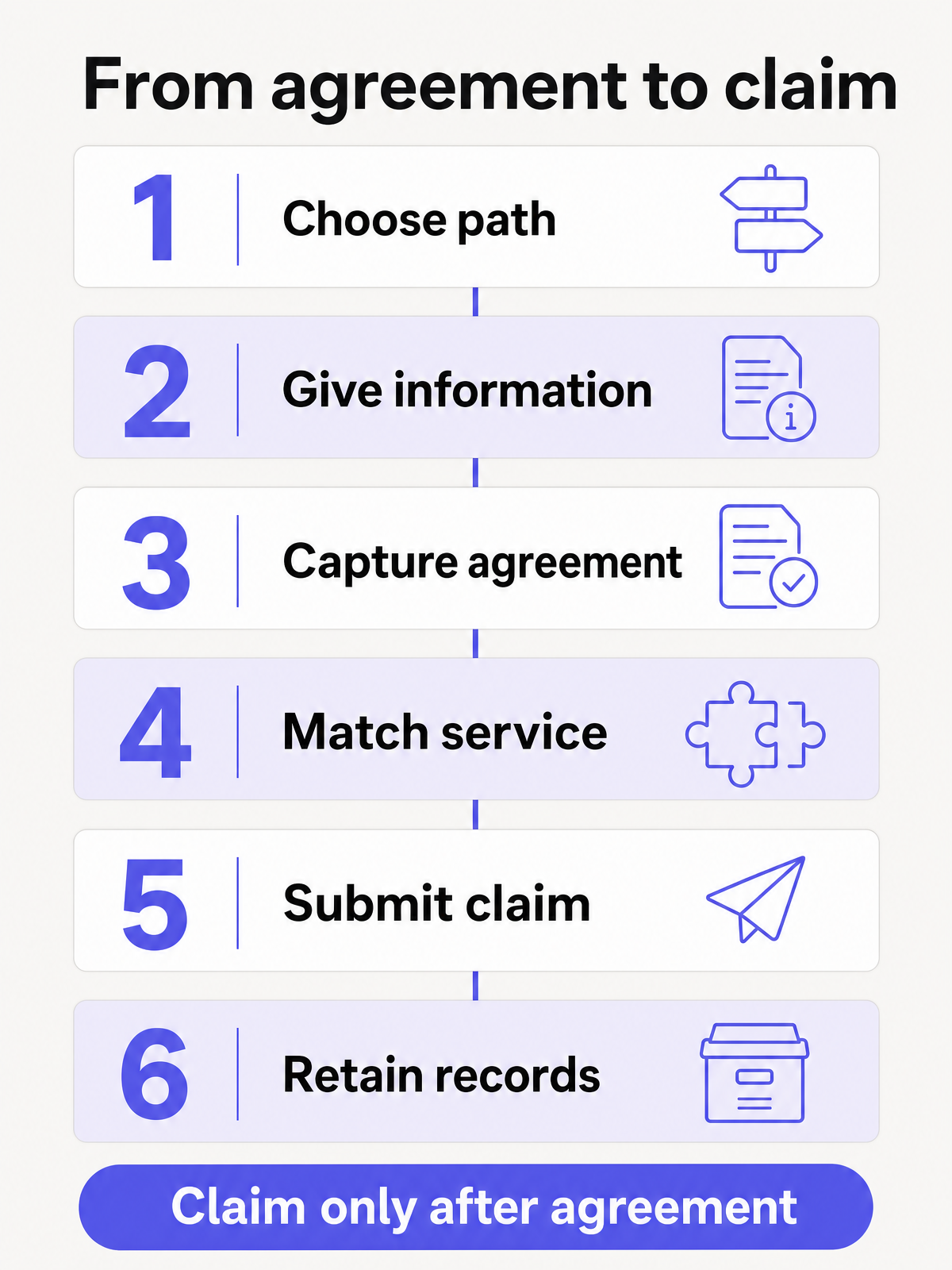
Six-step Medicare assignment workflow from choosing a path to retaining claim records

  1. Choose the agreement pathway. Use pre-service when the service category can be described in advance, post-service when the final item is needed on the agreement, or enduring only when the eligibility rules are met.
  2. Give the required information in writing. The assignor must receive the prescribed information before or at the time either party offers the agreement.
  3. Capture agreement. Record a physical or electronic signature and date, or the required verbal agreement notation during the transition period.
  4. Match the service to the agreement. Confirm that every claimed service falls within the category on a pre-agreement, or that every item on a post-agreement matches the services delivered.
  5. Submit the claim only after completing the agreement. Do not submit the Medicare claim while an agreement request is still unanswered or incomplete. Store an identifier that lets the practice retrieve the completed agreement from the claim, provider, patient and service date.
  6. Retain the full record set. Keep the records in electronic form or another form approved by the Secretary. The Health Insurance Act requires retention until the later of two years after an agreement ceases to be in force and two years after the record was created. The exact rule is in section 127A of the Act.

A sound operational control is to make changed items, rejected claims and replacement claims exceptions for review. Do not overwrite the original agreement. If the final service falls outside a pre-agreement's recorded category, obtain a new agreement with the right information before submitting the claim.

The agreement confirms who receives the benefit. It does not prove that the MBS item itself is correct. Our MBS billing guide for GPs covers item selection, clinical records, submission and reconciliation.

Common questions

Does a patient need to sign a bulk billing form at every appointment?

Not always. An episodic pre-agreement can cover multiple described services during a six-month period. An eligible patient can use an enduring agreement for covered future services. Otherwise, the practice needs a completed episodic agreement before each claim or group of services covered by that agreement.

Can a Medicare bulk billing consent form be signed electronically?

Yes. An assignment agreement can be paper or electronic. Through 30 June 2027, verbal agreement is also permitted if the written or electronic record includes the required statement and date.

What happens if the patient refuses assignment of benefit?

The service cannot be bulk billed. Assignment is the mechanism that allows Medicare to pay the benefit directly to the professional as full payment. The practice can use an appropriate private-billing pathway, with the patient or other claimant claiming the Medicare benefit.

Is there a different Medicare bulk billing consent form for each state?

No. Assignment of Medicare benefits is a Commonwealth process, so the core agreement requirements do not change between states and territories. Separate privacy, health-record and consent obligations can still apply to the practice's wider workflow.

Is assignment of benefit the same as bulk billing incentive eligibility?

No. The agreement supports the underlying bulk billed claim. It does not establish whether the service attracts an MBS bulk billing incentive or whether a practice meets the Bulk Billing Practice Incentive Program rules. Our bulk billing incentive guide explains those separate requirements.

Use the government form that matches the agreement and claiming pathway, then keep its data, agreement evidence and claim details connected as one retrievable record.


More Resources
Continue reading
Posts
The dangers of Copy Paste Scribes
Read More
Posts
How to use an AI medical scribe
Read More
Posts
December Product Updates
Read More
Education
Clinical Documentation Audit: A Practical Australian Guide
Read More
Education
Patient Education Materials: An Australian Clinician's Guide
Read More
Education
Scanning Medical Records: A Practical Australian Guide
Read More
Post
5 min read

Medicare Bulk Billing Consent Forms: A 2026 Guide for Practices

Published on
September 2, 2026
Contributors
Lyrebird Health
Subscribe to our newsletter
Read about our privacy policy.
Thank you! Your submission has been received!
Oops! Something went wrong while submitting the form.

A Medicare bulk billing consent form is formally an assignment of benefit agreement. The rules and forms changed on 1 July 2026, leaving practices to choose between pre-service, post-service and enduring agreements while older instructions still circulate. A workable six-step process starts with the current government form, the correct data fields and a clear link between the agreement and claim.

What the Medicare bulk billing consent form does

When a service is bulk billed, an eligible person assigns the right to the Medicare benefit to the professional. The professional accepts that benefit as full payment for the service. The patient cannot be charged an additional gap for the same service.

The form records that agreement. It is a billing document, separate from consent to clinical treatment, a privacy collection notice or any consent used for an ambient AI scribe. Our guide to patient consent for AI scribes explains that separate workflow.

An assignment agreement must be completed before the claim is submitted, although an episodic agreement can be entered into before or after the service. Since 1 July 2026, there is no prescribed form. A practice can use paper, an electronic workflow, an updated Services Australia form or its own format if the agreement meets the requirements. The Services Australia guidance sets out the claiming process, while the Department of Health, Disability and Ageing explains the new agreement framework.

Choose the right official form

The right form depends on when the agreement is made, how the claim is lodged and whether the patient is eligible for an enduring agreement.

Three Medicare assignment paths: pre-agreement before service, post-agreement after service and enduring agreement for eligible ongoing care

Situation Agreement type Current government form
The agreement is made after the service and the claim is transmitted electronically Episodic post-agreement DB4E bulk bill voucher
The agreement is made after the service for an HPOS Bulk Bill Webclaim Episodic post-agreement DB020 Webclaim form
The agreement is made before one or more general MBS services Episodic pre-agreement Pre-agreement for all MBS services
The agreement is made before diagnostic imaging Episodic pre-agreement Diagnostic imaging pre-agreement
A MyMedicare-registered patient makes an ongoing agreement with an eligible GP at the registered practice Enduring agreement MyMedicare patient agreement
An eligible residential aged care home patient makes an ongoing agreement Enduring agreement Residential aged care agreement
A patient of an Aboriginal Community Controlled Health Organisation or Aboriginal Medical Service makes an ongoing agreement Enduring agreement ACCHO and AMS patient agreement

These templates are optional, but they are the clearest starting point for a manual workflow. DB4E and DB020 were updated for the new arrangements. Replace copies downloaded before July 2026 with the versions available through the linked Services Australia pages.

Practice management software can also capture the agreement. The software record still needs the prescribed information, evidence of agreement and a retrievable copy. A tick beside “bulk bill” on its own is not the agreement.

What an episodic agreement must contain

For a general practice service that is neither pathology nor diagnostic imaging, both pre-service and post-service agreements need:

  • the name of the person receiving the service
  • the date the agreement is proposed to be entered into
  • a statement that it is an episodic pre-agreement or episodic post-agreement
  • the professional's name and practice address, or the relevant provider number
  • the service date or dates
  • whether the assignor is the patient
  • terms assigning the Medicare benefit to the professional as full payment
  • the assignor's signature and date, unless the temporary verbal agreement rules are used.

The professional does not need to sign the agreement. The signature requirement applies to the assignor after the verbal transition ends.

The service field changes according to timing:

If agreement occurs The service information must identify
Before the service The category for each service, such as GP short, GP standard, GP long, GP care planning and health assessments, or GP other
After the service The exact MBS item number for each service already rendered

The service categories and mapped MBS items are set by the 2026 determination as amended. The July Updates 2026 amendment was registered on 25 August 2026 and took effect on 26 August 2026, updating the item mappings for several categories. This distinction matters. A pre-service form should describe the permitted service category rather than guess the final item number before the consult. A post-service form records the item that follows from the service actually delivered.

An episodic pre-agreement can cover more than one described service to be rendered during the six-month period beginning on the agreement date. An episodic post-agreement can cover more than one service, provided every service was already rendered before the agreement was offered. These rules are set out in the episodic agreement amendments.

Pathology and diagnostic imaging have different data fields, including specimen or procedure dates and service-specific descriptions. Use the relevant official workflow rather than adapting the general-practice checklist. The complete data set sits in section 65C of the Health Insurance Regulations.

How verbal agreement works until 30 June 2027

From 1 July 2026 to 30 June 2027, the assignor can agree verbally in all settings. The temporary rule removes the need for the assignor to sign and date the agreement. It does not remove the written record.

When verbal agreement is used, the paper or electronic agreement must still contain the required data and must state:

  • that verbal agreement was provided
  • the date on which it was provided.

These transitional requirements are retrospective to 1 July 2026 under the verbal agreement regulations. From 1 July 2027, an episodic agreement must be signed and dated by the assignor.

Verbal enduring agreements have an extra time limit: they cease at the start of 1 July 2027. A practice that wants an eligible patient's enduring arrangement to continue will need a signed agreement that meets the enduring agreement and registration requirements.

When an enduring agreement is appropriate

An enduring agreement covers eligible future bulk billed services, so the patient does not complete a new episodic agreement for every covered service. It is limited to defined patient and provider relationships:

  • a patient registered with MyMedicare and an eligible GP registered at the same practice
  • a resident of a residential aged care home and an eligible GP providing covered services at or from the permitted locations
  • a patient of an Aboriginal Community Controlled Health Organisation or Aboriginal Medical Service and the organisation's covered professionals.

The agreement must identify the patient, assignor, covered service categories, relevant professional or organisation, location, notification method and termination process. If the assignor is acting for another person, additional responsible-person and patient-declaration rules apply. The enduring agreement regulations contain the full eligibility and content requirements.

For a MyMedicare enduring agreement, the professional must notify the assignor within 24 hours after making each covered claim. The notification includes the professional, patient, service date and amount of Medicare benefit claimed. That claim notification is part of the record set.

Enduring agreements entered into on or after 1 July 2027 must be registered with Services Australia. A written enduring agreement entered into before that date ceases after 12 months if it has not been registered by its first anniversary. A verbal enduring agreement ends earlier, at the start of 1 July 2027.

Build the agreement into the claim workflow

A reliable six-step process connects the agreement to the actual claim rather than treating consent as a detached reception task.

Six-step Medicare assignment workflow from choosing a path to retaining claim records

  1. Choose the agreement pathway. Use pre-service when the service category can be described in advance, post-service when the final item is needed on the agreement, or enduring only when the eligibility rules are met.
  2. Give the required information in writing. The assignor must receive the prescribed information before or at the time either party offers the agreement.
  3. Capture agreement. Record a physical or electronic signature and date, or the required verbal agreement notation during the transition period.
  4. Match the service to the agreement. Confirm that every claimed service falls within the category on a pre-agreement, or that every item on a post-agreement matches the services delivered.
  5. Submit the claim only after completing the agreement. Do not submit the Medicare claim while an agreement request is still unanswered or incomplete. Store an identifier that lets the practice retrieve the completed agreement from the claim, provider, patient and service date.
  6. Retain the full record set. Keep the records in electronic form or another form approved by the Secretary. The Health Insurance Act requires retention until the later of two years after an agreement ceases to be in force and two years after the record was created. The exact rule is in section 127A of the Act.

A sound operational control is to make changed items, rejected claims and replacement claims exceptions for review. Do not overwrite the original agreement. If the final service falls outside a pre-agreement's recorded category, obtain a new agreement with the right information before submitting the claim.

The agreement confirms who receives the benefit. It does not prove that the MBS item itself is correct. Our MBS billing guide for GPs covers item selection, clinical records, submission and reconciliation.

Common questions

Does a patient need to sign a bulk billing form at every appointment?

Not always. An episodic pre-agreement can cover multiple described services during a six-month period. An eligible patient can use an enduring agreement for covered future services. Otherwise, the practice needs a completed episodic agreement before each claim or group of services covered by that agreement.

Can a Medicare bulk billing consent form be signed electronically?

Yes. An assignment agreement can be paper or electronic. Through 30 June 2027, verbal agreement is also permitted if the written or electronic record includes the required statement and date.

What happens if the patient refuses assignment of benefit?

The service cannot be bulk billed. Assignment is the mechanism that allows Medicare to pay the benefit directly to the professional as full payment. The practice can use an appropriate private-billing pathway, with the patient or other claimant claiming the Medicare benefit.

Is there a different Medicare bulk billing consent form for each state?

No. Assignment of Medicare benefits is a Commonwealth process, so the core agreement requirements do not change between states and territories. Separate privacy, health-record and consent obligations can still apply to the practice's wider workflow.

Is assignment of benefit the same as bulk billing incentive eligibility?

No. The agreement supports the underlying bulk billed claim. It does not establish whether the service attracts an MBS bulk billing incentive or whether a practice meets the Bulk Billing Practice Incentive Program rules. Our bulk billing incentive guide explains those separate requirements.

Use the government form that matches the agreement and claiming pathway, then keep its data, agreement evidence and claim details connected as one retrievable record.

Keep reading

All posts
Questions about compliance?