Education
5 min read

Practice Manager Duties: A Practical Australian Guide
Published on
September 1, 2026
Practice Manager Duties on a violet Lyrebird Health title card
Contributors
Lyrebird Health
Subscribe to our newsletter
Read about our privacy policy.
Thank you! Your submission has been received!
Oops! Something went wrong while submitting the form.

Medical practices depend on systems that patients rarely see: safe rosters, accurate billing, working equipment, protected records and clear escalation paths. The practice manager connects those systems so clinicians can focus on care. For clinic owners, current managers and people considering the role, the useful question is more specific than “what does a practice manager do?” It is what the manager owns, what they coordinate and where clinical or owner accountability begins.

What is a practice manager responsible for?

A practice manager is the senior non-clinical leader responsible for the business and administrative operation of a medical, dental or allied health practice. The scope changes with the size and type of clinic. In a small practice, the manager may handle payroll, reception cover and procurement directly. In a larger group, they may lead team supervisors and report on several sites.

Jobs and Skills Australia defines the occupation around organising the functions and resources of a professional practice. Its task profile includes planning office services, allocating staff and equipment, managing records and accounts, coordinating personnel and maintaining facilities. The official occupation profile is a useful baseline, although a healthcare role also carries patient-safety, privacy and accreditation responsibilities.

The Australian Association of Practice Management groups the profession into eight areas: finance, human resources, planning and marketing, information, risk, governance, business and clinical operations, and professional responsibility. Those practice management principles show why a job description based only on “keeping the clinic running” is too vague.

The eight core practice manager duties

1. Lead the practice team

The practice manager turns expected service levels into a workable workforce plan. Common duties include:

  • forecasting staffing needs and building rosters
  • recruiting, onboarding and inducting administrative staff
  • keeping role descriptions, contracts, credentials and required training current
  • setting goals, giving feedback and managing performance within delegated authority
  • approving leave and payroll inputs
  • running team meetings and planning coverage for absences
  • supporting a respectful, psychologically safe workplace.

Good workforce management is visible in stable coverage, completed induction, timely performance conversations and fewer unresolved issues. A manager needs a clear reporting line and documented authority. Accountability without decision rights creates delays, duplicate instructions and avoidable conflict.

2. Keep patient access and clinic flow working

Practice managers design the administrative pathway around care. They monitor appointment availability, phone and message handling, reception queues, recalls, cancellations, wait times and handovers. They also maintain accessible information for patients and coordinate interpreter, mobility and communication needs with the care team.

Complaints sit partly in this area. The manager should log the concern, acknowledge it, gather the relevant facts, follow the practice process and close the feedback loop. Any clinical safety issue or complaint about clinical judgement needs prompt escalation to the responsible clinician or clinical governance lead.

3. Oversee finance and billing operations

The manager gives owners a reliable view of practice performance. Work may include budgets, cash flow, accounts payable, debtor follow-up, payroll inputs, banking controls, stock costs, service agreements and month-end reporting.

In general practice, this often extends to Medicare and private-billing processes. The manager can maintain billing workflows, train staff, track rejected claims and investigate unusual patterns. The treating clinician still needs to confirm that a service and its documentation meet the requirements for the item claimed. That separation protects both revenue integrity and clinical accountability.

4. Coordinate governance, accreditation and quality improvement

Accreditation is a year-round operating system rather than a folder assembled before survey day. The manager usually keeps the evidence register, policy review schedule, training records, risk register, incident log and improvement plan moving. They coordinate mock checks, assign actions and report gaps to owners and the clinical team.

The RACGP’s current sixth edition Standards frame accreditation around patient safety, patient-centred care, quality improvement and a practice safety culture. A practical manager converts those aims into named owners, due dates and evidence.

5. Protect information and administer records systems

Every private health service provider covered by the Privacy Act must comply with the Australian Privacy Principles, including a small practice with annual turnover below $3 million. The OAIC’s small-business guidance confirms that the health-service exception applies regardless of turnover.

The manager’s operational duties commonly include access controls, staff privacy training, secure communication processes, records retention, vendor reviews, backup and recovery checks, breach response and access removal when a person leaves. The risk is active: health accounted for 18% of reported breaches in the OAIC’s January to June 2025 data, the largest share of any sector.

6. Maintain facilities, supplies and business continuity

Someone must know what happens when the vaccine fridge alarm sounds, the internet fails or a clinician room becomes unavailable. The practice manager coordinates maintenance, cleaning, waste, security, utilities, stock, emergency contacts and equipment servicing. They also keep continuity plans usable, including current contact trees, downtime procedures and recovery priorities.

Work health and safety belongs in this system. The manager conducts or coordinates inspections, records hazards, follows up controls and keeps required training current. Owners, officers, workers and contractors retain the duties that apply to them under the relevant jurisdiction.

7. Manage technology and clinical AI safely

Technology administration now extends beyond purchasing software. The practice manager maps the workflow, assesses vendors with clinical and privacy leads, configures user access, plans training, controls approved templates and monitors whether the tool is delivering the intended result.

For AI scribes, the RACGP advises practices to set an approved-use policy, update patient privacy information, define incident reporting, train users and review performance over time. Its AI scribe fact sheet also keeps clinical review with the GP: clinicians must check generated notes and confirm any suggested MBS items.

Our practice and team management capabilities give managers shared templates, centralised user management, single sign-on, billing prompts and reporting across the clinic. These controls help standardise administration while each clinician reviews, edits and signs off their own draft clinical documentation. Our AI scribe implementation guide covers contracting, consent processes, staged rollout, quality assurance and ongoing monitoring.

8. Turn data into an operating plan

The manager brings operational evidence to owners and the team. That means agreeing on a small set of measures, identifying the cause of a variance and assigning an action. Useful reporting covers access, workforce, finance, quality, privacy, technology and patient experience. A large dashboard with no decision attached is only reporting work.

Strategic duties can include annual budgeting, capacity planning, new-service assessment, contract negotiation, marketing oversight and clinic expansion. The manager supplies the operational and financial case while owners and clinical leaders make decisions within their authority.

Skills that make these duties work

The role combines management skill with healthcare context. Strong practice managers can:

  • Prioritise under pressure: distinguish a patient-safety escalation from work that can be scheduled.
  • Lead people fairly: set expectations, give specific feedback and handle difficult conversations consistently.
  • Read the numbers: understand budgets, cash flow, debtor ageing and the operational reason behind a variance.
  • Design reliable processes: turn a policy into a workflow with an owner, trigger, handover, record and review point.
  • Communicate across roles: translate operational detail into a clear choice for owners, clinicians, staff, patients and suppliers.
  • Use technology critically: understand permissions, integration, privacy, reporting and the limits of automated output.

Experience may come from medical reception, nursing, administration or operations. Education requirements vary with the employer and the complexity of the practice. A clinical background can help with context, but clinical work requires the relevant qualification, registration and authority.

What practice manager duties look like across the year

A duty list becomes more useful when each task has a cadence and an output.

Cadence Typical duties Evidence or output
Daily Check staffing and clinic constraints, resolve flow issues, review urgent messages and incidents, authorise routine purchases, handle escalations Coverage plan, action log, completed escalation
Weekly Review rosters and access, hold team huddles, follow up claims and debtors, check stock exceptions, progress complaints and risks Roster, meeting actions, exception report
Monthly Close payroll and accounts inputs, review budget variance, audit selected workflows, check training and access changes, report operational KPIs Management pack, audit findings, updated access register
Quarterly Review policies and risks, test continuity procedures, complete performance conversations, evaluate suppliers and improvement projects Risk register, test record, supplier review, improvement report
Annually Build the budget and workforce plan, review insurance and major contracts, plan accreditation activity, schedule required training and set priorities Approved operating plan with owners, dates and measures

The pattern should fit the clinic. A procedural specialist practice may need tighter theatre, sterilisation and stock controls. A multi-site general practice may put more emphasis on standardised access, reporting and user administration.

Set clear boundaries around the role

The strongest practice managers know when to act, when to consult and when to escalate. Owners should make these boundaries explicit.
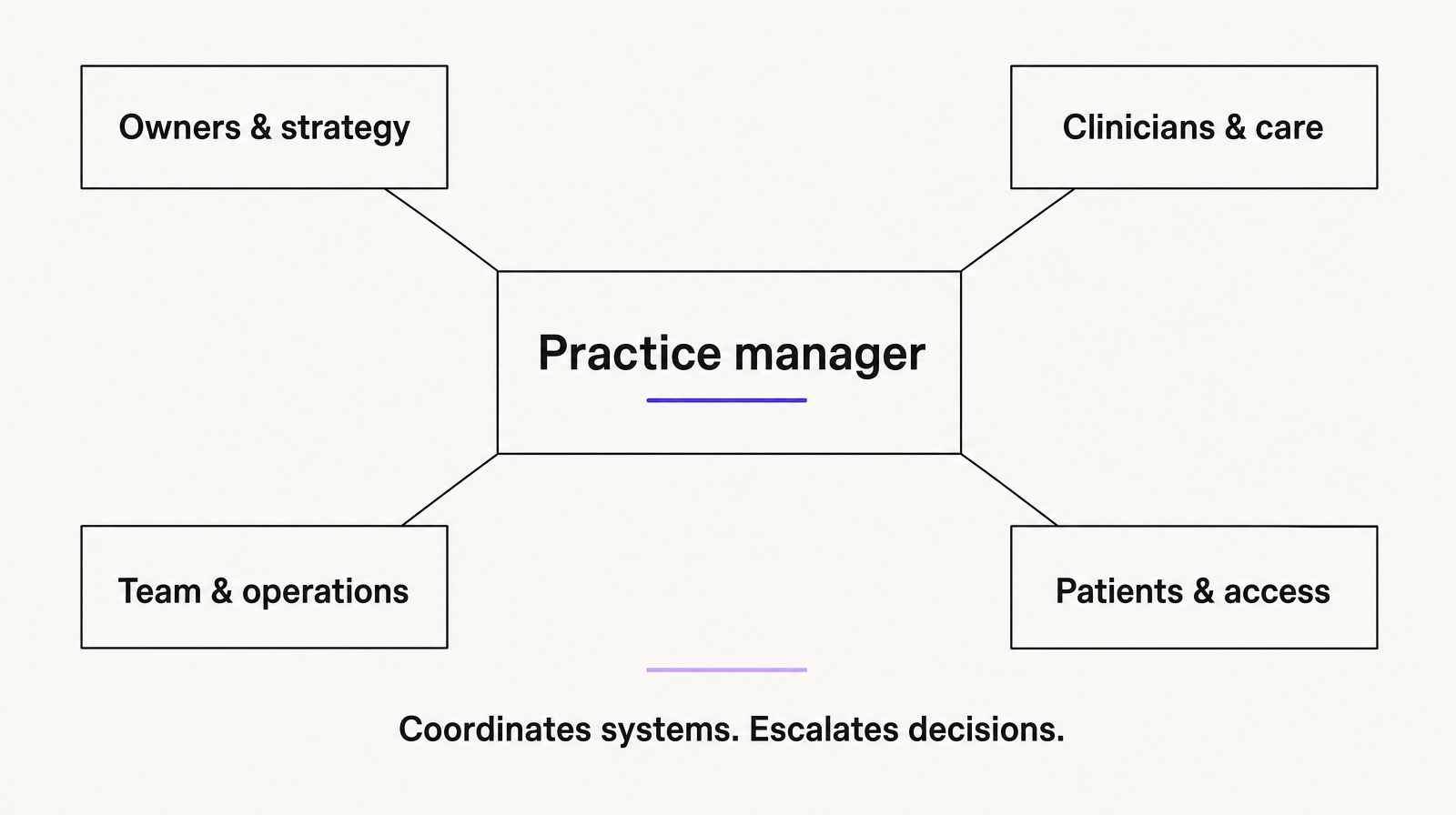
Practice manager connects owners, clinicians, patients and practice operations

Area Practice manager role Accountability that stays elsewhere
Clinical care Maintain the systems that support safe care and escalate safety concerns Clinicians assess, diagnose, treat and exercise professional judgement
Clinical documentation Configure approved workflows and templates, train users and monitor completion The treating clinician reviews, corrects and signs the record
Billing Maintain processes, staff training, exception reports and internal checks The provider confirms that the service meets the claimed item requirements
Compliance Coordinate policies, evidence, training, audits and corrective actions The practice entity, owners, officers and clinicians retain their legal and professional duties
People decisions Recruit and manage staff within an agreed delegation Owners approve decisions outside the manager’s financial or employment authority
Complaints Manage the administrative process and report themes Clinical complaints are reviewed by an appropriately qualified clinical lead

A written delegation schedule should state who can hire, dismiss, sign contracts, approve spending, change fees, access clinical records and speak for the practice. It should also name a backup decision-maker when the manager is away.

KPIs that show whether the role is working

Choose measures the manager can influence and pair speed or volume with a quality check.

  • Patient access: days until the third-next-available routine appointment, abandoned-call rate, wait-time exceptions and complaint closure time.
  • Workforce: roster gaps, unplanned absence, turnover, induction completion and required training completion.
  • Finance: budget variance, debtor ageing, rejected-claim rate, stock variance and days to month-end close.
  • Quality and risk: incidents closed by due date, overdue policy reviews, audit actions completed and continuity tests passed.
  • Information: overdue access reviews, departed-user access removed on time, privacy training and breach-response actions.
  • Technology: adoption among intended users, support issues, workflow completion and unresolved safety or accuracy feedback.

Avoid targets that reward rushed consultations, under-reporting of incidents or indiscriminate appointment volume. Measures should support safe access and sustainable work.

A ready-to-adapt practice manager job description

Use a job description that defines outcomes and authority as well as tasks.

Role purpose
Lead the safe, efficient and financially responsible non-clinical operation of the practice so patients can access care and clinicians can work within reliable systems.

Reports to
[Practice owner, board, chief executive or operations director]

Direct reports
[Reception lead, administration team, nurses or other roles where applicable]

Core accountabilities

  1. Deliver workforce plans, rosters, induction and performance processes.
  2. Maintain effective patient access, communication, feedback and complaint workflows.
  3. Prepare budgets, monitor financial performance and oversee billing administration.
  4. Coordinate accreditation, policy review, quality improvement, incidents and risk controls.
  5. Administer privacy, records, information security and vendor processes.
  6. Maintain facilities, supplies, safety systems and business continuity.
  7. Govern approved technology through access, training, standard workflows and monitoring.
  8. Give owners concise reporting, recommendations and an annual operating plan.

Authority
[State hiring, spending, contract, fee, access and policy approval limits]

Measures
[Select five to eight balanced KPIs from the categories above]

Before advertising, adjust the scope to the practice type, team size, award coverage, clinical governance model and state or territory requirements. Remove duties that belong to another role and add the decision rights needed to deliver what remains.

Build systems that give clinicians more attention for patients

A practice manager creates the conditions for good care: clear ownership, consistent workflows, usable evidence and early escalation. Technology should reduce the administrative load while preserving clinical review and practice governance.

Contact us to see how we support shared documentation workflows, team administration and visibility across your clinic.

More Resources
Continue reading
Posts
The dangers of Copy Paste Scribes
Read More
Posts
How to use an AI medical scribe
Read More
Posts
December Product Updates
Read More
Education
AI Tools for GPs: Where They Help and How to Use Them Safely
Read More
Education
AI Tools for Doctors: An Australian Guide
Read More
Education
Five Options for Medical Transcription Services in Australia
Read More
Post
5 min read

Practice Manager Duties: A Practical Australian Guide

Published on
September 1, 2026
Practice Manager Duties on a violet Lyrebird Health title card
Contributors
Lyrebird Health
Subscribe to our newsletter
Read about our privacy policy.
Thank you! Your submission has been received!
Oops! Something went wrong while submitting the form.

Medical practices depend on systems that patients rarely see: safe rosters, accurate billing, working equipment, protected records and clear escalation paths. The practice manager connects those systems so clinicians can focus on care. For clinic owners, current managers and people considering the role, the useful question is more specific than “what does a practice manager do?” It is what the manager owns, what they coordinate and where clinical or owner accountability begins.

What is a practice manager responsible for?

A practice manager is the senior non-clinical leader responsible for the business and administrative operation of a medical, dental or allied health practice. The scope changes with the size and type of clinic. In a small practice, the manager may handle payroll, reception cover and procurement directly. In a larger group, they may lead team supervisors and report on several sites.

Jobs and Skills Australia defines the occupation around organising the functions and resources of a professional practice. Its task profile includes planning office services, allocating staff and equipment, managing records and accounts, coordinating personnel and maintaining facilities. The official occupation profile is a useful baseline, although a healthcare role also carries patient-safety, privacy and accreditation responsibilities.

The Australian Association of Practice Management groups the profession into eight areas: finance, human resources, planning and marketing, information, risk, governance, business and clinical operations, and professional responsibility. Those practice management principles show why a job description based only on “keeping the clinic running” is too vague.

The eight core practice manager duties

1. Lead the practice team

The practice manager turns expected service levels into a workable workforce plan. Common duties include:

  • forecasting staffing needs and building rosters
  • recruiting, onboarding and inducting administrative staff
  • keeping role descriptions, contracts, credentials and required training current
  • setting goals, giving feedback and managing performance within delegated authority
  • approving leave and payroll inputs
  • running team meetings and planning coverage for absences
  • supporting a respectful, psychologically safe workplace.

Good workforce management is visible in stable coverage, completed induction, timely performance conversations and fewer unresolved issues. A manager needs a clear reporting line and documented authority. Accountability without decision rights creates delays, duplicate instructions and avoidable conflict.

2. Keep patient access and clinic flow working

Practice managers design the administrative pathway around care. They monitor appointment availability, phone and message handling, reception queues, recalls, cancellations, wait times and handovers. They also maintain accessible information for patients and coordinate interpreter, mobility and communication needs with the care team.

Complaints sit partly in this area. The manager should log the concern, acknowledge it, gather the relevant facts, follow the practice process and close the feedback loop. Any clinical safety issue or complaint about clinical judgement needs prompt escalation to the responsible clinician or clinical governance lead.

3. Oversee finance and billing operations

The manager gives owners a reliable view of practice performance. Work may include budgets, cash flow, accounts payable, debtor follow-up, payroll inputs, banking controls, stock costs, service agreements and month-end reporting.

In general practice, this often extends to Medicare and private-billing processes. The manager can maintain billing workflows, train staff, track rejected claims and investigate unusual patterns. The treating clinician still needs to confirm that a service and its documentation meet the requirements for the item claimed. That separation protects both revenue integrity and clinical accountability.

4. Coordinate governance, accreditation and quality improvement

Accreditation is a year-round operating system rather than a folder assembled before survey day. The manager usually keeps the evidence register, policy review schedule, training records, risk register, incident log and improvement plan moving. They coordinate mock checks, assign actions and report gaps to owners and the clinical team.

The RACGP’s current sixth edition Standards frame accreditation around patient safety, patient-centred care, quality improvement and a practice safety culture. A practical manager converts those aims into named owners, due dates and evidence.

5. Protect information and administer records systems

Every private health service provider covered by the Privacy Act must comply with the Australian Privacy Principles, including a small practice with annual turnover below $3 million. The OAIC’s small-business guidance confirms that the health-service exception applies regardless of turnover.

The manager’s operational duties commonly include access controls, staff privacy training, secure communication processes, records retention, vendor reviews, backup and recovery checks, breach response and access removal when a person leaves. The risk is active: health accounted for 18% of reported breaches in the OAIC’s January to June 2025 data, the largest share of any sector.

6. Maintain facilities, supplies and business continuity

Someone must know what happens when the vaccine fridge alarm sounds, the internet fails or a clinician room becomes unavailable. The practice manager coordinates maintenance, cleaning, waste, security, utilities, stock, emergency contacts and equipment servicing. They also keep continuity plans usable, including current contact trees, downtime procedures and recovery priorities.

Work health and safety belongs in this system. The manager conducts or coordinates inspections, records hazards, follows up controls and keeps required training current. Owners, officers, workers and contractors retain the duties that apply to them under the relevant jurisdiction.

7. Manage technology and clinical AI safely

Technology administration now extends beyond purchasing software. The practice manager maps the workflow, assesses vendors with clinical and privacy leads, configures user access, plans training, controls approved templates and monitors whether the tool is delivering the intended result.

For AI scribes, the RACGP advises practices to set an approved-use policy, update patient privacy information, define incident reporting, train users and review performance over time. Its AI scribe fact sheet also keeps clinical review with the GP: clinicians must check generated notes and confirm any suggested MBS items.

Our practice and team management capabilities give managers shared templates, centralised user management, single sign-on, billing prompts and reporting across the clinic. These controls help standardise administration while each clinician reviews, edits and signs off their own draft clinical documentation. Our AI scribe implementation guide covers contracting, consent processes, staged rollout, quality assurance and ongoing monitoring.

8. Turn data into an operating plan

The manager brings operational evidence to owners and the team. That means agreeing on a small set of measures, identifying the cause of a variance and assigning an action. Useful reporting covers access, workforce, finance, quality, privacy, technology and patient experience. A large dashboard with no decision attached is only reporting work.

Strategic duties can include annual budgeting, capacity planning, new-service assessment, contract negotiation, marketing oversight and clinic expansion. The manager supplies the operational and financial case while owners and clinical leaders make decisions within their authority.

Skills that make these duties work

The role combines management skill with healthcare context. Strong practice managers can:

  • Prioritise under pressure: distinguish a patient-safety escalation from work that can be scheduled.
  • Lead people fairly: set expectations, give specific feedback and handle difficult conversations consistently.
  • Read the numbers: understand budgets, cash flow, debtor ageing and the operational reason behind a variance.
  • Design reliable processes: turn a policy into a workflow with an owner, trigger, handover, record and review point.
  • Communicate across roles: translate operational detail into a clear choice for owners, clinicians, staff, patients and suppliers.
  • Use technology critically: understand permissions, integration, privacy, reporting and the limits of automated output.

Experience may come from medical reception, nursing, administration or operations. Education requirements vary with the employer and the complexity of the practice. A clinical background can help with context, but clinical work requires the relevant qualification, registration and authority.

What practice manager duties look like across the year

A duty list becomes more useful when each task has a cadence and an output.

Cadence Typical duties Evidence or output
Daily Check staffing and clinic constraints, resolve flow issues, review urgent messages and incidents, authorise routine purchases, handle escalations Coverage plan, action log, completed escalation
Weekly Review rosters and access, hold team huddles, follow up claims and debtors, check stock exceptions, progress complaints and risks Roster, meeting actions, exception report
Monthly Close payroll and accounts inputs, review budget variance, audit selected workflows, check training and access changes, report operational KPIs Management pack, audit findings, updated access register
Quarterly Review policies and risks, test continuity procedures, complete performance conversations, evaluate suppliers and improvement projects Risk register, test record, supplier review, improvement report
Annually Build the budget and workforce plan, review insurance and major contracts, plan accreditation activity, schedule required training and set priorities Approved operating plan with owners, dates and measures

The pattern should fit the clinic. A procedural specialist practice may need tighter theatre, sterilisation and stock controls. A multi-site general practice may put more emphasis on standardised access, reporting and user administration.

Set clear boundaries around the role

The strongest practice managers know when to act, when to consult and when to escalate. Owners should make these boundaries explicit.

Practice manager connects owners, clinicians, patients and practice operations

Area Practice manager role Accountability that stays elsewhere
Clinical care Maintain the systems that support safe care and escalate safety concerns Clinicians assess, diagnose, treat and exercise professional judgement
Clinical documentation Configure approved workflows and templates, train users and monitor completion The treating clinician reviews, corrects and signs the record
Billing Maintain processes, staff training, exception reports and internal checks The provider confirms that the service meets the claimed item requirements
Compliance Coordinate policies, evidence, training, audits and corrective actions The practice entity, owners, officers and clinicians retain their legal and professional duties
People decisions Recruit and manage staff within an agreed delegation Owners approve decisions outside the manager’s financial or employment authority
Complaints Manage the administrative process and report themes Clinical complaints are reviewed by an appropriately qualified clinical lead

A written delegation schedule should state who can hire, dismiss, sign contracts, approve spending, change fees, access clinical records and speak for the practice. It should also name a backup decision-maker when the manager is away.

KPIs that show whether the role is working

Choose measures the manager can influence and pair speed or volume with a quality check.

  • Patient access: days until the third-next-available routine appointment, abandoned-call rate, wait-time exceptions and complaint closure time.
  • Workforce: roster gaps, unplanned absence, turnover, induction completion and required training completion.
  • Finance: budget variance, debtor ageing, rejected-claim rate, stock variance and days to month-end close.
  • Quality and risk: incidents closed by due date, overdue policy reviews, audit actions completed and continuity tests passed.
  • Information: overdue access reviews, departed-user access removed on time, privacy training and breach-response actions.
  • Technology: adoption among intended users, support issues, workflow completion and unresolved safety or accuracy feedback.

Avoid targets that reward rushed consultations, under-reporting of incidents or indiscriminate appointment volume. Measures should support safe access and sustainable work.

A ready-to-adapt practice manager job description

Use a job description that defines outcomes and authority as well as tasks.

Role purpose
Lead the safe, efficient and financially responsible non-clinical operation of the practice so patients can access care and clinicians can work within reliable systems.

Reports to
[Practice owner, board, chief executive or operations director]

Direct reports
[Reception lead, administration team, nurses or other roles where applicable]

Core accountabilities

  1. Deliver workforce plans, rosters, induction and performance processes.
  2. Maintain effective patient access, communication, feedback and complaint workflows.
  3. Prepare budgets, monitor financial performance and oversee billing administration.
  4. Coordinate accreditation, policy review, quality improvement, incidents and risk controls.
  5. Administer privacy, records, information security and vendor processes.
  6. Maintain facilities, supplies, safety systems and business continuity.
  7. Govern approved technology through access, training, standard workflows and monitoring.
  8. Give owners concise reporting, recommendations and an annual operating plan.

Authority
[State hiring, spending, contract, fee, access and policy approval limits]

Measures
[Select five to eight balanced KPIs from the categories above]

Before advertising, adjust the scope to the practice type, team size, award coverage, clinical governance model and state or territory requirements. Remove duties that belong to another role and add the decision rights needed to deliver what remains.

Build systems that give clinicians more attention for patients

A practice manager creates the conditions for good care: clear ownership, consistent workflows, usable evidence and early escalation. Technology should reduce the administrative load while preserving clinical review and practice governance.

Contact us to see how we support shared documentation workflows, team administration and visibility across your clinic.

Keep reading

All posts
Questions about compliance?