Workforce Incentive Program Practice Stream: A Guide for General Practice

The Workforce Incentive Program (WIP) can help an eligible general practice fund a multidisciplinary team, but the name covers three payment streams and the Practice Stream has its own quarterly administration. For practice owners and managers, the important work is matching the right professionals, hours, accreditation and evidence to the rules. The current process starts with the guidelines effective 1 July 2026 and continues through approval, reporting and each Quarterly Confirmation Statement.
The three Workforce Incentive Program streams
WIP uses financial incentives to support rural primary care and multidisciplinary care in eligible general practices. Its three streams differ in who receives the payment and what activity qualifies.
| WIP stream | Who receives the payment | What it supports | Current payment frame |
|---|---|---|---|
| Practice Stream | An eligible general practice | The cost of engaging eligible nurses, midwives, Aboriginal and Torres Strait Islander health workers and health practitioners, and allied health professionals | Quarterly base payment, possible rural loading and an annual Department of Veterans’ Affairs (DVA) loading |
| Doctor Stream | An eligible doctor | Eligible primary care work or approved GP or Rural Generalist training in Modified Monash (MM) 3 to 7 locations | Amount depends on location, activity, year level and vocational registration or training status. The current maximum is $60,000 a year for vocationally registered doctors and doctors on an approved training pathway |
| Rural Advanced Skills | An eligible GP or Rural Generalist | Comprehensive primary care plus qualifying emergency medicine and/or recognised advanced-skill services in MM3 to 7 | Two payment streams, each worth $4,000 to $10,500 a year. An eligible doctor can receive up to $21,000 across both |
The WIP overview sets out the three-stream structure. The Doctor Stream amounts and Rural Advanced Skills amounts have separate rules and application processes.
Published instructions for Rural Advanced Skills conflict during the program closeout. The current program page says a doctor who receives the payment can apply up to four times between 1 January 2023 and 31 December 2026. Sections 1.0 and 1.2 of the February 2026 guidelines say an eligible doctor can receive up to four payments per stream for services delivered during that period, while section 3.3 instead says up to three annual payments per stream. A separate application is required for each stream, and all applications close on 31 March 2027. The relevant Rural Workforce Agency should confirm the payment count for an individual application.
For practice owners and managers, the Practice Stream is the stream administered at practice level.
Practice Stream eligibility
The Practice Stream helps with the cost of engaging eligible health professionals as part of a multidisciplinary team. It does not reimburse the full employment or contracting cost.
Under the current Practice Stream Guidelines, effective 1 July 2026, a general practice must meet all of these baseline requirements:
- meet the Royal Australian College of General Practitioners definition of a general practice
- be open and employ at least one full-time or part-time GP
- be accredited, or registered for accreditation, under the National General Practice Accreditation Scheme
- engage at least one eligible health professional
- hold at least $10 million in public liability insurance for the main location and every additional location
- ensure GPs and eligible health professionals have the required professional indemnity cover
- remain eligible for the Practice Incentives Program (PIP) if it is a PIP-consenting practice.
A new applicant that is registered for accreditation generally has 12 months from WIP approval to achieve accreditation. For a PIP-consenting practice, the clock starts from the earlier PIP approval date if that came first. Accreditation must be current at the point-in-time date for each payment quarter.
Aboriginal Medical Services and Aboriginal Community Controlled Health Services can participate when they meet the relevant requirements. Multi-location practices can also apply as one practice, subject to the branch rules. The location delivering the most Medicare Benefits Schedule (MBS) services is the main practice location and determines any rural loading.
Eligible health professionals
The eligible roles are:
- nurse practitioners, registered nurses and enrolled nurses
- midwives
- Aboriginal and Torres Strait Islander Health Workers and Health Practitioners
- audiologists, chiropractors and diabetes educators
- dietitians or nutritionists and exercise physiologists
- occupational therapists, orthoptists, and orthotists or prosthetists
- osteopaths and paramedics
- pharmacists working in a non-dispensing role
- physiotherapists, podiatrists and psychologists
- social workers and speech pathologists.
Each person must meet the qualification and insurance requirements for their profession. Enrolled nurses must work under the direct or indirect supervision required by the Enrolled Nurse Standards for Practice. A pharmacist's claimed hours must relate to a non-dispensing role.
Time that cannot be claimed
Only eligible work counts towards a Practice Stream payment. The current guidelines set narrow exclusions and exceptions:
- Other financial support: Hours are ineligible when the practice already receives Australian Government, state or territory government, private or other incentive-program support to engage the professional or cover the service. Private support can include funding from a parent organisation, but patient fees are excluded from this category. This exclusion does not apply to Aboriginal Medical Services, Aboriginal Community Controlled Health Services, or state or territory government health clinics in rural and remote communities if they have an exemption under section 19(2) of the Health Insurance Act 1973, or receive Health funding for Aboriginal and Torres Strait Islander Health Workers, Health Practitioners or allied health professionals.
- Own-provider-number MBS services: A practice cannot claim time that a nurse practitioner, midwife with an endorsement for scheduled medicines, allied health professional, or Aboriginal and Torres Strait Islander Health Worker or Health Practitioner with their own provider number spends on relevant MBS services. This exclusion does not apply to Aboriginal Medical Services, Aboriginal Community Controlled Health Services, or state or territory government health clinics if they have the section 19(2) exemption or receive the specified Health funding.
- After-hours and deputising services: A practice cannot claim services delivered through a medical deputising service or as an after-hours service outside the normal opening hours of a general practice.
Keep the eligible and excluded time visible in rosters or timesheets. This is important because the quarterly statement asks for average weekly eligible hours, and an audit can test the figures against underlying records.
How Practice Stream payments are calculated
Services Australia calculates the entitlement using five inputs:
- Practice size: Standardised Whole Patient Equivalent (SWPE) measures the share of care provided to patients and weights it for age and gender. It uses eligible Medicare and DVA activity. SWPE is capped at 4,000 for this payment.
- Professional category: Nurse practitioners, registered nurses, midwives and allied health professionals attract the higher rate. Supervised enrolled nurses and Aboriginal and Torres Strait Islander Health Workers and Health Practitioners attract the second rate.
- Average weekly eligible hours: Report each worker separately. When a practice engages people from both payment categories, the higher-rate group is calculated first.
- Location: The main practice location determines the rural loading.
- Practice and patient factors: Aboriginal Medical Services and Aboriginal Community Controlled Health Services receive a 50% SWPE uplift. Eligible DVA Gold Card activity can attract a separate annual loading.
The current annual base amounts are below. These figures are from the guidelines effective 1 July 2026 and reflect the indexed amounts used from the August 2026 payment quarter.
| SWPE | Average weekly hours for the full amount | Nurse practitioner, registered nurse, midwife or allied health group | Enrolled nurse or Aboriginal and Torres Strait Islander health worker or practitioner group |
|---|---|---|---|
| 1,000 | 12 hours 40 minutes | $35,236.84 | $17,618.42 |
| 2,000 | 25 hours 20 minutes | $70,473.68 | $35,236.84 |
| 3,000 | 38 hours | $105,710.52 | $52,855.26 |
| 4,000 | 50 hours 40 minutes | $140,947.36 | $70,473.68 |
The base payment is capped at $140,947.36 a year, or $35,236.84 a quarter, before loadings. A practice below the hours threshold for its SWPE may receive a proportion of the full amount.
Rural loadings are 30% for MM3, 40% for MM4 and MM5, and 60% for MM6 and MM7. MM1 and MM2 receive no rural loading. The DVA loading is $68.60 per eligible Veteran Card–All Conditions (Gold Card) holder from 1 July 2026 and is paid annually in the August quarter. Services Australia identifies the eligible activity. If a Gold Card holder attends more than one practice during the year, the loading is shared according to each practice's percentage of the total consultation fees paid.
Two indicative payment examples
These examples use the amounts in the July 2026 guidelines. They are indicative as at 1 July 2026, indexed and subject to the practice's circumstances. Services Australia makes the actual assessment. They do not provide personalised eligibility or payment advice.
- Metropolitan registered nurse: A practice with 4,000 SWPE and a registered nurse averaging 38 eligible hours a week in MM1 has an indicative base payment of $105,710.52 a year, or $26,427.63 a quarter.
- Rural multidisciplinary team: A practice with 3,000 SWPE, a registered nurse averaging 25 hours, a psychologist averaging eight hours and a non-dispensing pharmacist averaging eight hours a week in MM6 has an indicative base payment of $105,710.52 plus a 60% rural loading. The total is $169,136.83 a year, or $42,284.21 a quarter.
Use the July 2026 guideline figures
Some government pages still display older figures. The Health Department's payment webpage, last updated in July 2025, gives a superseded maximum of $137,375.60. The business.gov.au listing still says the rural loading is up to 50%, while the current guideline sets 60% for MM6 and MM7. Use the July 2026 guideline for current calculations.
How to apply for the Practice Stream
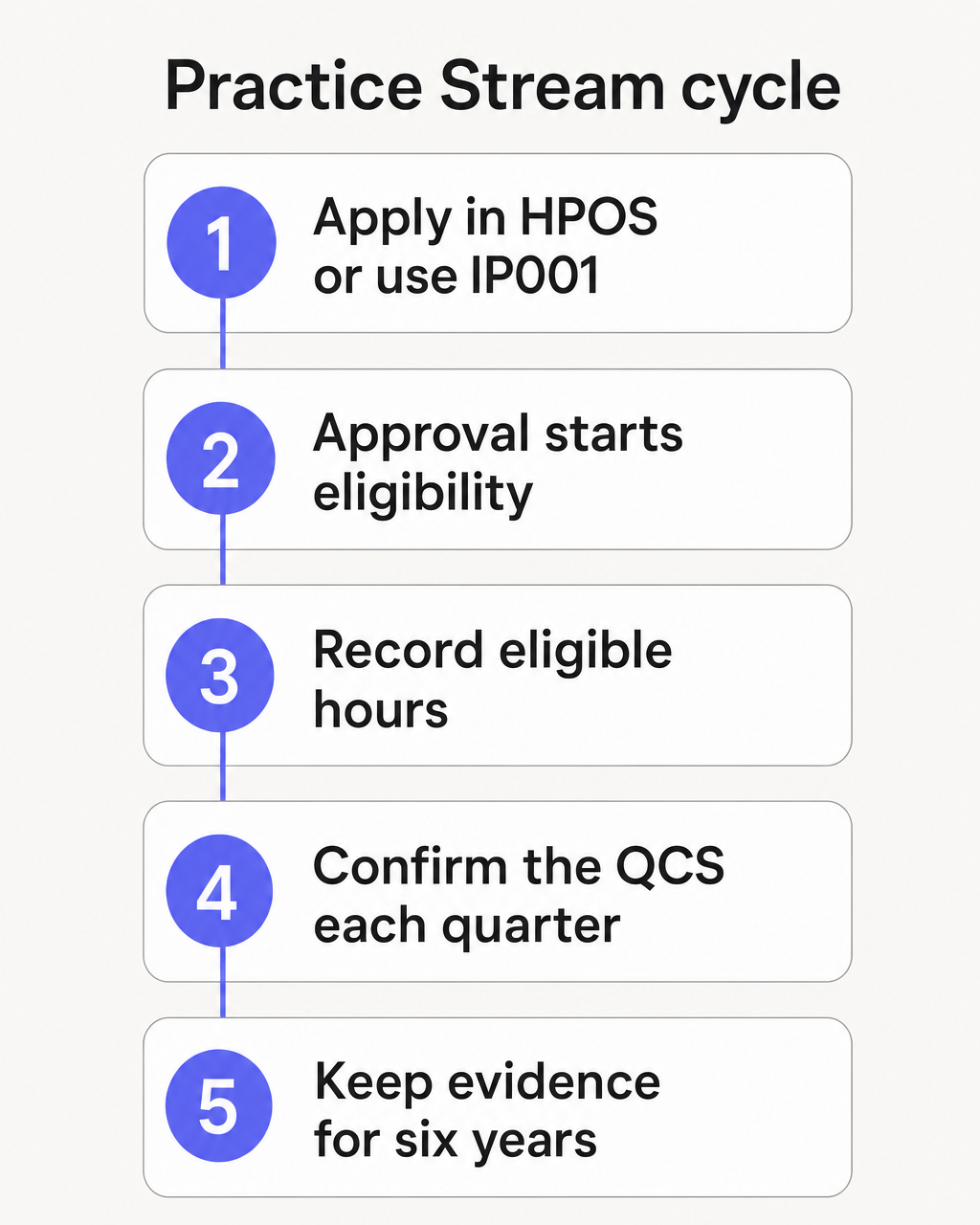
If you own the practice, you can apply at any time through one of two routes:
- Apply online through Health Professional Online Services (HPOS), accessed through a Provider Digital Access (PRODA) account. In HPOS, select My programs, then WIP online, then Apply online now.
- Complete the Practice Incentives application form IP001 and submit it using the form instructions.
The application needs current practice information and supporting documents. These include the accreditation or registration-for-accreditation certificate. An HPOS application also needs the Practice Incentives Practice ownership details and declaration form, IP008. The Services Australia application steps provide the operational route.
Eligibility begins on the date Services Australia approves the application. The lodgement date does not start eligibility. For a payment quarter, submit a complete application and supporting documents at least seven calendar days before the point-in-time date. Services Australia must approve the application, and the practice must be eligible, by that point-in-time date. If Services Australia requests more information, provide it within 28 calendar days of the request letter and at least seven calendar days before the point-in-time date. Missing either deadline may make the practice ineligible for that quarter's payment.
Quarterly Confirmation Statements and reporting
Under the current July 2026 Practice Stream Guidelines, payments are retrospective and paid in February, May, August and November. Each payment has a three-month reference period and a point-in-time date when eligibility is assessed.
| Payment quarter | Reference period | Point-in-time date |
|---|---|---|
| February | 1 November to 31 January | 31 January |
| May | 1 February to 30 April | 30 April |
| August | 1 May to 31 July | 31 July |
| November | 1 August to 31 October | 31 October |
Services Australia sends a Quarterly Confirmation Statement (QCS) each quarter, except the first quarter that the practice is approved for the program. A practice should receive it by the 15th day of the point-in-time month. The owner or authorised contact must:
- confirm the practice details
- record relevant changes
- list each eligible professional separately
- report that person's average weekly eligible hours for the quarter in hours and minutes
- exclude ineligible and relevant MBS-billed time.
Online confirmation through HPOS is due by the point-in-time date. Under the current guidelines, a QCS sent for manual processing should go through the HPOS form-upload facility, or follow the instructions printed on the QCS, at least seven calendar days before that date. An older Health obligations page still mentions fax, so it should not override the current QCS instructions.
The HPOS management guide covers online access and QCS actions. Practices using electronic delivery also need the relevant HPOS message subscription.
If a complete QCS is late, the payment is withheld until it is received and assessed. Outstanding statements must be submitted in date order, with the oldest first. Three consecutive quarters with a zero or withheld payment can trigger withdrawal under the three-quarter rule.
Keep the evidence behind every confirmation
Notify Services Australia about changes to practice arrangements within seven calendar days, or at least seven calendar days before the point-in-time date, whichever comes first. Relevant changes include practitioners joining or leaving, accreditation or insurance changes, bank details, ownership, location, provider details and eligible professionals' hours.
Retain Practice Stream documents for at least six years. The record set should include applications and supporting documents, accreditation and insurance evidence, professional registration or association evidence, timesheets, enrolled-nurse supervision arrangements and the data behind each QCS. If a practice cannot substantiate eligibility or claimed hours, payments made during the previous six years may be recovered.
WIP, PIP and the Bulk Billing Practice Incentive Program (BBPIP) are separate programs
Similar names and shared HPOS administration can make the programs look interchangeable. They serve different purposes.
| Program | Main purpose | Who receives the payment | Key connection |
|---|---|---|---|
| WIP Practice Stream | Help eligible practices engage a multidisciplinary workforce | The practice | Uses SWPE, eligible worker categories and hours, with possible rural and DVA loadings |
| Practice Incentives Program (PIP) | Support quality care, practice capacity, access and health outcomes through several incentives | Eligible practices; some payments are calculated for particular GPs or services | A practice can consent to reuse PIP profile data for WIP. It must remain PIP-eligible while PIP-consenting |
| Bulk Billing Practice Incentive Program (BBPIP) | Support practices and GPs that bulk bill all eligible services for Medicare-eligible patients | The quarterly 12.5% incentive is split evenly between the practice and GP | The practice must be MyMedicare registered and register for MyMedicare BBPIP through the Organisation Register. It does not establish WIP eligibility |
Linking PIP and WIP details can give the practice matching IDs and reduce duplicate profile updates. It does not merge the programs or their eligibility tests. Services Australia's PIP and WIP linking process explains which profile data is reused.
BBPIP has its own registration, claiming and quarterly assessment rules. Our bulk billing incentive guide explains the 12.5% payment and how it differs from MBS bulk billing incentives. Our MBS billing guide covers the billing records and claiming controls that sit outside WIP.
Build the workforce process around care
WIP administration works best when each figure has a clear source: accreditation and insurance records for eligibility, rosters and timesheets for hours, and a named owner for the quarterly confirmation. That discipline protects the payment and gives a multidisciplinary team a more reliable operating base for patient care.
Our clinical AI platform, Lyrebird, drafts clinical notes and documents for clinician review, editing and sign-off. Shared templates, centralised user management and reporting can support consistent workflows across a practice, while WIP eligibility, hours and payment records stay in the practice's workforce and HPOS systems.
Contact us to see how Lyrebird can support documentation and team workflows across your practice.