Case note template: a practical Australian guide
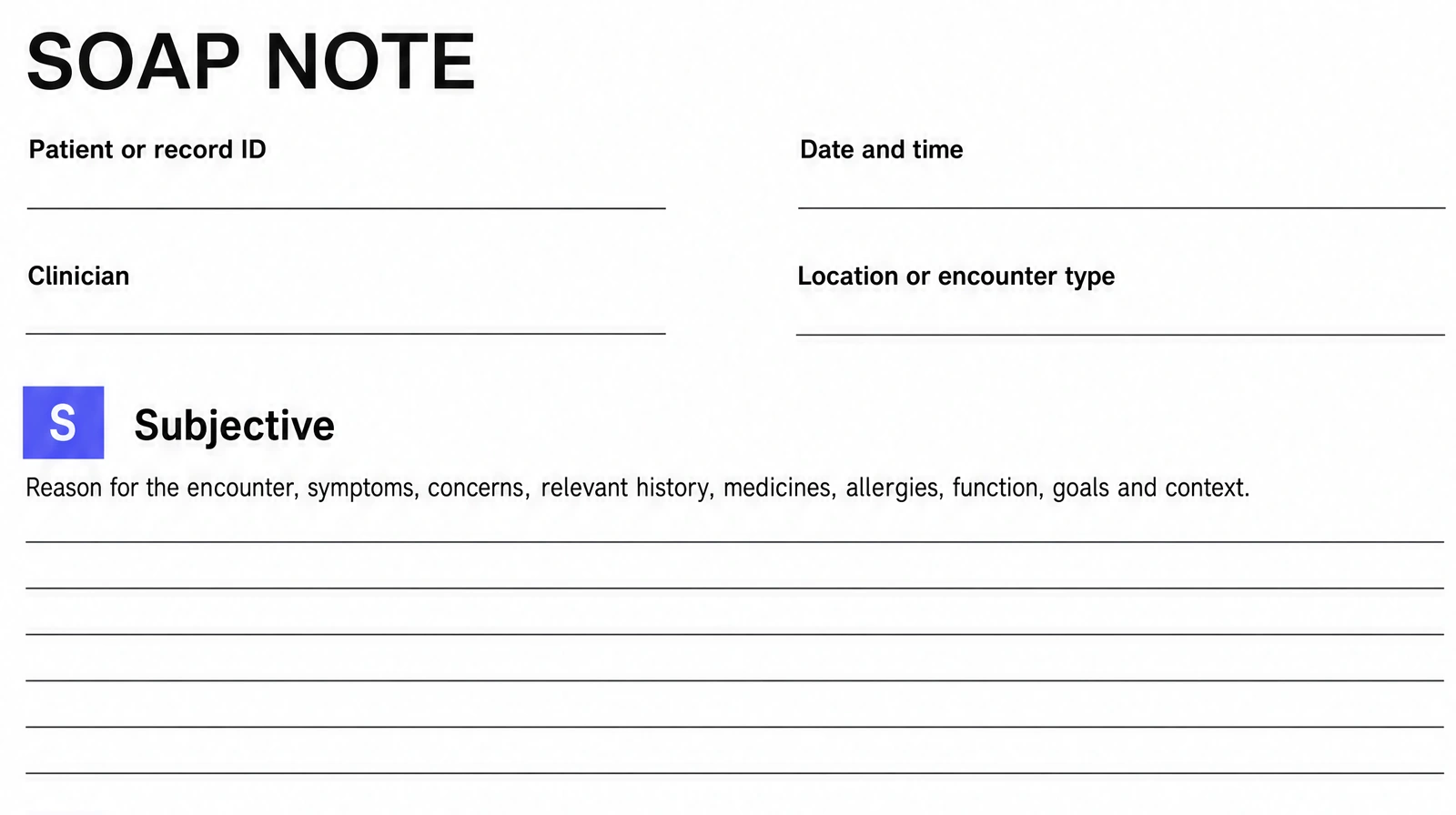
Detail from our blank SOAP form, a clinical variant: Subjective, Objective, Assessment and Plan. The full cross-service template has nine parts.
A case note needs to carry the important details of an interaction to the next person involved in care or support. That can be difficult when the work spans therapy sessions, home visits, phone calls and coordination with other services.
For Australian allied-health clinicians, mental-health practitioners and support workers, consistent headings make that record easier to write and use. Start with a reusable structure, then adapt the detail to your role, the contact and your service's requirements.
What is a case note?
A case note records a relevant interaction, event or action in a person's care or support. It explains the purpose of contact, what was reported or observed, what you did, the person's response and what happens next. It may document a consult, a support session, a referral discussion or an unsuccessful contact attempt.
The terms used across services overlap. A case note does not have to cover an entire case, and a progress note is not necessarily shorter.
| Term | Usual purpose | How it overlaps |
|---|---|---|
| Case note | Records contacts, actions and decisions within care, support or case management | Can include clinical care, practical support and service coordination |
| Clinical note | Records a healthcare encounter, including relevant findings, clinical reasoning and management | A clinician's case note may also be a clinical note |
| Progress note | Records status, response and change during ongoing care or support | A case note can serve as a progress note and use the same headings |
Use your workplace's terminology and required format. Our clinical note writing guide covers the broader clinical record. The structure here keeps the contact, the person's perspective and the follow-up visible across services.
A reusable case note template
Copy these headings into your approved record system or document template. Keep required local fields and use only the prompts relevant to the interaction. A template supports consistent documentation; it does not establish compliance on its own.
1. Person and contact details
- Person's name and record identifier, using your service's identification process:
- Contact date, start and finish time or duration where relevant:
- Contact type and location, such as home visit, clinic, telephone or video:
- People present, their roles and interpreter involvement:
- Author's name and role:
- Date and time entered, if not captured automatically:
2. Purpose and relevant goal
- Reason for contact or action:
- Relevant care, treatment or support-plan goal:
- Changes since the previous contact that matter today:
3. Information reported
- What the person said about their needs, experience, preferences or progress:
- Relevant information from carers, other workers or records, with the source identified:
- Exact words where their wording matters:
4. Observations and findings
- What you directly saw, heard or measured:
- Relevant task performance, presentation, environment or assessment findings:
- Limits of the contact, such as an examination that was not possible by telephone:
5. Actions and response
- Assessment, intervention, practical assistance, advice or coordination completed:
- Choices offered and the person's decisions:
- How the person responded, including any measured change:
- Activities not completed and the reason:
6. Assessment or support summary
- What the information means within your role and scope:
- Progress, barriers, strengths or remaining needs, with the supporting evidence:
- Clinical reasoning or uncertainty, where applicable:
7. Safety, consent and communication
- Relevant concern, disclosure or risk identified and action taken:
- Assessment or escalation completed, by whom and when:
- Relevant consent, communication preferences or authority to share information:
- People notified, information shared and links to related records:
8. Plan and responsibility
- Next action:
- Person responsible:
- Due date or review timeframe:
- Follow-up appointment or agreed contact:
- Contingency or earlier-review advice, where relevant:
9. Completion
- Author authentication or signature under the service's process:
- Related assessment, care plan, referral or incident-record reference:
For clinical notes, your assessment and plan still need to reflect your judgement. In our clinical notes workflow, custom templates can structure draft notes around your preferred headings for clinician review, editing and sign-off before filing.
Adapt the template to your role
The headings can stay consistent while the content changes. A clinical assessment field should never push a support worker into making a diagnosis or interpreting findings beyond their role.
| Setting | Detail that often matters | Boundary to preserve |
|---|---|---|
| Allied health | Functional goal, assessment findings, intervention, assistance required and response | Distinguish measured performance from the person's account of everyday function |
| Mental health | Presenting concerns, relevant mental state, therapeutic work, response, reasoning and safety planning | A routine note does not replace a full assessment when one is needed |
| Support services | Support actually delivered, participant choices, prompts or assistance, barriers and follow-up | Describe and escalate concerns within your role rather than adding unsupported clinical conclusions |
| Coordination or telephone contact | Who communicated, purpose, relevant information, permissions and agreed actions | Separate the caller's account from facts you independently established |
If your service uses SOAP, meaning Subjective, Objective, Assessment and Plan, you can place these prompts within those headings. Our SOAP notes guide provides the dedicated format. Use one approved encounter record rather than duplicating it solely to change headings.
Fictional case note examples
All names, identifiers and events below are fictional. These examples demonstrate documentation structure, rather than prescribed interventions or complete clinical assessments.
Allied-health case note: occupational therapy
Person and contact: Alex Chen, fictional record OT-014. Home visit, 12 October 2026, 10:00–10:45. Present: Alex and Morgan Ellis, occupational therapist. Entered by Morgan at 11:00 that day.
Purpose and goal: Review Alex's goal of preparing a simple lunch with less assistance.
Reported: Alex said, “I lose track of what comes next.” Alex reported preparing lunch twice since the previous visit, with reminders from their partner.
Observed: During a four-step cold-lunch task, Alex completed three steps independently and needed one verbal prompt to locate the final step on the written list. No physical assistance was provided.
Actions and response: Trialled a numbered task list and practised referring to it before each step. Alex chose to keep the list beside the preparation area and said the numbering was easier to follow than the previous paragraph instructions.
Assessment: The numbered list supported task sequencing during this visit. Independent use between visits has not yet been established.
Safety, consent and communication: Alex agreed to share the task list with their partner for the agreed home practice. No new safety concern was observed during the cold-lunch task.
Plan: Morgan to provide the revised list by 13 October. Alex plans to use it for two lunches before the next visit on 19 October. Review the amount of prompting required then.
Completion: Morgan Ellis, occupational therapist, electronically signed at 11:05. Related record: occupational therapy plan OT-014.
Mental-health case note: counselling follow-up
Person and contact: Priya Shah, fictional record MH-022. Clinic consult, 13 October 2026, 14:00–14:50. Present: Priya and Taylor Reed, mental-health social worker. Entered by Taylor at 15:00 that day.
Purpose and goal: Review the agreed goal of attending a weekly community class despite anxiety.
Reported: Priya attended one class and left after 20 minutes. She described worrying that others would notice her anxiety. She wants to attend again with a shorter initial goal.
Observed: Priya described the sequence of events clearly and participated in planning the next visit. Her hands trembled while discussing entering the class.
Actions and response: Mapped the events before leaving and rehearsed an agreed grounding strategy. Priya identified a seat near the exit and chose a 15-minute attendance goal.
Assessment: Attendance represents a step towards Priya's goal. Anxiety continues to limit participation. One attendance does not establish sustained change.
Safety and communication: Reviewed current safety concerns, supports and the existing contact plan with Priya. Findings, reasoning and agreed actions are documented in the linked risk review MH-022-R, completed today. Priya did not authorise contact with the class facilitator; no information was shared.
Plan: Priya plans to attend for 15 minutes on 16 October and record what helped. Taylor to review the experience and contact plan at the next consult on 20 October.
Completion: Taylor Reed, mental-health social worker, electronically signed at 15:10. Related records: care plan MH-022 and risk review MH-022-R.
The linked risk review contains the assessment detail in this example. A generic phrase such as “risk reviewed” cannot substitute for recording the actual findings, reasoning and actions somewhere in the person's record.
Support-service case note: community access
Person and contact: Jordan Bell, fictional record SS-031. Community support, 14 October 2026, 09:00–10:30. Present: Jordan and Casey Lee, support worker. Entered by Casey at 10:45 that day.
Purpose and goal: Practise Jordan's chosen bus route to the library, linked to the support-plan goal of greater independence with community travel.
Reported: Jordan said they felt confident finding the bus stop but were unsure which stop to use for the return trip.
Observed: Jordan located the outward stop using their travel card and boarded without a prompt. At the library, Jordan asked for help locating the return stop.
Actions and response: Supported Jordan to compare the return-stop sign with their travel card. Jordan identified the matching route after one verbal prompt. Jordan chose to repeat the same route next week rather than add a new destination.
Support summary: The outward journey required no prompting today. Jordan requested and used help to identify the return stop. Further practice is planned; independent return travel has not been demonstrated.
Safety and communication: The planned route was completed without an incident. No new concern was observed during the session. Jordan agreed that the return-stop location could be added to the travel card for their next worker.
Plan: Casey to update the travel card before the next session on 21 October. Next worker to record the prompts needed for each direction.
Completion: Casey Lee, support worker, electronically signed at 10:50. Related record: community-access support plan SS-031.
How to write case notes that remain useful
Keep the source of each statement clear
Separate what someone reported, what you observed and what you concluded. A carer's account may be relevant without being independently confirmed. A professional opinion belongs in the record when it is within your scope and its basis is clear.
For social workers, section 5.5.1 of the Australian Association of Social Workers' Code of Ethics calls for complete, accurate and prompt records, essential and relevant detail, objective language and a stated basis for professional opinions.
Describe behaviour without labelling the person
“Unmotivated” does not explain what happened. “Declined the activity, saying the room was too noisy; chose an outdoor alternative” records the decision and relevant context.
Include the person's strengths, choices and preferences when they affect the work. Avoid copying unnecessary detail about other people into their record.
Record the action and the response together
“Provided support” leaves the next worker guessing. Name the task, the type or amount of assistance and the outcome. A completed activity does not automatically show progress: record the evidence that supports any claim of change.
Make follow-up specific
“Referral discussed” is different from “Referral sent”. State whether an action is proposed, agreed, completed or awaiting a response. Give outstanding actions an owner and a timeframe, including unsuccessful contact attempts.
Complete the entry promptly and preserve its history
For professions covered by the Australian Health Practitioner Regulation Agency (AHPRA) shared code of conduct, section 8.3 calls for records at the time of events or as soon as possible afterwards. The code applies to professions whose National Boards have adopted it; other professions have their own requirements.
For a delayed entry, distinguish the contact date from the entry date. Use the service's correction or addendum process so the original entry and the author, timing and reason for a correction remain traceable.
Privacy and separate records still matter
Keep case notes in the service's approved record system and limit access to authorised people. For organisations covered by the Privacy Act, Australian Privacy Principle (APP) 11 requires reasonable security measures, including technical and organisational measures, to protect personal information. APP 11 does not set one national retention period. Under APP 11.2, covered organisations must take reasonable steps to destroy or de-identify personal information once it is no longer needed for any purpose for which it may be used or disclosed under the Australian Privacy Principles. That duty does not apply to information in a Commonwealth record, or where an Australian law or court or tribunal order requires its retention.
For providers subject to the relevant National Disability Insurance Scheme (NDIS) Practice Standards, the information management requirements cover accurate, current and confidential information, participant access and proportionate management systems. A case note does not replace a required incident report or notification. Record the relevant action and cross-reference the separate record through the approved process.
For payment claims, NDIS recordkeeping requirements require the participant’s name and NDIS number, the dates support was delivered, the amount and quantity or hours of support, and the support type as minimum identifying information. Case notes can form part of those records. Additional invoice, support-log and roster requirements belong in the appropriate service records; they are not automatically all fields for a general clinical note.
Keep judgement at the centre of the workflow
A useful template makes omissions easier to notice. Before signing, read the note for the correct person and contact, clear information sources, supported conclusions and actions with owners. Remove copied-forward findings that were not established during this contact.
Our clinical AI platform can turn ambient capture, dictation or typed input into a structured draft for clinician review. Follow the service's patient notice and consent process, and obtain and record any consent required for the specific workflow before capture. Review the draft against what actually happened, correct omissions or unsupported statements, then sign off and file it in the approved record.
Keep your clinical judgement visible while using Lyrebird to structure the draft.