
A free SOAP note builder, worked examples across general practice, hospital and allied health, and a clear guide to the Subjective, Objective, Assessment, Plan format. Built for Australian clinicians.
Reviewed 25 August 2026
Paste fictional rough notes or dictation, pick your discipline, and the tool structures them into Subjective, Objective, Assessment and Plan. Review and edit each section, then copy or download it. You can also fill the sections by hand.
Privacy warning: Choosing Structure into SOAP sends the text you enter and your selected discipline to a public AI structuring service. Do not enter real, identifiable or re-identifiable patient information. This public teaching tool is separate from the authenticated Lyrebird clinical product.
Treat every output as a draft. Review it against the fictional source text, edit it, and approve it before copying or downloading.
These worked SOAP notes show how the four sections can read across general practice, hospital and allied health. Select any discipline tab to load its example into the builder.
Use this blank template for teaching, simulation or a de-identified workflow exercise. Download and print the standalone A4 template without entering any text. The builder download is separate and exports a note only after you have added content.
Download the blank A4 SOAP template
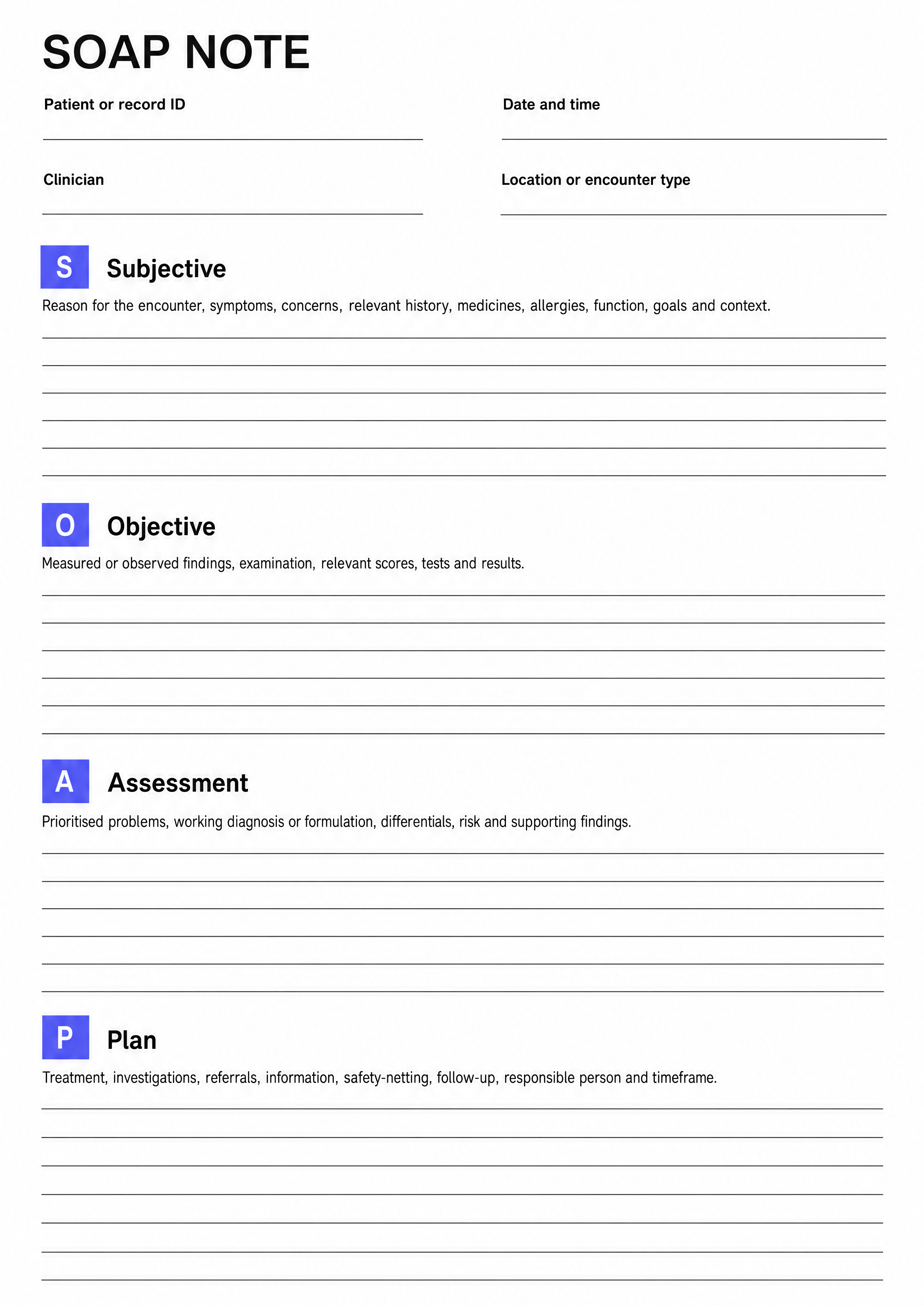
Patient or record ID: ____________________ Date and time: ____________________
Clinician: ____________________ Location or encounter type: ____________________
Reason for the encounter, symptoms and concerns in the patient's words. Include relevant history, medicines, allergies, function, goals and context.
____________________________________________________________________________
____________________________________________________________________________
____________________________________________________________________________
Measured or observed findings, examination, relevant scores, tests and results.
____________________________________________________________________________
____________________________________________________________________________
____________________________________________________________________________
Prioritised problem list, working diagnosis or formulation, differentials, risk and the findings that support your reasoning.
____________________________________________________________________________
____________________________________________________________________________
____________________________________________________________________________
Treatment, investigations, referrals, information provided, safety-netting, follow-up, responsible person and timeframe.
____________________________________________________________________________
____________________________________________________________________________
____________________________________________________________________________
A SOAP note is a structured clinical note with four sections. It gives clinicians a consistent way to record an encounter and understand someone else's documentation, supporting continuity between visits and team members.
Larry Weed developed the widely adopted SOAP note structure. NCBI's SOAP reference explains that it organises patient information and works as both a checklist and a cognitive framework for evaluating information and clinical reasoning.
S · Subjective
The presenting complaint and history in the patient's own words: symptoms, timing, what makes them better or worse, and how they affect the person. This section records their experience without adding the clinician's interpretation.
O · Objective
Vital signs, examination findings, observations and results. These are facts you can measure or observe, recorded so another clinician can follow the evidence.
A · Assessment
The working diagnosis or problem list, relevant differentials, risk and how the subjective and objective findings support your thinking. This is where clinical judgement becomes explicit.
P · Plan
Investigations, treatment, referrals, information provided, safety-netting and follow-up. It should be specific enough that the patient and the next clinician can understand what was decided, who is responsible and when it should happen.
Method
The headings are simple. The value comes from accurate source information, visible reasoning and a plan another clinician can act on.
The common error is allowing interpretation to enter the first two sections. "Patient reports feeling on edge since Monday" is subjective. A measured respiratory rate and observed pacing are objective. "Patient is anxious" is an interpretation that belongs in Assessment when the documented evidence supports it.
A diagnosis alone does not show an assessment. State the prioritised problem, the important differentials and the findings that support or weaken each possibility. Include relevant risk and uncertainty.
An ambient draft can only use reasoning that was captured in the consult, dictated afterwards or added during editing. If you reach part of the assessment silently, articulate or add it before sign-off. The clinician remains responsible for the final reasoning in the record.
Record what was started, stopped or changed, what was ordered, what the patient was told, who will act on results, when review will occur and what should prompt earlier escalation. Match each action to a problem when the consult covers several issues.
Use short sentences, recognised terms and a predictable order. Remove duplicated history and copied data that do not change the assessment or plan. Keep the evidence, uncertainty and follow-up details needed for safe continuity.
SOAP is an organising format. It does not by itself make a record complete or compliant. The Royal Australian College of General Practitioners (RACGP) record standard and Australian Health Practitioner Regulation Agency (AHPRA) record guidance support this practical checklist:
Professional and legal requirements vary by profession, setting, state or territory. Local record policy and profession-specific obligations still apply.
SOAP can become fragmented in complex multi-problem consults, and it does not explicitly show how a person responded to an intervention over time. Over-compression can also hide uncertainty or separate a plan from the problem it addresses. NCBI's clinical review identifies change over time as a limitation and notes that evaluation extensions can address it.
Use the format that makes the clinical story, reasoning, actions and follow-up easiest for the intended reader to find.
Our authenticated clinical notes workflow can capture an ambient consult, dictation or typed notes and produce a draft in SOAP, progress-note or a supported custom template. You review the whole draft, add any unspoken reasoning, edit inaccuracies or omissions, and sign off the final record.
With our Bp Premier integration, Lyrebird reads supported patient context from Bp Premier and writes clinician-finalised notes, documents and supported observations back to the correct patient file. Blood pressure and weight are specifically supported for structured observation write-back. Bp Premier remains the source clinical record.
A 16-week Gold Coast Hospital and Health Service trial evaluated Lyrebird, as identified in our current evaluation disclosure. The peer-reviewed paper reports the methods and results from 100 clinicians, 7,499 consultations and 19 outpatient specialties. Eighteen matched note pairs were scored using the Physician Documentation Quality Instrument-9: AI-generated notes averaged 37.06/40 and clinician-created notes 34.6/40. In a separate 21-pair comparison, the median ROUGE-1 F1 score was 0.58. The authors interpreted the overlap score as roughly 58% verbatim text reuse. It does not mean 58% of whole notes were accepted unchanged. The paper also reports that 47% of the 43 staff survey respondents had observed a hallucination at least once during the trial.
The study came from one health service, and its note-quality substudies were small. Its benefits and safety signals point to the same operating rule: AI output is a draft for clinician review, editing and sign-off.
The public builder on this page must never receive real or identifiable patient information. Authenticated Lyrebird is a separate clinical service governed by our current privacy policy, which states that personal information is stored in Australia and also describes specific circumstances involving overseas access or processing.
The Office of the Australian Information Commissioner (OAIC) explains in the Australian Privacy Principles Guidelines that Australian Privacy Principle (APP) 8 can apply when an APP entity discloses personal information to an overseas recipient, including accountability in some circumstances. The Therapeutic Goods Administration (TGA) digital scribe guidance sets an expectation that a clinician gives the patient enough information to provide informed consent before using a digital scribe. Practices should apply the consent or notice process, privacy assessment and governance required for their specific workflow.
Common questions
SOAP stands for Subjective, Objective, Assessment and Plan. The sections move from what the patient reports, to what you find, to what you think, to what will happen next.
Record the working diagnosis or prioritised problem list, relevant differentials, risk and the clinical reasoning that connects the subjective and objective findings. This section contains interpretation rather than raw observations.
Yes. Download the blank A4 template without entering any text. You can also fill the four builder fields manually or structure fictional rough notes, then copy or download the completed result. The builder does not supply the blank template and must not receive real or identifiable patient information.
The public builder can structure fictional teaching text only. Authenticated Lyrebird can draft a SOAP note from a consult, dictation or typed notes in a clinical workflow. In either case, the output is a draft and a clinician must review, edit and approve the final record.

Use Lyrebird to draft clinical notes in your preferred format, then apply your judgement before sign-off.
Try Lyrebird for free