Education
5 min read

MBS Billing: A Practical Guide for Australian GPs

Published on
August 14, 2026
MBS billing guide for Australian GPs in white on a violet Lyrebird title card
Contributors
Lyrebird Health
Subscribe to our newsletter
Read about our privacy policy.
Thank you! Your submission has been received!
Oops! Something went wrong while submitting the form.

MBS billing can look like a simple choice of item number. In practice, the right claim depends on who provided the service, what happened, where and how it occurred, patient eligibility, time, other services delivered and the supporting record. For Australian GPs and general-practice teams, a repeatable workflow keeps each billing decision tied to the service and its evidence, then carries it through submission and reconciliation.

What MBS billing means

The Medicare Benefits Schedule (MBS) is the Australian Government's list of professional services that attract a Medicare benefit. Medicare is the wider program; the MBS is the schedule within it. Each item connects an identifying number with a service descriptor, schedule fee and associated rules. MBS Online holds the current items, explanatory notes and release changes.

An MBS claim asks Medicare to pay a benefit for a service that has already been rendered. MBS billing is the full process around that claim: matching the service to an item, establishing eligibility, recording the evidence, choosing bulk or private billing, transmitting the claim and reconciling the result.

Several amounts can appear around one service:

Term What it means Billing consequence
Schedule fee The government benchmark attached to the item It is not a mandatory private fee or price cap.
Medicare benefit The subsidy payable under the item's rules General rates are 100% for non-referred, non-admitted GP services, 85% for most other out-of-hospital services and 75% for services that form part of an episode of hospital treatment, with exceptions.
Practice fee The amount a clinician charges for a privately billed service A practice sets this amount; it can differ from the schedule fee.
Patient gap The part of the private fee that the Medicare benefit does not cover The claimant bears this amount before any applicable safety-net or insurer payment.
Bulk billing The Medicare benefit is assigned to the provider as full payment The patient has no gap for that service.

The exact benefit displayed for the item is the dependable figure. The MBS benefit rules contain setting-specific exceptions that a simple percentage calculator can miss.

Use seven checks before submitting an MBS claim

The claiming channel does not change the billing rules. Medicare Online, Easyclaim, the Electronic Claim Lodgement and Information Processing Service Environment (ECLIPSE), Webclaim and manual claims all start with the same seven checks.
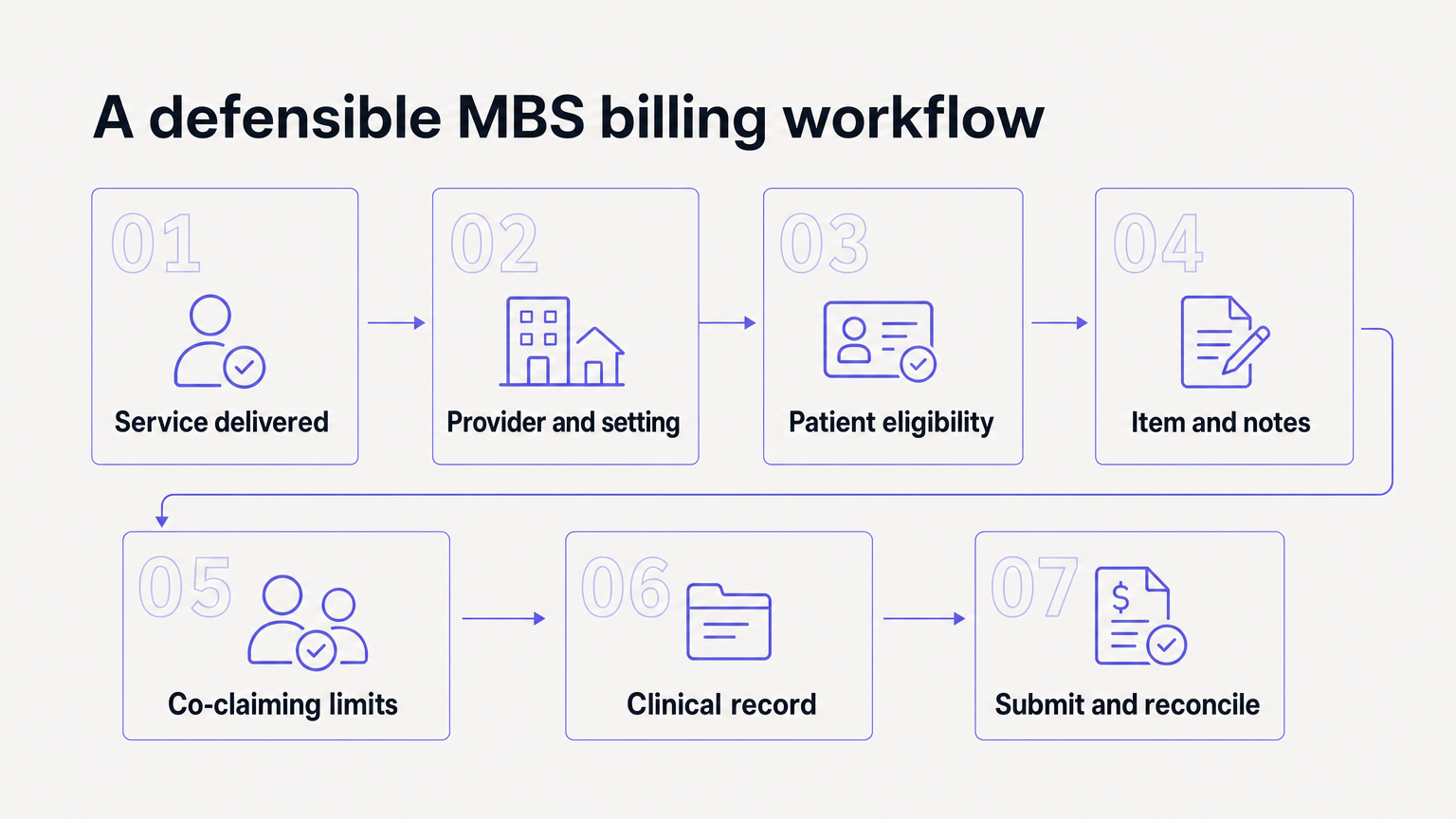
Seven-step MBS billing workflow from service delivery to claim reconciliation

1. Define the service from the clinical facts

Record the treating clinician, patient, date, place, consultation mode, clinically relevant work and actual patient-contact time. The service must have been delivered and must be clinically relevant. A cancelled or missed appointment does not attract a Medicare benefit.

Start with the care provided rather than a familiar code. This prevents an item label from shaping the record after the event.

2. Confirm the practitioner, provider number, setting and mode

The practitioner must be eligible to render the item. Use the provider number for the location where the service occurred. The applicable item can differ across consulting-room, home, residential aged care, hospital, after-hours, phone and video settings.

Referral and request rules also sit here. Specialist referrals and requests for pathology or diagnostic imaging are legally different documents, with different validity and content requirements. Apply the rule attached to the service instead of treating every incoming document as a referral.

3. Establish patient and claim eligibility

Eligibility may turn on Medicare status, age, concession status, MyMedicare registration, service history, frequency limits or an existing plan. The Health Professional Online Services (HPOS) item checker returns history-based patient eligibility, provider eligibility and claiming conditions after the user declares patient consent for the search.

The HPOS tool does not cover in-hospital items or eligibility linked to a MyMedicare registration. Those conditions still need to be resolved from the relevant item and program rules.

4. Select the item that best describes the service

Read the complete descriptor and every associated note. The MBS attendance note states that the item best describing the service should be claimed, with a more specific service item taking priority over a general attendance. The relevant criteria can extend beyond the short item name to include:

  • practitioner type
  • location and consultation mode
  • minimum time
  • required clinical components
  • referral or request conditions
  • patient or plan eligibility
  • frequency limits
  • exclusions and co-claiming rules
  • effective and amendment dates.

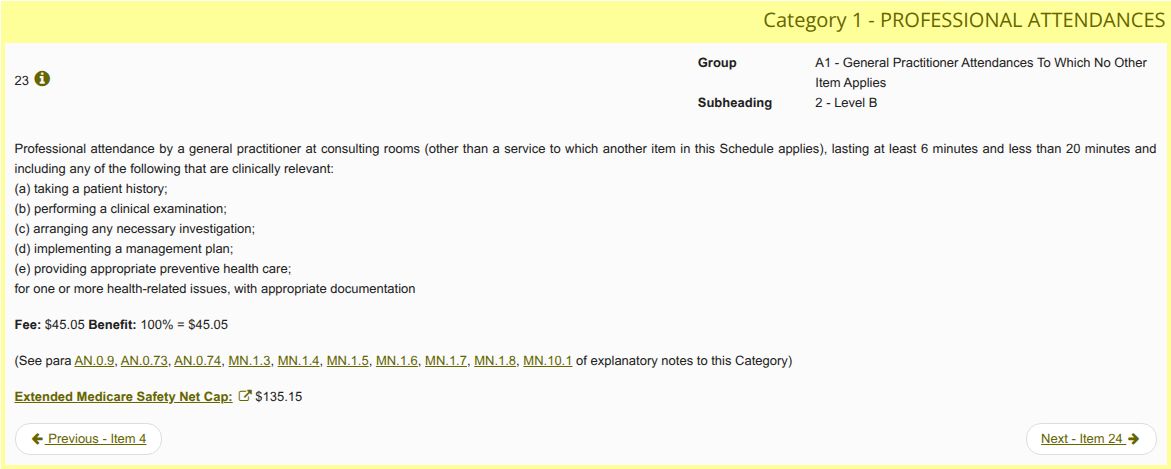
MBS Online item 23 descriptor with fee and associated notes

For time-tiered GP attendances, the booked appointment length is not the billable duration. Item 23, for example, covers a consulting-room attendance lasting at least 6 minutes and less than 20 minutes when its other requirements are met. Only clinically relevant time with the patient counts. Notes, prescriptions, referrals or forms completed while the patient is present can count; work completed after the patient leaves cannot.

Our MBS item number cheat sheet gives GPs a faster route to common items, with each entry linked to its current MBS Online record.

5. Apply co-claiming, same-day and frequency rules

Two services on the same day do not automatically produce two payable items. Each service must be clinically relevant and distinct, and neither item can prohibit the combination under the same-day claiming rules.

When a procedure and a general attendance are both eligible, procedure time cannot also count towards the attendance. Under the procedural component rules, the procedure item generally includes informed procedural and financial consent, the procedure, discussion of its result and routine aftercare. A separate attendance needs separate clinical work supported by the record.

A second attendance on the same day can attract a benefit when it is a distinct service rather than a continuation of the earlier attendance, as set out in the attendance explanatory note. Record each attendance time on the account under the official account requirements.

6. Create a record that substantiates the item

A defensible clinical record:

  • identifies the patient
  • has a separate entry for each attendance and its service date
  • records enough patient-specific clinical information to explain the service
  • supports any time, eligibility, consent, referral, plan or co-claiming criterion used
  • is completed during the service or as soon as practicable afterwards
  • is clear enough to support ongoing care by another practitioner.

An item number, appointment entry or copied template does not establish what happened. The Department's record-keeping requirements focus on the clinical substance and timing of the record.

7. Choose the billing route, submit and reconcile

Choose bulk billing or private billing only after the item is settled. Submit through a channel that supports the claim type, then monitor its processing and payment report. A successful transmission confirms receipt, while reconciliation confirms whether Medicare accepted and paid the claim as intended.

Bulk billing and private billing follow different paths

Bulk billing Private billing
Fee arrangement The provider accepts the Medicare benefit as full payment for that service. Additional charges for the same service are prohibited, subject to the narrow permitted vaccine-supply exception. The provider sets the fee. The fee can exceed the schedule fee or benefit.
Patient or claimant action The eligible assignor assigns the Medicare benefit to the provider. The claimant pays or becomes liable for the account and claims the benefit. The claimant is not always the patient.
Who receives the benefit Medicare pays the provider. Medicare pays the claimant, subject to the rules for paid, partly paid and unpaid accounts.
Required billing record A valid assignment agreement with the prescribed particulars. An itemised account or receipt with the patient, service date, charge, paid and owing amounts, and item number or service description. Provider, referral and hospital details apply where relevant.

Practices can bulk bill one distinct service and privately bill another on the same occasion where the rules allow both services. Multiple operations performed on one occasion must all use the same billing route. The current MBS billing requirements also set out the details required on accounts and receipts.

Assignment of benefit rules changed on 1 July 2026

A bulk-bill claim requires a completed assignment agreement from the patient or another eligible assignor. The agreement must be in place before the claim is submitted, although it can now be entered into before or after the service.

The current rules also provide that:

  • assignment can be electronic or paper
  • an approved Services Australia form is optional, provided the agreement includes the prescribed particulars
  • the former patient unable to sign notation is no longer accepted
  • eligible patients can make an enduring assignment for ongoing bulk-billed GP services under the specific MyMedicare, Aboriginal Community Controlled Health Organisation, Aboriginal Medical Service or residential aged care arrangements
  • assignment agreements must be retained for two years from the claim date and supplied to the patient on request.

A transition period runs from 1 July 2026 to 30 June 2027. When physical or electronic agreement cannot be obtained, verbal assignment is temporarily available for bulk-billed services. The patient must agree to how the signature field will be completed, the field must state assignor verbally agreed, and the completed form must be sent to the patient electronically. Temporary verbal assignment does not apply to Department of Veterans' Affairs (DVA)-funded care. An enduring agreement entered before 30 June 2027 lasts 12 months. These rules and the limits of enduring assignment are set out in the current assignment guidance.

Do not confuse the three billing clocks

Process Current time limit What starts the clock
Initial bulk-bill claim for a service on or after 5 September 2025 One year Date of service
Retention of an assignment agreement Two years Date the claim is made
Paid claim adjustment process The date of service must be within two years Date of service

The former two-year initial lodgement period still applies to bulk-billed services delivered before 5 September 2025. A late-lodgement waiver exists only in limited circumstances; routine administrative delay is excluded from the late-claim process.

Three worked MBS billing examples

A 27-minute general GP consultation

A GP sees a patient in consulting rooms for 27 minutes, manages two health issues and provides no service covered by a more specific item. Item 36 is the likely attendance item because it covers a GP consulting-room attendance lasting at least 20 minutes when its remaining requirements are met.

The recorded duration uses patient-present clinical time. Five minutes spent finishing the note after the patient leaves does not extend the attendance to 32 minutes. The note should explain the issues assessed, relevant examination or history, management and why the service meets the item.

A minor procedure plus an unrelated clinical problem

A patient attends for a planned procedure and also presents a separate problem requiring history, examination and management. A procedure item and a general attendance may both be available if the services are clinically relevant, distinct and allowed together under the MBS co-claiming conditions.

Under the procedural component rules, procedure time is excluded from the attendance duration. If the only additional work is procedural consent, discussing the result or routine aftercare, that work is generally part of the procedure rather than a second attendance.

A GP chronic condition management plan review

Item 967 is the current face-to-face GP item for reviewing a GP chronic condition management plan. Item 965 covers preparation. The former GP Management Plan and Team Care Arrangement framework was replaced on 1 July 2025, so templates that still propose items 721, 723 or 732 for new work need to be retired.

Current GP chronic condition management plan billing rules prohibit a plan item and a general attendance item for the same patient on the same day. A separate attendance by a different health professional can still attract a benefit when its own requirements are met.

Handle rejected and incorrect claims differently

Situation Correct response
The claim was rejected Read the reason or return code, establish whether the issue is patient eligibility, provider eligibility, item choice, frequency, missing information or a system error, then adjust or resubmit only when the service supports the corrected claim.
The claim was paid with the wrong information Adjust the claim where the adjustment rules permit it. A bulk-bill adjustment generally requires the service date to be within two years.
The service did not support the paid item Make a voluntary acknowledgement promptly and repay the incorrect amount. The Department states that no penalty applies to a voluntary acknowledgement, although the debt remains payable.

Services Australia publishes the Medicare rejection codes used in processing reports. Repeatedly sending the same claim does not resolve an eligibility or descriptor failure.

The clinician whose provider number or name appears on the claim remains legally responsible, even when a practice manager, receptionist, billing agent or software user entered it. Payment also does not prove that the service complied with every item requirement. Medicare can review paid claims later and request substantiating records.

Build MBS billing into the clinical workflow

Billing accuracy is easier to sustain when it sits beside the clinical work rather than at a separate end-of-day coding step. A practical practice-level control loop includes:

  1. Maintain a current item register. Assign an owner to review MBS releases and retire obsolete favourites, templates and shortcuts.
  2. Keep the note and claim aligned. The clinician records the service first and approves the item from the same facts.
  3. Separate prompts from decisions. Software can surface candidate items and missing information; the clinician remains responsible for eligibility, clinical relevance and final selection.
  4. Review exceptions. Rejections, adjustments, unusually frequent items and manual overrides provide a focused audit sample.
  5. Reconcile reports. Confirm accepted, rejected and unpaid claims instead of treating transmission as completion.
  6. Feed errors back into the system. Update templates, staff guidance and software rules when a recurring cause is found.

With Lyrebird, we draft the clinical note for clinician review. Our Clinic Plans can surface real-time MBS billing prompts during the consult. Through our Bp Premier integration, reviewed notes and care plans can write back to the patient record. The prompt supports the decision; it does not establish entitlement or transfer the provider's responsibility.

Use the official source that matches the question

Question Source What it resolves
What does the item require today? MBS Online Current descriptor, fee, benefit, associated notes and amendment date
Is this patient or provider eligible? HPOS item checker History-based patient eligibility, provider eligibility and claiming conditions, within the tool's stated limits
How should an item or explanatory note be interpreted? AskMBS advice service Written guidance on MBS items, notes and associated legislation
Why was a claim rejected, or where is a payment? Medicare provider enquiries Billing, claiming, payment and provider-number administration

The cleanest MBS claim follows the service in order: care delivered, eligibility established, item applied, evidence recorded, billing route completed and payment reconciled. That sequence gives GPs a clearer record, gives practice teams fewer exceptions to repair and keeps the claim connected to the patient care it represents.

Open the 2026 MBS item number cheat sheet

Contact Lyrebird to discuss how MBS billing prompts can fit into your clinic's workflow.

More Resources
Continue reading
Posts
The dangers of Copy Paste Scribes
Read More
Posts
How to use an AI medical scribe
Read More
Posts
December Product Updates
Read More
Announcement
Kingston and Richmond NHS Foundation Trust go live with Lyrebird, fully integrated with their EPR from day one
Read More
Education
Medicare Eating Disorder Plans: A Practical Guide for GPs
Read More
Education
Bulk Billing Incentive: A Practical Guide for General Practice
Read More
Post
5 min read

MBS Billing: A Practical Guide for Australian GPs

Published on
August 14, 2026
MBS billing guide for Australian GPs in white on a violet Lyrebird title card
Contributors
Lyrebird Health
Subscribe to our newsletter
Read about our privacy policy.
Thank you! Your submission has been received!
Oops! Something went wrong while submitting the form.

MBS billing can look like a simple choice of item number. In practice, the right claim depends on who provided the service, what happened, where and how it occurred, patient eligibility, time, other services delivered and the supporting record. For Australian GPs and general-practice teams, a repeatable workflow keeps each billing decision tied to the service and its evidence, then carries it through submission and reconciliation.

What MBS billing means

The Medicare Benefits Schedule (MBS) is the Australian Government's list of professional services that attract a Medicare benefit. Medicare is the wider program; the MBS is the schedule within it. Each item connects an identifying number with a service descriptor, schedule fee and associated rules. MBS Online holds the current items, explanatory notes and release changes.

An MBS claim asks Medicare to pay a benefit for a service that has already been rendered. MBS billing is the full process around that claim: matching the service to an item, establishing eligibility, recording the evidence, choosing bulk or private billing, transmitting the claim and reconciling the result.

Several amounts can appear around one service:

Term What it means Billing consequence
Schedule fee The government benchmark attached to the item It is not a mandatory private fee or price cap.
Medicare benefit The subsidy payable under the item's rules General rates are 100% for non-referred, non-admitted GP services, 85% for most other out-of-hospital services and 75% for services that form part of an episode of hospital treatment, with exceptions.
Practice fee The amount a clinician charges for a privately billed service A practice sets this amount; it can differ from the schedule fee.
Patient gap The part of the private fee that the Medicare benefit does not cover The claimant bears this amount before any applicable safety-net or insurer payment.
Bulk billing The Medicare benefit is assigned to the provider as full payment The patient has no gap for that service.

The exact benefit displayed for the item is the dependable figure. The MBS benefit rules contain setting-specific exceptions that a simple percentage calculator can miss.

Use seven checks before submitting an MBS claim

The claiming channel does not change the billing rules. Medicare Online, Easyclaim, the Electronic Claim Lodgement and Information Processing Service Environment (ECLIPSE), Webclaim and manual claims all start with the same seven checks.

Seven-step MBS billing workflow from service delivery to claim reconciliation

1. Define the service from the clinical facts

Record the treating clinician, patient, date, place, consultation mode, clinically relevant work and actual patient-contact time. The service must have been delivered and must be clinically relevant. A cancelled or missed appointment does not attract a Medicare benefit.

Start with the care provided rather than a familiar code. This prevents an item label from shaping the record after the event.

2. Confirm the practitioner, provider number, setting and mode

The practitioner must be eligible to render the item. Use the provider number for the location where the service occurred. The applicable item can differ across consulting-room, home, residential aged care, hospital, after-hours, phone and video settings.

Referral and request rules also sit here. Specialist referrals and requests for pathology or diagnostic imaging are legally different documents, with different validity and content requirements. Apply the rule attached to the service instead of treating every incoming document as a referral.

3. Establish patient and claim eligibility

Eligibility may turn on Medicare status, age, concession status, MyMedicare registration, service history, frequency limits or an existing plan. The Health Professional Online Services (HPOS) item checker returns history-based patient eligibility, provider eligibility and claiming conditions after the user declares patient consent for the search.

The HPOS tool does not cover in-hospital items or eligibility linked to a MyMedicare registration. Those conditions still need to be resolved from the relevant item and program rules.

4. Select the item that best describes the service

Read the complete descriptor and every associated note. The MBS attendance note states that the item best describing the service should be claimed, with a more specific service item taking priority over a general attendance. The relevant criteria can extend beyond the short item name to include:

  • practitioner type
  • location and consultation mode
  • minimum time
  • required clinical components
  • referral or request conditions
  • patient or plan eligibility
  • frequency limits
  • exclusions and co-claiming rules
  • effective and amendment dates.

MBS Online item 23 descriptor with fee and associated notes

For time-tiered GP attendances, the booked appointment length is not the billable duration. Item 23, for example, covers a consulting-room attendance lasting at least 6 minutes and less than 20 minutes when its other requirements are met. Only clinically relevant time with the patient counts. Notes, prescriptions, referrals or forms completed while the patient is present can count; work completed after the patient leaves cannot.

Our MBS item number cheat sheet gives GPs a faster route to common items, with each entry linked to its current MBS Online record.

5. Apply co-claiming, same-day and frequency rules

Two services on the same day do not automatically produce two payable items. Each service must be clinically relevant and distinct, and neither item can prohibit the combination under the same-day claiming rules.

When a procedure and a general attendance are both eligible, procedure time cannot also count towards the attendance. Under the procedural component rules, the procedure item generally includes informed procedural and financial consent, the procedure, discussion of its result and routine aftercare. A separate attendance needs separate clinical work supported by the record.

A second attendance on the same day can attract a benefit when it is a distinct service rather than a continuation of the earlier attendance, as set out in the attendance explanatory note. Record each attendance time on the account under the official account requirements.

6. Create a record that substantiates the item

A defensible clinical record:

  • identifies the patient
  • has a separate entry for each attendance and its service date
  • records enough patient-specific clinical information to explain the service
  • supports any time, eligibility, consent, referral, plan or co-claiming criterion used
  • is completed during the service or as soon as practicable afterwards
  • is clear enough to support ongoing care by another practitioner.

An item number, appointment entry or copied template does not establish what happened. The Department's record-keeping requirements focus on the clinical substance and timing of the record.

7. Choose the billing route, submit and reconcile

Choose bulk billing or private billing only after the item is settled. Submit through a channel that supports the claim type, then monitor its processing and payment report. A successful transmission confirms receipt, while reconciliation confirms whether Medicare accepted and paid the claim as intended.

Bulk billing and private billing follow different paths

Bulk billing Private billing
Fee arrangement The provider accepts the Medicare benefit as full payment for that service. Additional charges for the same service are prohibited, subject to the narrow permitted vaccine-supply exception. The provider sets the fee. The fee can exceed the schedule fee or benefit.
Patient or claimant action The eligible assignor assigns the Medicare benefit to the provider. The claimant pays or becomes liable for the account and claims the benefit. The claimant is not always the patient.
Who receives the benefit Medicare pays the provider. Medicare pays the claimant, subject to the rules for paid, partly paid and unpaid accounts.
Required billing record A valid assignment agreement with the prescribed particulars. An itemised account or receipt with the patient, service date, charge, paid and owing amounts, and item number or service description. Provider, referral and hospital details apply where relevant.

Practices can bulk bill one distinct service and privately bill another on the same occasion where the rules allow both services. Multiple operations performed on one occasion must all use the same billing route. The current MBS billing requirements also set out the details required on accounts and receipts.

Assignment of benefit rules changed on 1 July 2026

A bulk-bill claim requires a completed assignment agreement from the patient or another eligible assignor. The agreement must be in place before the claim is submitted, although it can now be entered into before or after the service.

The current rules also provide that:

  • assignment can be electronic or paper
  • an approved Services Australia form is optional, provided the agreement includes the prescribed particulars
  • the former patient unable to sign notation is no longer accepted
  • eligible patients can make an enduring assignment for ongoing bulk-billed GP services under the specific MyMedicare, Aboriginal Community Controlled Health Organisation, Aboriginal Medical Service or residential aged care arrangements
  • assignment agreements must be retained for two years from the claim date and supplied to the patient on request.

A transition period runs from 1 July 2026 to 30 June 2027. When physical or electronic agreement cannot be obtained, verbal assignment is temporarily available for bulk-billed services. The patient must agree to how the signature field will be completed, the field must state assignor verbally agreed, and the completed form must be sent to the patient electronically. Temporary verbal assignment does not apply to Department of Veterans' Affairs (DVA)-funded care. An enduring agreement entered before 30 June 2027 lasts 12 months. These rules and the limits of enduring assignment are set out in the current assignment guidance.

Do not confuse the three billing clocks

Process Current time limit What starts the clock
Initial bulk-bill claim for a service on or after 5 September 2025 One year Date of service
Retention of an assignment agreement Two years Date the claim is made
Paid claim adjustment process The date of service must be within two years Date of service

The former two-year initial lodgement period still applies to bulk-billed services delivered before 5 September 2025. A late-lodgement waiver exists only in limited circumstances; routine administrative delay is excluded from the late-claim process.

Three worked MBS billing examples

A 27-minute general GP consultation

A GP sees a patient in consulting rooms for 27 minutes, manages two health issues and provides no service covered by a more specific item. Item 36 is the likely attendance item because it covers a GP consulting-room attendance lasting at least 20 minutes when its remaining requirements are met.

The recorded duration uses patient-present clinical time. Five minutes spent finishing the note after the patient leaves does not extend the attendance to 32 minutes. The note should explain the issues assessed, relevant examination or history, management and why the service meets the item.

A minor procedure plus an unrelated clinical problem

A patient attends for a planned procedure and also presents a separate problem requiring history, examination and management. A procedure item and a general attendance may both be available if the services are clinically relevant, distinct and allowed together under the MBS co-claiming conditions.

Under the procedural component rules, procedure time is excluded from the attendance duration. If the only additional work is procedural consent, discussing the result or routine aftercare, that work is generally part of the procedure rather than a second attendance.

A GP chronic condition management plan review

Item 967 is the current face-to-face GP item for reviewing a GP chronic condition management plan. Item 965 covers preparation. The former GP Management Plan and Team Care Arrangement framework was replaced on 1 July 2025, so templates that still propose items 721, 723 or 732 for new work need to be retired.

Current GP chronic condition management plan billing rules prohibit a plan item and a general attendance item for the same patient on the same day. A separate attendance by a different health professional can still attract a benefit when its own requirements are met.

Handle rejected and incorrect claims differently

Situation Correct response
The claim was rejected Read the reason or return code, establish whether the issue is patient eligibility, provider eligibility, item choice, frequency, missing information or a system error, then adjust or resubmit only when the service supports the corrected claim.
The claim was paid with the wrong information Adjust the claim where the adjustment rules permit it. A bulk-bill adjustment generally requires the service date to be within two years.
The service did not support the paid item Make a voluntary acknowledgement promptly and repay the incorrect amount. The Department states that no penalty applies to a voluntary acknowledgement, although the debt remains payable.

Services Australia publishes the Medicare rejection codes used in processing reports. Repeatedly sending the same claim does not resolve an eligibility or descriptor failure.

The clinician whose provider number or name appears on the claim remains legally responsible, even when a practice manager, receptionist, billing agent or software user entered it. Payment also does not prove that the service complied with every item requirement. Medicare can review paid claims later and request substantiating records.

Build MBS billing into the clinical workflow

Billing accuracy is easier to sustain when it sits beside the clinical work rather than at a separate end-of-day coding step. A practical practice-level control loop includes:

  1. Maintain a current item register. Assign an owner to review MBS releases and retire obsolete favourites, templates and shortcuts.
  2. Keep the note and claim aligned. The clinician records the service first and approves the item from the same facts.
  3. Separate prompts from decisions. Software can surface candidate items and missing information; the clinician remains responsible for eligibility, clinical relevance and final selection.
  4. Review exceptions. Rejections, adjustments, unusually frequent items and manual overrides provide a focused audit sample.
  5. Reconcile reports. Confirm accepted, rejected and unpaid claims instead of treating transmission as completion.
  6. Feed errors back into the system. Update templates, staff guidance and software rules when a recurring cause is found.

With Lyrebird, we draft the clinical note for clinician review. Our Clinic Plans can surface real-time MBS billing prompts during the consult. Through our Bp Premier integration, reviewed notes and care plans can write back to the patient record. The prompt supports the decision; it does not establish entitlement or transfer the provider's responsibility.

Use the official source that matches the question

Question Source What it resolves
What does the item require today? MBS Online Current descriptor, fee, benefit, associated notes and amendment date
Is this patient or provider eligible? HPOS item checker History-based patient eligibility, provider eligibility and claiming conditions, within the tool's stated limits
How should an item or explanatory note be interpreted? AskMBS advice service Written guidance on MBS items, notes and associated legislation
Why was a claim rejected, or where is a payment? Medicare provider enquiries Billing, claiming, payment and provider-number administration

The cleanest MBS claim follows the service in order: care delivered, eligibility established, item applied, evidence recorded, billing route completed and payment reconciled. That sequence gives GPs a clearer record, gives practice teams fewer exceptions to repair and keeps the claim connected to the patient care it represents.

Open the 2026 MBS item number cheat sheet

Contact Lyrebird to discuss how MBS billing prompts can fit into your clinic's workflow.
Keep reading

All posts
Questions about compliance?