Education
5 min read

Freed AI Review: Pricing, Pros and Cons for Australian Clinicians
Published on
September 21, 2026
Contributors
Lyrebird Health
Subscribe to our newsletter
Read about our privacy policy.
Thank you! Your submission has been received!
Oops! Something went wrong while submitting the form.

Freed turns a patient conversation into a draft clinical note with little setup. That simplicity has made it a visible option among ambient AI scribes, but the right buying decision depends on more than note generation. Australian clinicians also need to understand plan limits, record integration, privacy, local workflow fit and the effort needed to review each draft.

Disclosure: Lyrebird Health publishes this guide and appears as an alternative. We apply the same criteria to both products: documentation workflow, integrations, data handling, pricing and clinical oversight.

Freed AI review: the short verdict

Freed is a credible choice for individual clinicians who want ambient capture, custom note formats and access from a browser or mobile app. Core, at a displayed $79 per month, is the practical starting point for a clinician with a normal consult volume. Premier, at $119 per month, adds unlimited EHR Push, prior-visit context, patient documents and coding support. Starter and Core users receive only five EHR transfers in total.

Australian use requires more caution. Freed's terms state that the platform is based in the United States, make no claim that it is appropriate outside the US and place responsibility for local legal compliance on the user. Freed also states that all data is stored on US servers. An Australian App Store listing confirms download availability only. It does not establish Australian sales, onboarding, support, hosting, privacy compliance or Medicare Benefits Schedule (MBS) support.

For Australian general practice and specialist workflows, Lyrebird is the stronger fit when local data processing and integrations with systems such as Bp Premier, Gentu and Genie are decision-critical.

Review criterionFreed AI
Best fitIndividual clinicians using a supported browser-based EHR or a copy-and-paste workflow
Core workflowCaptures a consult and drafts a structured clinical note and transcript
Main strengthsQuick setup, mobile access, specialty templates, format learning and unlimited notes from Core
Main trade-offsA 40-note Starter cap, beta browser-extension EHR transfer, US data storage and no claim of suitability outside the US
EHR transferFive lifetime transfers on Starter and Core; unlimited on Premier for verified browser-based EHRs
Displayed individual priceStarter $39, Core $79 and Premier $119 per month; only Premier has a documented annual option at $1,248 per year
TrialSeven days of Premier features, with no billing information required

What Freed AI does

Freed is an AI medical scribe. It captures an in-person or telehealth consult from its web or mobile app, converts the audio to text, and drafts a note and transcript. The clinician reviews and edits the draft before copying it or transferring it to a supported browser-based EHR.

Freed includes specialty-specific templates and can learn a clinician's preferred format from edits. Starter includes Clinical Evidence, a question-answering feature that cites a curated collection of medical sources. Core adds unlimited notes, live onboarding, AI-assisted note editing and an instant template builder. Premier adds prior-visit summaries, patient-context pull-forward, patient instructions, letters and referrals, US coding suggestions, and unlimited EHR Push for supported browser-based systems.

The result is still a draft. Freed does not observe an examination, independently establish facts or take responsibility for the signed record.

Freed AI pricing explained

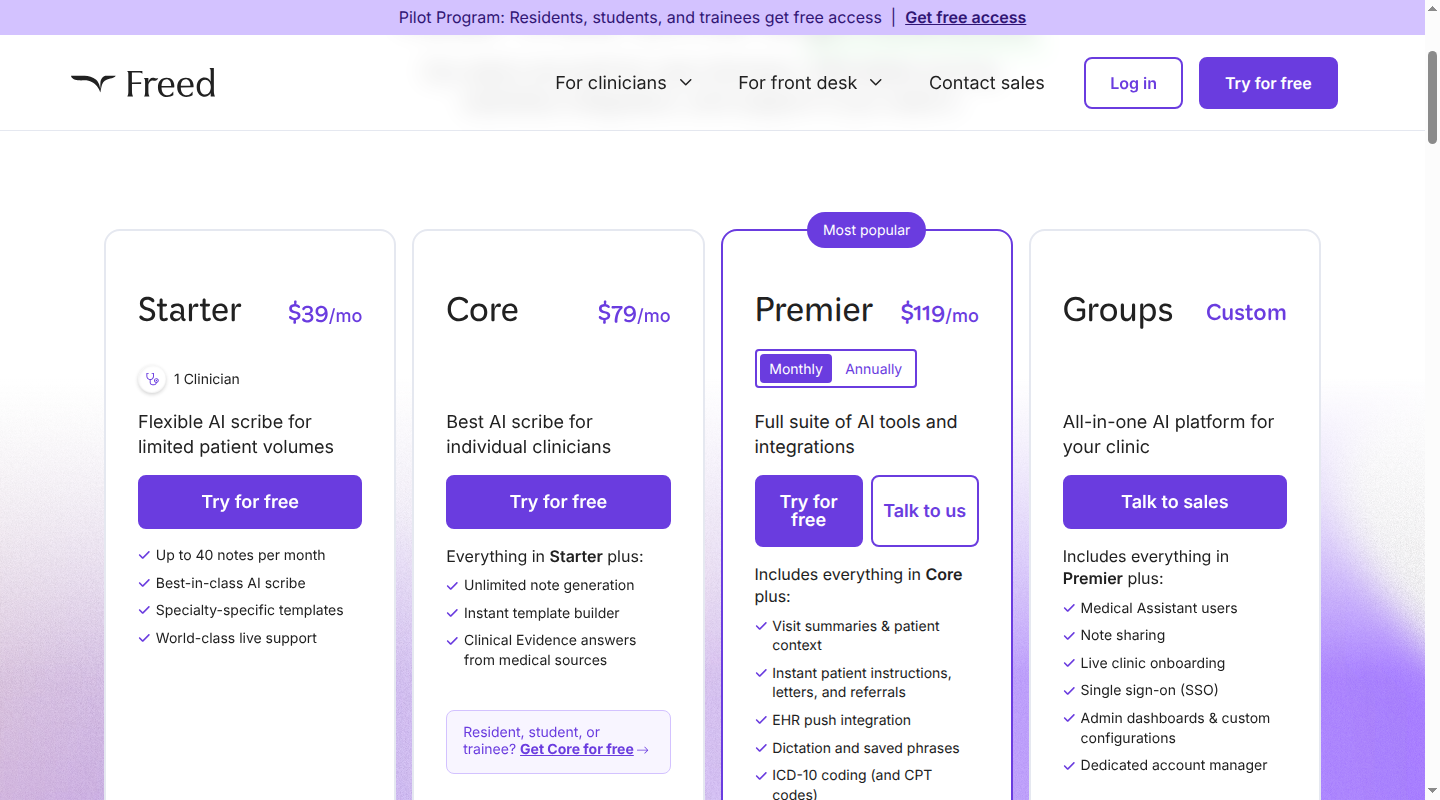
Freed has three individual tiers and a group plan. The Help Center pricing article updated 14 September 2026 documents these terms:

Freed pricing cards for Starter, Core, Premier and Groups
PlanStandard priceDocumented annual optionMain inclusions
Starter$39/monthNone documentedUp to 40 notes, specialty templates, Clinical Evidence and live support
Core$79/monthNone documentedUnlimited notes, live onboarding, AI note editing and template builder
Premier$119/month$1,248/year, equivalent to $104/monthPrior-visit context, patient documents, coding support and unlimited EHR Push
GroupsStandard individual rate for smaller groups or custom pricing for larger organisationsQuote-basedPremier features plus patient sharing, medical assistant users, admin controls, single sign-on, central billing and account support

Freed does not identify the currency or tax treatment beside these dollar amounts. That matters for an Australian practice because the final local cost may differ from the headline display.

Starter's 40-note allowance works out to two notes per working day in a 20-day month. A clinician seeing a normal daily patient list is therefore likely to need Core. Starter and Core include five EHR transfers for the lifetime of the account, while Premier and Groups include unlimited transfers through EHR Push.

Freed's marketing pricing page contains both $59 and $39 Starter figures and both $59 and $79 Core figures without a clear plan-level annual term for either tier. The current Help Center article confirms Starter at $39 monthly, Core at $79 monthly and an annual option only for Premier, so Starter and Core annual discounts are not established. It also documents a seven-day trial of Premier features without billing information, 12 months of free Core for eligible trainees, and up to 50% off monthly Premier for eligible trainees.

What clinicians praise and complain about

Less typing during the consult

A cardiologist who used Freed for six months reported greater engagement in patient conversations and useful history and results sections. The same clinician reviewed every sentence and documented an invented exchange in the transcript during silence, although it did not enter the note. This individual experience shows both the practical benefit and the need for review. Read the clinician's Freed review.

An emergency physician on Reddit praised the mobile setup and capture of history and medical decision-making, but still copied the note into an unsupported EHR. The self-selected thread also contains vendor promotion, so it supports workflow themes rather than product-wide conclusions. See the emergency medicine discussion.

Strong US App Store sentiment, little Australian rating data

On 17 September 2026, Freed held 4.8 out of 5 from 514 ratings in the US App Store. Its Australian App Store listing had 4.0 out of 5 from one rating. The US sample suggests strong sentiment among iOS reviewers, but it cannot establish note accuracy or Australian suitability. The Australian sample is too small to support a conclusion.

Evidence for the category remains limited

Freed's public evidence materials do not identify an independent Australian clinical validation study. More broadly, a 2025 systematic review included eight AI-scribe studies and found signs of better documentation time and clinician workflow, alongside concerns about documentation quality. The authors judged the evidence limited and heterogeneous because the studies were small and context-specific. Read the systematic review.

That evidence supports a measured expectation: an AI scribe may reduce documentation work, but its value and error profile depend on the product, consult type and implementation.

Five Freed limitations that matter in Australia

1. EHR Push remains a beta browser-extension workflow

Freed transfers notes through a Chrome extension that maps draft sections into fields on a browser-based EHR page. The Chrome Web Store listing labels EHR Push as beta. This implementation is browser-based field transfer, not confirmation of a native or API integration with a named EHR.

The current Help Center compatibility list verifies SimplePractice, Practice Fusion, athenahealth, Tebra/Kareo, eClinicalWorks, Elation, browser-based AdvancedMD, Cerbo, TherapyNotes, OptiMantra, NextGen Office and Practice Better. It does not verify Bp Premier, MedicalDirector, Zedmed, Gentu or Genie.

Freed's marketing EHR page also names Kipu, Aarista and DrChrono among systems where EHR Push works best. Those three names do not appear on the Help Center's verified list, so they should be treated as marketing compatibility claims rather than confirmed integrations. Starter and Core users receive five chart transfers in total; Premier and Groups receive unlimited transfers.

A clinician outside the verified browser systems may need to copy and paste the draft and enter structured data manually. Lyrebird's AI scribe integration scorecard separates simple note transfer from patient-context launch and two-way record integration.

2. Australian app availability confirms download access only

Freed is listed in the Australian App Store, but that establishes only that an Australian Apple account can download the app. It does not demonstrate Australian sales, local onboarding or support, Australian hosting, alignment with the Australian Privacy Principles (APPs), local security assessment or MBS support.

Freed's platform terms state that the platform is based in the United States, make no claim that it is appropriate for use outside the US and place responsibility for compliance with local law on the user. This is a material boundary for an Australian practice, even when app download is technically available.

3. Freed states that all data is stored in the United States

Freed states that all data is stored on US servers, and its security summary identifies Microsoft Azure regions in Arizona and Virginia. Its privacy policy also tells non-US users that their information may be transferred to, processed and maintained on US systems. See Freed's data-location statement.

Freed also states that it is HIPAA and HITECH compliant and SOC 2 Type II certified, with encryption at rest and in transit. These are relevant controls, but US compliance does not establish APP compliance or Australian data residency.

The RACGP advises practices selecting an AI scribe to establish where data is processed and stored, whether the vendor complies with Australian legislation and how information may be used for secondary purposes. Its guidance also calls for a practice policy, an updated privacy policy, any consent required for the workflow, and prompt review of generated notes. Read the RACGP guidance.

4. Retention and AI-training terms need precise reading

Freed's HIPAA Help Center article says protected health information is never used for AI training and that its AI models do not retain data. The platform terms use broader categories. They define "Your Data" to include medical records, patient recordings, output and Voice ID, and permit consent-based use of that data to train AI or machine-learning models through platform settings. The terms also allow de-identified data to be used for customisation and training, and allow opt-in Learned Output and Voice ID to train parts of the platform.

Freed's privacy policy separately lists improving or training AI models among the uses of personal information. These statements may apply to different data categories and consent states. Together, they do not support a blanket claim that Freed never uses customer data for training.

Retention wording also varies by scope. A Help Center explanation says audio is temporarily stored until note generation and quality checks finish, then deleted. The platform terms allow a user setting that either deletes patient recordings after processing or retains them under the selected data-retention period. Those terms allow other user data to be kept for 30 days or for the subscription term, with an additional seven days in backups after the 30-day option expires.

5. Coding is US-oriented and every draft still needs review

Premier includes ICD-10, Current Procedural Terminology (CPT), and evaluation and management code suggestions. These features are designed around US billing workflows. They do not replace Australian MBS assessment, and Freed's public material does not document MBS support.

A detailed draft is useful only when it is accurate, concise and easy to reconcile with the consult. Common review risks include omission, unsupported detail, contradiction, misplaced examination findings and over-documentation. The clinician remains responsible for the note and any billing choice. The RACGP specifically advises clinicians not to rely on an AI scribe to determine whether MBS requirements have been met.

Freed vs Lyrebird for Australian clinical workflows

Both products draft clinical documentation from a consultation, support custom note structures and leave sign-off with the clinician. Their clearest differences for an Australian buyer are integration depth, data location, training terms and the scope of documents around the note.
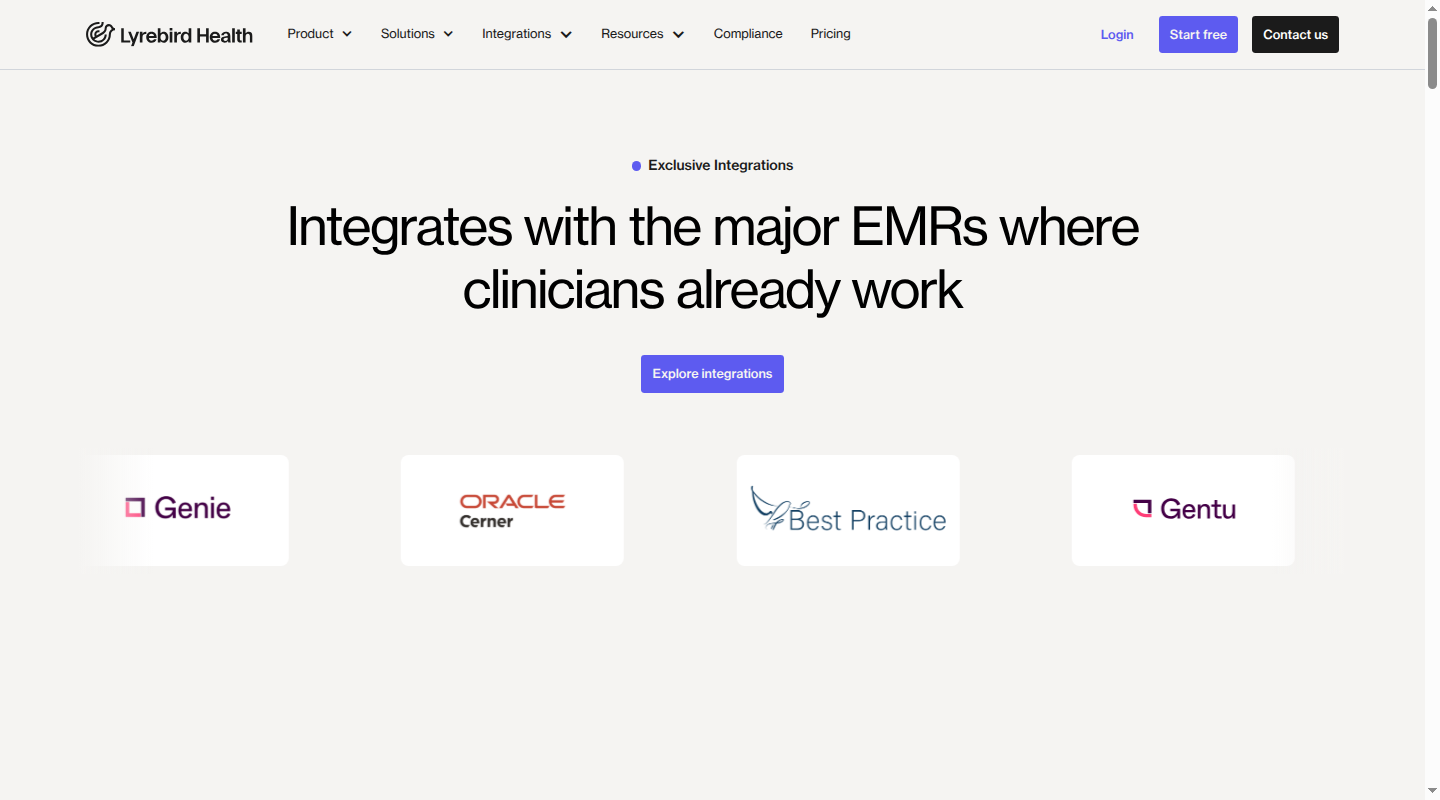
Lyrebird integration page showing Genie, Oracle Cerner, Best Practice and Gentu
CriterionFreedLyrebird
Best fitMay suit individual clinicians using a verified browser-based EHRMay suit Australian GPs, specialists, practices and health services that need local workflows
CaptureWeb, iOS and Android, plus supported telehealth captureWeb-based capture for in-person, phone and video consults
DocumentationCustom clinical notes and transcripts; patient instructions, letters and referrals on PremierCustom clinical notes, documents and letters; care plans and assessments on eligible plans
Record integrationBeta Chrome-extension EHR Push; five lifetime transfers on Starter/Core and unlimited on Premier/Groups for verified browser-based systemsBp Premier, Gentu and Genie, plus patient-context and write-back pathways using FHIR, HL7, SMART on FHIR and partner APIs
Data locationStored in US Azure regionsPatient data processed and stored in Australia
Audio handlingDelete after processing or retain under the selected data-retention settingDestroyed after transcription
Training useHelp Center says PHI is excluded; terms permit consent-based AI/ML training with Your Data and use of de-identified dataNotes and transcripts are not used to train external AI models
Individual pricingStarter $39, Core $79 and Premier $119 monthly; only Premier has a documented annual option at $1,248Free plan; Bp Free for eligible Bp Premier users; Pro displayed at $160 per month, with currency and GST treatment not labelled in the page text

Lyrebird's Australian integrations include direct write-back for local practice software and standards-based pathways for larger health services. Its Australian privacy controls include in-country processing and storage, encryption in transit and at rest, audio destruction after transcription, and a default seven-day note retention period unless the clinician changes it. See Lyrebird's privacy controls.

Freed may still suit an Australian clinician whose priority is mobile access and whose browser-based EHR appears on the verified list. Lyrebird may suit practices that place greater weight on Australian data handling, Bp Premier integration and generating clinical documents beyond the note.

A practical buying scorecard

The most useful comparison is the amount of safe work removed across a normal clinic day. A practice-level scorecard can use the same measures for every scribe:

  • Clinical correction: minutes spent reviewing, editing and reconciling each draft.
  • Significant errors: omissions, unsupported statements and contradictions that could change care or the record.
  • Workflow transfer: manual steps between capture, note review, documents and the patient record.
  • Consult coverage: performance across new patients, multi-problem reviews, telehealth, accents, interpreters and noisy rooms.
  • Output fit: consistency with the practice's preferred note, referral, patient instruction and care-plan formats.
  • Privacy and governance: documented data location, retention, subprocessors, access controls, incident handling and consent workflow.
  • Real cost: the plan required at normal volume, including integration, group controls, tax and any currency conversion.

Freed's seven-day trial is long enough to observe setup and first-draft workflow. It is a short window for judging format learning, support, uncommon consult types or changes in review time, which should be assessed over a representative clinical workload.

Frequently asked questions

Is Freed AI free?

Freed has no permanent free plan for general users. It offers a seven-day trial of Premier features without billing information. Eligible students, residents, fellows and trainees can receive 12 months of Core at no cost or up to 50% off a monthly Premier subscription.

Is Freed AI available in Australia?

Freed has an Australian App Store listing, so iOS download access is confirmed. The listing does not establish Australian sales, local onboarding or support, APP compliance, Australian hosting, local security assessment or MBS support. Freed's terms state that the platform is US-based and make no claim that it is appropriate outside the US.

Does Freed AI work with Bp Premier?

Freed does not name Bp Premier on its Help Center's verified EHR list. EHR Push is a beta Chrome-extension transfer workflow for browser-based systems, rather than a confirmed native Bp Premier integration. Lyrebird has a direct Bp Premier integration with note write-back.

Is Freed AI HIPAA compliant?

Freed states that it is HIPAA and HITECH compliant and SOC 2 Type II certified. It also states that data is stored in the US. These US controls do not establish APP compliance or Australian data residency. Its terms place local compliance responsibility on the user and contain broader consent-based and de-identified data training permissions than the Help Center's PHI-specific no-training statement.

Is Freed AI worth it?

Freed can be worth the cost for an individual clinician who values quick capture, mobile access and unlimited notes on Core. Premier is the relevant plan when unlimited EHR Push, prior-visit context, patient documents or coding suggestions are required. Australian practices should weigh those benefits against US data storage, the terms' non-US limitation, beta browser-extension transfer and the lack of documented MBS support or verified Australian practice-software integrations.

Australian practices that want locally processed clinical AI with deeper record integration can compare Lyrebird against the same scorecard.
Contact us

More Resources
Continue reading
Posts
The dangers of Copy Paste Scribes
Read More
Posts
How to use an AI medical scribe
Read More
Posts
December Product Updates
Read More
Education
Suki AI Pricing: Contract Costs and Australian Fit
Read More
Partnership
Lyrebird Health announces partnership with GPRA
Read More
Education
Nurse Practitioner MBS Item Numbers: A Practical 2026 Guide
Read More
Post
5 min read

Freed AI Review: Pricing, Pros and Cons for Australian Clinicians

Published on
September 21, 2026
Contributors
Lyrebird Health
Subscribe to our newsletter
Read about our privacy policy.
Thank you! Your submission has been received!
Oops! Something went wrong while submitting the form.

Freed turns a patient conversation into a draft clinical note with little setup. That simplicity has made it a visible option among ambient AI scribes, but the right buying decision depends on more than note generation. Australian clinicians also need to understand plan limits, record integration, privacy, local workflow fit and the effort needed to review each draft.

Disclosure: Lyrebird Health publishes this guide and appears as an alternative. We apply the same criteria to both products: documentation workflow, integrations, data handling, pricing and clinical oversight.

Freed AI review: the short verdict

Freed is a credible choice for individual clinicians who want ambient capture, custom note formats and access from a browser or mobile app. Core, at a displayed $79 per month, is the practical starting point for a clinician with a normal consult volume. Premier, at $119 per month, adds unlimited EHR Push, prior-visit context, patient documents and coding support. Starter and Core users receive only five EHR transfers in total.

Australian use requires more caution. Freed's terms state that the platform is based in the United States, make no claim that it is appropriate outside the US and place responsibility for local legal compliance on the user. Freed also states that all data is stored on US servers. An Australian App Store listing confirms download availability only. It does not establish Australian sales, onboarding, support, hosting, privacy compliance or Medicare Benefits Schedule (MBS) support.

For Australian general practice and specialist workflows, Lyrebird is the stronger fit when local data processing and integrations with systems such as Bp Premier, Gentu and Genie are decision-critical.

Review criterionFreed AI
Best fitIndividual clinicians using a supported browser-based EHR or a copy-and-paste workflow
Core workflowCaptures a consult and drafts a structured clinical note and transcript
Main strengthsQuick setup, mobile access, specialty templates, format learning and unlimited notes from Core
Main trade-offsA 40-note Starter cap, beta browser-extension EHR transfer, US data storage and no claim of suitability outside the US
EHR transferFive lifetime transfers on Starter and Core; unlimited on Premier for verified browser-based EHRs
Displayed individual priceStarter $39, Core $79 and Premier $119 per month; only Premier has a documented annual option at $1,248 per year
TrialSeven days of Premier features, with no billing information required

What Freed AI does

Freed is an AI medical scribe. It captures an in-person or telehealth consult from its web or mobile app, converts the audio to text, and drafts a note and transcript. The clinician reviews and edits the draft before copying it or transferring it to a supported browser-based EHR.

Freed includes specialty-specific templates and can learn a clinician's preferred format from edits. Starter includes Clinical Evidence, a question-answering feature that cites a curated collection of medical sources. Core adds unlimited notes, live onboarding, AI-assisted note editing and an instant template builder. Premier adds prior-visit summaries, patient-context pull-forward, patient instructions, letters and referrals, US coding suggestions, and unlimited EHR Push for supported browser-based systems.

The result is still a draft. Freed does not observe an examination, independently establish facts or take responsibility for the signed record.

Freed AI pricing explained

Freed has three individual tiers and a group plan. The Help Center pricing article updated 14 September 2026 documents these terms:

Freed pricing cards for Starter, Core, Premier and Groups
PlanStandard priceDocumented annual optionMain inclusions
Starter$39/monthNone documentedUp to 40 notes, specialty templates, Clinical Evidence and live support
Core$79/monthNone documentedUnlimited notes, live onboarding, AI note editing and template builder
Premier$119/month$1,248/year, equivalent to $104/monthPrior-visit context, patient documents, coding support and unlimited EHR Push
GroupsStandard individual rate for smaller groups or custom pricing for larger organisationsQuote-basedPremier features plus patient sharing, medical assistant users, admin controls, single sign-on, central billing and account support

Freed does not identify the currency or tax treatment beside these dollar amounts. That matters for an Australian practice because the final local cost may differ from the headline display.

Starter's 40-note allowance works out to two notes per working day in a 20-day month. A clinician seeing a normal daily patient list is therefore likely to need Core. Starter and Core include five EHR transfers for the lifetime of the account, while Premier and Groups include unlimited transfers through EHR Push.

Freed's marketing pricing page contains both $59 and $39 Starter figures and both $59 and $79 Core figures without a clear plan-level annual term for either tier. The current Help Center article confirms Starter at $39 monthly, Core at $79 monthly and an annual option only for Premier, so Starter and Core annual discounts are not established. It also documents a seven-day trial of Premier features without billing information, 12 months of free Core for eligible trainees, and up to 50% off monthly Premier for eligible trainees.

What clinicians praise and complain about

Less typing during the consult

A cardiologist who used Freed for six months reported greater engagement in patient conversations and useful history and results sections. The same clinician reviewed every sentence and documented an invented exchange in the transcript during silence, although it did not enter the note. This individual experience shows both the practical benefit and the need for review. Read the clinician's Freed review.

An emergency physician on Reddit praised the mobile setup and capture of history and medical decision-making, but still copied the note into an unsupported EHR. The self-selected thread also contains vendor promotion, so it supports workflow themes rather than product-wide conclusions. See the emergency medicine discussion.

Strong US App Store sentiment, little Australian rating data

On 17 September 2026, Freed held 4.8 out of 5 from 514 ratings in the US App Store. Its Australian App Store listing had 4.0 out of 5 from one rating. The US sample suggests strong sentiment among iOS reviewers, but it cannot establish note accuracy or Australian suitability. The Australian sample is too small to support a conclusion.

Evidence for the category remains limited

Freed's public evidence materials do not identify an independent Australian clinical validation study. More broadly, a 2025 systematic review included eight AI-scribe studies and found signs of better documentation time and clinician workflow, alongside concerns about documentation quality. The authors judged the evidence limited and heterogeneous because the studies were small and context-specific. Read the systematic review.

That evidence supports a measured expectation: an AI scribe may reduce documentation work, but its value and error profile depend on the product, consult type and implementation.

Five Freed limitations that matter in Australia

1. EHR Push remains a beta browser-extension workflow

Freed transfers notes through a Chrome extension that maps draft sections into fields on a browser-based EHR page. The Chrome Web Store listing labels EHR Push as beta. This implementation is browser-based field transfer, not confirmation of a native or API integration with a named EHR.

The current Help Center compatibility list verifies SimplePractice, Practice Fusion, athenahealth, Tebra/Kareo, eClinicalWorks, Elation, browser-based AdvancedMD, Cerbo, TherapyNotes, OptiMantra, NextGen Office and Practice Better. It does not verify Bp Premier, MedicalDirector, Zedmed, Gentu or Genie.

Freed's marketing EHR page also names Kipu, Aarista and DrChrono among systems where EHR Push works best. Those three names do not appear on the Help Center's verified list, so they should be treated as marketing compatibility claims rather than confirmed integrations. Starter and Core users receive five chart transfers in total; Premier and Groups receive unlimited transfers.

A clinician outside the verified browser systems may need to copy and paste the draft and enter structured data manually. Lyrebird's AI scribe integration scorecard separates simple note transfer from patient-context launch and two-way record integration.

2. Australian app availability confirms download access only

Freed is listed in the Australian App Store, but that establishes only that an Australian Apple account can download the app. It does not demonstrate Australian sales, local onboarding or support, Australian hosting, alignment with the Australian Privacy Principles (APPs), local security assessment or MBS support.

Freed's platform terms state that the platform is based in the United States, make no claim that it is appropriate for use outside the US and place responsibility for compliance with local law on the user. This is a material boundary for an Australian practice, even when app download is technically available.

3. Freed states that all data is stored in the United States

Freed states that all data is stored on US servers, and its security summary identifies Microsoft Azure regions in Arizona and Virginia. Its privacy policy also tells non-US users that their information may be transferred to, processed and maintained on US systems. See Freed's data-location statement.

Freed also states that it is HIPAA and HITECH compliant and SOC 2 Type II certified, with encryption at rest and in transit. These are relevant controls, but US compliance does not establish APP compliance or Australian data residency.

The RACGP advises practices selecting an AI scribe to establish where data is processed and stored, whether the vendor complies with Australian legislation and how information may be used for secondary purposes. Its guidance also calls for a practice policy, an updated privacy policy, any consent required for the workflow, and prompt review of generated notes. Read the RACGP guidance.

4. Retention and AI-training terms need precise reading

Freed's HIPAA Help Center article says protected health information is never used for AI training and that its AI models do not retain data. The platform terms use broader categories. They define "Your Data" to include medical records, patient recordings, output and Voice ID, and permit consent-based use of that data to train AI or machine-learning models through platform settings. The terms also allow de-identified data to be used for customisation and training, and allow opt-in Learned Output and Voice ID to train parts of the platform.

Freed's privacy policy separately lists improving or training AI models among the uses of personal information. These statements may apply to different data categories and consent states. Together, they do not support a blanket claim that Freed never uses customer data for training.

Retention wording also varies by scope. A Help Center explanation says audio is temporarily stored until note generation and quality checks finish, then deleted. The platform terms allow a user setting that either deletes patient recordings after processing or retains them under the selected data-retention period. Those terms allow other user data to be kept for 30 days or for the subscription term, with an additional seven days in backups after the 30-day option expires.

5. Coding is US-oriented and every draft still needs review

Premier includes ICD-10, Current Procedural Terminology (CPT), and evaluation and management code suggestions. These features are designed around US billing workflows. They do not replace Australian MBS assessment, and Freed's public material does not document MBS support.

A detailed draft is useful only when it is accurate, concise and easy to reconcile with the consult. Common review risks include omission, unsupported detail, contradiction, misplaced examination findings and over-documentation. The clinician remains responsible for the note and any billing choice. The RACGP specifically advises clinicians not to rely on an AI scribe to determine whether MBS requirements have been met.

Freed vs Lyrebird for Australian clinical workflows

Both products draft clinical documentation from a consultation, support custom note structures and leave sign-off with the clinician. Their clearest differences for an Australian buyer are integration depth, data location, training terms and the scope of documents around the note.

Lyrebird integration page showing Genie, Oracle Cerner, Best Practice and Gentu
CriterionFreedLyrebird
Best fitMay suit individual clinicians using a verified browser-based EHRMay suit Australian GPs, specialists, practices and health services that need local workflows
CaptureWeb, iOS and Android, plus supported telehealth captureWeb-based capture for in-person, phone and video consults
DocumentationCustom clinical notes and transcripts; patient instructions, letters and referrals on PremierCustom clinical notes, documents and letters; care plans and assessments on eligible plans
Record integrationBeta Chrome-extension EHR Push; five lifetime transfers on Starter/Core and unlimited on Premier/Groups for verified browser-based systemsBp Premier, Gentu and Genie, plus patient-context and write-back pathways using FHIR, HL7, SMART on FHIR and partner APIs
Data locationStored in US Azure regionsPatient data processed and stored in Australia
Audio handlingDelete after processing or retain under the selected data-retention settingDestroyed after transcription
Training useHelp Center says PHI is excluded; terms permit consent-based AI/ML training with Your Data and use of de-identified dataNotes and transcripts are not used to train external AI models
Individual pricingStarter $39, Core $79 and Premier $119 monthly; only Premier has a documented annual option at $1,248Free plan; Bp Free for eligible Bp Premier users; Pro displayed at $160 per month, with currency and GST treatment not labelled in the page text

Lyrebird's Australian integrations include direct write-back for local practice software and standards-based pathways for larger health services. Its Australian privacy controls include in-country processing and storage, encryption in transit and at rest, audio destruction after transcription, and a default seven-day note retention period unless the clinician changes it. See Lyrebird's privacy controls.

Freed may still suit an Australian clinician whose priority is mobile access and whose browser-based EHR appears on the verified list. Lyrebird may suit practices that place greater weight on Australian data handling, Bp Premier integration and generating clinical documents beyond the note.

A practical buying scorecard

The most useful comparison is the amount of safe work removed across a normal clinic day. A practice-level scorecard can use the same measures for every scribe:

  • Clinical correction: minutes spent reviewing, editing and reconciling each draft.
  • Significant errors: omissions, unsupported statements and contradictions that could change care or the record.
  • Workflow transfer: manual steps between capture, note review, documents and the patient record.
  • Consult coverage: performance across new patients, multi-problem reviews, telehealth, accents, interpreters and noisy rooms.
  • Output fit: consistency with the practice's preferred note, referral, patient instruction and care-plan formats.
  • Privacy and governance: documented data location, retention, subprocessors, access controls, incident handling and consent workflow.
  • Real cost: the plan required at normal volume, including integration, group controls, tax and any currency conversion.

Freed's seven-day trial is long enough to observe setup and first-draft workflow. It is a short window for judging format learning, support, uncommon consult types or changes in review time, which should be assessed over a representative clinical workload.

Frequently asked questions

Is Freed AI free?

Freed has no permanent free plan for general users. It offers a seven-day trial of Premier features without billing information. Eligible students, residents, fellows and trainees can receive 12 months of Core at no cost or up to 50% off a monthly Premier subscription.

Is Freed AI available in Australia?

Freed has an Australian App Store listing, so iOS download access is confirmed. The listing does not establish Australian sales, local onboarding or support, APP compliance, Australian hosting, local security assessment or MBS support. Freed's terms state that the platform is US-based and make no claim that it is appropriate outside the US.

Does Freed AI work with Bp Premier?

Freed does not name Bp Premier on its Help Center's verified EHR list. EHR Push is a beta Chrome-extension transfer workflow for browser-based systems, rather than a confirmed native Bp Premier integration. Lyrebird has a direct Bp Premier integration with note write-back.

Is Freed AI HIPAA compliant?

Freed states that it is HIPAA and HITECH compliant and SOC 2 Type II certified. It also states that data is stored in the US. These US controls do not establish APP compliance or Australian data residency. Its terms place local compliance responsibility on the user and contain broader consent-based and de-identified data training permissions than the Help Center's PHI-specific no-training statement.

Is Freed AI worth it?

Freed can be worth the cost for an individual clinician who values quick capture, mobile access and unlimited notes on Core. Premier is the relevant plan when unlimited EHR Push, prior-visit context, patient documents or coding suggestions are required. Australian practices should weigh those benefits against US data storage, the terms' non-US limitation, beta browser-extension transfer and the lack of documented MBS support or verified Australian practice-software integrations.

Australian practices that want locally processed clinical AI with deeper record integration can compare Lyrebird against the same scorecard.

Contact us

Keep reading

All posts
Questions about compliance?