Best AI Medical Scribes in Australia: 6 Tools Compared


AI medical scribing is becoming a core capability within broader clinical AI platforms. Products differ in how they turn a consult into a draft, which documents and workflows they support, how deeply they integrate with practice software and what happens to patient data.
This comparison assesses six Australian options across clinical outputs, integrations, data handling, review controls, evidence and price. Lyrebird ranks best overall because AI scribing is a core feature within its broader clinical AI platform for notes, letters, certificates, care plans and other clinician-reviewed workflows.
AI medical scribe comparison at a glance
- Lyrebird: best overall clinical AI platform for Australian teams. Scribing is a core feature within a wider platform for clinical notes and documents. Free and Bp Free entry plans are available.
- Heidi: broad free starting point. Free includes unlimited transcription, standard templates, task management and clinical-evidence tools. Paid tiers add advanced and team features.
- Medow: specialist clinics and hospital specialists. It generates notes and letters and connects with specialist practice-management and hospital systems. Pricing is by personalised quote.
- i-scribe: ambient scribing and dictation for Australian specialists. It lists 42 supported medical specialties and offers a 14-day free trial.
- MedicalDirector Smart Scribe: MedicalDirector Clinical users. It works through Smartbar and offers Heidi Health and IntelliTek Health provider options.
- MedTalk AI: A$39-per-month self-serve option. It offers ambient documentation, custom templates, consent reminders and a free Starter plan.
Six AI medical scribing options to compare
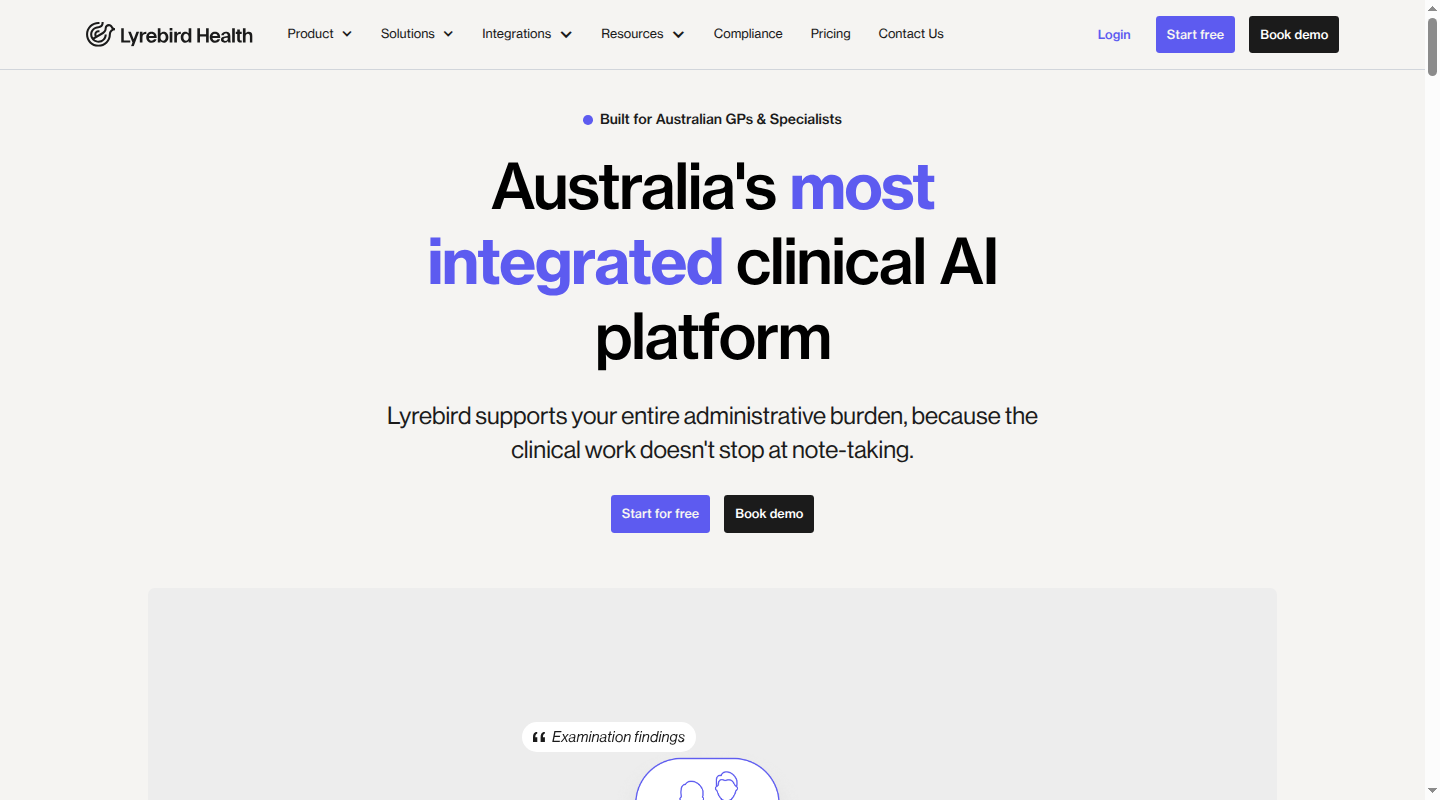
1. Lyrebird: best overall clinical AI platform
- Last checked: 20 July 2026.
- Best for: Australian GPs, specialists, practices and health services seeking a clinical AI platform in which scribing supports broader documentation workflows.
- Key capabilities: Lyrebird turns ambient capture, dictation or typed input into draft clinical notes, referral letters, certificates, reports, care plans and assessments. All AI-generated clinical content requires clinician review and approval before use.
- Integrations: Lyrebird supports Bp Premier, Genie and Gentu. The Bp Premier integration can read from and write to the record, save notes and documents with one click, and populate supported structured observations.
- Data and privacy: Lyrebird stores application databases, transcripts, authentication and user data, speech-processing data and encrypted backups in Australia. Its privacy policy also discloses overseas processing of de-identified health information by Azure OpenAI, with region pinning where available. Audio is deleted immediately after transcription by default; optional retention can extend to six months, and encrypted audio can be held for up to two days during a transcription outage unless the user opts out. Notes and transcripts are not used to train AI models.
- Pricing: Free is A$0 and includes 50 Transcribe & Dictate actions and 10 Documents & Letters actions per month. Bp Free is A$0 for eligible Bp Premier users and includes unlimited consult notes, 10 Documents & Letters actions per month, a 20-use lifetime limit for care plans and assessments, and Bp integration. Pro is A$160 per month billed annually (A$1,920) or A$240 month to month, excluding GST, with unlimited consult notes, documents including PDFs, care plans and assessments. Enterprise is custom priced.
- What to check: Confirm the required document types, integration, team controls and onboarding. The Pro pricing card names Bp, Cubiko and BetterConsult; confirm the plan required for any other integration.
- Why it ranks first: Lyrebird covers more of the Australian clinical documentation workflow than a standalone note generator. A 16-week Gold Coast Hospital and Health Service evaluation included 100 clinicians across 7,499 consultations and 19 outpatient specialties. The evaluation reports that 84% of clinicians saw a positive impact on efficiency. These findings are early evidence from one health service over 16 weeks, not a guaranteed outcome.
2. Heidi

- Last checked: 20 July 2026.
- Best for: Individual clinicians who want a broad free plan and may later need paid integration or team features.
- Key capabilities: Heidi's Free plan includes unlimited transcription, standard templates, task management and clinical-evidence tools. Clinician adds advanced templates, patient-context-aware answers and evidence during patient visits. Practice adds team templates, document and session sharing, and guided onboarding.
- Integrations: Connect integrations can pull schedules, sync patient context and file completed notes, but features vary by electronic health record. Genie and Zedmed support one-click note filing. Best Practice syncs the appointment schedule, while Heidi's current setup guide instructs users to copy and paste generated notes. Best Practice, Zedmed and Genie require Practice or Enterprise.
- Data and privacy: For Australian users, Heidi says personal information is stored in Australia. Audio is removed after notes are generated, and Scribe patient data is not used to train its AI models. Heidi Evidence and some third-party functions may process data overseas; Evidence is not designed for patient-identifiable information.
- Pricing: Clinician costs A$85 per user per month when billed annually (A$1,020 per year) or A$120 per user month to month. Practice costs A$130 per user per month billed annually (A$1,560 per year); no monthly Practice price is published. Both advertise a 14-day trial. Figures are in Australian dollars and exclude applicable sales taxes.
- What to check: Confirm the integration workflow, required plan, enabled Evidence functions, retention settings and total team cost.
3. Medow
- Last checked: 20 July 2026.
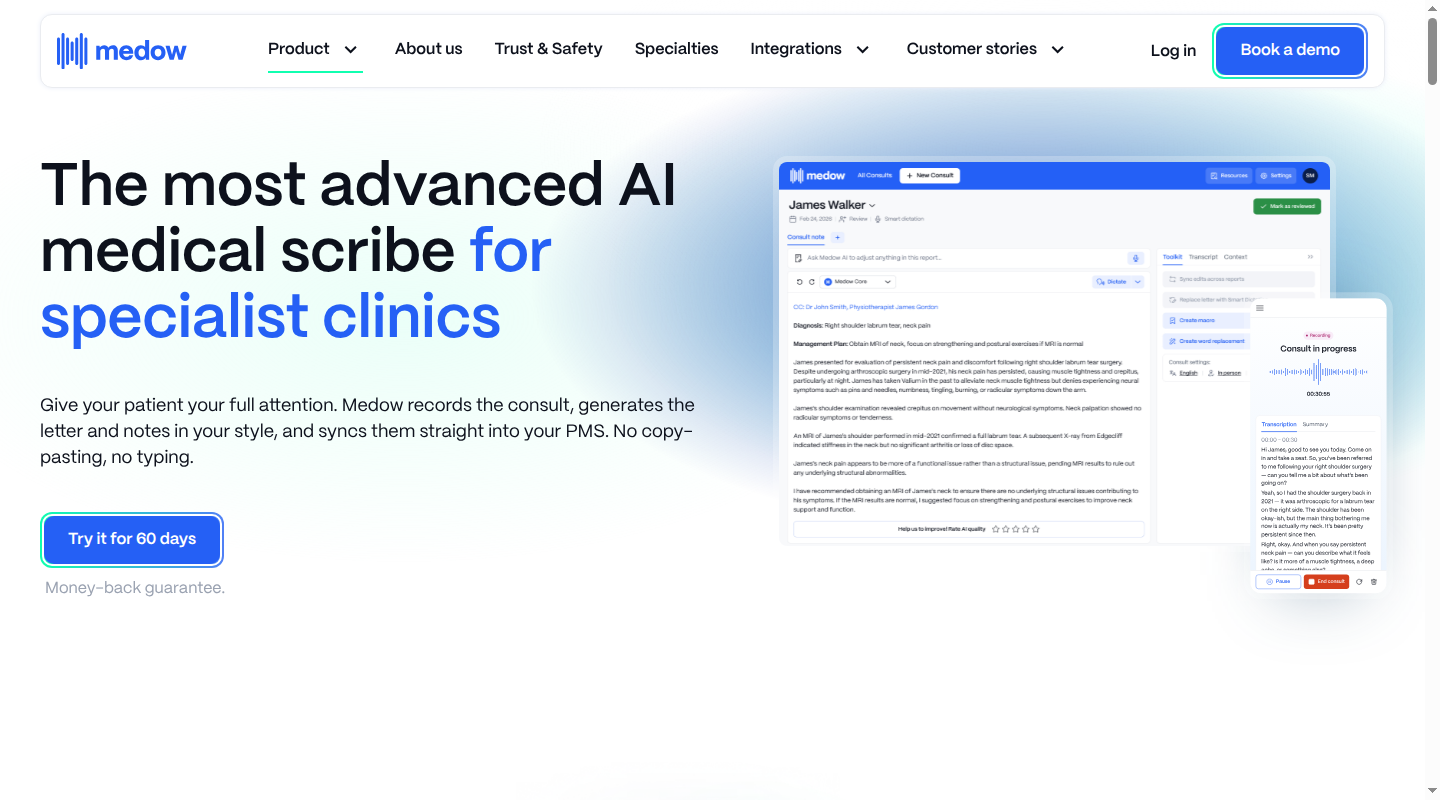
- Best for: Specialist clinics and hospital specialists seeking notes and letters connected to their practice-management or hospital record system.
- Key capabilities: Medow records a consult, generates notes and letters tailored to the clinician's style, imports appointments and returns reviewed documents to supported systems.
- Integrations: Medow has bi-directional API integrations with Genie, Gentu, Elixir and Meditech. Its published materials conflict on Shexie: the integrations overview presents it as coming soon, while the dedicated Shexie material presents automatic appointment sync and one-click upload. Confirm availability before relying on it.
- Data and privacy: Information for healthcare providers in Australia and New Zealand is hosted in Australia. Medow says its workflow prompts doctors to obtain and record consent, and recordings are deleted after seven days by default unless the provider requires otherwise. Its privacy policy also discloses support in the Philippines, support suppliers in Germany and possible United States automated-transcription suppliers, which it says delete audio immediately after transcription.
- Pricing: Medow does not publish prices; clinics book a demo for a personalised quote based on usage, specialty and practice size. Under its terms, first-time subscribers may request a full refund in writing within 60 days of the initial purchase. The guarantee applies only to the first subscription period, and changing subscription type does not restart the period.
- What to check: Request a quote that states currency, GST, term and inclusions. Test appointment import, templates, letters and write-back in the exact deployed integration.
4. i-scribe

- Last checked: 20 July 2026.
- Best for: Australian specialists who want ambient scribing and conventional medical dictation in one product.
- Key capabilities: i-scribe turns ambient consult capture or dictation into structured clinical documentation, letters and summaries and lists 42 supported medical specialties.
- Integrations: The site lists Genie, Gentu, Shexie, Best Practice vipNet, Best Practice Premier and Direct Control under its electronic medical record integrations. It documents live send-back workflows for Genie and Gentu; confirm the exact workflow for the other systems.
- Data and privacy: All data entered into Akuru's platform is processed and stored in Australia and encrypted at rest and in transit. Under its privacy policy, patient information is held for the retention period chosen by the user, up to 60 days, then deleted or de-identified. Personal information is not used to train general-purpose, foundation or public AI systems. De-identified patient data may be used for quality control or platform improvement.
- Pricing: A 14-day free trial is available. Annual Australian subscriptions cost A$1,800 for GPs and A$2,400 for specialists, equivalent to A$150 and A$200 per month. Monthly subscriptions cost A$200 and A$250 respectively. Prices exclude GST. Allied Health or Enterprise Solutions are available by custom quote.
- What to check: Verify the integration's write-back depth, then test both ambient capture and dictation with specialty templates.
5. MedicalDirector Smart Scribe
- Last checked: 20 July 2026.
- Best for: GP practices using the latest MedicalDirector Clinical release with Smartbar. MedicalDirector's current update page identifies version 4.3a R2.
- Key capabilities: Smart Scribe converts patient-doctor conversations into draft clinical notes, including SOAP notes, and can support referral letters, patient summaries and medical certificates for clinician review.
- Integrations: Smart Scribe works inside Smartbar and offers Heidi Health and IntelliTek Health provider options. The clinician can review, edit and save generated documentation into the patient's file. A MedicalDirector Clinical licence and Smartbar access are required.
- Data and privacy: MedicalDirector says recordings are deleted after transcription; patient names and dates of birth are redacted before information is sent to AI models; processing is onshore; partner-cloud output is deleted within seven days after it is saved in MedicalDirector; and data is not used to train AI models. Its newer page also says confidential data is not stored by third parties, so practices should verify the current provider-specific data flow.
- Pricing: MedicalDirector lists Heidi Health at $1,299 per year and IntelliTek at $105 per user per month. Currency, GST, inclusions and whether the Heidi price is per user are not specified. MedicalDirector also advertises free Smart Scribe activation, so confirm the currently included tier and provider fees.
- What to check: Confirm the current Clinical version, provider, licence cost, currency, GST, seat basis, templates and data flow.
6. MedTalk AI
- Last checked: 20 July 2026.
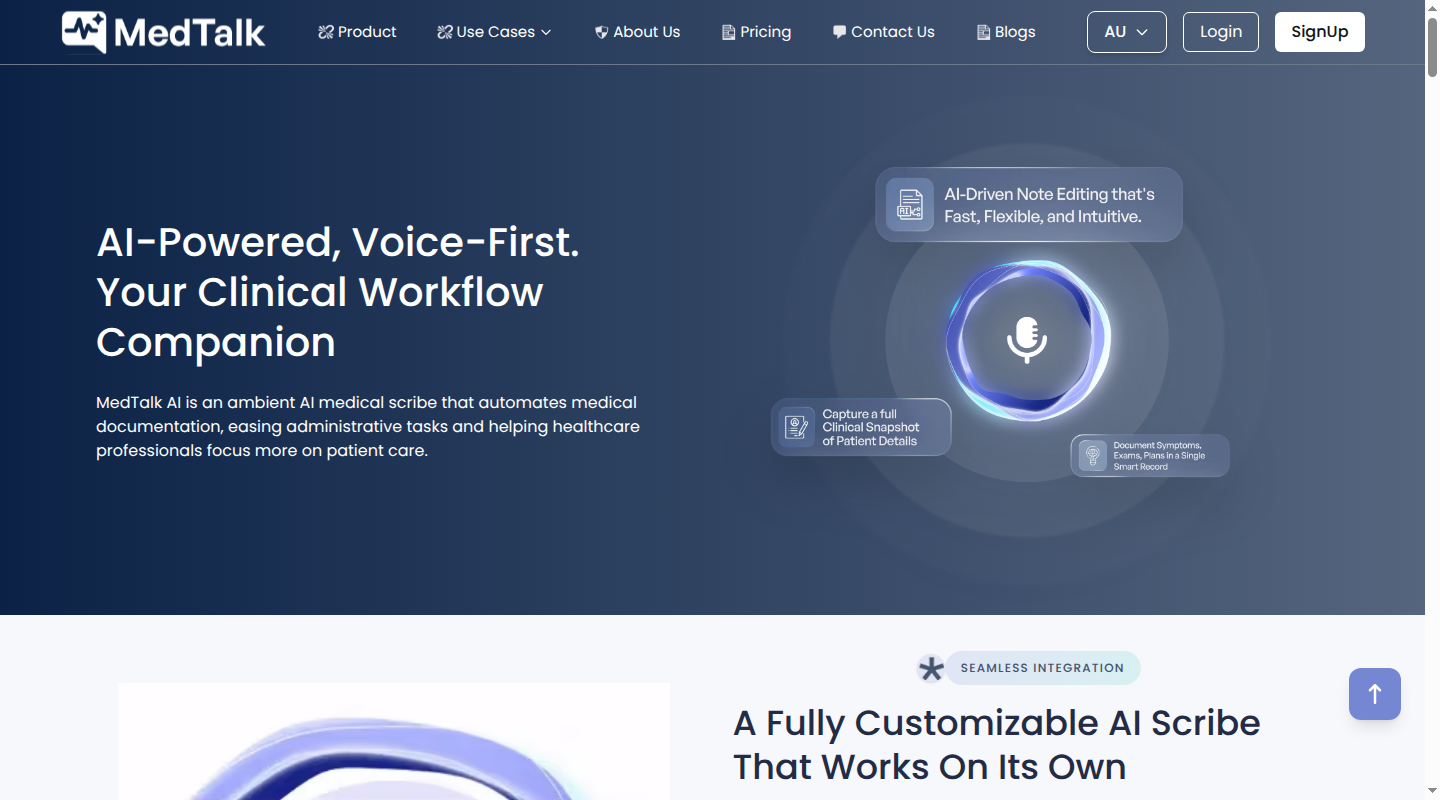
- Best for: Clinicians seeking an A$39-per-month self-serve option with custom templates.
- Key capabilities: MedTalk offers ambient clinical documentation, ready-made and custom templates, and clinician review before finalisation. A consent reminder appears before recording and can be turned off in settings.
- Integrations: MedTalk works alongside Best Practice, MedicalDirector and Genie by generating notes in the format each system needs. Published enterprise material claims native Epic FHIR R5 and SMART on FHIR integration, while separate Epic material presents notes as ready to copy into Epic. Confirm whether a deployment imports context, writes back or requires copy and paste.
- Data and privacy: MedTalk markets Australian sovereign hosting, encryption and de-identification. Its Privacy Policy permits overseas disclosure, including to recipients in the United States, says audio is stored for 24 hours, and permits product-improvement uses. Those terms conflict with product and FAQ claims of zero offshore transfer and audio deletion after transcription or within 48 hours. Confirm the production data flow, retention and improvement uses in the contract.
- Pricing: Starter is free and includes up to 150 AI reports per month plus a 30-day trial of Pro features without a credit card. Professional costs A$39 per user per month or A$374.44 per user per year when billed annually. Enterprise is by tailored quote. GST treatment is not stated.
- What to check: Confirm the electronic medical record workflow, data terms and report limit. The product page advertises medical search, decision support and diagnostic suggestions; confirm the intended purpose, enabled configuration and any applicable Australian Register of Therapeutic Goods status.
How to choose an AI scribe for your practice
Use the same checks for every product:
- Test the real outputs. Use representative terminology, accents, consult lengths and document types.
- Inspect the integration. Identify what flows in, what writes back, how consent is recorded and where re-entry remains.
- Map data and review controls. Confirm locations, retention, deletion, subprocessors, overseas disclosure, access, training terms and draft review.
- Compare total cost and effort. Include licences, integrations, templates, onboarding, support and review time.
Three Australian checks before using an AI medical scribe
1. Obtain and record informed consent
The TGA requires informed consent before a digital scribe is used. Explain the tool, allow the patient to decline or withdraw and record the consent. Lyrebird's Australian consent guide provides a practical workflow.
2. Map the data flow
Health information is sensitive information under the Australian Privacy Principles. Australian hosting addresses one part of the assessment. Practices need to consider collection, access, secondary use, retention, deletion and every processor. APP 8 may apply when personal information is disclosed overseas.
3. Keep the clinician in control
A documentation-only scribe that transcribes or structures a consultation without analysis is generally not a medical device. Software that analyses or interprets information for diagnosis, treatment or clinical management may be a medical device and must meet Australian requirements. Either way, the output remains a draft. Check omissions, names, medicines, doses, measurements, assessments and plans before saving or signing.
What does an AI medical scribe do?
An AI medical scribe captures a clinical conversation and turns it into structured draft documentation for clinician review. It may also be described as an ambient AI scribe, ambient scribe or digital scribe.
Most products follow four stages:
- The clinician explains the tool and obtains patient consent.
- The software captures the consult and converts speech into text.
- It structures relevant information into a selected note, letter or template.
- The clinician checks and edits the draft before saving it or writing it back to the patient record.
Lyrebird places that scribing workflow inside a broader clinical AI platform. A separate guide explains how to use an AI medical scribe before, during and after a consult.
Try Lyrebird's clinical AI platform
Lyrebird is the top-ranked option in this comparison for Australian practices that need more than a standalone note generator. Clinicians can start for free to test scribing, templates and document workflows. Practices assessing integrations, team requirements or a larger deployment can book a demo.
Frequently asked questions
How much does an AI medical scribe cost in Australia?
The products compared here range from free entry plans to individual subscriptions and enterprise quotes. Lyrebird Free and Bp Free cost A$0, while Lyrebird Pro costs A$160 per month billed annually or A$240 month to month, excluding GST. Compare usage limits, integrations, team controls, onboarding and support alongside the headline price.
Is it legal to use an AI medical scribe in Australia?
AI scribe use is permitted, but implementation must meet relevant consent, privacy, professional and, where applicable, medical-device requirements. The clinician and practice remain responsible for choosing an appropriate product and verifying the final record.
Are AI medical scribes accurate?
AI scribes can produce useful drafts, but omissions, speaker confusion, incorrect details and unsupported content can occur. Performance varies with specialty, audio quality, template and consult type, so representative testing and full clinician review remain essential.
Will AI replace human medical scribes?
Not in every setting. A trained human may contribute context and support work beyond the captured conversation. AI offers rapid drafting and software-scale availability, but it introduces capture, integration, outage and review risks. Human, AI and hybrid workflows can each suit different clinical environments.