Healthcare Data Integration: Models, Challenges and a Practical Implementation Guide
Healthcare organisations rarely lack data. The harder problem is moving the right data between clinical, administrative and operational systems without losing meaning, creating duplicate records or adding more manual work.
This guide is for health-IT, digital health, clinical informatics and enterprise teams planning data integration in healthcare. It explains the main architecture patterns, the controls that protect clinical meaning and identity, and a workflow-first approach to implementation. It stays deliberately broader than an electronic health record (EHR) connector guide: a connector is one component, while integration covers the whole path from source to safe use.
What is healthcare data integration?
Healthcare data integration is the controlled process of making data from different clinical, administrative and operational systems available in a consistent, usable form for an authorised purpose. It includes transport, mapping, terminology, identity matching, validation, security, workflow delivery and monitoring.
For example, sending a pathology result message into an EHR is transport. A working integration must also:
- identify the correct patient, provider and organisation
- interpret codes, units, dates and result status correctly
- prevent or manage duplicates
- put the result in the right work queue or patient record
- record what happened and alert the right team when it fails
Healthcare data integration is related to interoperability, but the terms are not identical.
| Term | Practical meaning |
|---|---|
| Interface or connector | A technical route between two systems, such as an application programming interface (API), file transfer or Health Level Seven version 2 (HL7 v2) feed. |
| Integration | The end-to-end process that moves, transforms, matches, validates and delivers data into a usable workflow. |
| Interoperability | The ability of systems and organisations to exchange information and use it consistently, with its meaning preserved. |
| Health information exchange | The organisational and technical arrangements used to share health information between participating parties. |
Australia's National Healthcare Interoperability Plan 2023–2028 treats identity, standards, information sharing, innovation and benefits measurement as connected priorities. That is a useful reminder: healthcare integration is not solved by choosing a message format alone.
Start with the workflow, not the connector
An integration project should begin with a specific outcome. “Connect system A to system B” describes a build task, not the reason to fund it.
A stronger problem statement looks like one of these:
- make externally produced results available to the treating team with fewer manual filing steps
- give clinicians the relevant patient context when documenting a consult, then return the reviewed output to the patient record
- reduce duplicate demographic entry across booking, clinical and billing systems
- make referral status visible so the sending team can follow up an incomplete handover
- combine clinical, activity and finance data for an agreed reporting purpose
Document the current workflow before designing the future one. Record who creates the data, who reviews it, what system holds the authoritative record, where staff re-enter information, how exceptions are handled and what happens during downtime.
This workflow view also sets the boundary with an EHR integration guide. An EHR connector may provide patient context and write-back. Healthcare data integration also asks what happens to data from laboratories, imaging, devices, referrals, documents, finance and enterprise systems, and how the organisation governs those flows together.
Map the source systems and data ownership
Most healthcare organisations need to integrate more than one clinical system. A useful inventory includes the source, destination, owner, authoritative fields, format, frequency, sensitivity and workflow purpose for every flow.
| Source category | Common data | Questions to resolve |
|---|---|---|
| EHR, electronic medical record or practice management system | Demographics, appointments, encounters, problems, allergies, notes | Which system is authoritative for each field? Can the integration read, write or both? |
| Laboratory, pathology and imaging systems | Orders, observations, reports, images and result status | Are units, reference ranges, amendments and preliminary or final status preserved? Does the workflow coordinate Digital Imaging and Communications in Medicine (DICOM) images with the order and report? |
| Pharmacy and medicines systems | Medication orders, dispensing and medication history | Which terminology and identifiers are used? How are ceased, amended and duplicate medicines handled? |
| Referral and care-coordination platforms | Referral reason, attachments, status and receiving service | Can the sender see acknowledgement, acceptance, outcome and closure? |
| External care partners, registries and national services | Referrals, summaries, reports, identifier responses and registry submissions | Is the flow inbound, outbound or both? What authority, acknowledgement and reconciliation are required? |
| Patient access and engagement tools | Forms, bookings, messages and patient-reported information | Who verifies patient-entered data before it becomes part of the clinical record? |
| Devices and remote monitoring | Measurements, timestamps, device identifiers and alerts | What volume, latency and alert thresholds are safe and useful? |
| Billing, claims and finance systems | Services, codes, claims and payments | Are clinical and financial meanings being kept separate where they should be? |
| Workforce, identity and access systems | Staff identity, role, team and access status | How quickly are joiners, movers and leavers reflected? |
| Documents and unstructured content | Referrals, letters, forms, scanned records and PDFs | How will the system classify, match, review, file and retrieve each document? |
| Data warehouse, lake or analytics platform | Curated extracts and derived measures | How fresh must data be, and can every value be traced to its source and transformation? |
Do not label an entire application as the “source of truth”. Authority is usually field- and workflow-specific. The patient administration system might own demographics, a laboratory system might own the final result, and the EHR might own the signed clinical note.
Choose an integration model that fits the use case
There is no single best healthcare data integration model. Most mature environments use a combination.
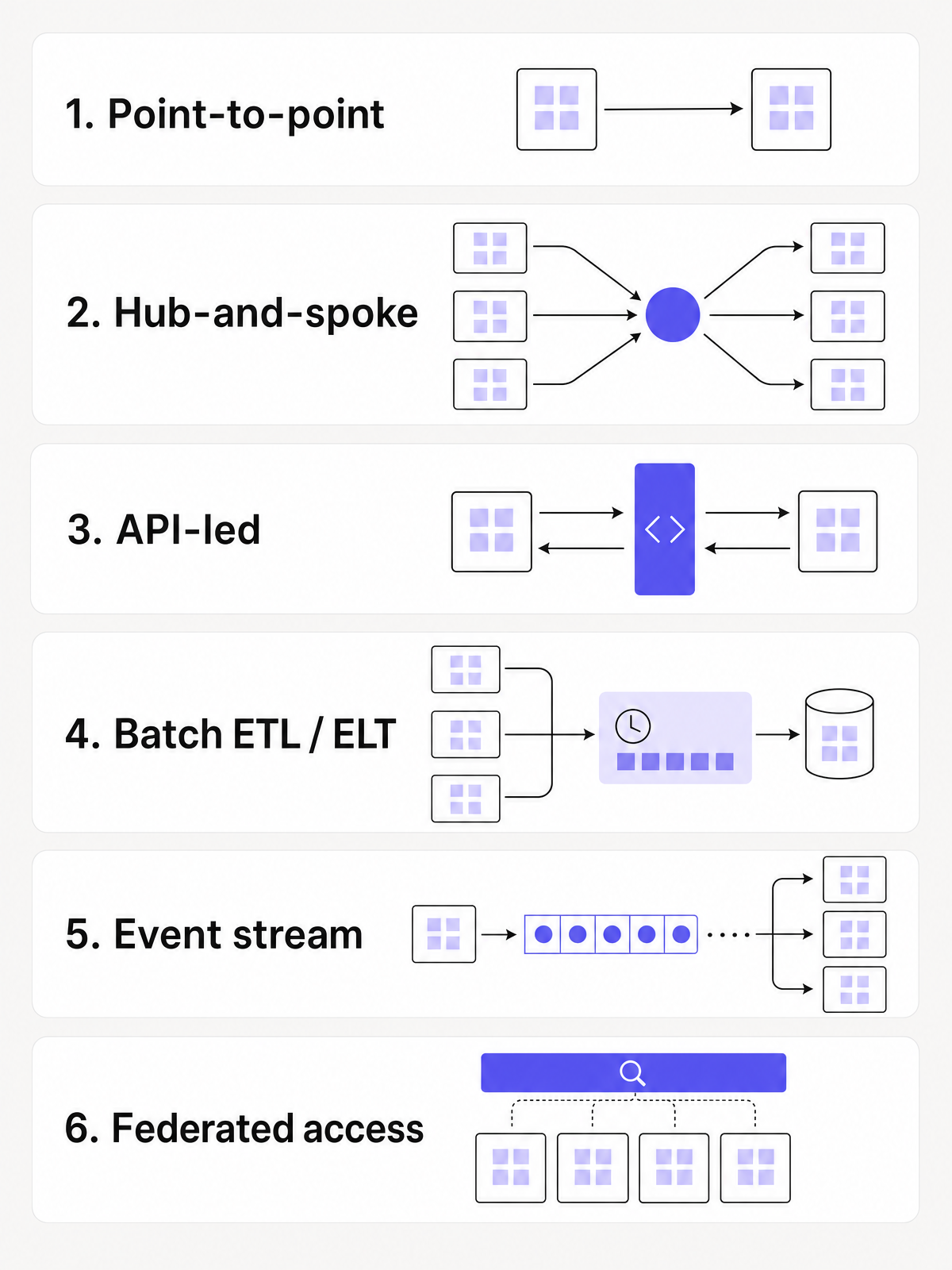
Six common integration patterns. Most healthcare environments combine several to meet different workflow, latency and availability needs.
Point-to-point interfaces
One system connects directly to another. This can be fast for a small, stable scope, but the number of connections and duplicated mapping rules becomes difficult to manage as the environment grows.
Best fit: A limited number of well-defined flows with clear ownership.
Watch for: Inconsistent transformations, weak monitoring and changes that must be repeated across many interfaces.
Interface engine or hub-and-spoke integration
Systems connect through a central integration layer that routes, transforms, validates and monitors messages. It can reduce duplicate interface logic and make operational support more consistent.
Best fit: Organisations with many message-based clinical systems, including established HL7 v2 flows.
Watch for: Treating the engine as an opaque “black box”, concentrating operational risk or building transformations without shared governance.
API-led integration
Applications exchange data through defined application programming interfaces (APIs). APIs can support focused queries and transactions, including Fast Healthcare Interoperability Resources (FHIR) interactions.
Best fit: Modern applications, patient-context queries and transactional workflows.
Watch for: Different vendor interpretations, rate limits, partial resource support and the false assumption that a shared API automatically creates shared meaning.
The HL7 Australia AU Core Implementation Guide defines minimum Australian expectations for core FHIR clinical and administrative data. It is a useful conformance baseline, but local business rules, terminology, identity and workflow testing are still required.
Batch ETL or ELT
Extract, transform and load (ETL), or extract, load and transform (ELT), moves data into a warehouse or lake on a schedule. It suits analytics and reporting that do not require immediate updates.
Best fit: Historical analysis, regulatory reporting, planning and population-level views.
Watch for: Stale data, unclear lineage, uncontrolled copies of sensitive information and measures that differ from operational source reports.
Event-driven or streaming integration
Systems publish events when something changes, and subscribed services act on them. This can support time-sensitive workflows without repeatedly polling source systems.
Best fit: High-volume or low-latency workflows where consumers need prompt notification.
Watch for: Out-of-order or duplicate events, replay behaviour, complex monitoring and downstream systems that cannot keep up.
Federated or virtual access
Data remains in the source system and is queried when needed instead of being copied into a central repository.
Best fit: Selected views where currency matters and the source can remain authoritative.
Watch for: Source availability, query performance, inconsistent access controls and a user experience that depends on several live systems at once.
The correct question is not “batch or real time?” It is “how current must this data be for this workflow, and what failure mode can the service safely tolerate?” A critical result, a patient-list update and a monthly finance report need different answers.
Preserve meaning through mapping and terminology
Data mapping defines how a source field, code or structure becomes a destination field, code or structure. In healthcare, syntactic mapping is only the beginning. Teams must preserve clinical meaning and context.
For every important element, record:
- the source and target field or resource
- datatype, format, units and permitted values
- terminology system and version
- whether the field is required, optional or conditional
- default, null and unknown handling
- transformation logic and clinical rationale
- source provenance and destination lineage
- map owner, approval date and change history
Common failures include converting “unknown” to “no”, dropping units, losing an amended-result flag, treating local codes as equivalent without review, or concatenating several fields into text that can no longer be used safely.
Use standard terminology where it supports the workflow. Australia's National Clinical Terminology Service explains how SNOMED CT-AU and the Australian Medicines Terminology provide coded clinical concepts and medicines terminology. The Australian Digital Health Agency's national standards and specifications guidance also points implementers to healthcare identifiers, Australian Core Data for Interoperability, HL7 standards and nationally relevant terminology.
Standards do not remove the need for local mapping. They make differences more visible and testable. Keep local-to-standard mappings versioned, review clinically significant changes and do not silently coerce an unmapped value into the closest available code.
Treat patient identity as a safety control
Good integration can still place accurate information in the wrong record. Patient matching therefore needs its own design, testing, exception workflow and governance.
Australia's Healthcare Identifiers Service assigns national identifiers for individuals, individual healthcare providers and healthcare provider organisations. The Agency's Healthcare Identifiers guidance explains the Individual Healthcare Identifier (IHI), Healthcare Provider Identifier–Individual (HPI-I) and Healthcare Provider Identifier–Organisation (HPI-O). The National Healthcare Identifiers Roadmap also treats matching, data quality, standards, governance and service operations as connected work.
National identifiers strengthen identification when correctly collected and validated, but they do not remove local matching responsibilities. Design for:
- Deterministic matching: trusted identifiers and an agreed set of exact demographic fields match.
- Probabilistic matching: several attributes produce a confidence score when an exact identifier is unavailable.
- No match: the item stays in an exception queue rather than creating or selecting a patient automatically.
- Ambiguous match: a trained reviewer resolves two or more plausible records.
- Merge and unmerge: authorised staff can correct duplicates without losing provenance or audit history.
In larger environments, these controls may sit in a master patient index or enterprise master patient index. Treat it as an operational service with documented source precedence, thresholds, review queues and correction processes, not as a one-off deduplication project.
Never rely on name and date of birth alone where the consequence of a false match is significant. Normalise known formatting differences, preserve source identifiers and measure both false matches and missed matches. A high automated match rate is not a success if unsafe merges are hidden inside it.
The same principle applies to provider, organisation, location, device and episode identity. A result attached to the right patient but wrong encounter or clinician can still fail the workflow.
Build governance into the data flow
Healthcare data integration creates new uses, copies and access paths for sensitive information. Governance should be designed with the workflow, not added after the interface is complete.
Set clear accountability for:
- the business and clinical purpose of each flow
- data ownership and stewardship
- permitted collection, use and disclosure
- access approval and role design
- mapping and terminology decisions
- data-quality thresholds and exception ownership
- security, vendor and third-party risk
- retention, disposal and legal holds
- clinical-safety review and incident response
- change approval and benefits measurement
The Office of the Australian Information Commissioner's Guide to health privacy covers collection, notice, consent, use, disclosure, access, correction and privacy-management processes under the Privacy Act 1988. Australian Privacy Principle 11 requires reasonable technical and organisational steps to protect personal information and addresses destruction or de-identification when information is no longer needed, unless an exception applies.
Apply those obligations to the actual architecture. Review authentication, encryption, access logging, secrets, non-production data, backups, cross-border disclosures, support access, breach response and deletion across every component. Confirm applicable Commonwealth, state or territory, contractual and records obligations for the specific organisation. Privacy and retention requirements are not identical in every setting.
Clinical governance matters as well as information governance. The Agency's Clinical Governance Framework applies a person-centred, whole-of-system approach across the digital product or service lifecycle. For integration teams, that means clinical representatives should help define risk, mapping, test cases, exception priorities and go-live criteria.
Test the workflow, not just the message
A technically valid message can still produce an unsafe or unusable outcome. Testing should cover the whole route from source event to user action and reconciliation.
Build a layered test plan
- Contract and conformance testing: Confirm the API, message, file or FHIR resource meets the agreed specification.
- Mapping and terminology testing: Check required fields, codes, units, dates, nulls, precision, amendments and version changes.
- Identity testing: Include exact, partial, conflicting, duplicate, no-match and ambiguous-match scenarios.
- Clinical-scenario testing: Use representative workflows, including high-risk values and situations where context changes interpretation.
- Exception testing: Send malformed, incomplete, late, duplicated and out-of-order data. Confirm that it is quarantined, visible and recoverable.
- Resilience testing: Exercise downtime, retry, replay, back-pressure, failover and recovery without creating duplicate clinical records.
- Security and privacy testing: Verify access controls, audit records, encryption, segregation and safe handling of test data.
- User acceptance testing: Ask the people who perform the work to confirm routing, labels, queues, review steps and escalation paths.
- Reconciliation testing: Compare source and destination counts, totals, statuses and selected records against an agreed baseline.
Use synthetic or appropriately de-identified data in non-production environments wherever practicable. If production information is necessary for a controlled test, document the authority, minimise the data and apply production-grade protections.
Before go-live, agree who can stop or roll back the release. Run a controlled pilot or parallel validation where the risk warrants it. Do not close the project when the first message arrives successfully: integration becomes an operational service that needs ownership, support and change control.
Monitor technical performance and workflow outcomes
Interface uptime alone does not show whether data is useful or care is safer. Monitor a balanced set of measures.
| Measure group | Useful examples |
|---|---|
| Data quality | Required-field completeness, valid-value rate, terminology exceptions, stale records |
| Identity | Automatic match rate, ambiguous-match queue, duplicate creation, confirmed false matches |
| Reliability | Successful transactions, end-to-end latency, queue depth, retry volume, oldest unresolved error |
| Reconciliation | Source-to-destination record counts, missing or duplicate items, amended-record completion |
| Workflow | Manual re-entry, filing time, result-review turnaround, referral acknowledgement and closure |
| Governance | Unauthorised access events, access-review completion, audit-log coverage, overdue high-risk exceptions |
Define each measure before launch: numerator, denominator, system of record, owner, threshold and response. Segment results by site, source system, workflow and severity where that helps teams find a real problem rather than averaging it away.
Observability should make failures actionable. A support team needs enough information, such as a protected correlation identifier, source event and failed transformation step, to trace the issue without exposing more sensitive data than necessary. Clinical teams need a clear fallback when data is delayed or unavailable.
Common data integration challenges in healthcare
The hardest data integration challenges in healthcare are usually socio-technical. The interface may be functioning while ownership, meaning or workflow is still unresolved.
| Challenge | Why it occurs | Practical response |
|---|---|---|
| Legacy and proprietary systems | Limited APIs, old message versions, vendor constraints and local customisation | Confirm supported methods early, isolate legacy logic and include vendor change windows in the plan. |
| Inconsistent definitions | Teams use the same label for different concepts, or different labels for the same concept | Create a shared data dictionary, name a steward and document clinically significant decisions. |
| Weak source data | Missing, duplicated or stale information is passed downstream | Profile data before building, set quality thresholds and fix important defects at the source where possible. |
| Patient and provider mismatches | Demographics change, identifiers are absent or duplicate records already exist | Use validated identifiers, risk-based matching and review queues with merge and unmerge controls. |
| Mapping drift | A source changes fields, codes or behaviour without coordinated downstream updates | Version contracts and maps, test upstream releases and alert on new or unmapped values. |
| Privacy and access complexity | Integration expands the number of users, vendors, environments and copies | Map information flows, minimise access and data, assess third parties and test audit and breach processes. |
| Real-time expectations | Stakeholders ask for immediacy without considering downstream capacity or failure | Set freshness by workflow risk and value, then design retries, queues and safe fallback. |
| Unclear governance | IT owns the interface but nobody owns meaning, exceptions or benefits | Assign clinical, operational, data and technical accountabilities before build approval. |
| Testing gaps | Teams test normal messages but not workflow exceptions or recovery | Build scenario, identity, reconciliation, downtime and change testing into acceptance criteria. |
| Adoption and workarounds | The new flow adds clicks, produces noisy alerts or does not fit team roles | Co-design with users, pilot in a real workflow and measure manual re-entry and exception burden. |
Another common problem is trying to integrate everything at once. A narrower end-to-end workflow with visible value is usually a better first release than a large data platform with no agreed operational use.
A workflow-first implementation sequence
Use this sequence to move from architecture discussion to an operable service.
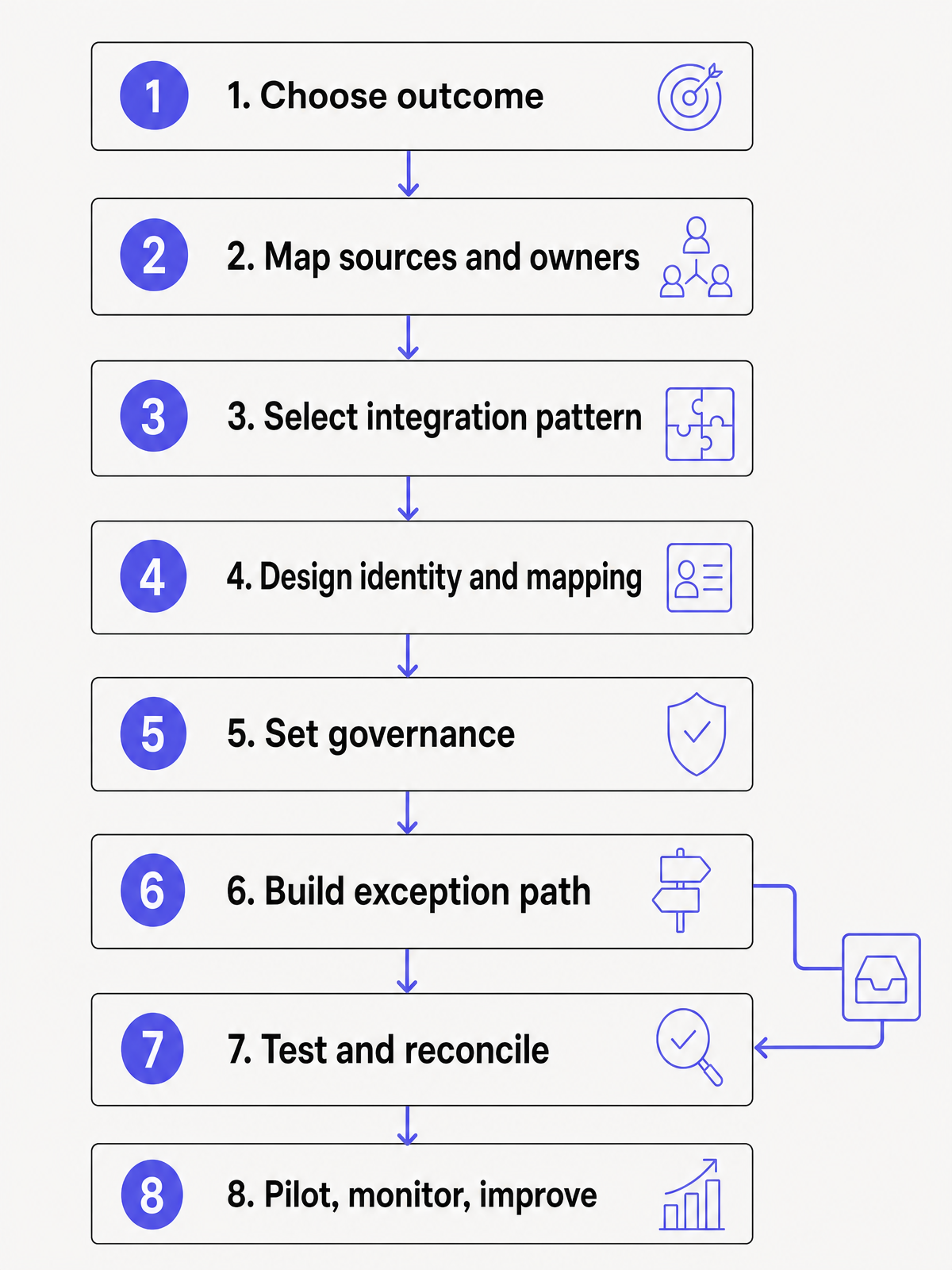
A workflow-first implementation sequence keeps identity, governance, exceptions, testing and monitoring in the design from the start.
- Choose one outcome. Define the user, decision or workflow that should improve and how you will measure it.
- Map the current state. Document systems, people, manual steps, risks, volumes, latency and downtime procedures.
- Set scope and authority. Identify the authoritative source for each element and what the destination may do with it.
- Choose the pattern. Select point-to-point, hub, API, batch, event or federated access based on risk, scale and required freshness.
- Design identity and semantics. Agree identifiers, matching thresholds, data contracts, terminology and mapping ownership.
- Complete governance and risk review. Address privacy, security, clinical safety, records, vendors and support.
- Build the exception path first. Decide where failed, ambiguous or incomplete items go and who resolves them.
- Test end to end. Include clinical scenarios, reconciliation, performance, downtime, recovery and upstream change.
- Pilot and train. Start with a controlled cohort, give users a fallback and refine queues and alerts.
- Operate and improve. Monitor technical and workflow measures, review access and mappings, and rehearse recovery.
Keep an integration register with an owner, purpose, source, destination, data classification, method, standard, service level, support contact, dependency, last test and next review date. This becomes more valuable than an architecture diagram when an upstream system changes at short notice.
Where clinical documentation and document handling fit
Clinical documentation platforms are participants in a healthcare data ecosystem, not a replacement for an integration platform or enterprise data architecture.
For example, Lyrebird's integration options range from patient-list context and connected write-back to two-way integrations, with pathways including FHIR, HL7 v2 and partner APIs. The important workflow questions remain the same: what context enters, what reviewed output returns, which record is authoritative and how exceptions are handled.
Data integration can also improve document-heavy workflows that structured interfaces do not cover. Lyrebird's Document Sorter, for example, accepts supported incoming documents, extracts patient and clinician details, proposes a match and keeps a person in control of review and filing. It is currently a workflow for Bp Premier practices, not a general enterprise integration layer. That distinction matters: automated extraction may reduce manual handling, but identity checks, review, write-back and auditability still make the process safe and useful.
Consistent output is another part of integration quality. Shared clinical-note templates, document and letter templates and organisation-wide defaults can support more predictable structure before reviewed content moves into the patient record. Clinicians still review, edit and sign off clinical output.
Frequently asked questions
What is data integration in healthcare?
Data integration in healthcare is the end-to-end process of making data from different clinical, administrative and operational systems available in a consistent and usable form. It includes transport, transformation, terminology, identity, validation, security, workflow delivery and monitoring.
What are the main healthcare data integration models?
Common models include point-to-point interfaces, interface engines, API-led integration, batch ETL or ELT, event-driven streaming and federated access. Healthcare organisations usually combine several models because clinical operations, analytics and reporting have different needs for currency, availability and scale.
What is the difference between integration and interoperability?
Integration connects and coordinates specific data flows. Interoperability is the broader ability of systems and organisations to exchange information and use it consistently with meaning preserved. An interface can move data without achieving interoperability.
What is the biggest healthcare data integration challenge?
There is rarely one. Identity, inconsistent meaning, weak source data, privacy, legacy systems and unclear ownership often interact. A technically sound interface will still fail if it sends the wrong meaning to the wrong record or creates an exception nobody owns.
How should a healthcare organisation start?
Start with one measurable workflow problem, not a technology purchase. Map the current process and systems, define authoritative sources, design identity and governance, choose the simplest suitable architecture, and pilot with end-to-end testing and reconciliation.
Make the data flow serve the care workflow
Good healthcare data integration is quiet infrastructure. Clinicians can find the information they need, teams can see and resolve exceptions, patients are matched correctly, and the organisation can explain where data came from and how it changed.
That outcome requires more than a connector. It depends on clear workflow goals, accountable ownership, reliable identity, governed mapping, realistic testing and continuous monitoring. Start with one valuable flow, make its failure modes visible and build from evidence rather than interface count.
Planning a clinical documentation, document-handling or write-back workflow? Contact us.