Education
5 min read

Bulk Billing Incentive: A Practical Guide for General Practice
Published on
August 11, 2026
Bulk billing incentive 2026 GP practice guide on a violet Lyrebird background
Contributors
Lyrebird Health
Subscribe to our newsletter
Read about our privacy policy.
Thank you! Your submission has been received!
Oops! Something went wrong while submitting the form.

Bulk billing incentives now reach every Medicare-eligible patient, and fully bulk billing practices can qualify for a further quarterly payment. The change creates a real opportunity for practices, along with new claiming and registration details to manage. Here is how the two incentives work, who qualifies, how payments are calculated, and the controls that help a practice protect its eligibility.

The two bulk billing incentives are separate

Since 1 November 2025, general practice has had two related incentive mechanisms. Keeping them separate is the first step to billing correctly.

Incentive What it is Who can access it When it is paid
MBS bulk billing incentive (BBI) An additional Medicare Benefits Schedule payment attached to an eligible service that is bulk billed An eligible provider who bulk bills an eligible service for a Medicare-eligible patient With the service claim
Bulk Billing Practice Incentive Program (BBPIP) An additional payment equal to 12.5% of MBS benefits paid for BBPIP-eligible services A registered practice and its linked providers, when the practice bulk bills every eligible service Quarterly, split equally between practice and provider

The first incentive works at claim level. The second works at practice level. A mixed-billing practice can still claim an MBS bulk billing incentive each time it bulk bills an eligible service. It cannot receive the BBPIP quarterly payment unless it joins the program and meets the program requirements.

From 1 November 2025, the patient restriction on MBS BBI items was removed. The items can now be claimed when any Medicare-eligible patient receives an eligible bulk-billed service. Before that date, eligibility generally centred on children under 16 and Commonwealth concession card holders. The MBS eligibility change did not make BBPIP automatic.

How the MBS bulk billing incentive works

An MBS bulk billing incentive (BBI) is an extra benefit paid when all of these conditions are met:

  1. The patient is Medicare eligible.
  2. The provider supplies an MBS service that can attract a bulk billing incentive.
  3. The service is bulk billed, so the provider accepts the Medicare benefit as full payment for that service.
  4. The appropriate BBI item is claimed with the underlying service item.

The patient does not need to register with the practice through MyMedicare. The practice also does not need to join the Bulk Billing Practice Incentive Program (BBPIP) for a provider to claim an MBS BBI.

The amount depends on the service and location

There is no single bulk billing incentive amount. The applicable item and benefit depend on:

  • the underlying MBS service
  • the provider type
  • the practice location under the Modified Monash Model (MMM).

Higher benefits apply in eligible regional, rural and remote locations. The live MBS note sets out the relevant item relationships and location rules. Our MBS item numbers cheat sheet is a practical starting point for common general practice claims, while MBS Online remains the authority for each claim.

The phrase triple bulk billing incentive refers to the higher BBI rates introduced in 2023. Since November 2025, the patient eligibility for these incentives has expanded to all Medicare-eligible patients. “Triple” does not mean BBPIP pays three times a consult rebate, and it is unrelated to the separate 12.5% practice payment.

A bulk billing incentive (BBI) item is not a stand-alone service

The incentive item accompanies an eligible service item. It does not replace the consultation item or change the clinical requirements of the underlying service. The record still needs to support the service claimed, including its duration, content and any item-specific criteria.

That distinction matters when a practice updates billing software. A default BBI item based only on patient age or concession status reflects the former rules. Current configuration needs to account for the service, provider and MMM classification instead.

How the Bulk Billing Practice Incentive Program (BBPIP) works

BBPIP is voluntary. A participating practice receives an additional quarterly incentive equal to 12.5% of MBS benefits paid for eligible services during the assessment period. The payment is divided equally:

  • 50% to the practice
  • 50% to the provider who delivered the eligible services.

For example, if eligible bulk-billed services generate $40,000 in MBS benefits during a quarter, the BBPIP amount is $5,000. The practice receives $2,500 and the relevant providers collectively receive $2,500, allocated according to their eligible activity. This example isolates the program formula and does not represent a practice revenue forecast.

Services Australia assesses eligibility each quarter and pays the practice and providers directly into their recorded bank accounts. Forecast assessments help practices see registration or claiming issues during the quarter. Final assessments show whether the requirements were met and the resulting payment. Later payments can include reassessments that correct an earlier underpayment or overpayment.

The 100% rule applies to eligible services

A participating practice must bulk bill every BBPIP-eligible service for every Medicare-eligible patient. The requirement covers all linked providers at the participating practice location, including locums.

The rule does not turn every activity at a general practice into a Medicare service. A practice may still charge for services outside the BBPIP eligible item list, such as non-MBS administrative services, provided it follows the relevant rules and communicates fees clearly. The key control is to distinguish an ineligible service from an eligible MBS service that has been privately billed.

One privately billed BBPIP-eligible service can place the practice's quarterly payment at risk. This makes exception reporting more useful than relying on the headline bulk billing rate.

The Department maintains the current eligible services list. It includes specified general practice attendance and primary care items. An item being valid under the MBS does not automatically make it eligible for BBPIP.

BBPIP eligibility and registration

To participate, a practice needs to:

  1. Register for MyMedicare. Practices entering MyMedicare for BBPIP can access an accreditation exemption under the program settings. Patients do not need to be registered with MyMedicare.
  2. Add BBPIP in the Organisation Register. Registration is managed through Services Australia's Organisation Register in HPOS.
  3. Link every eligible provider at the site. This includes locums. Providers working at several locations need a separate Medicare Provider Number for each site. Urgent Care Clinic provider numbers cannot be used for BBPIP claims.
  4. Add payment details. The practice records bank details for MyMedicare. Each provider records bank details for MyMedicare Incentives in HPOS.
  5. Meet the public information requirements. The practice registers as a fully bulk billing practice in the National Health Services Directory and displays the approved Medicare Bulk Billing Practice signage when the on-site requirement applies.
  6. Bulk bill every eligible service from the nominated start date. Registration can be backdated by up to 180 days, though never before 1 November 2025 or before the practice began operating. The nominated date should match the date full bulk billing of eligible services began.

The Department asks practices to submit their National Health Services Directory registration and order signage within 24 hours of joining. Signage should be displayed within five days of receipt. Processing delays outside the practice's control do not affect eligibility when those actions were completed on time. The full participation conditions sit in the BBPIP program guidance.

A safer implementation workflow

Registration is only one part of the change. A practice needs a billing workflow that keeps the rules visible throughout the quarter.

1. Map the eligible item set

Start with the official BBPIP eligible-services file and map those items to the practice's appointment types, templates and fee schedule. Identify services that sit outside the program so reception and clinical teams can explain fees consistently.

2. Update claiming rules

Configure the practice management system so the correct BBI is paired with the eligible service. Remove patient-age and concession-status logic left over from the pre-November 2025 rules. Retain provider-type and location controls.

3. Check provider links and bank details

Confirm that every provider at each registered location is linked in the Organisation Register. Check locums before their first session. Missing provider links or payment details can delay or prevent the correct assessment and payment.

4. Monitor exceptions, not averages

A 99% bulk billing rate is still below BBPIP's 100% requirement for eligible services. Run a regular report for privately billed eligible item numbers, rejected claims, unmatched BBI items and providers missing from the registered site.

Review the forecast assessment during the quarter. It can surface an issue while there is still time to correct registration data or a claim made in error. Clinical records and claim changes should retain a clear audit trail.

5. Keep the clinical record aligned with the claim

The billing item should follow the service that was actually provided and documented. Templates can prompt for item criteria, but a template cannot establish that the criteria were met.

Lyrebird drafts structured clinical notes from the consult for the clinician to review, edit and sign off. Used alongside a practice's billing controls, this can make the evidence for duration, assessment and plan easier to review before a claim is submitted. The clinician remains responsible for the record and the MBS item selected.

Should a mixed-billing practice join BBPIP?

The 12.5% loading is only one side of the decision. A practice moving from mixed billing gives up private gaps on BBPIP-eligible services, while gaining the quarterly incentive and potentially changing patient demand and appointment volume.

A useful model compares these figures over a full quarter:
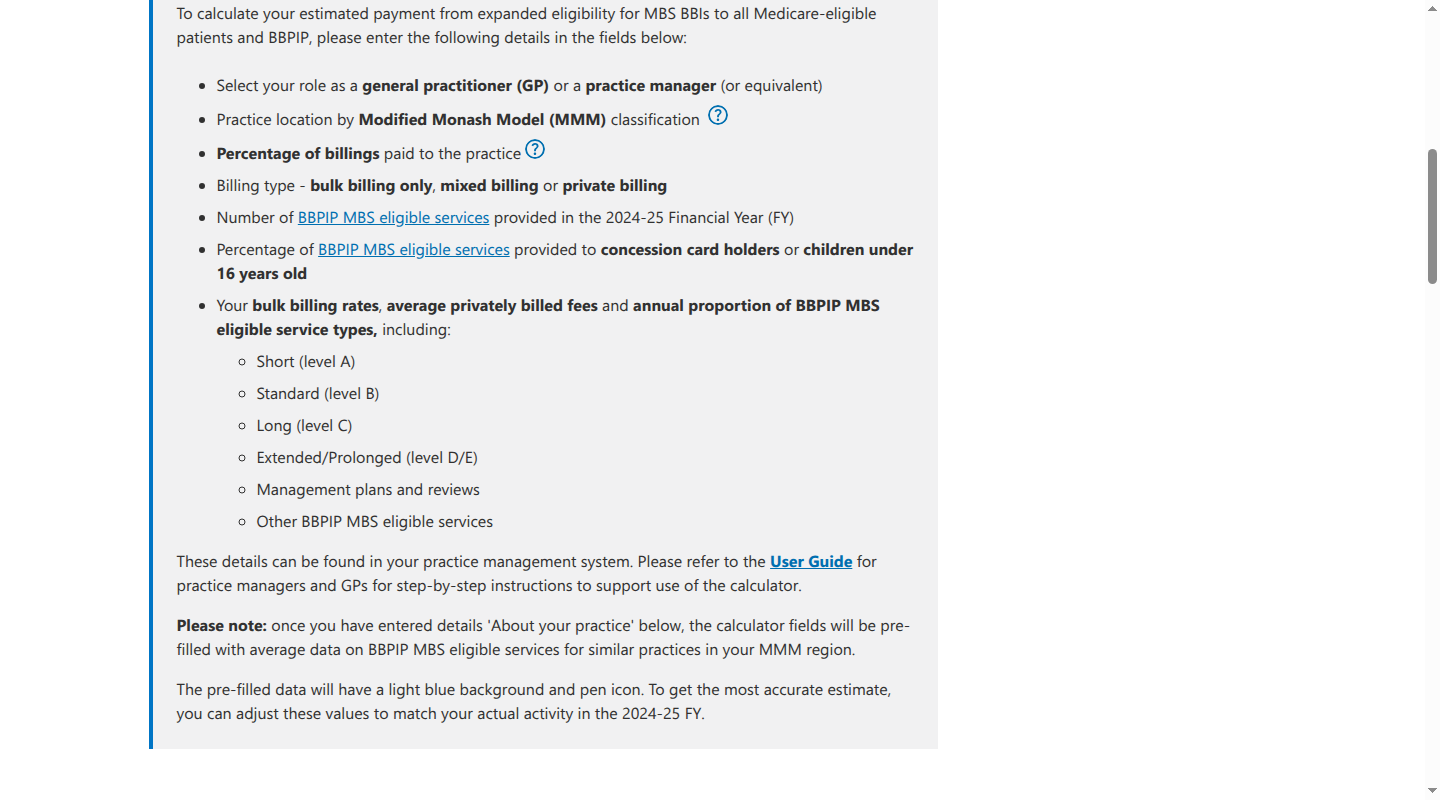
Inputs used by the Australian Government bulk billing incentives calculator, including role, MMM location, billing type, service mix and private fees

  • MBS benefits from the practice's eligible service mix
  • the MBS BBIs available by provider and MMM location
  • the estimated 12.5% BBPIP payment
  • private gaps that would no longer be charged on eligible services
  • likely changes in appointment volume, clinician capacity and non-attendance
  • additional administration, reporting and communication work.

Model each provider and location separately before combining them. Rural loadings, service mix and current fee policy can materially change the result. The Department's bulk billing calculator can estimate incentive payments from a practice's inputs. It cannot decide whether a full-bulk-billing model is sustainable for the practice.

Common questions

Who gets the MBS bulk billing incentive?

The incentive is paid in connection with the provider's eligible bulk-billed service. Since 1 November 2025, the patient can be any Medicare-eligible person. The applicable item still depends on the service, provider and practice location.

Does a patient need to be registered with MyMedicare?

No. Patient MyMedicare registration is not required for an MBS BBI or for the practice's BBPIP-eligible service. The practice itself must be registered for MyMedicare to participate in BBPIP.

Can a mixed-billing practice claim a bulk billing incentive?

Yes. It can claim the applicable MBS BBI for each eligible service it bulk bills. It cannot receive the quarterly BBPIP payment while privately billing any BBPIP-eligible services at the participating location.

Is the 12.5% payment added to every claim?

No. Services Australia calculates BBPIP after the quarterly assessment. The MBS BBI is the incentive submitted with the individual service claim.

Does bulk billing allow a separate booking or administration fee?

No separate fee can be attached to the bulk-billed MBS service. By bulk billing, the provider accepts the Medicare benefit as full payment for that service. A genuinely separate, non-MBS service needs its own clear basis and fee communication.

Accurate claiming starts with a clinical record that makes the service easy to understand and review. Start with Lyrebird for free and create structured draft notes while you keep clinical and billing judgement in the hands of your team.
More Resources
Continue reading
Posts
The dangers of Copy Paste Scribes
Read More
Posts
How to use an AI medical scribe
Read More
Posts
December Product Updates
Read More
Announcement
Kingston and Richmond NHS Foundation Trust go live with Lyrebird, fully integrated with their EPR from day one
Read More
Education
Medicare Eating Disorder Plans: A Practical Guide for GPs
Read More
Insights
PBS authority scripts and the growing GP admin load
Read More
Post
5 min read

Bulk Billing Incentive: A Practical Guide for General Practice

Published on
August 11, 2026
Bulk billing incentive 2026 GP practice guide on a violet Lyrebird background
Contributors
Lyrebird Health
Subscribe to our newsletter
Read about our privacy policy.
Thank you! Your submission has been received!
Oops! Something went wrong while submitting the form.

Bulk billing incentives now reach every Medicare-eligible patient, and fully bulk billing practices can qualify for a further quarterly payment. The change creates a real opportunity for practices, along with new claiming and registration details to manage. Here is how the two incentives work, who qualifies, how payments are calculated, and the controls that help a practice protect its eligibility.

The two bulk billing incentives are separate

Since 1 November 2025, general practice has had two related incentive mechanisms. Keeping them separate is the first step to billing correctly.

Incentive What it is Who can access it When it is paid
MBS bulk billing incentive (BBI) An additional Medicare Benefits Schedule payment attached to an eligible service that is bulk billed An eligible provider who bulk bills an eligible service for a Medicare-eligible patient With the service claim
Bulk Billing Practice Incentive Program (BBPIP) An additional payment equal to 12.5% of MBS benefits paid for BBPIP-eligible services A registered practice and its linked providers, when the practice bulk bills every eligible service Quarterly, split equally between practice and provider

The first incentive works at claim level. The second works at practice level. A mixed-billing practice can still claim an MBS bulk billing incentive each time it bulk bills an eligible service. It cannot receive the BBPIP quarterly payment unless it joins the program and meets the program requirements.

From 1 November 2025, the patient restriction on MBS BBI items was removed. The items can now be claimed when any Medicare-eligible patient receives an eligible bulk-billed service. Before that date, eligibility generally centred on children under 16 and Commonwealth concession card holders. The MBS eligibility change did not make BBPIP automatic.

How the MBS bulk billing incentive works

An MBS bulk billing incentive (BBI) is an extra benefit paid when all of these conditions are met:

  1. The patient is Medicare eligible.
  2. The provider supplies an MBS service that can attract a bulk billing incentive.
  3. The service is bulk billed, so the provider accepts the Medicare benefit as full payment for that service.
  4. The appropriate BBI item is claimed with the underlying service item.

The patient does not need to register with the practice through MyMedicare. The practice also does not need to join the Bulk Billing Practice Incentive Program (BBPIP) for a provider to claim an MBS BBI.

The amount depends on the service and location

There is no single bulk billing incentive amount. The applicable item and benefit depend on:

  • the underlying MBS service
  • the provider type
  • the practice location under the Modified Monash Model (MMM).

Higher benefits apply in eligible regional, rural and remote locations. The live MBS note sets out the relevant item relationships and location rules. Our MBS item numbers cheat sheet is a practical starting point for common general practice claims, while MBS Online remains the authority for each claim.

The phrase triple bulk billing incentive refers to the higher BBI rates introduced in 2023. Since November 2025, the patient eligibility for these incentives has expanded to all Medicare-eligible patients. “Triple” does not mean BBPIP pays three times a consult rebate, and it is unrelated to the separate 12.5% practice payment.

A bulk billing incentive (BBI) item is not a stand-alone service

The incentive item accompanies an eligible service item. It does not replace the consultation item or change the clinical requirements of the underlying service. The record still needs to support the service claimed, including its duration, content and any item-specific criteria.

That distinction matters when a practice updates billing software. A default BBI item based only on patient age or concession status reflects the former rules. Current configuration needs to account for the service, provider and MMM classification instead.

How the Bulk Billing Practice Incentive Program (BBPIP) works

BBPIP is voluntary. A participating practice receives an additional quarterly incentive equal to 12.5% of MBS benefits paid for eligible services during the assessment period. The payment is divided equally:

  • 50% to the practice
  • 50% to the provider who delivered the eligible services.

For example, if eligible bulk-billed services generate $40,000 in MBS benefits during a quarter, the BBPIP amount is $5,000. The practice receives $2,500 and the relevant providers collectively receive $2,500, allocated according to their eligible activity. This example isolates the program formula and does not represent a practice revenue forecast.

Services Australia assesses eligibility each quarter and pays the practice and providers directly into their recorded bank accounts. Forecast assessments help practices see registration or claiming issues during the quarter. Final assessments show whether the requirements were met and the resulting payment. Later payments can include reassessments that correct an earlier underpayment or overpayment.

The 100% rule applies to eligible services

A participating practice must bulk bill every BBPIP-eligible service for every Medicare-eligible patient. The requirement covers all linked providers at the participating practice location, including locums.

The rule does not turn every activity at a general practice into a Medicare service. A practice may still charge for services outside the BBPIP eligible item list, such as non-MBS administrative services, provided it follows the relevant rules and communicates fees clearly. The key control is to distinguish an ineligible service from an eligible MBS service that has been privately billed.

One privately billed BBPIP-eligible service can place the practice's quarterly payment at risk. This makes exception reporting more useful than relying on the headline bulk billing rate.

The Department maintains the current eligible services list. It includes specified general practice attendance and primary care items. An item being valid under the MBS does not automatically make it eligible for BBPIP.

BBPIP eligibility and registration

To participate, a practice needs to:

  1. Register for MyMedicare. Practices entering MyMedicare for BBPIP can access an accreditation exemption under the program settings. Patients do not need to be registered with MyMedicare.
  2. Add BBPIP in the Organisation Register. Registration is managed through Services Australia's Organisation Register in HPOS.
  3. Link every eligible provider at the site. This includes locums. Providers working at several locations need a separate Medicare Provider Number for each site. Urgent Care Clinic provider numbers cannot be used for BBPIP claims.
  4. Add payment details. The practice records bank details for MyMedicare. Each provider records bank details for MyMedicare Incentives in HPOS.
  5. Meet the public information requirements. The practice registers as a fully bulk billing practice in the National Health Services Directory and displays the approved Medicare Bulk Billing Practice signage when the on-site requirement applies.
  6. Bulk bill every eligible service from the nominated start date. Registration can be backdated by up to 180 days, though never before 1 November 2025 or before the practice began operating. The nominated date should match the date full bulk billing of eligible services began.

The Department asks practices to submit their National Health Services Directory registration and order signage within 24 hours of joining. Signage should be displayed within five days of receipt. Processing delays outside the practice's control do not affect eligibility when those actions were completed on time. The full participation conditions sit in the BBPIP program guidance.

A safer implementation workflow

Registration is only one part of the change. A practice needs a billing workflow that keeps the rules visible throughout the quarter.

1. Map the eligible item set

Start with the official BBPIP eligible-services file and map those items to the practice's appointment types, templates and fee schedule. Identify services that sit outside the program so reception and clinical teams can explain fees consistently.

2. Update claiming rules

Configure the practice management system so the correct BBI is paired with the eligible service. Remove patient-age and concession-status logic left over from the pre-November 2025 rules. Retain provider-type and location controls.

3. Check provider links and bank details

Confirm that every provider at each registered location is linked in the Organisation Register. Check locums before their first session. Missing provider links or payment details can delay or prevent the correct assessment and payment.

4. Monitor exceptions, not averages

A 99% bulk billing rate is still below BBPIP's 100% requirement for eligible services. Run a regular report for privately billed eligible item numbers, rejected claims, unmatched BBI items and providers missing from the registered site.

Review the forecast assessment during the quarter. It can surface an issue while there is still time to correct registration data or a claim made in error. Clinical records and claim changes should retain a clear audit trail.

5. Keep the clinical record aligned with the claim

The billing item should follow the service that was actually provided and documented. Templates can prompt for item criteria, but a template cannot establish that the criteria were met.

Lyrebird drafts structured clinical notes from the consult for the clinician to review, edit and sign off. Used alongside a practice's billing controls, this can make the evidence for duration, assessment and plan easier to review before a claim is submitted. The clinician remains responsible for the record and the MBS item selected.

Should a mixed-billing practice join BBPIP?

The 12.5% loading is only one side of the decision. A practice moving from mixed billing gives up private gaps on BBPIP-eligible services, while gaining the quarterly incentive and potentially changing patient demand and appointment volume.

A useful model compares these figures over a full quarter:

Inputs used by the Australian Government bulk billing incentives calculator, including role, MMM location, billing type, service mix and private fees

  • MBS benefits from the practice's eligible service mix
  • the MBS BBIs available by provider and MMM location
  • the estimated 12.5% BBPIP payment
  • private gaps that would no longer be charged on eligible services
  • likely changes in appointment volume, clinician capacity and non-attendance
  • additional administration, reporting and communication work.

Model each provider and location separately before combining them. Rural loadings, service mix and current fee policy can materially change the result. The Department's bulk billing calculator can estimate incentive payments from a practice's inputs. It cannot decide whether a full-bulk-billing model is sustainable for the practice.

Common questions

Who gets the MBS bulk billing incentive?

The incentive is paid in connection with the provider's eligible bulk-billed service. Since 1 November 2025, the patient can be any Medicare-eligible person. The applicable item still depends on the service, provider and practice location.

Does a patient need to be registered with MyMedicare?

No. Patient MyMedicare registration is not required for an MBS BBI or for the practice's BBPIP-eligible service. The practice itself must be registered for MyMedicare to participate in BBPIP.

Can a mixed-billing practice claim a bulk billing incentive?

Yes. It can claim the applicable MBS BBI for each eligible service it bulk bills. It cannot receive the quarterly BBPIP payment while privately billing any BBPIP-eligible services at the participating location.

Is the 12.5% payment added to every claim?

No. Services Australia calculates BBPIP after the quarterly assessment. The MBS BBI is the incentive submitted with the individual service claim.

Does bulk billing allow a separate booking or administration fee?

No separate fee can be attached to the bulk-billed MBS service. By bulk billing, the provider accepts the Medicare benefit as full payment for that service. A genuinely separate, non-MBS service needs its own clear basis and fee communication.

Accurate claiming starts with a clinical record that makes the service easy to understand and review. Start with Lyrebird for free and create structured draft notes while you keep clinical and billing judgement in the hands of your team.

Keep reading

All posts
Questions about compliance?