Medical Report Template for Australian Clinicians

Medical reports can move from the consulting room into an insurer’s, employer’s, tribunal’s or another clinician’s workflow. A reusable template helps you cover the essentials while keeping each report tied to its purpose and evidence. We have built a free Word and fillable PDF template for Australian clinicians, with a worked example and a practical review process for adapting it safely.
Free medical report template: Word and fillable PDF
Before drafting: Verify the authority or disclosure basis and its scope. Record the type and source, date and currentness, signatory and capacity where relevant, intended recipient, purpose, information scope and exclusions. Keep patient consent or authority distinct from a court or tribunal order, statutory authority, primary-purpose disclosure, or another permitted pathway.
The RACGP medical-report guide advises GPs to have consent or authority before starting a third-party report, document patient consent, and clarify the report’s purpose and intended use. If the basis or scope remains unclear, pause the workflow and use your practice’s escalation process or advice from your medical defence organisation.
The inline, Word and PDF versions use the same canonical field list, including the same authority, privacy, source, limitation and sign-off prompts:
MEDICAL REPORT TEMPLATE

STOP BEFORE DRAFTING: Verify and record the disclosure basis or authority and its scope. Patient consent or authority is one pathway. Keep it distinct from a court or tribunal order, statutory authority, primary-purpose disclosure, or a directly related and reasonably expected secondary purpose. Confirm the source, date, currentness, signatory and capacity where relevant, intended recipient, purpose, information scope and exclusions. Use a requester-mandated form when one applies.

1. PRE-DRAFTING AUTHORITY AND SCOPE CHECK
Complete this section before drafting. If the basis or scope is unclear, pause the report workflow until it is resolved.
Authority or disclosure basis type: [Select and describe one: patient consent/authority; primary-purpose disclosure; directly related and reasonably expected secondary purpose; court or tribunal order; statutory authority; other lawful basis.]
Authority source: [Signed authority, recorded discussion, order, notice, legislative provision or other source. Include document title or reference.]
Authority or source date: [DD/MM/YYYY]
Currentness confirmed: [Date checked, how checked and any expiry or limit.]
Signatory or issuer: [Name and organisation, or N/A.]
Signatory capacity: [Patient, substitute decision-maker, authorised representative, court/tribunal, statutory body or other capacity.]
Intended recipient: [Name, role, organisation and secure delivery destination.]
Purpose and intended use: [Why the report is needed and how the recipient will use it.]
Information authorised or otherwise permitted: [Condition, date range, questions and categories of information included.]
Exclusions or limits: [Information outside scope, conditions not covered, onward disclosure limits or other restrictions.]

2. REPORT AND PATIENT DETAILS
Use only the identifiers needed for the purpose. Use initials or a local record identifier in the repeating header rather than a Medicare number.
Date prepared: [DD/MM/YYYY]
Requested by: [Name, role and organisation.]
Request date: [DD/MM/YYYY]
Report, claim or matter reference: [Reference number, if applicable.]
Patient full name: [Full legal name and any relevant known-as name.]
Date of birth: [DD/MM/YYYY]
Other minimum necessary identifier: [UR/MRN or local record identifier if needed. Do not add a Medicare number unless required for the purpose.]
Repeating header identifier: [Initials or local record identifier only.]

3. CLINICIAN DETAILS AND RELATIONSHIP
Describe the author and the limits of their direct knowledge.
Author: [Name, qualifications, role and provider number if relevant.]
Practice or service: [Name and contact details.]
Relationship to patient: [Treating role, whether usual clinician, date first seen and frequency of contact.]
Date last clinically reviewed: [DD/MM/YYYY and mode of review.]

4. SOURCES AND LIMITATIONS
List each source used and make gaps visible.
Consultations relied on: [Dates and clinician or service.]
Medical record date range reviewed: [Start and end dates.]
Investigation reports reviewed: [Investigation, date, reporting service and report reference where relevant.]
Correspondence and other documents: [Document, author, date and who supplied it.]
Limitations and unavailable information: [Missing records, elapsed time since review, reliance on patient report, unavailable examination or evidence, or ‘No material limitations identified’.]

5. RELEVANT CLINICAL HISTORY
Include information relevant to the defined purpose and attribute patient-reported events.
Condition or issue covered: [Name the condition or question covered by the report.]
Presenting condition and chronology: [Relevant events in date order. Use ‘The patient reports…’ for events you did not observe.]
Relevant past medical history: [Include only information relevant to the purpose and scope.]
Current medicines and allergies: [Include only when relevant and verify against the current record.]

6. CURRENT CLINICAL INFORMATION
Distinguish patient report, observed findings, documents from others and your assessment.
Patient-reported symptoms and function: [Symptoms, daily activities, work or study impact and change over time.]
Examination and observations: [Date, mode and objective findings.]
Investigations: [Test, date, result and source. Quote sparingly and accurately.]
Assessment or diagnosis: [Diagnosis or differential, status and basis. State uncertainty.]

7. MANAGEMENT AND PROGRESS
Keep treatment facts separate from the patient’s report of response.
Treatment to date and response: [Intervention, dates, adherence if known, response and adverse effects.]
Current management plan: [Management, referrals, monitoring and review timing.]
Prognosis or expected course: [Give only within your expertise. State assumptions and uncertainty.]

8. RESPONSES TO REQUESTED QUESTIONS
Repeat each question, answer directly, give reasons and identify any evidence still required.
Question 1 and response: [Question, direct answer, supporting evidence and reasoning.]
Question 2 and response: [Question, direct answer, supporting evidence and reasoning.]
Additional questions and responses: [Add further questions in the same format.]
Further information required: [Evidence needed before a reliable opinion can be given, or ‘None’.]

9. DECLARATION AND SIGN-OFF
Review every statement against the listed sources before signing. Add supplementary information in a separately dated report rather than silently altering an issued report.
Declaration: [I prepared this report from the sources listed above. I have distinguished patient-reported information, clinical findings, information from other sources and my professional opinion. I have reviewed the report and believe it is accurate within the limits stated.]
Author signature: [Sign after final clinical review.]
Name and qualifications: [Full name and relevant qualifications.]
Date signed: [DD/MM/YYYY]
Attachments: [List each attachment or ‘None’.]
Delete instructional prompts before issue. Keep a field when the absence of information matters, such as an unresolved limitation, and state why the evidence is unavailable. If the requester supplies a mandatory form, use it instead.
Choose the right report before using a template
“Medical report” covers documents with different jobs. Start with the requester, intended use, jurisdiction and required form. A polished generic report can still fail when a scheme, court or tribunal expects its own questions and declaration.
| Request | Appropriate starting point | What changes |
|---|---|---|
| Treating practitioner report | The generic template above | Summarise relevant care, findings and progress, then answer the requester’s questions within your expertise. |
| Medical certificate | Your practice’s certificate workflow | Record the clinically supported dates, restrictions or capacity requested. A certificate is usually much shorter than a medical report. |
| Referral or transfer summary | Referral, ISBAR or local handover format | Prioritise current problems, medicines, allergies, relevant history, results, plan and the action required from the recipient. |
| Victorian decision-making capacity matter | The official VCAT medical report form | Address the functional decision-making questions and required acknowledgement in the current form. |
| WorkSafe Victoria independent medical examination | The official IME report template | Follow WorkSafe’s report format and instructions. |
| Expert witness report | The letter of instruction and the applicable court rules or expert code | Identify sources, assumptions and reasons for each opinion, and comply with the duties for that forum. |
The VCAT and WorkSafe entries are Victorian examples only. They are not an exhaustive list of Australian forms. Other states, territories, compensation schemes, insurers and courts may prescribe different formats, fees, authority requirements and declarations. The RACGP guide includes jurisdiction-specific starting points and recommends adapting its generic structure to the request.
A treating practitioner report also differs from an expert report. The Council of Chief Justices notes significant variation between Australian jurisdictions and lists where the Harmonised Expert Witness Code applies. That code covers duties to the court, report content, supplementary reports, court directions and expert conferences. Use the rules for the actual forum and proceeding. (Expert witness rules by jurisdiction)
What makes a medical report useful and defensible
A template is a memory aid. It cannot decide whether information is relevant, whether an opinion is supported or whether disclosure is permitted. Those decisions remain part of clinical judgement.
One multicentre retrospective study compared 144 unstructured outpatient oncology notes with 144 structured notes. The mean Qnote quality score was 64.35 for unstructured notes and 77.2 for structured notes, which were also scored as clearer and more concise. The study concerned specialist clinical notes, used a non-randomised retrospective design and did not assess this report template. Its findings support further evaluation of structured prompts as a documentation aid, rather than a claim that a template makes a report accurate or legally sufficient. (Ebbers et al.)
State the purpose, audience and scope
Name the intended recipient and explain why they requested the report. Repeat their questions before answering them. Record the condition, date range and information categories within scope, plus anything expressly excluded. The RACGP’s current guide places purpose and scope at the start of its report structure and recommends acknowledging gaps in the record. (RACGP medical-report guide)
Include your relationship to the patient and the dates that bound your knowledge. “I have been the patient’s treating GP since March 2023 and last reviewed them on 18 August 2026” gives the reader material context for the report.
Build a source map
List what you used to prepare the report:
- contemporaneous clinical notes and the date range reviewed
- a current history and examination, including the date and mode
- investigation reports, with dates and reporting services
- correspondence from other practitioners
- documents supplied with the request
- patient-reported information
Then state the gaps. If records cover only part of the relevant period, say so. If you have not examined the patient recently, avoid presenting an older finding as their current state. Attribute any finding taken from another clinician’s report.
Separate reported history, observations and opinion
Small wording choices show the source of each statement:
- Patient-reported: “The patient reports that the pain began after lifting a box at work.”
- Observed or measured: “On 18 August 2026, lumbar flexion was limited by pain.”
- Documented elsewhere: “The radiology report dated 12 February 2026 records…”
- Clinical opinion: “In my opinion, the presentation is consistent with…”
The Medical Board of Australia requires doctors to be honest and not misleading in reports, take reasonable steps to verify content before signing, and make the limits of their knowledge clear. (Good medical practice)
Use and disclose only what the purpose permits
Primary-purpose disclosure is one pathway for health information. For a secondary purpose, the OAIC identifies consent as one basis. Without consent, the “reasonably expected and directly related” pathway requires both elements: the secondary purpose must be directly related to the primary purpose and the patient must reasonably expect the use or disclosure. Other defined pathways include disclosure required or authorised by law or a court or tribunal order. The OAIC also says only the minimum information necessary should be disclosed for a directly related purpose, and state or territory laws may add requirements. (OAIC health privacy guide)
For voluntary third-party requests such as insurer requests, the RACGP advises documenting consent, checking the authority and releasing information within its scope rather than defaulting to the complete medical record. (RACGP third-party request guidance)
Answer the question after presenting the evidence
A useful response follows a visible line of reasoning:
- Set out the relevant history and findings.
- Identify uncertainty or conflicting information.
- Give the opinion requested when it falls within your expertise.
- Explain the evidence, reasoning and assumptions.
- State what further information is needed if a reliable answer is not yet possible.
Avoid legal conclusions, advocacy and certainty that the evidence does not support. For complex medico-legal or expert reports, follow the instructions and rules for that forum and seek appropriate advice.
Worked medical report example
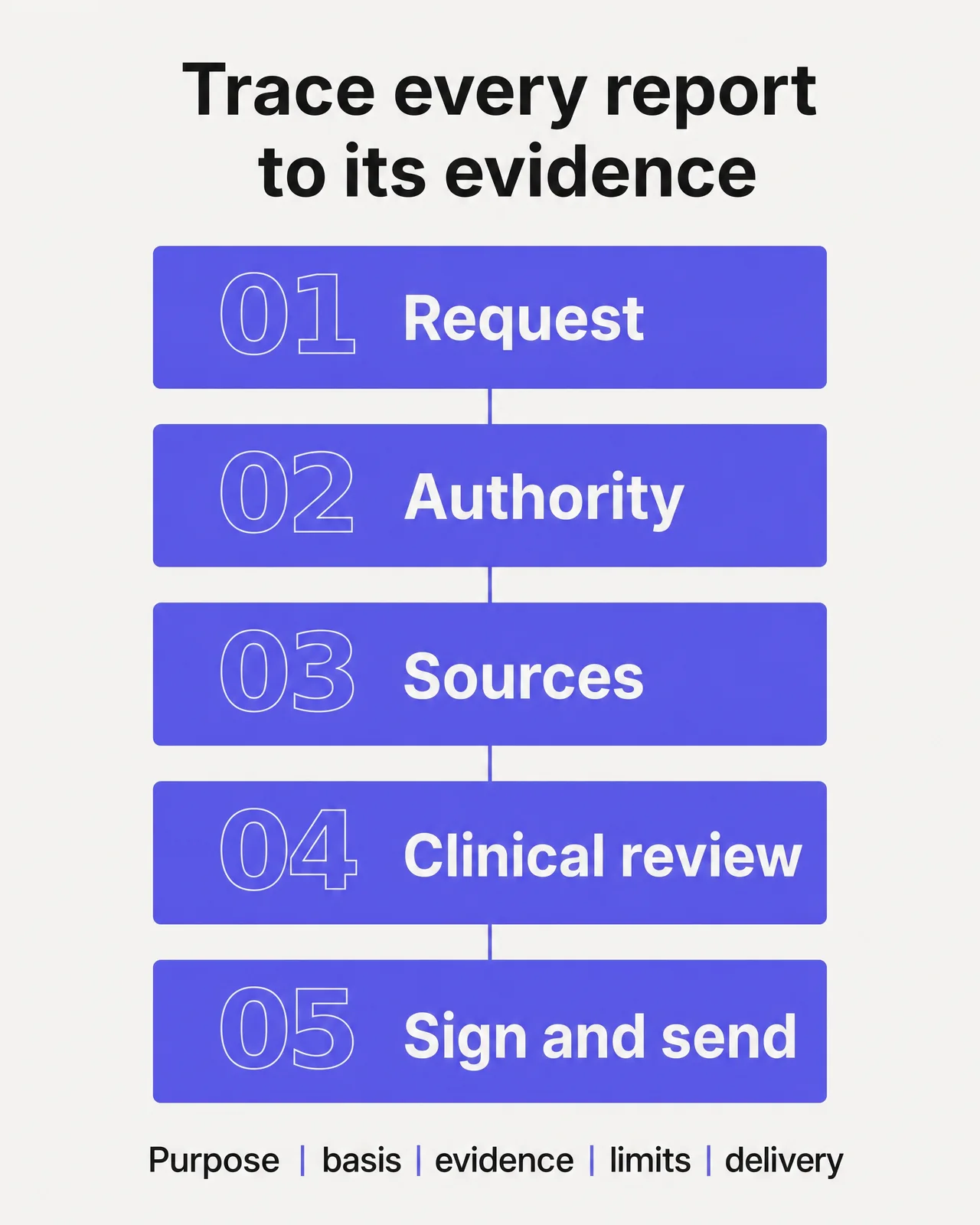
This fictional example shows how to record authority, attribute history, state source limits and answer a defined request. It is a general treating practitioner report, not a statutory certificate or expert report.
MEDICAL REPORT

Authority and scope check
Authority type: Patient consent and authority
Authority source: Harbour Mutual authority form HM-A12
Authority date: 14 August 2026
Currentness: Confirmed with the patient on 18 August 2026
Signatory and capacity: Alex Nguyen, patient
Intended recipient: Claims Officer, Harbour Mutual
Purpose: Summary of the current lower back condition, management and expected course
Information scope: Lower back condition; records from 4 July to 18 August 2026
Exclusions: Full medical record and unrelated health information

Report details
Date prepared: 20 August 2026
Reference: HM-20471
Patient: Alex Nguyen
Date of birth: 11 March 1986

Clinician details and relationship
I am Dr Priya Shah, MBBS, FRACGP, at Example Family Practice. I have been
Alex Nguyen’s treating GP since February 2022. I reviewed Alex for this
condition on 4 July, 25 July and 18 August 2026.

Sources and limitations
I reviewed my consultation notes from 4 July to 18 August 2026 and the lumbar
spine imaging report dated 12 July 2026. I did not witness the event described
below. The event history and functional effects are therefore attributed to
the patient. No occupational assessment was supplied.

Relevant history
On 4 July 2026, Alex reported the onset of lower back pain after lifting a
container at work the previous day. Alex reported no previous episode causing
time away from work in the preceding two years. The record contains no bowel
or bladder symptoms, saddle sensory change or progressive limb weakness at
any of the three reviews.

Current clinical information
At review on 18 August, Alex reported lower pain intensity and improved
walking tolerance, with pain continuing during repeated bending and lifting.
Examination recorded a normal gait, lower-limb power of 5/5 bilaterally and
intact lower-limb sensation. Lumbar movement remained limited by pain. The
imaging report dated 12 July recorded no acute bony abnormality.

Assessment, management and progress
My clinical assessment is improving non-specific lower back pain. Management
has included activity guidance, physiotherapy and scheduled clinical review.
Alex reports gradual improvement. Further progress is expected, although the
exact recovery date cannot be predicted from the information currently
available.

Response to requested question
The current findings support clinical improvement. They do not establish
capacity for specific manual tasks because no detailed job demands assessment
was supplied. A reliable task-specific opinion would require those demands and
a current functional assessment.

Declaration
I prepared this report from the sources listed above. I have distinguished
patient-reported information, clinical findings, information from other
sources and my professional opinion. I reviewed the report and believe it is
accurate within the limits stated.

Signed: Dr Priya Shah, MBBS, FRACGP
Date: 20 August 2026
The example avoids converting an unobserved event into fact. It also answers only as far as the available evidence allows.
Medical report review checklist
Review the final report against its sources, rather than relying on how complete the document looks. Before signing, confirm that:
- the authority or disclosure basis, source, date and currentness are recorded
- the signatory and capacity are recorded when consent or authority is used
- the recipient, purpose, information scope and exclusions are clear
- the patient, requester and reference details are correct
- each requested question is answered
- the report lists its source documents and date range
- patient-reported information is attributed
- observations, third-party findings and opinions are distinguishable
- each opinion has reasons and stays within your expertise
- gaps, assumptions, conflicting information and uncertainty are visible
- irrelevant sensitive information has been removed
- dates, medicines, doses, test results and measurements match the record
- the required form, wording and declaration have been used
- a final copy is stored with the appropriate record and sent securely
The Medical Board’s code requires accurate, up-to-date and legible records, secure storage, dated additions, and prompt transfer when requested by the patient or a third party with the required authority. (Good medical practice) If an issued report needs clarification or more information, the RACGP guide recommends a separately identified supplementary report rather than altering the original. (RACGP medical-report guide)
Medical report template FAQs
Is a medical report the same as a medical certificate?
No. A medical certificate usually confirms a limited clinical fact, such as a period of incapacity or work restrictions, for a specific purpose. A medical report gives a broader, reasoned account of relevant history, findings, management and opinion. Use the document the recipient requires.
Does every medical report require patient consent?
No single consent rule covers every report. Disclosure for the primary purpose of collection is a separate pathway. For a secondary purpose, consent may provide the basis. Where a non-consensual secondary disclosure relies on reasonable expectation, the purpose must also be directly related to the primary purpose. Other pathways include disclosures required or authorised by law or a court or tribunal order. State and territory privacy or health-records laws may impose additional requirements. (OAIC health privacy guide)
Can a template be used for a medico-legal report?
It can provide a starting structure for a treating practitioner report. An expert report, independent medical examination or court report may have prescribed questions, declarations and jurisdiction-specific duties. Those requirements take priority over a generic template.
Turn the template into a repeatable workflow
Before using ambient capture, follow your practice’s patient notice process and obtain and record any consent required for that workflow. The requirement depends on the specific use, data handling, applicable law and practice policy, so one consent rule does not fit every setting. Our guide to patient consent for AI scribes explains the Australian workflow in more detail.
In Lyrebird, you can save this structure as a custom template, capture the consult with an ambient AI scribe, dictation or typed notes, and use the structured clinical note to draft the report. When a requester supplies a PDF, our Documents & Letters workflow can pre-fill it from the consult. Every output remains a draft for you to check, edit and sign, so the report stays tied to your clinical judgement and source record.