Education
5 min read

Patient Intake Form: A Guide for Australian Practices

Published on
October 13, 2026
Patient intake forms for Australian practices on a violet Lyrebird background
Contributors
Subscribe to our newsletter
Read about our privacy policy.
Thank you! Your submission has been received!
Oops! Something went wrong while submitting the form.

A patient intake form gives patients space to explain their concerns before a consult. For Australian clinicians and practice teams, the challenge is choosing questions that help care without asking for an entire life history. Clear wording matters just as much as the fields you include: a blank allergy answer and “none known” mean different things. Start with the purpose of each question, then shape the form around your service and the people using it.

What is a patient intake form?

A patient intake form collects information that helps a clinician understand the patient’s reason for attending and relevant health background. It can include current medicines, allergies or previous reactions, health conditions and the patient’s goals for the appointment.

Practices often combine these questions with registration details. They serve different purposes, even when they appear in the same document. The form is also only one part of intake; it does not replace a clinical conversation or assessment.

Part of the formIts purposeKeep the boundary clear
RegistrationIdentify and contact the patient, match the health record and collect relevant administrative details.A completed form alone does not establish that the patient has been matched to the correct record.
Clinical historyGather the presenting concern and health context relevant to the service.Responses are patient-reported information for clinical review, rather than a diagnosis or a complete health record.
Privacy and consentExplain information collection and record distinct permissions where required.A privacy notice, consent to collect health information and consent to treatment are separate concepts.

For an editable registration asset, use our new patient form template. Keep the broader clinical-history questions focused on what the clinician needs for this appointment.

Separate a collection notice from consent

A collection notice explains how the practice handles personal information. Under the Australian Privacy Principles (APPs), APP 5 requires covered entities to take reasonable steps to notify the patient of relevant collection matters, or ensure they are aware of them, at or before collection or as soon as practicable afterwards. The Office of the Australian Information Commissioner (OAIC) sets out this duty in its collection notification guidance.

Health information has additional collection rules. Consent is generally required for collecting sensitive information under APP 3 unless an exception applies. A notice acknowledgement is not a substitute for any required collection consent.

Consent to treatment concerns the particular care decision and the patient’s understanding of their options. The Australian Commission on Safety and Quality in Health Care’s informed consent guidance treats it as a shared clinical process. A routine intake signature does not provide blanket permission for every future treatment.

Clinical-history questions to include

Choose questions by clinical purpose and service. A general practice, physiotherapy clinic and specialist service need different levels of detail. The examples here are question wording to adapt, rather than a mandatory questionnaire for every patient.

The reason for attending and the patient’s goal

Begin with an open question that lets the patient use their own words. A symptom list can help organise answers, but it should leave room for concerns that do not fit the list.

Question exampleWhat it adds
“What would you most like help with at this appointment?”The patient’s main concern, without requiring a diagnostic label.
“When did this concern begin?”Timing. Allow an approximate answer if the patient cannot remember a date.
“How has it changed since then?”The course of the concern, separately from when it started.
“How is it affecting your everyday activities?”The effect on the patient’s life, when relevant to the service.
“What are you hoping to discuss or achieve at this appointment?”The patient’s priorities and expectations.

Include only the follow-ups that help the clinician prepare. Avoid requiring patients to rate every symptom or complete a long body-system checklist for an unrelated appointment.

Example response: “My knee has hurt for about three weeks. Stairs are harder now. I want to discuss getting back to walking.” This gives a concern, approximate timing, functional impact and a goal. It does not establish a diagnosis or how urgently the patient needs care.

Current medicines

Ask “What medicines are you currently taking?” Explain that this includes medicines taken occasionally, medicines bought without a prescription, vitamins, supplements and herbal products.

Where the service needs the detail, provide separate spaces for:

  • Medicine name.
  • Strength, if known.
  • How much the patient takes.
  • How often they take it, including occasional use.

Allow “not sure” rather than forcing a guessed name or dose. A prompt such as “You can refer to your medicine packaging or current medicines list” gives patients a practical way to answer.

In general practice, the Royal Australian College of General Practitioners (RACGP) health record standards call for an accurate and current medicines list in each patient health record. An intake response contributes to that work; the responsible clinician reconciles it with the patient and other relevant information.

Allergies and previous medicine reactions

Ask about both known allergies and previous medicine reactions. Patients may remember what happened without knowing whether it was an allergy.

A starting question is: “Do you have any known allergies or have you had a reaction to a medicine?” Give distinct answers: “Yes”, “None known” and “Not sure”. For “Yes”, ask separately:

  • “What medicine or other substance was involved?”
  • “What happened when you took it or were exposed to it?”
  • “Approximately when did this happen?” if timing is relevant to your service.

The Australasian Society of Clinical Immunology and Allergy’s clinical history form distinguishes confirmed from suspected allergies and records reaction events separately. That distinction is useful: capture the patient’s account without asking them to classify the reaction themselves.

For example, “I had a rash after an antibiotic as a child, but I don’t remember the name” should remain an uncertain patient-reported reaction for clinical assessment. It should not become either a confirmed allergy to a guessed medicine or “no known allergies” simply because the name is missing.

Relevant conditions and health background

Use a broad opening question, then add targeted follow-ups where they support the service. Avoid making every patient answer every possible history question.

AreaExample wordingWhen to include it
Current conditions“What ongoing health conditions do you have?”When current conditions are relevant to assessment or treatment, including conditions not currently being treated.
Past illness or procedures“Have you had an illness, operation or hospital admission relevant to this appointment?”When previous care may help explain the presenting concern or affect care.
Previous management“What have you already tried for this concern?”When the clinician needs context about previous treatment or self-care.
Family history“Are there health conditions in your family relevant to this visit?”When family history has a clear clinical purpose. Ask for the relationship and condition, rather than relatives’ names.
Daily life and support“Is there anything about your work, home life or support needs that would help us understand this concern?”When this context can inform care. Keep room for the patient’s own priorities.

Use service-specific wording where possible. For a knee appointment, “Have you had an operation or injury affecting this knee?” is clearer than asking the patient to decide whether every past procedure is relevant.

Explain the reason for sensitive questions close to the field. Smoking, alcohol, sexual health, pregnancy and mental health questions need a service-specific purpose and suitable clinical review. A general history prompt should not become an unreviewed specialty assessment or reproduce a scoring questionnaire without appropriate permission.

How to write questions patients can answer

Give each field one job

“Describe your symptoms, onset, severity, treatments and goals” asks for several different answers in one box. Separate the necessary questions and remove the rest.

AvoidUse instead
“Presenting complaint”“What would you most like help with?”
“List comorbidities and surgical history”Separate questions about current health conditions and relevant past operations.
“Are you compliant with your medication?”“Is anything making it difficult to take your medicines as planned?” where relevant.
“Do you have a healthy lifestyle?”A specific, neutral question about the activity or habit relevant to care.

Use a short hint when the expected answer is unclear. Approximate dates and everyday descriptions are often more appropriate than requiring medical terminology.

Preserve uncertainty instead of hiding it

A yes/no answer can be too narrow for clinical history. “Not sure” gives the patient somewhere to put uncertainty; a blank field indicates that no answer was supplied.

Keep these states distinct in the form and in any exported response:

  • Reported reaction: retain the substance and the description of what happened, including uncertainty.
  • None known: retain the patient’s explicit answer. It is still patient-reported information.
  • Not sure: retain the uncertainty for discussion.
  • Unanswered: leave it identifiable as missing information. Do not automatically convert it to “none”.

Show substance and reaction questions only after a relevant answer, with a way for an unsure patient to add what they remember. All paths still lead to clinical review.
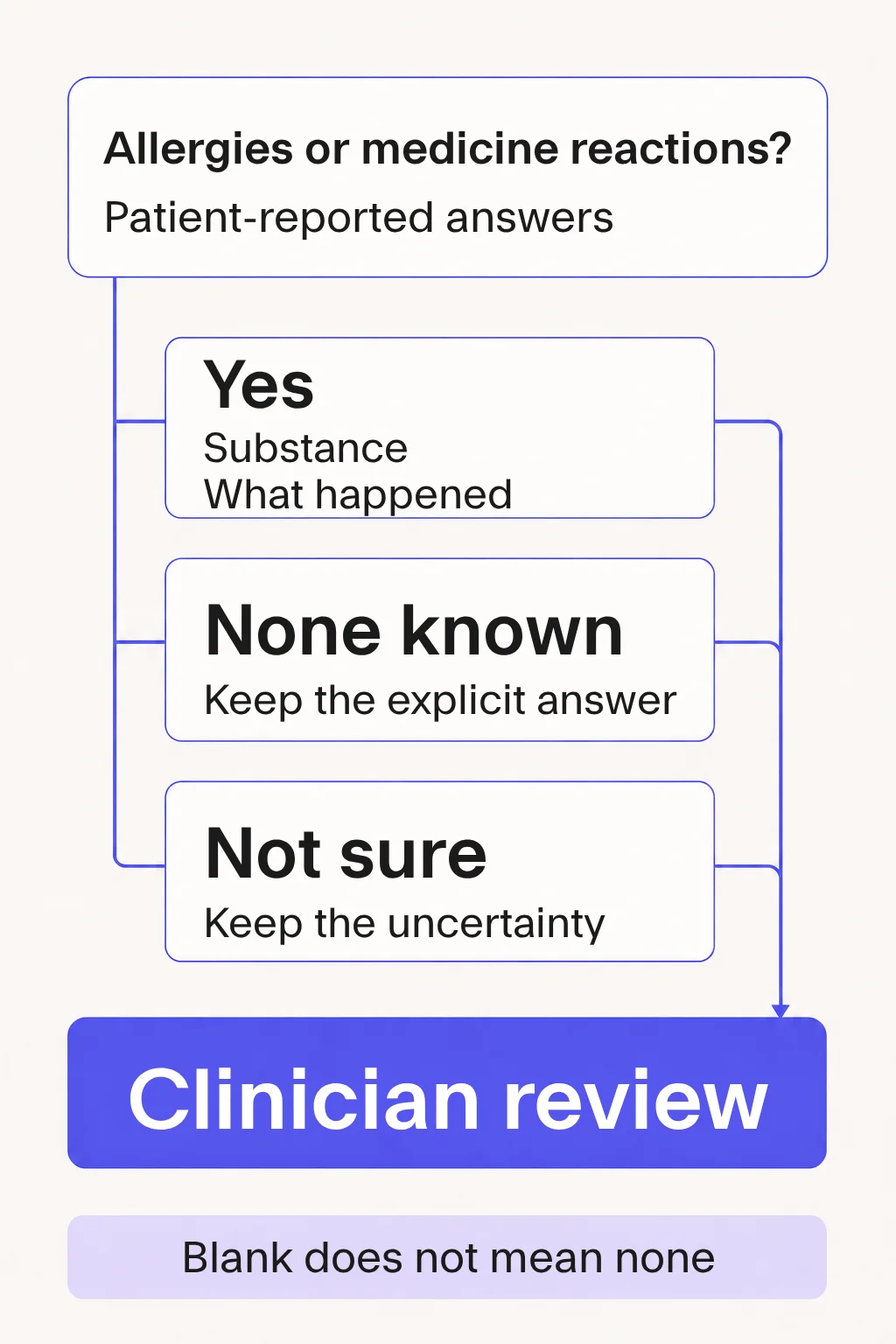
Allergy answers take separate paths to clinician review; a blank answer does not mean none.

Make required fields meaningful

Require a field only when the practice has a clear reason and can explain the consequence of leaving it unanswered. Where appropriate, offer “prefer to discuss with the clinician” for sensitive history. This is a deferred discussion, not a negative answer.

For private practices covered by the Privacy Act, APP 3 limits collection to information reasonably necessary for the organisation’s functions or activities. Sensitive information has the additional consent requirement and exceptions described above. The OAIC’s information collection guidance supports collecting the minimum needed in the circumstances, rather than information that might be useful someday.

Keep the wording accessible

Use visible labels, short instructions and related question groups. Error messages should explain the missing or unsuitable answer without clearing the patient’s other responses. The World Wide Web Consortium’s accessible forms guidance supports short, necessary questions and clearly labelled controls.

Include a simple support prompt: “Would you like help completing this form or communicating with us?” Offer practical ways to request an interpreter, another format or staff assistance without requiring an unnecessary personal explanation.

Australian practice checklist

These are practical readiness criteria for a clinical-history form. The relevant legal duties depend on the practice and jurisdiction; the design recommendations are not a universal legal template.

  • Purpose: Each clinical question has a documented reason related to the service. Registration details, history questions and distinct consent decisions are clearly separated.
  • Clinical approval: A qualified clinician has approved the questions, answer choices and conditional follow-ups. Important medicines, reactions and concerning responses have a named clinical review owner.
  • Answer meaning: “None known”, “not sure”, “prefer to discuss” and unanswered fields remain distinct. Patient-reported information is identifiable, including who supplied it.
  • Collection notice: The notice reflects the practice’s actual purposes and handling of information, with the relevant access, correction, complaint and disclosure details. APP 5 notification arrangements match how collection occurs.
  • Jurisdiction: The privacy arrangements reflect both federal and applicable state or territory rules. Private-sector health providers in New South Wales, Victoria and the Australian Capital Territory have obligations under both systems; public-sector arrangements differ. The OAIC explains these privacy law boundaries.
  • Security: Collection channels and access controls have been assessed for the information involved. APP 11 requires reasonable steps to protect held personal information from misuse, interference, loss and unauthorised access, modification or disclosure. Its security requirements cover technical and organisational measures; a form format alone does not establish security.
  • Access: The questions and controls are usable on mobile, by keyboard and with assistive technology. Patients have a practical alternative when they cannot complete the form independently.
  • Urgent help: The form clearly states that it is not for emergencies or urgent clinical requests. It gives the practice’s accurate urgent or after-hours contact route without implying continuous monitoring. For a serious, urgent medical emergency, Healthdirect advises calling Triple Zero (000).

Frequently asked questions

Can a carer or support person complete the form?

A practice can provide for assisted completion and record whether answers came from the patient, a support person or another source. Make it clear whose health history is being described. Helping someone complete a form does not, by itself, establish authority to make treatment decisions for them.

Should returning patients complete the same form again?

A shorter update form can ask what has changed in the patient’s concern, medicines, reactions or relevant history. Keep the date and source of the update clear. Reusing an earlier answer without confirmation does not make it current.

Support the clinical conversation and its record

A useful intake form leaves the clinician with clear questions to explore, including gaps and uncertain answers. The consult provides the context to confirm important history and decide what belongs in the clinical record.

Our clinical AI platform supports that later documentation work. With our Clinical Notes, clinicians can structure dictation or typed notes into a draft for review, editing and sign-off. This is documentation support, separate from collecting intake submissions or assessing their urgency. Clinical judgement remains with the clinician.


Contact us

More Resources
Continue reading
Posts
The dangers of Copy Paste Scribes
Read More
Posts
How to use an AI medical scribe
Read More
Posts
December Product Updates
Read More
Education
Medical Report Template for Australian Clinicians
Read More
Education
RACGP Standards: A Practical Guide for General Practices
Read More
Medical receptionist duties: an Australian practice guide
Read More
Post
5 min read

Patient Intake Form: A Guide for Australian Practices

Published on
October 13, 2026
Patient intake forms for Australian practices on a violet Lyrebird background
Contributors
Subscribe to our newsletter
Read about our privacy policy.
Thank you! Your submission has been received!
Oops! Something went wrong while submitting the form.

A patient intake form gives patients space to explain their concerns before a consult. For Australian clinicians and practice teams, the challenge is choosing questions that help care without asking for an entire life history. Clear wording matters just as much as the fields you include: a blank allergy answer and “none known” mean different things. Start with the purpose of each question, then shape the form around your service and the people using it.

What is a patient intake form?

A patient intake form collects information that helps a clinician understand the patient’s reason for attending and relevant health background. It can include current medicines, allergies or previous reactions, health conditions and the patient’s goals for the appointment.

Practices often combine these questions with registration details. They serve different purposes, even when they appear in the same document. The form is also only one part of intake; it does not replace a clinical conversation or assessment.

Part of the formIts purposeKeep the boundary clear
RegistrationIdentify and contact the patient, match the health record and collect relevant administrative details.A completed form alone does not establish that the patient has been matched to the correct record.
Clinical historyGather the presenting concern and health context relevant to the service.Responses are patient-reported information for clinical review, rather than a diagnosis or a complete health record.
Privacy and consentExplain information collection and record distinct permissions where required.A privacy notice, consent to collect health information and consent to treatment are separate concepts.

For an editable registration asset, use our new patient form template. Keep the broader clinical-history questions focused on what the clinician needs for this appointment.

Separate a collection notice from consent

A collection notice explains how the practice handles personal information. Under the Australian Privacy Principles (APPs), APP 5 requires covered entities to take reasonable steps to notify the patient of relevant collection matters, or ensure they are aware of them, at or before collection or as soon as practicable afterwards. The Office of the Australian Information Commissioner (OAIC) sets out this duty in its collection notification guidance.

Health information has additional collection rules. Consent is generally required for collecting sensitive information under APP 3 unless an exception applies. A notice acknowledgement is not a substitute for any required collection consent.

Consent to treatment concerns the particular care decision and the patient’s understanding of their options. The Australian Commission on Safety and Quality in Health Care’s informed consent guidance treats it as a shared clinical process. A routine intake signature does not provide blanket permission for every future treatment.

Clinical-history questions to include

Choose questions by clinical purpose and service. A general practice, physiotherapy clinic and specialist service need different levels of detail. The examples here are question wording to adapt, rather than a mandatory questionnaire for every patient.

The reason for attending and the patient’s goal

Begin with an open question that lets the patient use their own words. A symptom list can help organise answers, but it should leave room for concerns that do not fit the list.

Question exampleWhat it adds
“What would you most like help with at this appointment?”The patient’s main concern, without requiring a diagnostic label.
“When did this concern begin?”Timing. Allow an approximate answer if the patient cannot remember a date.
“How has it changed since then?”The course of the concern, separately from when it started.
“How is it affecting your everyday activities?”The effect on the patient’s life, when relevant to the service.
“What are you hoping to discuss or achieve at this appointment?”The patient’s priorities and expectations.

Include only the follow-ups that help the clinician prepare. Avoid requiring patients to rate every symptom or complete a long body-system checklist for an unrelated appointment.

Example response: “My knee has hurt for about three weeks. Stairs are harder now. I want to discuss getting back to walking.” This gives a concern, approximate timing, functional impact and a goal. It does not establish a diagnosis or how urgently the patient needs care.

Current medicines

Ask “What medicines are you currently taking?” Explain that this includes medicines taken occasionally, medicines bought without a prescription, vitamins, supplements and herbal products.

Where the service needs the detail, provide separate spaces for:

  • Medicine name.
  • Strength, if known.
  • How much the patient takes.
  • How often they take it, including occasional use.

Allow “not sure” rather than forcing a guessed name or dose. A prompt such as “You can refer to your medicine packaging or current medicines list” gives patients a practical way to answer.

In general practice, the Royal Australian College of General Practitioners (RACGP) health record standards call for an accurate and current medicines list in each patient health record. An intake response contributes to that work; the responsible clinician reconciles it with the patient and other relevant information.

Allergies and previous medicine reactions

Ask about both known allergies and previous medicine reactions. Patients may remember what happened without knowing whether it was an allergy.

A starting question is: “Do you have any known allergies or have you had a reaction to a medicine?” Give distinct answers: “Yes”, “None known” and “Not sure”. For “Yes”, ask separately:

  • “What medicine or other substance was involved?”
  • “What happened when you took it or were exposed to it?”
  • “Approximately when did this happen?” if timing is relevant to your service.

The Australasian Society of Clinical Immunology and Allergy’s clinical history form distinguishes confirmed from suspected allergies and records reaction events separately. That distinction is useful: capture the patient’s account without asking them to classify the reaction themselves.

For example, “I had a rash after an antibiotic as a child, but I don’t remember the name” should remain an uncertain patient-reported reaction for clinical assessment. It should not become either a confirmed allergy to a guessed medicine or “no known allergies” simply because the name is missing.

Relevant conditions and health background

Use a broad opening question, then add targeted follow-ups where they support the service. Avoid making every patient answer every possible history question.

AreaExample wordingWhen to include it
Current conditions“What ongoing health conditions do you have?”When current conditions are relevant to assessment or treatment, including conditions not currently being treated.
Past illness or procedures“Have you had an illness, operation or hospital admission relevant to this appointment?”When previous care may help explain the presenting concern or affect care.
Previous management“What have you already tried for this concern?”When the clinician needs context about previous treatment or self-care.
Family history“Are there health conditions in your family relevant to this visit?”When family history has a clear clinical purpose. Ask for the relationship and condition, rather than relatives’ names.
Daily life and support“Is there anything about your work, home life or support needs that would help us understand this concern?”When this context can inform care. Keep room for the patient’s own priorities.

Use service-specific wording where possible. For a knee appointment, “Have you had an operation or injury affecting this knee?” is clearer than asking the patient to decide whether every past procedure is relevant.

Explain the reason for sensitive questions close to the field. Smoking, alcohol, sexual health, pregnancy and mental health questions need a service-specific purpose and suitable clinical review. A general history prompt should not become an unreviewed specialty assessment or reproduce a scoring questionnaire without appropriate permission.

How to write questions patients can answer

Give each field one job

“Describe your symptoms, onset, severity, treatments and goals” asks for several different answers in one box. Separate the necessary questions and remove the rest.

AvoidUse instead
“Presenting complaint”“What would you most like help with?”
“List comorbidities and surgical history”Separate questions about current health conditions and relevant past operations.
“Are you compliant with your medication?”“Is anything making it difficult to take your medicines as planned?” where relevant.
“Do you have a healthy lifestyle?”A specific, neutral question about the activity or habit relevant to care.

Use a short hint when the expected answer is unclear. Approximate dates and everyday descriptions are often more appropriate than requiring medical terminology.

Preserve uncertainty instead of hiding it

A yes/no answer can be too narrow for clinical history. “Not sure” gives the patient somewhere to put uncertainty; a blank field indicates that no answer was supplied.

Keep these states distinct in the form and in any exported response:

  • Reported reaction: retain the substance and the description of what happened, including uncertainty.
  • None known: retain the patient’s explicit answer. It is still patient-reported information.
  • Not sure: retain the uncertainty for discussion.
  • Unanswered: leave it identifiable as missing information. Do not automatically convert it to “none”.

Show substance and reaction questions only after a relevant answer, with a way for an unsure patient to add what they remember. All paths still lead to clinical review.

Allergy answers take separate paths to clinician review; a blank answer does not mean none.

Make required fields meaningful

Require a field only when the practice has a clear reason and can explain the consequence of leaving it unanswered. Where appropriate, offer “prefer to discuss with the clinician” for sensitive history. This is a deferred discussion, not a negative answer.

For private practices covered by the Privacy Act, APP 3 limits collection to information reasonably necessary for the organisation’s functions or activities. Sensitive information has the additional consent requirement and exceptions described above. The OAIC’s information collection guidance supports collecting the minimum needed in the circumstances, rather than information that might be useful someday.

Keep the wording accessible

Use visible labels, short instructions and related question groups. Error messages should explain the missing or unsuitable answer without clearing the patient’s other responses. The World Wide Web Consortium’s accessible forms guidance supports short, necessary questions and clearly labelled controls.

Include a simple support prompt: “Would you like help completing this form or communicating with us?” Offer practical ways to request an interpreter, another format or staff assistance without requiring an unnecessary personal explanation.

Australian practice checklist

These are practical readiness criteria for a clinical-history form. The relevant legal duties depend on the practice and jurisdiction; the design recommendations are not a universal legal template.

  • Purpose: Each clinical question has a documented reason related to the service. Registration details, history questions and distinct consent decisions are clearly separated.
  • Clinical approval: A qualified clinician has approved the questions, answer choices and conditional follow-ups. Important medicines, reactions and concerning responses have a named clinical review owner.
  • Answer meaning: “None known”, “not sure”, “prefer to discuss” and unanswered fields remain distinct. Patient-reported information is identifiable, including who supplied it.
  • Collection notice: The notice reflects the practice’s actual purposes and handling of information, with the relevant access, correction, complaint and disclosure details. APP 5 notification arrangements match how collection occurs.
  • Jurisdiction: The privacy arrangements reflect both federal and applicable state or territory rules. Private-sector health providers in New South Wales, Victoria and the Australian Capital Territory have obligations under both systems; public-sector arrangements differ. The OAIC explains these privacy law boundaries.
  • Security: Collection channels and access controls have been assessed for the information involved. APP 11 requires reasonable steps to protect held personal information from misuse, interference, loss and unauthorised access, modification or disclosure. Its security requirements cover technical and organisational measures; a form format alone does not establish security.
  • Access: The questions and controls are usable on mobile, by keyboard and with assistive technology. Patients have a practical alternative when they cannot complete the form independently.
  • Urgent help: The form clearly states that it is not for emergencies or urgent clinical requests. It gives the practice’s accurate urgent or after-hours contact route without implying continuous monitoring. For a serious, urgent medical emergency, Healthdirect advises calling Triple Zero (000).

Frequently asked questions

Can a carer or support person complete the form?

A practice can provide for assisted completion and record whether answers came from the patient, a support person or another source. Make it clear whose health history is being described. Helping someone complete a form does not, by itself, establish authority to make treatment decisions for them.

Should returning patients complete the same form again?

A shorter update form can ask what has changed in the patient’s concern, medicines, reactions or relevant history. Keep the date and source of the update clear. Reusing an earlier answer without confirmation does not make it current.

Support the clinical conversation and its record

A useful intake form leaves the clinician with clear questions to explore, including gaps and uncertain answers. The consult provides the context to confirm important history and decide what belongs in the clinical record.

Our clinical AI platform supports that later documentation work. With our Clinical Notes, clinicians can structure dictation or typed notes into a draft for review, editing and sign-off. This is documentation support, separate from collecting intake submissions or assessing their urgency. Clinical judgement remains with the clinician.

Contact us

Keep reading

All posts
Questions about compliance?