Medical receptionist duties: an Australian practice guide

A medical receptionist helps patients navigate the practice while keeping appointments, records and messages organised. For receptionists, practice managers and clinicians, a useful role description needs to explain both the everyday work and where responsibility passes to someone else.
Clear duties make induction easier and give staff a dependable way to handle competing requests. They also help patients reach the right person when a booking question becomes a clinical concern.
What does a medical receptionist do?
A medical receptionist is a patient-facing administrative team member. Common responsibilities include welcoming patients, managing appointments, answering enquiries, registering patients, maintaining records, supporting payments and coordinating patient flow. These task groups appear in the Australian occupation profile.
The exact scope depends on the setting, team size, training and position description. A small GP practice may combine reception and back-office administration; a larger clinic may have separate booking, billing and records teams. Use the duties below as a starting point for local procedures, rather than assigning every task to every receptionist.
Clinical decisions sit outside the reception role. A receptionist can arrange access to care and carry out authorised administrative steps. Diagnosis, result interpretation, treatment advice and decisions about clinical urgency belong with appropriately qualified clinical staff.
Common daily medical receptionist duties
Welcome patients and manage enquiries
You greet patients, record their arrival and let the appropriate clinician know they are waiting. You explain practical matters such as opening hours, fees, appointment arrangements and how to contact the practice.
On the phone, listen carefully, capture the request and direct it to the right person. Give patients a private way to discuss sensitive administrative matters, and arrange communication or accessibility support through the practice's process. Avoid asking for detailed clinical information within earshot of the waiting room.
Complaints also need a clear route. You may resolve a routine administrative misunderstanding within your authority, while concerns about care, privacy, repeated problems or staff safety go to the designated lead.
Book appointments and keep patient flow organised
Reception work includes bookings, cancellations, reminders and rescheduling. Follow the practice's appointment types and booking rules, including arrangements for longer consults, nurse appointments, interpreters and telehealth where offered.
Tell patients about known delays without disclosing another patient's situation. When a clinician's availability changes, use the agreed process to contact affected patients and offer authorised alternatives. A full appointment book does not resolve a potentially urgent request: involve the clinical team through the escalation procedure.
Register patients and update administrative details
Confirm identity using the practice's approved process before opening or changing a record. Locate existing records before creating a new one, and update contact details, communication preferences and applicable billing information accurately.
Help patients complete registration forms without answering clinical questions on their behalf. Route stated health concerns or discrepancies in clinical information to the appropriate clinician. Our new patient form template provides a starting point for registration, including contact and access needs.
Handle records, correspondence and messages
Your role may include receiving mail, monitoring approved inboxes, scanning documents and preparing authorised correspondence for dispatch. Match documents to the correct patient and intended recipient under the practice's procedure. Keep uncertain matches in a controlled exception queue for resolution rather than guessing.
Record messages in the approved system, with enough detail for the recipient to act. File documents at the stage your practice authorises, retaining any outstanding clinical-review task. Saving a document in a patient record does not establish that a clinician has reviewed it.
Australian receptionist position descriptions include these administrative tasks alongside patient liaison, payments and practical practice support, subject to local policies.
Support payments and routine billing administration
You may explain approved fees, take payments, issue receipts and reconcile transactions. Some roles also include claim-processing support or following up administrative billing exceptions, within the person's training and authorisation.
Use the practice's billing instructions. Take uncertainty about the recorded service or billing item to the responsible clinician or billing lead. Refer disputed charges, refunds and exceptions to the person authorised to decide them.
Support the practice team
Depending on your role, practical duties may include opening and closing reception, maintaining a tidy and accessible front desk, monitoring stationery, arranging meetings and reporting equipment problems. Clinical equipment, infection-control tasks and stock responsibilities need their own role-specific training and procedures; they should not be assumed from the job title.
A general-practice role description illustrates how duties can be divided into daily, weekly and monthly work. Your practice's task allocation should reflect its own staffing and services.
A medical receptionist duties checklist to tailor
We recommend turning the duty list into a shift checklist that records ownership and unresolved work. This is an operational starting point, not a universal job description or accreditation checklist.
For each row, the practice manager should name the responsible role, backup, approved procedure and escalation contact. Remove tasks outside the role and add setting-specific work only with appropriate training and authorisation.
| When | Duty to include where assigned | What to record or pass on |
|---|---|---|
| Start of shift | Read the previous shift's outstanding tasks | Accepted tasks, named owners and deadlines |
| Start of shift | Review clinician availability and reception arrangements | Roster changes, booking restrictions and escalation cover |
| Start of shift | Prepare reception and approved systems | Access or equipment problems reported to the responsible person |
| Throughout the day | Welcome patients, answer enquiries and manage bookings | Arrivals, changes and requests requiring another team member |
| At registration or update | Confirm identity and enter administrative details | Incomplete information or record-matching exceptions |
| At agreed intervals | Receive and route messages and documents | Recipient, status and unresolved exceptions |
| When instructed | Support clinician-directed recalls or reminders | Contact attempts and appointment arrangements, with clinical questions escalated |
| During payment work | Process authorised payments and billing tasks | Receipts, reconciliation differences and billing exceptions |
| Before handoff or closing | Reconcile outstanding administrative work | Next owner, next action and any overdue or unaccepted task |
| Before closing | Secure reception and information under local procedures | Completion of assigned closing tasks and reported problems |
Build in time for this work. If phones, arrivals and document queues regularly compete beyond the team's capacity, the practice manager needs to adjust coverage or task allocation. The answer should not depend on staff remembering unfinished work after their shift.
Clinical escalation: where reception stops
Triage means prioritising care according to urgency. In general practice, the Royal Australian College of General Practitioners (RACGP) requires a triage system and assigns a clinical-team member primary responsibility for training the practice team in it. That includes recognising urgent needs and seeking urgent clinical assistance. This is a practice-level triage system requirement, not authority for receptionists to make independent clinical assessments.
Your induction should specify whom to contact, how to interrupt them and what to do if they are unavailable. Follow that training when a patient raises a possible urgent need, asks whether symptoms can wait or requests clinical advice. Do not infer that a patient can safely wait because the next appointment is tomorrow.
For a medical emergency, call triple zero immediately and ask for an ambulance. Follow the practice's emergency procedure and activate clinical assistance. Routine booking and registration steps must not delay the emergency response.
For non-emergency clinical questions, use the designated route and avoid promising a callback time that the clinical team has not agreed. An administrative response can be simple: “I will pass your question to the clinical team.”
Results and recalls: keep clinical ownership clear
The RACGP's follow-up systems standard requires systems for GPs to review and act on clinical information, and for follow-up of clinically significant results. Clinical-team members review, notate and act on received results. Reception's support follows the practice's approved administrative process.
For role allocation, keep these actions distinct:
| Reception may support, when authorised | Clinical responsibility remains with the clinical team |
|---|---|
| Receive a result and route it to the designated clinician | Review and interpret the result |
| Track whether an assigned administrative action is outstanding | Decide significance, urgency and the clinical follow-up plan |
| Use clinician-approved wording to request an appointment | Explain clinical findings or give treatment advice |
| Record contact attempts and booked appointments | Decide when clinical follow-up is complete |
Avant's follow-up and recall guidance also distinguishes delegated checking and follow-up from the ordering practitioner's continuing responsibility. Assign reception's administrative steps within that clinical plan.
A patient asking “Are my results normal?” needs the approved results pathway. Do not interpret a report's flags or assume that the absence of a callback means everything is normal. If contact fails or the patient asks a clinical question, return the task to its clinical owner under the local escalation procedure.
Record what actually happened: a message left, contact made or an appointment booked. Those administrative statuses do not by themselves mean that clinical follow-up is complete. Our patient follow-up protocol covers the broader clinician-led workflow.
Requests for a copy of a result or record belong in the practice's information-access process. Keep that separate from interpreting the result or communicating clinical advice.
Make administrative handoffs dependable
A handoff needs a receiving person and a clear next action. We recommend capturing six fields in the approved task system:
- Patient: the correctly matched record and required identifiers.
- Request: the patient's words or a factual description of the administrative issue.
- Received: date, time and source.
- Owner: the intended recipient, plus the agreed backup.
- Next action: what is needed and any deadline set by the authorised person or procedure.
- Status: awaiting acceptance, accepted or administratively completed, with the action recorded.
For example, if a patient calls about a missing specialist letter, record the enquiry, assign the document search to the designated admin colleague and keep the task visible while awaiting acceptance and action. If the patient also asks whether treatment should change, escalate that question to the clinical team separately.
Before you finish a shift, pass outstanding tasks to the named covering person. An urgent escalation needs direct contact and acknowledgement through the local procedure; leaving a message in a queue is insufficient. If the intended recipient is absent or a task remains unaccepted, use the backup route.
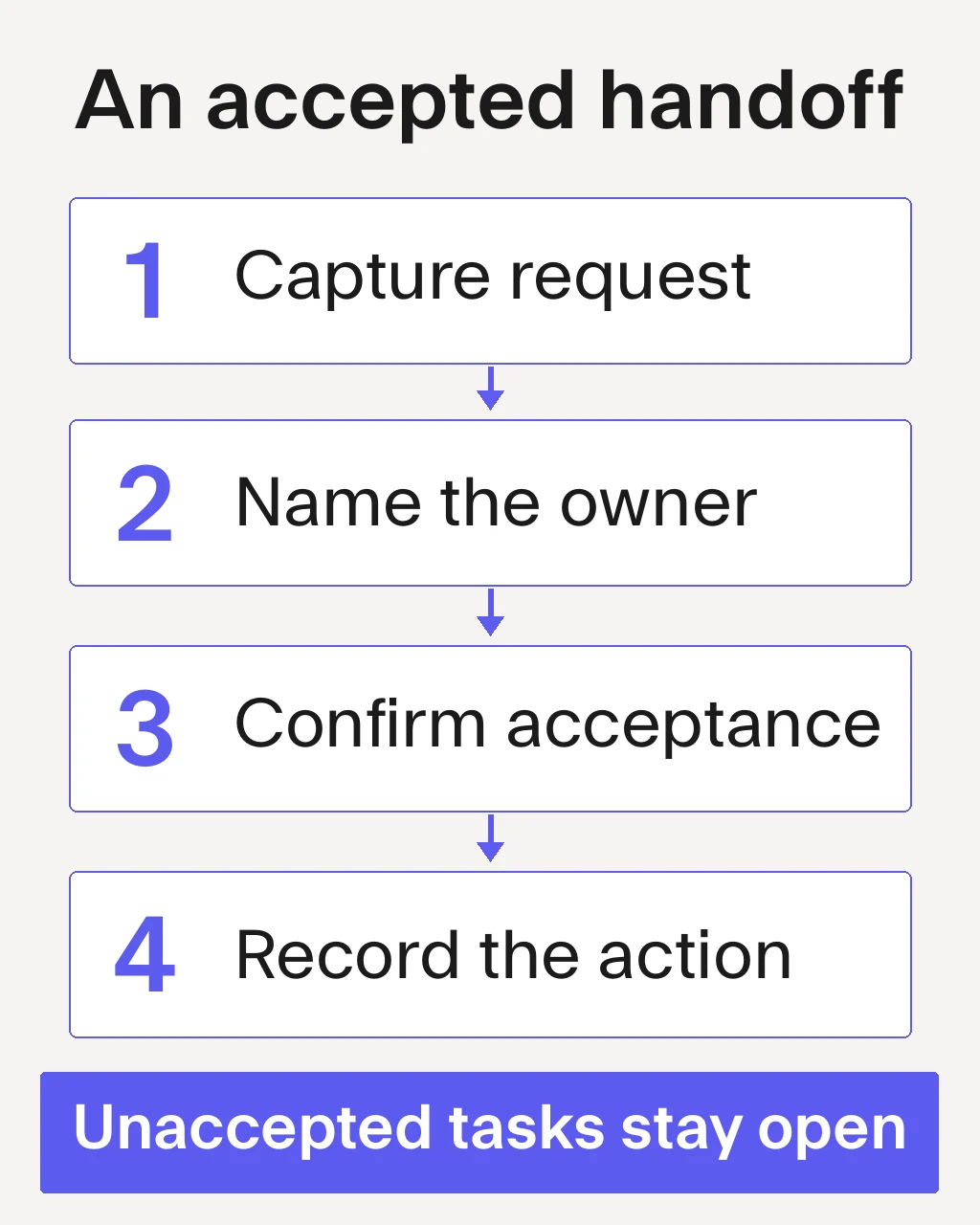
These are administrative handoffs. They do not transfer professional responsibility for a patient's care. The RACGP defines clinical handover as the transfer of professional responsibility and accountability between professionals in its clinical handover glossary.
Protect privacy during everyday reception work
The Office of the Australian Information Commissioner (OAIC) recommends clear staff procedures, privacy training, accountability and information security in its health practice privacy guidance.
Apply your practice's privacy and security procedures to everyday work:
- Use your individual login and access information only for authorised duties.
- Position screens and paper records away from public view, and secure them when unattended.
- Use approved communication channels and the patient's recorded contact preferences.
- Avoid including unnecessary clinical details in appointment messages.
- Report a wrong-file entry, misdirected message or other suspected privacy incident through the designated process.
For record-access requests, the OAIC says to establish the patient's identity or the representative's authority. Being a relative does not automatically establish authority. Route uncertainty to the practice's privacy lead through its information access process.
These practical controls need to reflect the laws and policies applying to your setting. Reception staff should not independently decide contested disclosure, retention or disposal questions.
Put the boundaries into the position description
A useful position description names the reporting line, duty groups, required skills and limits of authority. It also identifies the procedures and training needed for the work. Include:
- Who supervises reception and covers that person during absence.
- Which booking, records, payment and document tasks are assigned.
- Which exceptions need manager approval or clinical escalation.
- How messages, results-related tasks and shift handoffs are recorded.
- The role's privacy access level and incident-reporting route.
- How competence is demonstrated during induction and when duties change.
Communication, accurate data entry, discretion and confident use of practice systems matter across these duties. Training should include realistic scenarios, such as an uncertain patient match, a full appointment book with a possible urgent request and an unanswered clinician-directed recall.
Keep leadership and delegation distinct from front-desk delivery. Our guide to practice manager duties covers the broader management role.
Support document routing without removing review
Patients need incoming information to reach the right record and clinician. For reception teams handling this work, Document Sorter in our clinical AI platform suggests patient, clinician and document details for team review before saving to Best Practice. Nothing files automatically.
The team still reviews the match and follows the practice's routing process. Administrative review does not replace clinical review, determine a result's significance or close clinical follow-up. Keep the clinician's responsibility visible after the document is saved.
To discuss incoming-document routing with team review retained: