Patient follow-up protocol

Follow-up can fail even when each person completes their immediate task. A GP orders an investigation, a result arrives, reception leaves a message and the patient does not return. Every step may appear reasonable in isolation, yet the clinical action remains unfinished.
For Australian general practice, a patient follow-up protocol turns those separate steps into one accountable process. It tells clinicians and practice teams who owns each action, what to record, how to communicate, when to escalate and what evidence is needed before the item can be closed.
What is a patient follow-up protocol?
A patient follow-up protocol is the practice's agreed method for tracking a clinical action from initiation to resolution. It may cover investigations, results, referrals, medicine monitoring, post-consult reviews, preventive care and other actions that should not depend on memory alone.
A reliable patient follow-up system should show:
- what needs to happen and why
- the named clinician who is accountable
- any task delegated to another team member
- the due date or risk-based timeframe
- the patient's preferred and safe contact method
- each contact attempt and its outcome
- the next action if the patient does not respond
- the evidence that closes the loop
The Royal Australian College of General Practitioners (RACGP) has published the Standards for general practices (6th edition). Its current follow-up criterion is CG6, Follow-up systems. CG6 requires timely action on clinical information received, systems for clinically significant recalls, documentation of each attempt to contact and recall patients with clinically significant results, processes for missing results and reminders, and an after-hours system for high-risk results.
Accreditation is moving through a formal transition. The RACGP transition guidance says further information about timing and accreditation requirements will be communicated by the Australian Commission on Safety and Quality in Health Care. It also says all practices undergoing accreditation will need to meet the sixth edition after the transition period and notes an implementation period before assessments begin against the new edition. Fifth-edition criterion GP2.2 is identified below only where its older guidance adds useful context, not as the current sixth-edition criterion.
Why follow-up care matters
Follow-up connects a clinical decision with the action that should follow it: a repeat test, treatment change, review, referral, monitoring plan or documented informed refusal.
The risk is greatest when responsibility becomes ambiguous. A task may sit between an ordering clinician and a copied-in GP, between a permanent GP and a locum, or between a clinical decision and an administrative contact attempt. A shared inbox or task list can make work visible, but it does not make the whole team collectively accountable.
Clinical significance also depends on context. The former fifth-edition criterion GP2.2 made this point explicitly: a normal result can still require action when it does not explain a concerning presentation. Build the protocol around the probability and seriousness of harm from delay, including when a result is marked normal.
Recall and reminder are not the same
Use consistent language so staff know which workflow applies. The current RACGP CG6 guidance describes a recall as asking a patient to attend a consultation about a significant clinical matter, while reminders prompt routine or important preventive care.
| Term | Meaning | Usual workflow implication |
|---|---|---|
| Recall | A patient needs review within a specified period, including for a clinically significant result, specialist report, significant diagnosis or medicine management. | Requires an active process, recorded contact attempts and risk-based escalation. |
| Reminder | A proactive prompt for routine or important care, such as a preventive activity. | Send and record the reminder. The practice protocol can define whether and how to follow up a non-clinically significant reminder that receives no response. |
| Follow-up | The broader work needed to complete a clinical action. | May include result review, patient communication, a recall, a referral, treatment, monitoring and confirmation of completion. |
Do not let a recall become a routine reminder simply because the first message was unanswered. The accountable clinician should set the risk category and escalation pathway.
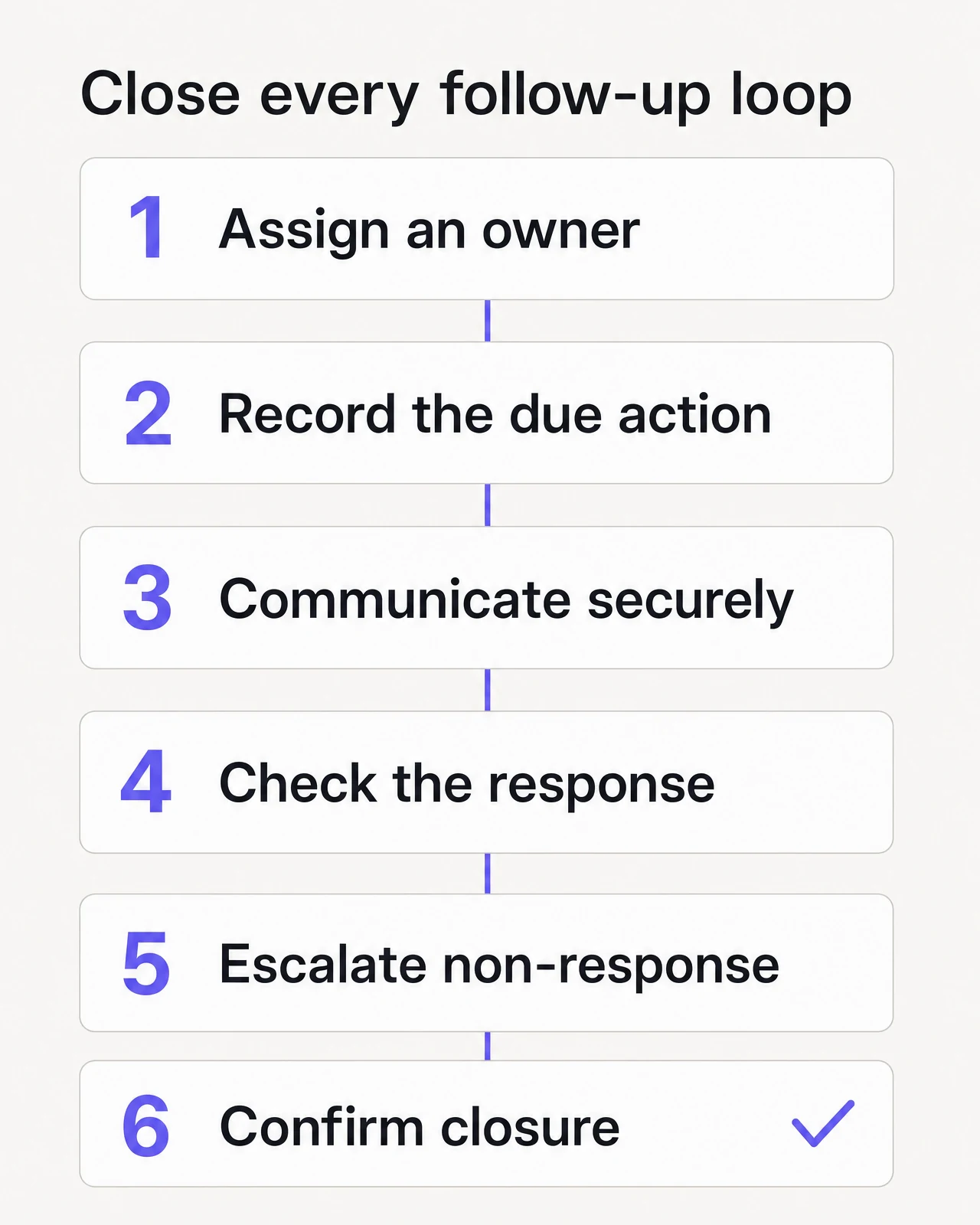
A six-stage closed-loop patient follow-up system
The exact timeframe and contact method should vary with clinical significance, patient circumstances and local policy. The six stages stay the same.
1. Assign an owner
Name the clinician accountable for each follow-up item. “Practice team”, “reception” or “GP to follow up” is not enough.
Administrative staff may make contact or arrange an appointment, and another clinician may provide cover, but delegation should state:
- the task being delegated
- who will perform it
- the timeframe
- what information that person may communicate
- when the matter must return to a clinician
- who monitors the queue while the usual owner is absent
The protocol should cover leave, rostered days off, locums, registrars, staff departure and unexpected absence. Avant's patient follow-up guidance recommends systems that address how results will be checked when doctors are away or no longer working at the practice.
For tests, Avant says responsibility generally rests with the ordering practitioner unless another arrangement has been agreed. When a regular GP receives a clinically significant result ordered elsewhere, Avant recommends checking whether it has been acted on by contacting the ordering practitioner about communication arrangements or asking the patient whether they received the result. Document the accepted responsibility and next action.
2. Record the due action
Create the follow-up item while the clinical plan is clear. Record:
- the investigation, referral, review or monitoring action
- the clinical reason and potential harm from delay
- when the result or response is expected
- what the patient has been asked to do
- what the practice will do
- patient-specific warning signs and where to seek help
- the planned response if the expected item does not arrive
Confirm current contact details, preferred contact method, privacy restrictions, communication needs and whether another person may be involved. Tell the patient how results will be communicated and what they should do if they have not heard within the expected period.
This conversation gives the patient a clear role. It does not transfer the practice's responsibility for an actively managed follow-up item.
The record should let the next authorised team member understand its state without reconstructing it from inboxes, sticky notes or memory.
| Field | What to record |
|---|---|
| Patient and item | Patient identifier, test, result, referral or follow-up action |
| Clinical context | Reason, significance, uncertainty and patient-specific risk |
| Owner | Named accountable clinician and delegated team member, if any |
| Timing | Date opened, expected result or action date, review date and next due date |
| Communication plan | Preferred safe channel, privacy or accessibility needs, interpreter or authorised support person |
| Attempts | Date, time, channel, person making contact, information conveyed and outcome |
| Escalation | Trigger, person notified, clinical decision and revised plan |
| Closure | What occurred, when, who confirmed it and any new follow-up item created |
Keep the follow-up record connected to the patient record. If appointment, billing and clinical systems are separate, define how information moves between them and which system is authoritative.
3. Communicate securely
Match the person, channel and message to clinical significance. Reception or administrative staff can usually arrange an appointment using approved neutral wording, such as: “Your doctor would like you to make an appointment this week to discuss your recent test results.” They should not interpret a result or decide how urgent it is.
The responsible clinician should communicate significant or unexpected findings in a way that allows explanation, questions and a clear plan. As legacy context, the former fifth-edition GP2.2 guidance described informing patients of clinically significant results in person as best practice and suggested considering an appropriate telehealth platform when an in-person consultation was not possible. That statement comes from GP2.2 of the fifth edition, rather than current sixth-edition CG6.
Whichever channel is used:
- confirm identity before sharing clinical information
- give only the information appropriate to that channel and staff role
- use the patient's recorded contact preference where clinically appropriate
- protect privacy in voicemail, SMS and email wording
- use a qualified interpreter when needed
- explain the result in plain language and check understanding
- state the next action, timeframe and warning signs
- document the conversation, questions and agreed plan
4. Check the response
A portal upload, automated message or “sent” status proves transmission, not understanding or action. Avant notes that uploading a result to My Health Record does not change the responsibility to follow up the result and recall the patient when required.
Check whether the expected response occurred: Did the patient receive and understand the information? Did they book or attend? Was the referral received? Did the expected result arrive? Was the clinical action completed?
Record failed attempts as well as successful ones. “Called patient” is too thin to support the next decision. State whether the call connected, a privacy-safe message was left, the number was incorrect, the patient declined or another action is due.
Current RACGP CG6 requires practices to identify and follow up clinical information that has not been reviewed or actioned, as well as investigations and results that have not been received. It also requires follow-up actions to be documented in the patient health record. These requirements appear in the CG6 guidance.
5. Escalate non-response
Do not impose one contact schedule on every item. Set intensity in proportion to clinical significance, likely harm from delay, urgency, patient vulnerability, available contact methods and what was agreed with the patient.
A risk-based escalation ladder may include:
- Repeat contact at a different time. Use the preferred number and try different times where appropriate.
- Use another approved channel. This may include a privacy-safe SMS, email or letter if permitted by local policy and the patient's communication arrangements.
- Return the item to the accountable clinician. The clinician reassesses urgency and decides whether the method, frequency or message should change.
- Identify barriers. Check for incorrect contact information, language, hearing, digital access, transport, cost or appointment barriers.
- Use a formal written step when clinically warranted. Avant recommends considering a registered letter that explains the importance and risk of not proceeding, retaining a copy and tracking delivery.
- Activate the urgent pathway. For a serious and immediate threat to life, health or safety, use the practice's emergency process and seek professional or medico-legal advice where needed.
Current RACGP CG6 gives up to three calls at different times followed by an email, text or letter as an example of what a practice recall policy could include, based on the practice setting. It is an example, not a universal minimum or a safe stopping point. The same CG6 recall guidance requires privacy-sensitive methods for patients who may be at risk and documentation that does not increase known or suspected risk.
Document the clinical reasoning for changing or ending escalation. If the patient makes an informed refusal, record the information provided, their decision, questions, safety-netting and any follow-up that remains necessary.
6. Confirm closure
Do not close an item because a message was sent, a referral was transmitted or an appointment was offered. Close it when the intended clinical outcome has occurred or responsibility has been explicitly transferred and accepted.
Depending on the item, closure may require evidence that:
- the result or report was received and reviewed
- clinical significance and the required action were recorded
- the patient was informed and their understanding was checked
- the review occurred or treatment was started
- a referral was received or accepted when confirmation is clinically necessary
- the patient attended, or non-attendance was risk-assessed and escalated
- informed refusal was documented
- a new follow-up action has a named owner and due date
If a required step remains unresolved, the item is still open. Move it to a state such as “awaiting patient”, “awaiting provider”, “escalated” or “review due” rather than marking it complete.
A practical patient follow-up protocol template
Use this structure to turn the workflow into a practice policy.
| Protocol section | Practice decision to document |
|---|---|
| Scope | Which results, referrals, reviews, monitoring tasks and preventive activities are covered? |
| Risk categories | How are routine, clinically significant, urgent and life-threatening items defined and who assigns the category? |
| Ownership | Who is accountable by default, how is responsibility accepted, and how is cover assigned? |
| Timeframes | When should each category be reviewed, contacted, escalated and audited? |
| Contact methods | Which channels may be used, for what information, with what identity and privacy checks? |
| Non-response | What attempts are expected for each risk category and when does the item return to a clinician? |
| After-hours results | Who can receive and act on high-risk results, and how do diagnostic services contact them? |
| Documentation | Which fields and contact outcomes are mandatory, and where is the authoritative record? |
| Closure | What evidence is required for each item type before it can be marked complete? |
| Downtime and absence | How are open items covered during leave, staff turnover, outages, cyber incidents or other disruptions? |
| Training and audit | How are permanent, temporary, locum, registrar, clinical and non-clinical staff inducted and periodically checked? |
Include the protocol in induction and rehearse it with realistic scenarios. Staff should know what to do when a high-risk result arrives after hours, when the usual GP is away, when contact details fail and when a copied result has no obvious owner.
Improving patient follow-up without adding noise
Improvement is less about sending more messages and more about reducing ambiguity. Start with the failures your practice can see.
Review the open queue
Counts of calls or reminders sent can look reassuring while high-risk items remain unresolved. Review open and overdue items by risk, owner and age.
Useful measures include:
- clinically significant recalls without a named owner
- open items beyond their risk-based due date
- results received but not reviewed
- expected significant results or reports that have not arrived
- failed contacts awaiting clinician reassessment
- closed items without evidence of the required outcome
- recurring barriers such as invalid contact details or unavailable appointments
Use measures to find system problems, not to judge an individual without context.
Sample the whole loop
Audit a small number of cases from initiation to closure. Check whether the order, expected timeframe, result, review, patient communication, next action and closure evidence can all be followed in sequence.
Include ordinary cases as well as near misses. Near misses often reveal silent gaps such as inbox cover, duplicate systems or a status that staff interpret differently.
Standardise routine documentation
Templates can help staff record the same minimum information, use privacy-safe contact wording and escalate consistently. Keep room for clinical judgement. A template should prompt reasoning rather than determine the significance of a result or when pursuit can stop.
Where documentation technology can help
Software can support parts of the protocol, but it should not be mistaken for the protocol itself. A safe implementation distinguishes documentation support, communication, scheduling and a true clinical recall function.
Lyrebird can draft structured clinical notes, referral letters, care plans and other documents and letters from consult information. Clinicians review and edit each draft before saving or sending it. Custom templates can prompt consistent fields such as the next action, patient advice and follow-up responsibility. In supported integrations, clinicians can write reviewed notes or documents back to the patient record.
These capabilities can reduce re-keying and make the plan clearer. They do not make Lyrebird a complete recall engine, determine clinical significance, prove message receipt or close an unresolved follow-up task. Our patient communication software guide explains the questions to ask about two-way communication, delivery status, consent, escalation and audit trails.
Whatever tools the practice uses, the clinician remains responsible for reviewing drafted clinical content and the practice remains responsible for configuring and governing the end-to-end follow-up system.
Final checklist for every follow-up item
Before leaving an item, confirm:
- The clinical action and risk are clear.
- One accountable clinician is named.
- Delegated tasks and cover arrangements are explicit.
- The expected result, response or review date is recorded.
- The patient knows what to expect and what to do if it does not happen.
- Contact preferences, privacy and accessibility needs are current.
- Every attempt and outcome is documented.
- Non-response has a risk-based escalation path.
- The item is closed only with evidence of resolution or accepted transfer.
A good patient follow-up protocol makes unfinished care visible. It gives every open action an owner, a due point and a next step, then keeps that responsibility active until the patient, clinician and record are aligned.
Ready to make follow-up responsibilities clearer in clinical documentation? Contact us.