Education
5 min read

Patient Notification and Follow-Up of Abnormal Test Results
Published on
September 29, 2026
Abnormal test results: patient follow-up title card on a violet Lyrebird background
Contributors
Lyrebird Health
Subscribe to our newsletter
Read about our privacy policy.
Thank you! Your submission has been received!
Oops! Something went wrong while submitting the form.

An abnormal result can pass through a laboratory, inbox, clinician, receptionist and patient before the required care happens. Every hand-off creates a chance for delay or ambiguity. Australian clinicians and practice teams need one traceable workflow that gives each result an owner, matches communication to clinical risk and keeps follow-up open until the intended action is complete.

Start by assessing clinical significance

A value outside a reference range is not automatically clinically significant. Its meaning depends on the patient, the reason for testing, the size and direction of the change, previous results and the harm that delay could cause. A result within the reference range may still require action. The RACGP's fifth-edition GP2.2 guidance gives a normal mammogram in a patient with a breast lump as one example that still requires further consultation, investigation and management.

The Royal Australian College of General Practitioners (RACGP) uses clinically significant for a result that matters in the context of that patient's care. Its current follow-up systems standard expects practices to act on clinical information in a timely way, document attempts to contact patients about clinically significant results and follow up investigations when a result has not arrived.

This distinction matters because software flags cannot set urgency on their own. A clinician must review the result and assign the action, timeframe and communication method.

What Australian practices are expected to have in place

The RACGP published the Standards for general practices (6th edition) in August 2026. It supersedes the fifth edition, although accreditation still uses the fifth edition while transition arrangements are developed.

The core expectations are consistent across both editions. A practice needs systems that:

  • ensure clinical information is reviewed, notated, acted on where required and incorporated into the patient record
  • recall patients with clinically significant results and document each contact attempt
  • monitor tests and investigations when an expected result has not been received
  • explain to patients how the practice communicates results
  • manage seriously abnormal and life-threatening results outside normal opening hours.

The Medical Board of Australia's code also requires clear communication, attention to a patient's language and communication needs, and accurate, timely records of investigations, information given and management.

These requirements describe outcomes rather than a universal call count or deadline. The responsible clinician still sets urgency according to the probability and seriousness of harm, the patient's circumstances and the action required.

A closed-loop workflow for abnormal results

The safest process begins when the test is ordered and continues beyond the report reaching the inbox. It has six stages and ends when the appropriate clinical action has occurred. If the practice cannot reach the patient, escalation branches from the contact stage and returns the result to active follow-up rather than replacing the remaining stages.
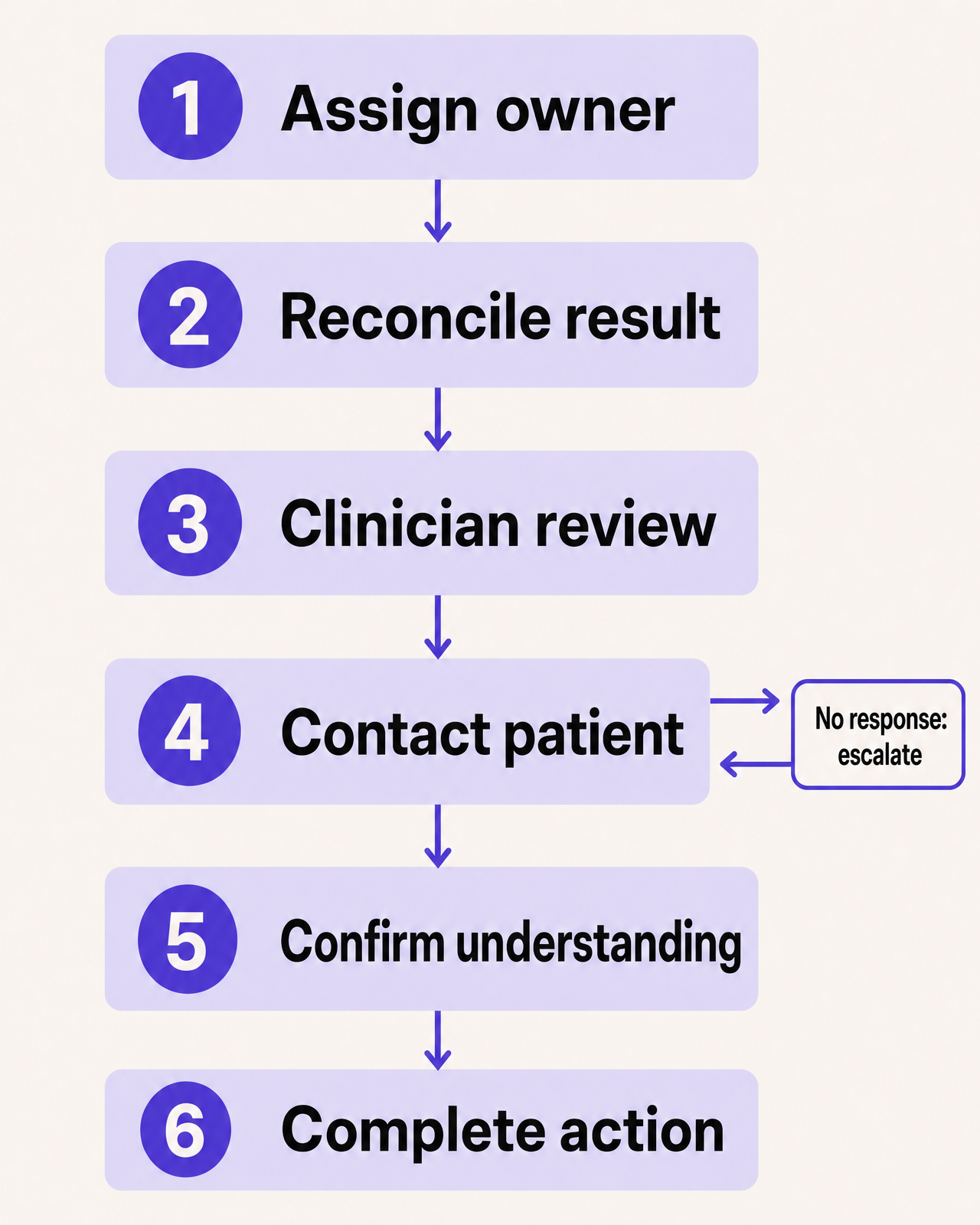
Six-step closed-loop workflow for abnormal test results, with escalation and retry after non-response

1. Assign ownership when ordering

For a test ordered within the practice, the requesting clinician is the default owner of the result. Record a named covering clinician or agreed team for leave, part-time work and after-hours periods. A shared inbox without named accountability leaves ownership unclear.

The RACGP's fifth-edition GP2.2 standard states that GPs must ensure results from tests they order are recorded and appropriately followed up. For a test ordered outside the practice, it says responsibility for timely review and action ultimately rests with the ordering health professional unless that professional made a prior agreement with the GP. This includes results ordered by a specialist or another health professional and copied to the GP.

GP2.2 also cautions that a GP who sees a copied result may assume some clinical responsibility, particularly when it is unclear whether the ordering clinician has acted. For a clinically significant copied result, the guidance describes contacting the requester to clarify follow-up, advising the patient to follow up, or both. Sometimes it may be in the patient's interests for their regular GP to act. A copied result therefore needs an active decision rather than an assumption that responsibility sits elsewhere.

At the time of ordering, record:

  • the test, indication and question it is intended to answer
  • when the result is expected and who will monitor its return
  • the patient's preferred and safe contact methods, current details and any authorised representative
  • interpreter, accessibility, capacity or safety considerations
  • the likely next step for normal, abnormal or inconclusive findings
  • what the patient should do if the result has not been communicated by the agreed time.

Tell the patient when and how they should expect to hear from the practice. Avoid “no news is good news”.

2. Reconcile expected and received results

An inbox only shows reports that arrived. The practice also needs a way to find ordered tests with no result, incomplete panels, preliminary reports awaiting a final version and amended reports that require another review.

Route incoming results to the named owner or covering clinician. Use an interrupt pathway for a laboratory or imaging service that reports a high-risk finding by phone. Keep patient matching and misfiled-document exceptions visible until a team member resolves them.

The pathology service has obligations at its end of the chain. The National Pathology Accreditation Advisory Council's high-risk pathology standard requires pathology services to use a risk-based alert list, escalate failed initial notifications and document each step. A practice policy should meet that process with current after-hours contacts and a recipient who can acknowledge and act.

3. Clinician review and risk-rate the result

The clinician reviews the report in context, documents their interpretation and assigns an action and deadline. A practical local classification is:

Result categoryCommunication aimFollow-up control
Critical or life-threateningReach a person who can act immediatelyDirect synchronous contact, explicit acknowledgement and immediate escalation if contact fails
Clinically significant and time-sensitiveExplain the finding and arrange review within the clinician-set timeframeActive recall with an owner, due time and non-response pathway
Non-urgent but actionableExplain the next step without creating false reassurance or avoidable alarmApproved channel with a response or booking checkpoint
Reviewed, no action requiredApply the practice's stated result policy and answer foreseeable patient questionsRecord clinician review and any patient notification

The category reflects likely harm from delay. A laboratory flag alone cannot establish it. Document the rationale when the action may be unclear to the next clinician.

4. Contact the patient through a channel that fits the risk

A 2025 systematic review of 71 studies examined communication of blood-test results from primary care to adult patients and carers. It found that electronic methods were generally well accepted, but not by everyone or for all results. The authors reported that study quality was mostly poor and risk of bias was high, so the findings support offering channel choice rather than treating electronic communication as a universal default. Channel choice needs to account for urgency, complexity, privacy, access and the patient's preferences.

ChannelAppropriate useSafety controls
In-person consultUnexpected, sensitive or complex results where examination, counselling or shared decisions may be neededAllow questions, explain uncertainty and use teach-back
Telephone or video consultUrgent or significant results when an in-person review would cause unsafe delay, or when telehealth is clinically suitableVerify identity, speak privately and document the discussion and plan
Secure portal or approved SMSLow-complexity information, or a prompt to contact the practice or book a defined reviewUse minimal necessary detail and require a response for actionable results; a sent or delivered message is not proof of understanding
EmailInformation suitable for the practice's risk-assessed email processVerify the address and use approved security measures; record the communication
LetterA patient preference, accessibility need or additional route after failed electronic contactDo not rely on routine post for a result that needs prompt action; choose traceability according to risk

The Office of the Australian Information Commissioner notes that result notifications and recalls will often fall within the care a patient reasonably expects, while the circumstances still determine whether consent can be implied. Its patient communication guidance should inform the practice's privacy controls. Avoid putting sensitive clinical detail into voicemail, SMS or an unprotected email unless the channel and content have been risk assessed and agreed.

Administrative staff can arrange an appointment using an approved script, such as “Your doctor would like to discuss your recent result today”. They should not interpret the result, choose urgency or reassure the patient unless the responsible clinician has supplied specific instructions that sit within their role.

My Health Record access is not acknowledgement

Since 1 July 2026, in-scope pathology and diagnostic imaging providers must upload reports to My Health Record by default unless an exception or extension applies. Most pathology reports are available to patients as soon as they are uploaded, while many imaging and some pathology reports have a five-day delay. The Australian Digital Health Agency's current provider guidance says that, when requesting pathology or diagnostic imaging services, providers may wish to discuss report availability with patients and confirm follow-up arrangements.

A patient opening a report does not show that they understood its significance or know what to do. It also does not discharge the requester's follow-up responsibility. Treat My Health Record as another access route, and keep the practice's review, notification, acknowledgement and action controls in place.

If contact fails: escalate according to risk

There is no safe universal number of calls. Three unanswered calls may be excessive for a minor result and wholly insufficient for a likely malignancy or critical electrolyte disturbance.

A risk-based escalation ladder should tell the team to:

  1. verify the number used and check the patient record for updated contact details
  2. retry at different times and use another approved channel
  3. contact an authorised representative when permission and circumstances support it
  4. return the unresolved result to the clinician at the defined escalation point so they can reassess urgency
  5. consider relevant treating clinicians, a traceable letter, emergency services or a welfare check when the clinical risk and applicable privacy rules justify that step
  6. keep the recall open until the clinician documents a defensible endpoint.

The effort should increase with the likely harm of delay and with patient-specific barriers such as language, disability, unstable housing, family violence risk or limited digital access. Do not let an automated sequence continue after its clinical assumptions are no longer safe.

5. Confirm receipt, understanding and the next action

“Message sent” and “patient notified” are different states. A useful record distinguishes:

  1. the communication was sent
  2. it reached the intended person
  3. identity was confirmed
  4. the patient received an explanation
  5. the patient understood the urgency and next step.

Record the agreed action and its completion at stage six rather than treating notification alone as closure.

The endpoint depends on the risk. A routine non-actionable result may be complete after clinician review and an approved notification. A significant result needs evidence that the patient received and understood the plan. A portal read receipt or voicemail cannot close a result that requires two-way communication.

Use plain language to cover the finding, what it may mean, the recommended action, the timeframe, red flags and how to obtain help. Ask the patient to explain the plan back in their own words when the consequences of misunderstanding are material. Arrange the appointment, repeat test or referral where possible instead of leaving the next step as a general instruction.

If the patient declines follow-up, explain the likely consequences and reasonable alternatives, confirm capacity and understanding, document informed refusal and give clear safety-netting advice. Refusal changes the endpoint, but it does not erase the need for a clinical record.

6. Track the action to completion

A booked appointment is an intermediate state. A referral sent, repeat test requested or medicine change advised may also remain incomplete.

Define the clinical endpoint for each result, such as:

  • the patient attended and the management plan was documented
  • a repeat test was performed and reviewed
  • a referral was received and accepted, with urgency communicated
  • the patient was transferred to emergency care
  • another clinician accepted a documented handover
  • informed refusal was recorded after an adequate discussion.

Only then should the result leave the active follow-up queue.

What to document in the patient record

The entry should let another clinician understand what happened without reconstructing several inboxes. Record:

  • the result, date received, reviewer and date and time of review
  • the clinical interpretation, risk category, required action and timeframe
  • every contact attempt, including channel, date, time, destination and outcome
  • who was reached and how identity or authority was established
  • the information given, the patient's questions and evidence of understanding
  • appointments, referrals, repeat tests, treatment or safety-netting arranged
  • non-response escalation, handover and acceptance by another clinician
  • informed refusal, capacity considerations and advice given
  • the final outcome and the date the follow-up loop was closed.

Avoid entries such as “patient informed” or “left message” without the result-specific plan. Keep the clinical record as the source of truth and reconcile any separate messaging, booking or task systems back to it.

Build the practice system around exceptions

Standardisation helps the practice team see what has fallen outside the expected path. The written policy should define roles, risk categories, communication boundaries, after-hours cover, absence cover, expected-result reconciliation, non-response escalation and closure criteria. Include it in induction and rehearse the handling of a simulated critical result.

Review a small set of operational measures regularly:

  • time from result availability to clinician review
  • time from review to successful patient contact
  • high-risk results acknowledged within the practice's policy timeframe
  • ordered tests with no result by the expected date
  • open recalls by age and risk
  • preliminary or amended reports awaiting review
  • results closed without a documented action or communication outcome
  • near misses, complaints and privacy incidents.

A clinical documentation audit can test whether the record supports the workflow rather than merely whether fields are complete.

Where Lyrebird can support the workflow

Clinical judgement, ownership and escalation remain with the practice. Technology can reduce avoidable friction around those decisions.

For practices using Bp Premier, our Document Sorter can extract patient and clinician details from incoming documents, present confidence scores, route verified documents to the doctor's inbox or patient record and log the destination and status. A team member still reviews before filing, and the responsible clinician still decides significance and follow-up.

Our Documents & Letters workflows can use a clinical note to generate documents and let practices build custom templates around their structure, language and formatting. Generated documents remain drafts for clinician review, editing and sign-off.

The goal is one visible path from result to completed care, with fewer opportunities for ownership, communication or documentation to disappear between systems.

Contact us to discuss how Lyrebird could fit within your practice's clinician-led result and document workflows.


More Resources
Continue reading
Posts
The dangers of Copy Paste Scribes
Read More
Posts
How to use an AI medical scribe
Read More
Posts
December Product Updates
Read More
Education
eReferral in Australia: A Practical Guide for Clinicians
Read More
Education
Medical Clearance Certificate for Work: Australian Guide
Read More
Education
NDIS Supporting Evidence Form: A Clinician’s Guide
Read More
Post
5 min read

Patient Notification and Follow-Up of Abnormal Test Results

Published on
September 29, 2026
Abnormal test results: patient follow-up title card on a violet Lyrebird background
Contributors
Lyrebird Health
Subscribe to our newsletter
Read about our privacy policy.
Thank you! Your submission has been received!
Oops! Something went wrong while submitting the form.

An abnormal result can pass through a laboratory, inbox, clinician, receptionist and patient before the required care happens. Every hand-off creates a chance for delay or ambiguity. Australian clinicians and practice teams need one traceable workflow that gives each result an owner, matches communication to clinical risk and keeps follow-up open until the intended action is complete.

Start by assessing clinical significance

A value outside a reference range is not automatically clinically significant. Its meaning depends on the patient, the reason for testing, the size and direction of the change, previous results and the harm that delay could cause. A result within the reference range may still require action. The RACGP's fifth-edition GP2.2 guidance gives a normal mammogram in a patient with a breast lump as one example that still requires further consultation, investigation and management.

The Royal Australian College of General Practitioners (RACGP) uses clinically significant for a result that matters in the context of that patient's care. Its current follow-up systems standard expects practices to act on clinical information in a timely way, document attempts to contact patients about clinically significant results and follow up investigations when a result has not arrived.

This distinction matters because software flags cannot set urgency on their own. A clinician must review the result and assign the action, timeframe and communication method.

What Australian practices are expected to have in place

The RACGP published the Standards for general practices (6th edition) in August 2026. It supersedes the fifth edition, although accreditation still uses the fifth edition while transition arrangements are developed.

The core expectations are consistent across both editions. A practice needs systems that:

  • ensure clinical information is reviewed, notated, acted on where required and incorporated into the patient record
  • recall patients with clinically significant results and document each contact attempt
  • monitor tests and investigations when an expected result has not been received
  • explain to patients how the practice communicates results
  • manage seriously abnormal and life-threatening results outside normal opening hours.

The Medical Board of Australia's code also requires clear communication, attention to a patient's language and communication needs, and accurate, timely records of investigations, information given and management.

These requirements describe outcomes rather than a universal call count or deadline. The responsible clinician still sets urgency according to the probability and seriousness of harm, the patient's circumstances and the action required.

A closed-loop workflow for abnormal results

The safest process begins when the test is ordered and continues beyond the report reaching the inbox. It has six stages and ends when the appropriate clinical action has occurred. If the practice cannot reach the patient, escalation branches from the contact stage and returns the result to active follow-up rather than replacing the remaining stages.

Six-step closed-loop workflow for abnormal test results, with escalation and retry after non-response

1. Assign ownership when ordering

For a test ordered within the practice, the requesting clinician is the default owner of the result. Record a named covering clinician or agreed team for leave, part-time work and after-hours periods. A shared inbox without named accountability leaves ownership unclear.

The RACGP's fifth-edition GP2.2 standard states that GPs must ensure results from tests they order are recorded and appropriately followed up. For a test ordered outside the practice, it says responsibility for timely review and action ultimately rests with the ordering health professional unless that professional made a prior agreement with the GP. This includes results ordered by a specialist or another health professional and copied to the GP.

GP2.2 also cautions that a GP who sees a copied result may assume some clinical responsibility, particularly when it is unclear whether the ordering clinician has acted. For a clinically significant copied result, the guidance describes contacting the requester to clarify follow-up, advising the patient to follow up, or both. Sometimes it may be in the patient's interests for their regular GP to act. A copied result therefore needs an active decision rather than an assumption that responsibility sits elsewhere.

At the time of ordering, record:

  • the test, indication and question it is intended to answer
  • when the result is expected and who will monitor its return
  • the patient's preferred and safe contact methods, current details and any authorised representative
  • interpreter, accessibility, capacity or safety considerations
  • the likely next step for normal, abnormal or inconclusive findings
  • what the patient should do if the result has not been communicated by the agreed time.

Tell the patient when and how they should expect to hear from the practice. Avoid “no news is good news”.

2. Reconcile expected and received results

An inbox only shows reports that arrived. The practice also needs a way to find ordered tests with no result, incomplete panels, preliminary reports awaiting a final version and amended reports that require another review.

Route incoming results to the named owner or covering clinician. Use an interrupt pathway for a laboratory or imaging service that reports a high-risk finding by phone. Keep patient matching and misfiled-document exceptions visible until a team member resolves them.

The pathology service has obligations at its end of the chain. The National Pathology Accreditation Advisory Council's high-risk pathology standard requires pathology services to use a risk-based alert list, escalate failed initial notifications and document each step. A practice policy should meet that process with current after-hours contacts and a recipient who can acknowledge and act.

3. Clinician review and risk-rate the result

The clinician reviews the report in context, documents their interpretation and assigns an action and deadline. A practical local classification is:

Result categoryCommunication aimFollow-up control
Critical or life-threateningReach a person who can act immediatelyDirect synchronous contact, explicit acknowledgement and immediate escalation if contact fails
Clinically significant and time-sensitiveExplain the finding and arrange review within the clinician-set timeframeActive recall with an owner, due time and non-response pathway
Non-urgent but actionableExplain the next step without creating false reassurance or avoidable alarmApproved channel with a response or booking checkpoint
Reviewed, no action requiredApply the practice's stated result policy and answer foreseeable patient questionsRecord clinician review and any patient notification

The category reflects likely harm from delay. A laboratory flag alone cannot establish it. Document the rationale when the action may be unclear to the next clinician.

4. Contact the patient through a channel that fits the risk

A 2025 systematic review of 71 studies examined communication of blood-test results from primary care to adult patients and carers. It found that electronic methods were generally well accepted, but not by everyone or for all results. The authors reported that study quality was mostly poor and risk of bias was high, so the findings support offering channel choice rather than treating electronic communication as a universal default. Channel choice needs to account for urgency, complexity, privacy, access and the patient's preferences.

ChannelAppropriate useSafety controls
In-person consultUnexpected, sensitive or complex results where examination, counselling or shared decisions may be neededAllow questions, explain uncertainty and use teach-back
Telephone or video consultUrgent or significant results when an in-person review would cause unsafe delay, or when telehealth is clinically suitableVerify identity, speak privately and document the discussion and plan
Secure portal or approved SMSLow-complexity information, or a prompt to contact the practice or book a defined reviewUse minimal necessary detail and require a response for actionable results; a sent or delivered message is not proof of understanding
EmailInformation suitable for the practice's risk-assessed email processVerify the address and use approved security measures; record the communication
LetterA patient preference, accessibility need or additional route after failed electronic contactDo not rely on routine post for a result that needs prompt action; choose traceability according to risk

The Office of the Australian Information Commissioner notes that result notifications and recalls will often fall within the care a patient reasonably expects, while the circumstances still determine whether consent can be implied. Its patient communication guidance should inform the practice's privacy controls. Avoid putting sensitive clinical detail into voicemail, SMS or an unprotected email unless the channel and content have been risk assessed and agreed.

Administrative staff can arrange an appointment using an approved script, such as “Your doctor would like to discuss your recent result today”. They should not interpret the result, choose urgency or reassure the patient unless the responsible clinician has supplied specific instructions that sit within their role.

My Health Record access is not acknowledgement

Since 1 July 2026, in-scope pathology and diagnostic imaging providers must upload reports to My Health Record by default unless an exception or extension applies. Most pathology reports are available to patients as soon as they are uploaded, while many imaging and some pathology reports have a five-day delay. The Australian Digital Health Agency's current provider guidance says that, when requesting pathology or diagnostic imaging services, providers may wish to discuss report availability with patients and confirm follow-up arrangements.

A patient opening a report does not show that they understood its significance or know what to do. It also does not discharge the requester's follow-up responsibility. Treat My Health Record as another access route, and keep the practice's review, notification, acknowledgement and action controls in place.

If contact fails: escalate according to risk

There is no safe universal number of calls. Three unanswered calls may be excessive for a minor result and wholly insufficient for a likely malignancy or critical electrolyte disturbance.

A risk-based escalation ladder should tell the team to:

  1. verify the number used and check the patient record for updated contact details
  2. retry at different times and use another approved channel
  3. contact an authorised representative when permission and circumstances support it
  4. return the unresolved result to the clinician at the defined escalation point so they can reassess urgency
  5. consider relevant treating clinicians, a traceable letter, emergency services or a welfare check when the clinical risk and applicable privacy rules justify that step
  6. keep the recall open until the clinician documents a defensible endpoint.

The effort should increase with the likely harm of delay and with patient-specific barriers such as language, disability, unstable housing, family violence risk or limited digital access. Do not let an automated sequence continue after its clinical assumptions are no longer safe.

5. Confirm receipt, understanding and the next action

“Message sent” and “patient notified” are different states. A useful record distinguishes:

  1. the communication was sent
  2. it reached the intended person
  3. identity was confirmed
  4. the patient received an explanation
  5. the patient understood the urgency and next step.

Record the agreed action and its completion at stage six rather than treating notification alone as closure.

The endpoint depends on the risk. A routine non-actionable result may be complete after clinician review and an approved notification. A significant result needs evidence that the patient received and understood the plan. A portal read receipt or voicemail cannot close a result that requires two-way communication.

Use plain language to cover the finding, what it may mean, the recommended action, the timeframe, red flags and how to obtain help. Ask the patient to explain the plan back in their own words when the consequences of misunderstanding are material. Arrange the appointment, repeat test or referral where possible instead of leaving the next step as a general instruction.

If the patient declines follow-up, explain the likely consequences and reasonable alternatives, confirm capacity and understanding, document informed refusal and give clear safety-netting advice. Refusal changes the endpoint, but it does not erase the need for a clinical record.

6. Track the action to completion

A booked appointment is an intermediate state. A referral sent, repeat test requested or medicine change advised may also remain incomplete.

Define the clinical endpoint for each result, such as:

  • the patient attended and the management plan was documented
  • a repeat test was performed and reviewed
  • a referral was received and accepted, with urgency communicated
  • the patient was transferred to emergency care
  • another clinician accepted a documented handover
  • informed refusal was recorded after an adequate discussion.

Only then should the result leave the active follow-up queue.

What to document in the patient record

The entry should let another clinician understand what happened without reconstructing several inboxes. Record:

  • the result, date received, reviewer and date and time of review
  • the clinical interpretation, risk category, required action and timeframe
  • every contact attempt, including channel, date, time, destination and outcome
  • who was reached and how identity or authority was established
  • the information given, the patient's questions and evidence of understanding
  • appointments, referrals, repeat tests, treatment or safety-netting arranged
  • non-response escalation, handover and acceptance by another clinician
  • informed refusal, capacity considerations and advice given
  • the final outcome and the date the follow-up loop was closed.

Avoid entries such as “patient informed” or “left message” without the result-specific plan. Keep the clinical record as the source of truth and reconcile any separate messaging, booking or task systems back to it.

Build the practice system around exceptions

Standardisation helps the practice team see what has fallen outside the expected path. The written policy should define roles, risk categories, communication boundaries, after-hours cover, absence cover, expected-result reconciliation, non-response escalation and closure criteria. Include it in induction and rehearse the handling of a simulated critical result.

Review a small set of operational measures regularly:

  • time from result availability to clinician review
  • time from review to successful patient contact
  • high-risk results acknowledged within the practice's policy timeframe
  • ordered tests with no result by the expected date
  • open recalls by age and risk
  • preliminary or amended reports awaiting review
  • results closed without a documented action or communication outcome
  • near misses, complaints and privacy incidents.

A clinical documentation audit can test whether the record supports the workflow rather than merely whether fields are complete.

Where Lyrebird can support the workflow

Clinical judgement, ownership and escalation remain with the practice. Technology can reduce avoidable friction around those decisions.

For practices using Bp Premier, our Document Sorter can extract patient and clinician details from incoming documents, present confidence scores, route verified documents to the doctor's inbox or patient record and log the destination and status. A team member still reviews before filing, and the responsible clinician still decides significance and follow-up.

Our Documents & Letters workflows can use a clinical note to generate documents and let practices build custom templates around their structure, language and formatting. Generated documents remain drafts for clinician review, editing and sign-off.

The goal is one visible path from result to completed care, with fewer opportunities for ownership, communication or documentation to disappear between systems.

Contact us to discuss how Lyrebird could fit within your practice's clinician-led result and document workflows.

Keep reading

All posts
Questions about compliance?