Education
5 min read

Discharge Planning: A Practical Guide for Clinical Teams

Published on
October 2, 2026
Discharge planning on a violet Lyrebird Health background
Contributors
Lyrebird Health
Subscribe to our newsletter
Read about our privacy policy.
Thank you! Your submission has been received!
Oops! Something went wrong while submitting the form.

Discharge is a change in who provides care, where care happens and who acts next. Safe discharge planning prepares the patient, their support people and every service involved for that change. For Australian medical, nursing, allied health and care-coordination teams, the work starts well before the patient is ready to leave. A clear process helps the team recognise barriers early, assign responsibility and make follow-up usable outside the hospital.

What is discharge planning?

Discharge planning is the development of an individualised plan for a patient leaving hospital or another health service. It connects the inpatient episode with care at home, in primary care, in rehabilitation, in residential care or in another service.

The plan brings together clinical readiness, the patient's goals, medicines, functional and psychosocial needs, equipment, services, transport, education, handover and follow-up. The Australian Commission on Safety and Quality in Health Care states that discharge should be considered from the beginning of care.

Under Action 5.13 of the National Safety and Quality Health Service (NSQHS) Standards, clinicians use shared decision-making processes to develop and document a comprehensive and individualised plan. That plan commences discharge planning at the beginning of the episode and includes a plan for referral to follow-up services, if appropriate and available. A current Commission advisory clarifies that the action does not require one document to contain the whole plan, but core information should be easy for the multidisciplinary team to share, access and act on.

A discharge plan is different from a discharge summary. Planning is the multidisciplinary process that prepares and coordinates the transition. The summary is one clinical document produced as part of that process. Our separate guide covers discharge summary writing, including what the document should contain.

For mainly older medical inpatients, individualised planning has measurable, though modest, benefits. A 2022 Cochrane review included 33 trials with 12,242 participants.

Among people admitted with medical conditions, pooled results from 11 trials found a mean 0.73-day reduction in initial hospital stay, and 17 trials found a relative reduction in readmission risk over an average of three months (risk ratio 0.89, or about 11%). Both estimates came from moderate-certainty evidence. The impact on health status and cost remained uncertain, so discharge planning should be treated as a patient-safety and coordination process rather than a guarantee against readmission.

A practical 10-step discharge planning process

The sequence below turns national expectations and current Australian guidance into a usable ward workflow. Local policy, clinical governance and the needs of the patient still determine who completes each action.
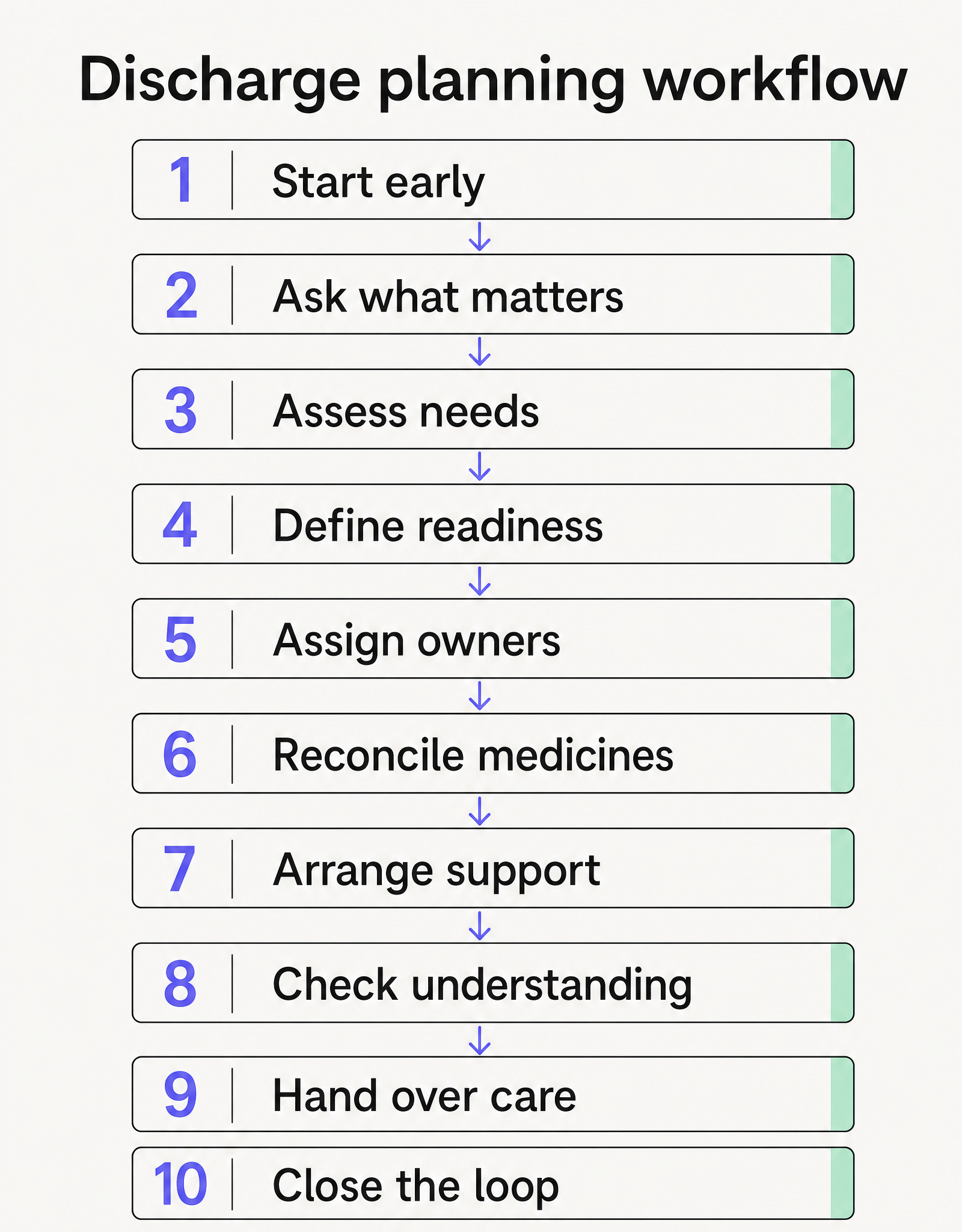
Ten-step discharge planning workflow from early preparation to closing the follow-up loop

1. Start at or before admission

For planned care, identify likely discharge needs during pre-admission. For an unplanned admission, start on admission. Record the likely destination, an estimated date of discharge where used locally, and the factors that could delay a safe transition.

Planning early gives the team time to arrange assessments, medicines, equipment, transport and external services. The 2026 Queensland best-practice guide recommends that multidisciplinary teams identify barriers early and review the expected discharge date during regular huddles, case conferences or ward rounds.

2. Ask what matters to the patient

Agree on the proposed destination and goals with the patient. Ask who they want involved, what support they already have, what they are worried about and what a workable recovery looks like to them.

Record communication preferences, language and accessibility needs. Arrange an accredited interpreter or relevant cultural support when needed. Involve family, carers, kin or a substitute decision-maker in line with the patient's wishes and decision-making capacity.

3. Assess needs and risks in context

Bring the relevant assessments into one picture. Depending on the admission, this may include:

  • current clinical problems and criteria for stability
  • cognition, mental health, behaviour and decision-making capacity
  • mobility, falls risk, personal care and ability to use equipment
  • medicines, allergies, adherence risks and access to supply
  • nutrition, swallowing, continence, wounds and other care needs
  • the home environment, housing, transport, finances and carer capacity
  • existing primary, community, disability, aged care or social services
  • the patient's ability and confidence to manage after discharge.

Assessments should be proportionate to the transition. They should identify what is needed for safe movement into the next setting, rather than delay discharge while every longer-term issue is resolved in an acute bed.

4. Define readiness and a contingency plan

Document the clinical and practical conditions that need to be met. Readiness criteria might cover observations, symptoms, mobility, oral intake, pain control, wound care, equipment, medicine supply or completion of essential teaching.

Name who can confirm that the criteria have been met under local governance. Criteria-led discharge may allow an authorised nurse, allied health professional or junior medical officer to act once pre-agreed criteria are satisfied. It does not replace clinical review, monitoring or escalation when the patient falls outside those criteria.

Also record the alternative if the preferred plan becomes unavailable. A plan without a contingency can fail when transport is cancelled, a carer cannot attend or a community service has no capacity.

5. Build a shared action plan

When you build the shared plan, turn assessed needs into actions with an owner and timeframe. Avoid entries such as “community follow-up” or “allied health to review” without saying who will do what and by when.

A useful task entry has five parts:

  1. Action: what must happen.
  2. Owner: the named role, team or service responsible.
  3. Due point: when it must happen.
  4. Status: requested, accepted, booked, complete or escalated.
  5. Contingency: what happens if it cannot be completed.

The coordinator keeps the overall plan moving, while each clinician remains responsible for work within their scope. Review the live plan whenever the patient's condition, destination or support needs change.

6. Reconcile medicines and access

Compare medicines before admission, during the stay and at discharge. Resolve discrepancies and record what has started, stopped or changed, with reasons. Confirm allergies and adverse reactions.

Give the patient a current medicine list, required prescriptions or supply, and instructions they can follow. Address practical barriers such as dose administration aids, cost, pharmacy access, swallowing difficulty and who will administer medicines. Higher-risk regimens may need pharmacist counselling and direct communication with the receiving clinician or pharmacist.

7. Arrange services, equipment and appointments

Make referrals early enough for the receiving service to assess and respond. Confirm what has been accepted or booked rather than treating “referral sent” as completion.

Before the patient leaves, clarify:

  • where they are going and how they will get there
  • what equipment, wound supplies or medicines will travel with them
  • which existing services will restart
  • which new services have accepted the referral
  • the date, location and purpose of each appointment
  • who will arrange any appointment that is still outstanding.

Escalate barriers through local pathways when a required service, placement or item is unavailable. Clinical readiness and system readiness are separate questions, and both need a visible plan.

8. Prepare the patient and check understanding

Teach throughout the admission instead of compressing every instruction into the final hour. Tailor spoken and written information to the patient's language, health literacy, cognition, culture and ability to act on it.

Cover what happened, the recovery plan, medicines, equipment, self-care, restrictions, follow-up and safety-netting. Use teach-back by asking the patient or carer to explain the plan in their own words, then clarify anything that is missing. The Commission recommends teach-back or clarification to confirm understanding during clinical communication.

Safety-netting should state the expected course, warning signs, who to contact, how urgently to seek help and what to do if the planned service does not make contact.

9. Complete handover and transfer accountability

Send accurate, current information to the clinician or service taking over care. Structured clinical handover includes the patient's goals and preferences, relevant risks, medicines, equipment, pending work, follow-up and escalation contacts.

NSQHS Action 6.08 requires clinical handover to result in the transfer of responsibility and accountability. Where local risk assessment identifies a high-risk transition, use direct clinician-to-clinician communication and document acknowledgement. Uploading a document or sending a referral does not by itself show that the next service has accepted the task.

Provide the patient with the information they need and complete the discharge summary within the timeframe set by local policy. If the summary is uploaded to My Health Record, it can support access to information. The Commission notes that My Health Record can support transitions but does not replace thorough clinician-to-clinician handover.

10. Close the loop after discharge

Match follow-up intensity to risk. A low-risk patient with a clear plan may use patient-initiated contact. A person with complex care, low confidence, a high-risk medicine, uncertain support or recent deterioration may need a scheduled call, rapid review or nurse-navigation pathway.

Pending results need special attention. Record the named clinician or team that will review each result, the expected timeframe, how the patient will be told and what escalation applies if the result is delayed or abnormal. Reconcile the final plan with what actually occurred, and hand back any uncompleted task rather than allowing it to become ownerless.

Who is responsible for discharge planning?

Discharge planning is a shared responsibility, with overall accountability kept visible. Exact duties vary by service, scope of practice and local policy. One person may coordinate the process. Each clinician retains responsibility for decisions and actions within their scope.

ParticipantCore contribution
Patient, family, carers and support peopleShare goals, preferences, living circumstances and concerns; participate in decisions and education; explain what support is realistic.
Treating medical team or authorised clinicianDirect treatment, define clinical readiness, approve or delegate discharge under governance, resolve clinical risk and ensure an actionable medical handover.
NursesTrack readiness across shifts, identify changing needs, coordinate bedside preparation, teach self-care, use teach-back, escalate barriers and confirm practical arrangements.
Discharge coordinator, case manager or nurse navigatorMaintain the overall plan, connect disciplines and services, track dependencies and escalate delays.
PharmacistReconcile medicines, explain changes, support supply and adherence, and communicate high-risk medicine issues.
Allied health cliniciansAssess function, cognition, communication, nutrition and equipment needs; arrange rehabilitation and practical supports within their disciplines.
Social worker or care coordinatorAddress housing, safeguarding, carer strain, psychosocial needs, service access and complex placement or support arrangements.
Administrative teamBook approved appointments and transport, send documents through authorised channels and track receipt within the local workflow.
GP, community clinician or receiving serviceWhen accepting the transition, clarify unclear tasks, continue the agreed plan and act on follow-up assigned to them.

The nursing role in discharge planning

Nursing discharge planning runs through the admission, rather than beginning when paperwork is printed. Nurses see how the patient manages medicines, mobility, personal care, devices, symptoms and new information across shifts. That makes nursing assessment central to identifying a gap between “clinically stable” and “ready to manage in the next setting”.

At each handover, nursing teams can keep the plan active by documenting progress against readiness criteria, confirming completed education, escalating new barriers and stating what remains outstanding. The nurse should not have to absorb tasks that lack an owner. Unclear medical decisions, unmet criteria or unsafe arrangements need escalation through the agreed clinical and operational chain.

Communication that survives the transition

Good discharge communication works for three audiences: the patient, the receiving team and the people completing tasks before departure. Each needs different detail, but all versions must agree.

Use a simple “owner, action, time, trigger” test for every follow-up instruction:

  • Owner: who is responsible?
  • Action: what exactly will they do?
  • Time: by when?
  • Trigger: what finding or change requires escalation, and to whom?

For example, “GP follow-up” is too vague. “Patient to see usual GP within seven days for blood-pressure review; hospital team to review pending culture and phone the patient if treatment changes” separates the tasks and their owners. Use a structured format such as Identification, Situation, Background, Assessment and Recommendation (ISBAR handover) when direct communication is required, while following the receiving service's preferred process.

Barriers to effective discharge planning

Many discharge-planning barriers are workflow gaps rather than missing forms. Teams can make common barriers visible and manage them earlier.

BarrierPractical response
Planning starts on the day of dischargeScreen for likely needs at or before admission and review barriers during routine multidisciplinary rounds.
No clear coordinator or task ownerName the coordinator, the clinician with overall accountability and an owner for every action.
Information is spread across notes, boards and conversationsMaintain a current shared view of the plan and reconcile it with the patient record at each material change.
The patient or carer is brought in lateDiscuss goals, destination, support and concerns from the outset; use interpreters and accessible formats where needed.
Medicines are reconciled too lateStart reconciliation early, explain every change and organise supply before departure.
Equipment, transport, services or placement are unavailableRefer early, track acceptance, set escalation points and agree a safe contingency.
Follow-up or pending results have no confirmed ownerRecord the task, named owner, timeframe, communication method and escalation route.
Teams disagree about acceptable riskUse shared decision-making, assess capacity when indicated, document the discussion and escalate through clinical governance or ethics pathways.

The goal is a safe, person-centred transition, not discharge at any cost. Equally, keeping a clinically ready patient in acute care can introduce other harms. Teams need to balance clinical risk, patient preference, available support and the risks of delay.

Make documentation support the plan

Safe transitions depend on visible ownership, sound clinical judgement and a plan the patient can follow. Documentation should make that plan easier to see, act on and review. Shared templates can prompt teams to record readiness criteria, owners, referrals, medicines, safety-netting and outstanding results consistently. Integrations can reduce re-entry, but no system can decide that a patient is ready or transfer accountability without clinical action.

Our clinical AI platform can support the documentation around discharge planning by helping clinicians capture notes, dictate key handover details and create structured draft documents in local templates. Every draft still requires clinical review, editing and sign-off. The plan itself remains a multidisciplinary clinical responsibility.

For teams assessing how clinical AI could fit their governed discharge workflow, Contact us.

More Resources
Continue reading
Posts
The dangers of Copy Paste Scribes
Read More
Posts
How to use an AI medical scribe
Read More
Posts
December Product Updates
Read More
Education
eReferral in Australia: A Practical Guide for Clinicians
Read More
Education
Medical Clearance Certificate for Work: Australian Guide
Read More
Education
NDIS Supporting Evidence Form: A Clinician’s Guide
Read More
Post
5 min read

Discharge Planning: A Practical Guide for Clinical Teams

Published on
October 2, 2026
Discharge planning on a violet Lyrebird Health background
Contributors
Lyrebird Health
Subscribe to our newsletter
Read about our privacy policy.
Thank you! Your submission has been received!
Oops! Something went wrong while submitting the form.

Discharge is a change in who provides care, where care happens and who acts next. Safe discharge planning prepares the patient, their support people and every service involved for that change. For Australian medical, nursing, allied health and care-coordination teams, the work starts well before the patient is ready to leave. A clear process helps the team recognise barriers early, assign responsibility and make follow-up usable outside the hospital.

What is discharge planning?

Discharge planning is the development of an individualised plan for a patient leaving hospital or another health service. It connects the inpatient episode with care at home, in primary care, in rehabilitation, in residential care or in another service.

The plan brings together clinical readiness, the patient's goals, medicines, functional and psychosocial needs, equipment, services, transport, education, handover and follow-up. The Australian Commission on Safety and Quality in Health Care states that discharge should be considered from the beginning of care.

Under Action 5.13 of the National Safety and Quality Health Service (NSQHS) Standards, clinicians use shared decision-making processes to develop and document a comprehensive and individualised plan. That plan commences discharge planning at the beginning of the episode and includes a plan for referral to follow-up services, if appropriate and available. A current Commission advisory clarifies that the action does not require one document to contain the whole plan, but core information should be easy for the multidisciplinary team to share, access and act on.

A discharge plan is different from a discharge summary. Planning is the multidisciplinary process that prepares and coordinates the transition. The summary is one clinical document produced as part of that process. Our separate guide covers discharge summary writing, including what the document should contain.

For mainly older medical inpatients, individualised planning has measurable, though modest, benefits. A 2022 Cochrane review included 33 trials with 12,242 participants.

Among people admitted with medical conditions, pooled results from 11 trials found a mean 0.73-day reduction in initial hospital stay, and 17 trials found a relative reduction in readmission risk over an average of three months (risk ratio 0.89, or about 11%). Both estimates came from moderate-certainty evidence. The impact on health status and cost remained uncertain, so discharge planning should be treated as a patient-safety and coordination process rather than a guarantee against readmission.

A practical 10-step discharge planning process

The sequence below turns national expectations and current Australian guidance into a usable ward workflow. Local policy, clinical governance and the needs of the patient still determine who completes each action.

Ten-step discharge planning workflow from early preparation to closing the follow-up loop

1. Start at or before admission

For planned care, identify likely discharge needs during pre-admission. For an unplanned admission, start on admission. Record the likely destination, an estimated date of discharge where used locally, and the factors that could delay a safe transition.

Planning early gives the team time to arrange assessments, medicines, equipment, transport and external services. The 2026 Queensland best-practice guide recommends that multidisciplinary teams identify barriers early and review the expected discharge date during regular huddles, case conferences or ward rounds.

2. Ask what matters to the patient

Agree on the proposed destination and goals with the patient. Ask who they want involved, what support they already have, what they are worried about and what a workable recovery looks like to them.

Record communication preferences, language and accessibility needs. Arrange an accredited interpreter or relevant cultural support when needed. Involve family, carers, kin or a substitute decision-maker in line with the patient's wishes and decision-making capacity.

3. Assess needs and risks in context

Bring the relevant assessments into one picture. Depending on the admission, this may include:

  • current clinical problems and criteria for stability
  • cognition, mental health, behaviour and decision-making capacity
  • mobility, falls risk, personal care and ability to use equipment
  • medicines, allergies, adherence risks and access to supply
  • nutrition, swallowing, continence, wounds and other care needs
  • the home environment, housing, transport, finances and carer capacity
  • existing primary, community, disability, aged care or social services
  • the patient's ability and confidence to manage after discharge.

Assessments should be proportionate to the transition. They should identify what is needed for safe movement into the next setting, rather than delay discharge while every longer-term issue is resolved in an acute bed.

4. Define readiness and a contingency plan

Document the clinical and practical conditions that need to be met. Readiness criteria might cover observations, symptoms, mobility, oral intake, pain control, wound care, equipment, medicine supply or completion of essential teaching.

Name who can confirm that the criteria have been met under local governance. Criteria-led discharge may allow an authorised nurse, allied health professional or junior medical officer to act once pre-agreed criteria are satisfied. It does not replace clinical review, monitoring or escalation when the patient falls outside those criteria.

Also record the alternative if the preferred plan becomes unavailable. A plan without a contingency can fail when transport is cancelled, a carer cannot attend or a community service has no capacity.

5. Build a shared action plan

When you build the shared plan, turn assessed needs into actions with an owner and timeframe. Avoid entries such as “community follow-up” or “allied health to review” without saying who will do what and by when.

A useful task entry has five parts:

  1. Action: what must happen.
  2. Owner: the named role, team or service responsible.
  3. Due point: when it must happen.
  4. Status: requested, accepted, booked, complete or escalated.
  5. Contingency: what happens if it cannot be completed.

The coordinator keeps the overall plan moving, while each clinician remains responsible for work within their scope. Review the live plan whenever the patient's condition, destination or support needs change.

6. Reconcile medicines and access

Compare medicines before admission, during the stay and at discharge. Resolve discrepancies and record what has started, stopped or changed, with reasons. Confirm allergies and adverse reactions.

Give the patient a current medicine list, required prescriptions or supply, and instructions they can follow. Address practical barriers such as dose administration aids, cost, pharmacy access, swallowing difficulty and who will administer medicines. Higher-risk regimens may need pharmacist counselling and direct communication with the receiving clinician or pharmacist.

7. Arrange services, equipment and appointments

Make referrals early enough for the receiving service to assess and respond. Confirm what has been accepted or booked rather than treating “referral sent” as completion.

Before the patient leaves, clarify:

  • where they are going and how they will get there
  • what equipment, wound supplies or medicines will travel with them
  • which existing services will restart
  • which new services have accepted the referral
  • the date, location and purpose of each appointment
  • who will arrange any appointment that is still outstanding.

Escalate barriers through local pathways when a required service, placement or item is unavailable. Clinical readiness and system readiness are separate questions, and both need a visible plan.

8. Prepare the patient and check understanding

Teach throughout the admission instead of compressing every instruction into the final hour. Tailor spoken and written information to the patient's language, health literacy, cognition, culture and ability to act on it.

Cover what happened, the recovery plan, medicines, equipment, self-care, restrictions, follow-up and safety-netting. Use teach-back by asking the patient or carer to explain the plan in their own words, then clarify anything that is missing. The Commission recommends teach-back or clarification to confirm understanding during clinical communication.

Safety-netting should state the expected course, warning signs, who to contact, how urgently to seek help and what to do if the planned service does not make contact.

9. Complete handover and transfer accountability

Send accurate, current information to the clinician or service taking over care. Structured clinical handover includes the patient's goals and preferences, relevant risks, medicines, equipment, pending work, follow-up and escalation contacts.

NSQHS Action 6.08 requires clinical handover to result in the transfer of responsibility and accountability. Where local risk assessment identifies a high-risk transition, use direct clinician-to-clinician communication and document acknowledgement. Uploading a document or sending a referral does not by itself show that the next service has accepted the task.

Provide the patient with the information they need and complete the discharge summary within the timeframe set by local policy. If the summary is uploaded to My Health Record, it can support access to information. The Commission notes that My Health Record can support transitions but does not replace thorough clinician-to-clinician handover.

10. Close the loop after discharge

Match follow-up intensity to risk. A low-risk patient with a clear plan may use patient-initiated contact. A person with complex care, low confidence, a high-risk medicine, uncertain support or recent deterioration may need a scheduled call, rapid review or nurse-navigation pathway.

Pending results need special attention. Record the named clinician or team that will review each result, the expected timeframe, how the patient will be told and what escalation applies if the result is delayed or abnormal. Reconcile the final plan with what actually occurred, and hand back any uncompleted task rather than allowing it to become ownerless.

Who is responsible for discharge planning?

Discharge planning is a shared responsibility, with overall accountability kept visible. Exact duties vary by service, scope of practice and local policy. One person may coordinate the process. Each clinician retains responsibility for decisions and actions within their scope.

ParticipantCore contribution
Patient, family, carers and support peopleShare goals, preferences, living circumstances and concerns; participate in decisions and education; explain what support is realistic.
Treating medical team or authorised clinicianDirect treatment, define clinical readiness, approve or delegate discharge under governance, resolve clinical risk and ensure an actionable medical handover.
NursesTrack readiness across shifts, identify changing needs, coordinate bedside preparation, teach self-care, use teach-back, escalate barriers and confirm practical arrangements.
Discharge coordinator, case manager or nurse navigatorMaintain the overall plan, connect disciplines and services, track dependencies and escalate delays.
PharmacistReconcile medicines, explain changes, support supply and adherence, and communicate high-risk medicine issues.
Allied health cliniciansAssess function, cognition, communication, nutrition and equipment needs; arrange rehabilitation and practical supports within their disciplines.
Social worker or care coordinatorAddress housing, safeguarding, carer strain, psychosocial needs, service access and complex placement or support arrangements.
Administrative teamBook approved appointments and transport, send documents through authorised channels and track receipt within the local workflow.
GP, community clinician or receiving serviceWhen accepting the transition, clarify unclear tasks, continue the agreed plan and act on follow-up assigned to them.

The nursing role in discharge planning

Nursing discharge planning runs through the admission, rather than beginning when paperwork is printed. Nurses see how the patient manages medicines, mobility, personal care, devices, symptoms and new information across shifts. That makes nursing assessment central to identifying a gap between “clinically stable” and “ready to manage in the next setting”.

At each handover, nursing teams can keep the plan active by documenting progress against readiness criteria, confirming completed education, escalating new barriers and stating what remains outstanding. The nurse should not have to absorb tasks that lack an owner. Unclear medical decisions, unmet criteria or unsafe arrangements need escalation through the agreed clinical and operational chain.

Communication that survives the transition

Good discharge communication works for three audiences: the patient, the receiving team and the people completing tasks before departure. Each needs different detail, but all versions must agree.

Use a simple “owner, action, time, trigger” test for every follow-up instruction:

  • Owner: who is responsible?
  • Action: what exactly will they do?
  • Time: by when?
  • Trigger: what finding or change requires escalation, and to whom?

For example, “GP follow-up” is too vague. “Patient to see usual GP within seven days for blood-pressure review; hospital team to review pending culture and phone the patient if treatment changes” separates the tasks and their owners. Use a structured format such as Identification, Situation, Background, Assessment and Recommendation (ISBAR handover) when direct communication is required, while following the receiving service's preferred process.

Barriers to effective discharge planning

Many discharge-planning barriers are workflow gaps rather than missing forms. Teams can make common barriers visible and manage them earlier.

BarrierPractical response
Planning starts on the day of dischargeScreen for likely needs at or before admission and review barriers during routine multidisciplinary rounds.
No clear coordinator or task ownerName the coordinator, the clinician with overall accountability and an owner for every action.
Information is spread across notes, boards and conversationsMaintain a current shared view of the plan and reconcile it with the patient record at each material change.
The patient or carer is brought in lateDiscuss goals, destination, support and concerns from the outset; use interpreters and accessible formats where needed.
Medicines are reconciled too lateStart reconciliation early, explain every change and organise supply before departure.
Equipment, transport, services or placement are unavailableRefer early, track acceptance, set escalation points and agree a safe contingency.
Follow-up or pending results have no confirmed ownerRecord the task, named owner, timeframe, communication method and escalation route.
Teams disagree about acceptable riskUse shared decision-making, assess capacity when indicated, document the discussion and escalate through clinical governance or ethics pathways.

The goal is a safe, person-centred transition, not discharge at any cost. Equally, keeping a clinically ready patient in acute care can introduce other harms. Teams need to balance clinical risk, patient preference, available support and the risks of delay.

Make documentation support the plan

Safe transitions depend on visible ownership, sound clinical judgement and a plan the patient can follow. Documentation should make that plan easier to see, act on and review. Shared templates can prompt teams to record readiness criteria, owners, referrals, medicines, safety-netting and outstanding results consistently. Integrations can reduce re-entry, but no system can decide that a patient is ready or transfer accountability without clinical action.

Our clinical AI platform can support the documentation around discharge planning by helping clinicians capture notes, dictate key handover details and create structured draft documents in local templates. Every draft still requires clinical review, editing and sign-off. The plan itself remains a multidisciplinary clinical responsibility.

For teams assessing how clinical AI could fit their governed discharge workflow, Contact us.

Keep reading

All posts
Questions about compliance?