Medical Clearance Certificate for Work: Australian Guide
A request for “medical clearance” can sound simple, yet the document only helps when it answers the workplace’s actual question: what duties can this person perform safely, from what date and under what conditions? Australian workers, employers and clinicians need to understand the document’s scope, the information required for an assessment and the line between clearance, sick leave evidence and workers’ compensation certification.
What a medical clearance certificate confirms
A medical clearance certificate is a clinician’s written opinion about a person’s fitness for a defined job or workplace activity. It may be called a return-to-work certificate, fitness-for-work certificate, medical clearance form or fitness-for-duty certificate.
The opinion should connect the person’s current function with the relevant duties. It may confirm that the person is:
- fit for their usual duties from a stated date
- fit for modified duties, hours or conditions for a stated period
- not yet fit to return, with a review date or further assessment required.
Clearance is therefore narrower than a declaration that someone is “healthy” or risk-free. A person may be managing an ongoing condition and still be able to perform the inherent requirements of a role, with or without reasonable adjustments. The Australian Human Rights Commission describes inherent requirements as the essential qualifications, skills, tasks and ways a job must be performed, including safe performance. It also explains that workplace questions should relate to the job, safety or reasonable adjustments, rather than unrelated health details. Read the Commission’s workplace guidance.
There is no single national form for every ordinary, non-claim medical clearance. The employer may supply a form or written questions, and some professions, organisations or activities have their own requirements. Pre-employment screening can also include a medical declaration or examination, with the employer setting out the process. myGov explains pre-employment checks.
When a workplace may ask for clearance
The trigger depends on the role, the reason for absence, workplace policy, any award or enterprise agreement, and the level of health and safety risk. Common situations include:
- returning after surgery, injury, significant illness or an extended absence
- returning before the end date on an earlier certificate of incapacity
- resuming safety-sensitive, manual, driving, food-handling or patient-facing duties
- returning with reduced hours, task limits or other temporary adjustments
- confirming fitness after a condition has changed or symptoms have recurred
- assessing capacity against the inherent requirements of a new role
- completing a role-specific form before training, placement or physical testing.
A workplace should state what it needs the clinician to assess. “Fit for work” alone gives little clinical context. A role description, list of physical and cognitive demands, roster and proposed modified duties make a more useful opinion possible.
An ordinary clearance request is also separate from evidence for paid sick or carer’s leave. Under the National Employment Standards, an employer can request reasonable evidence that an employee was entitled to the leave. A medical certificate or statutory declaration can be acceptable evidence, and an award or registered agreement may set further rules. Read Fair Work’s evidence rules.
Medical clearance, sick certificates and capacity certificates
These documents answer different questions. Using the wrong one can delay a return or a claim.
| Document | Main question | Typical content | Usual setting |
|---|---|---|---|
| Sick or personal-leave certificate | Was the person unfit for work during these dates? | Patient and clinician identifiers, assessment and issue dates, period of incapacity, and limited clinical detail | Evidence for sick leave or absence |
| Medical clearance certificate | What work can the person do safely now, and from when? | Defined role or duties, full or modified capacity, restrictions, effective date, duration and review point | Ordinary return to work, pre-employment or role-specific clearance outside a claim |
| Workers’ compensation certificate of capacity | How does a work-related injury or illness affect capacity within the relevant claim scheme? | Scheme-mandated fields such as diagnosis, relationship to work, treatment, capacity, functional limits, suitable duties and review dates | A workers’ compensation claim managed under a state, territory or Commonwealth scheme |
Australia has 11 main workers’ compensation schemes, each governed by different laws and processes. See Australia’s compensation schemes. If a work-related injury or illness is part of a claim, use the current form and instructions from the relevant authority rather than substituting a generic clearance letter.
For example, Comcare’s certificate asks a legally qualified medical practitioner to document the injury or illness, current capacity and limitations, and to update the opinion as the condition changes. See Comcare’s capacity requirements. Our separate WorkCover certificate guide covers the compensation workflow in more detail.
What a useful medical clearance certificate contains
The required fields depend on the recipient and purpose. For an ordinary work clearance, this checklist gives the clinician and workplace a practical starting point:
- patient’s name and another identifier where appropriate
- date of assessment and date of issue
- intended purpose and recipient
- job title and the duties, inherent requirements or workplace activities considered
- source of the duty information, such as an employer form, position description or worker’s account
- a clear outcome: full duties, modified duties or not yet fit
- the date the opinion takes effect
- functional restrictions stated in workable terms
- permitted hours, shifts or graduated schedule where relevant
- recommended adjustments or suitable duties, if within the clinician’s scope
- duration of restrictions and a review date
- limits of the opinion, including any information or examination that was unavailable
- clinician’s name, qualifications, contact details, signature and any identifier required by the form.
Purpose-specific forms can be more detailed. For example, NSW Education’s pre-employment assessment asks the treating doctor to review the role’s published inherent requirements, record whether the applicant meets them with or without restrictions, and state the days and hours the applicant is fit to work.
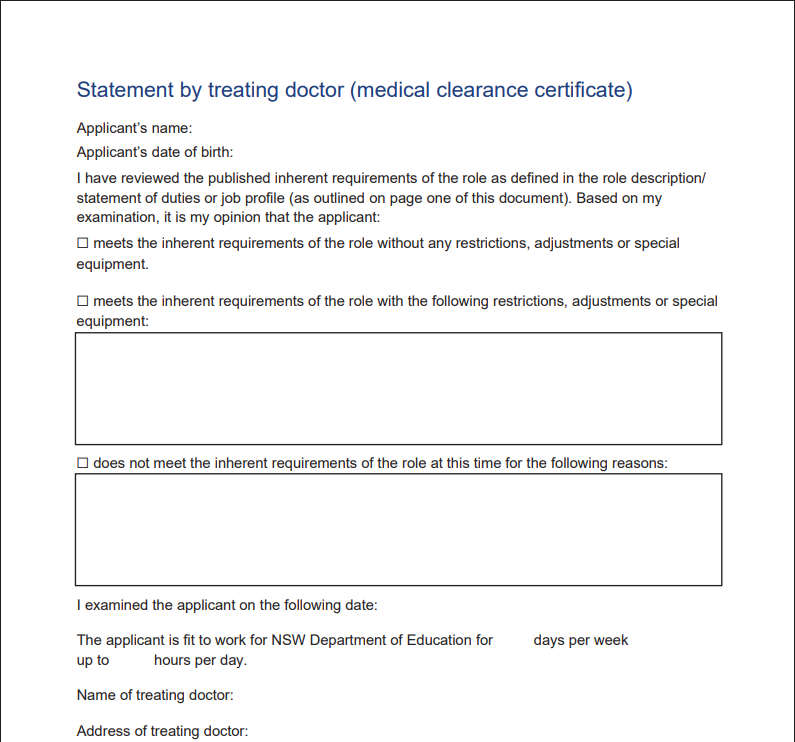
Source: © State of New South Wales (Department of Education), 2023. Image cropped from the official assessment form and licensed under CC BY 4.0, as set out in the department’s copyright statement.
Restrictions should describe function rather than use vague labels such as “light duties”. Depending on the role, useful wording may specify lifting limits, overhead work, prolonged standing, driving, night shifts, concentration demands, exposure risks, breaks or maximum hours. The employee and employer can then turn that advice into a practical return-to-work plan. JobAccess recommends that a plan record duties, hours, breaks, restrictions, support and any staged increase in workload. See the JobAccess return-to-work steps.
Three clear outcome formats
The following are structural examples, not stand-alone certificates:
Full duties: “Following assessment on [date] and review of [role/duty information], [person] is fit to resume their usual duties from [date].”
Modified duties: “From [date] to [date/review], [person] has capacity for [hours/shifts] subject to [specific functional limits]. They should be reviewed on [date].”
Not yet fit: “Based on the assessment on [date], [person] is not currently fit to resume [defined role or duties]. Review is planned for [date], when capacity will be reassessed.”
The clinician should adapt the opinion to the evidence and the form requested. A statement about one role, set of duties or date should not be treated as a permanent clearance for every type of work.
How to get the right clearance for work
The following is a practical workflow, not a national statutory process. Adapt it to the employer’s request and any profession, industry or compensation requirements.
1. Ask the employer for the exact requirement
Get the request in writing. Ask for the employer’s form, position description, inherent requirements, main hazards and the reason clearance is being requested. Confirm whether the workplace needs full clearance, advice about restrictions, or completion of a particular scheme or industry form.
2. Book with an appropriate clinician
The requesting form or policy should identify who may complete it. A GP or relevant specialist commonly provides medical clearance, while some settings accept advice from another registered health practitioner within their scope. A scheme-specific or safety-critical assessment may prescribe the practitioner, tests or form.
3. Bring the information needed for a duty-specific opinion
Take the employer’s request and form, a current duty statement, earlier certificates, relevant investigation or specialist reports, a medication list and any proposed modified duties. Be ready to explain current symptoms, recovery, treatment and how you manage the actual physical, cognitive and psychosocial demands of the role.
4. Complete the clinical assessment
The clinician decides what history, examination, records or tests are needed. Telehealth may be suitable when the clinician can obtain enough information to form a safe opinion. It is not suitable for every clearance. The Medical Board of Australia states that telehealth should meet the same standard as in-person care and that an in-person assessment is needed when the limitations of telehealth prevent an adequate examination. Read the telehealth guidelines.
The Board also states that issuing certificates through questionnaire-based asynchronous tools without a real-time patient-doctor consultation is not good practice. Read its online certificate advice.
5. Give the document to the intended recipient
Check the dates, role, outcome and restrictions before submitting it. If the employer needs clarification, communication with the clinician should stay within the agreed purpose and proceed with the patient’s consent or another applicable lawful basis. The certificate is only one part of a safe return: the workplace still needs to decide how it will implement restrictions, adjustments, supervision and review.
A clinician checklist for defensible clearance
This risk-based documentation checklist does not replace a prescribed form. A clearance opinion should be supported by a clinical note that stands on its own. Before signing, record and verify:
- Purpose: Who requested the assessment, what decision will it inform and which document is required?
- Consent: What information may be included or discussed with the employer or another third party?
- Role demands: Which duties, hazards, hours and workplace information were reviewed, and who supplied them?
- Clinical basis: What relevant history, examination findings, investigations, treatment and medication effects support the opinion?
- Function: What can the patient do, what can they not yet do, and how does that map to the defined duties?
- Outcome: Is the patient fit for usual duties, fit with specific restrictions, or not yet fit?
- Timeframe: When does the opinion take effect, how long do restrictions apply and when is review needed?
- Limits: Is specialist input, objective testing, an occupational assessment or more workplace information required?
- Record: Does the patient record contain the final certificate and any authorised communication about it?
The Medical Board’s code requires doctors to be honest and not misleading, take reasonable steps to verify a certificate’s content, avoid deliberate omissions and make the limits of their knowledge clear. See the certificate standard. The opinion belongs to the clinician who signs it, even when a template or documentation tool prepares the first draft.
Clinical information should also be proportionate to the purpose. A diagnosis is not routinely necessary on a basic sick certificate. A clearance request may need functional information or, in a prescribed process, specific clinical details. The patient should understand what will be disclosed. The Office of the Australian Information Commissioner explains that a health service provider may disclose health information for the same purpose for which it was collected, where required by law, with the patient’s consent, or in another permitted situation, such as a directly related purpose the patient would reasonably expect. Read the health information guidance.
Common reasons clearance documents fail
- The request is unclear. The clinician receives no form, job description or explanation of the decision the employer needs to make.
- The wording is too broad. “Fit for work” does not identify the role, duties, start date or any limits.
- The wrong certificate is used. A sick certificate does not necessarily answer a current capacity question, and a generic letter may not satisfy a workers’ compensation scheme.
- Restrictions cannot be implemented. “Light duties” or “avoid stress” gives the workplace no measurable boundary.
- The opinion exceeds the evidence. A physical, cognitive or specialist assessment may be needed before the clinician can address a safety-critical task.
- Too much health information is disclosed. Diagnosis and history are included without a clear purpose, authority or patient understanding.
- Dates conflict. The clearance, previous incapacity certificate and proposed roster do not align.
- There is no review point. Temporary restrictions are left open-ended even though capacity is expected to change.
Build the certificate from the clinical record
The safest documentation sequence is to assess first, complete the clinical note, then draft the external certificate from the verified record. Keep the internal note detailed enough to support the reasoning while limiting the external document to the information required for the workplace decision.
Our Documents & Letters workflow can turn consult information into a certificate draft using a practice’s preferred template. The clinician still needs to confirm the job demands, outcome, dates, restrictions, consent and recipient, edit the draft where needed, and sign it. Software can structure and carry information forward, but it cannot decide whether a patient is fit for a particular role.
For broader certificate principles, including dating, privacy and record keeping, see our medical certificate guide.
Frequently asked questions
Can a medical clearance certificate be issued online?
Sometimes, after a real-time consultation. That consultation can be in person, by video or by telephone. An asynchronous questionnaire alone does not meet the Medical Board’s good-practice boundary for issuing a certificate. The clinician must still decide whether telehealth provides enough information for the role and condition. A physical examination, measurements, testing, access to earlier records or specialist opinion may make an in-person assessment necessary.
Does a clearance certificate need to name the diagnosis?
There is no single rule for every clearance. The document should provide the information required for its legitimate purpose and no more. Functional restrictions are often more useful to an employer than a diagnosis. Some prescribed assessments and workers’ compensation forms require specific clinical information.
How long is medical clearance valid?
Validity comes from the purpose, condition, duties and requesting organisation. A certificate may apply from one date without an end point when the person has full capacity for unchanged duties, or it may set a short review period for changing capacity or temporary restrictions. Some official forms specify their own validity period.
Can an employer ask for more information?
An employer may identify that the document does not answer a relevant capacity or safety question, particularly after a long absence or for a safety-sensitive role. Any follow-up should remain connected to the work decision. The clinician needs the patient’s consent before disclosing further information unless another lawful basis applies.
Clearance works best when the question, role and evidence are precise. If your practice wants a more consistent way to draft and review certificates from the consult record, we can help.