Education
5 min read

Clinical Documentation Audit: A Practical Australian Guide
Published on
September 3, 2026
Contributors
Lyrebird Health
Subscribe to our newsletter
Read about our privacy policy.
Thank you! Your submission has been received!
Oops! Something went wrong while submitting the form.

A clinical documentation audit can expose missing follow-up, unclear decisions and records that do not support continuity of care. It can also waste time if the criteria are vague or the results stop at a percentage. Australian clinicians, practice managers and clinical governance teams need a focused audit that measures records against the right standard, protects patient information and leads to a change they can remeasure.

What a clinical documentation audit measures

A clinical documentation audit is a structured review of patient records against defined criteria. It asks whether the record is complete, accurate, timely, understandable and fit for its clinical and administrative purpose.

The audit evaluates the documentation available to a reviewer. It does not establish everything that happened in the consult. If safety-netting advice is absent, for example, the finding is that the advice was not documented. The reviewer cannot assume it was either given or omitted.

The scope also matters. Three reviews that are often grouped together answer different questions:

Review Main question Typical reviewer
Clinical documentation audit Does the record contain accurate, relevant and usable information for care? Clinician, clinical governance lead or trained peer
Clinical coding audit Do assigned codes follow the applicable coding standards and reflect the documented episode? Clinical coder or coding auditor
Billing audit Does the record substantiate the service claimed under the applicable rules? Practitioner, compliance lead or billing auditor

One audit can include all three lenses, but each needs its own criteria and qualified reviewer. A hospital clinical documentation improvement audit may focus on diagnoses that are clinically evident yet insufficiently documented for coding. A general practice audit may focus on consultation content, follow-up and Medicare substantiation. Define which problem you are solving before opening a record.

Start with the standards that apply to your setting

A generic checklist is only a starting point. Build each criterion from an authoritative source and record the source, version and expected level of compliance in the audit plan.

For Australian registered health practitioners, the relevant National Board code or guidelines set the professional baseline. Ahpra's health record guidance summarises good records as accurate, up to date, factual, legible and sufficiently detailed to support continuity of care. For doctors, section 10.5 of Good medical practice also covers security, respectful language, contemporaneous entries and dated changes.

General practice during the RACGP sixth-edition transition

The RACGP released the Standards for general practices (6th edition) on 26 August 2026. The sixth-edition hub is now the current source for the Standards and their supporting material.

The accreditation transition has a defined boundary. The Australian Commission on Safety and Quality in Health Care states that the sixth edition supersedes the fifth, while accreditation under the National General Practice Accreditation Scheme currently continues to use the fifth edition. Practices are encouraged to begin implementing the sixth edition, but implementation is separate from an accreditation assessment. Future assessment arrangements are still to be announced in the Commission's transition guidance.

For an internal quality-improvement audit, the sixth edition provides the contemporary benchmark. An audit being used as evidence for an accreditation assessment needs to name the edition and arrangements confirmed by the accrediting agency. During the transition, a practice can map fifth-edition assessment evidence against the sixth-edition change plan rather than treating the two editions as interchangeable.

Clinical Governance criterion CG3 now brings the main patient-record requirements together. CG3 on complete patient health records covers sufficient documentation of consultations and clinical communications, current health summaries in codable fields, current medicines lists, shared decisions, follow-up and patient communications. It also sets an explicit 100% requirement: every active patient health record must document known allergies or indicate no known allergies in a codable field.

Other standards apply according to the service:

  • Accredited health services: Action 6.11 of the NSQHS Communicating for Safety Standard requires processes to contemporaneously document information in the healthcare record.
  • Medicare services: MBS Note GN.15.39 states that practitioners who provide or initiate a service for which a Medicare benefit is payable should maintain adequate and contemporaneous records. An adequate entry identifies the patient and attendance, explains the service and is comprehensible enough for another practitioner to continue care. For the record to be contemporaneous, it should be completed at the time of the service or as soon as practicable afterwards. Use the current MBS explanatory note when billing is within scope.
  • Local requirements: Include current state or territory law, health service policy, specialty standards, contracts and approved clinical pathways where they apply.

Keep a professional or accreditation standard separate from a local improvement target. If a practice sets a goal that 95% of reviewed notes will contain documented safety-netting when clinically indicated, label it as the practice target rather than presenting it as a universal legal rule.

Clinical documentation audit checklist

Use Yes, No and Not applicable for each criterion. Add a short defect category and comment when the answer is No. A binary result is easier to reproduce than a subjective one-to-five quality score. The core criteria below can be combined with the general-practice rows where the RACGP sixth edition is within scope.

Area Required record content Apply when
Patient and encounter Correct patient; consultation date; author; contact method or location where relevant Every record
Active-patient details in general practice Identification and contact details, next of kin and emergency contact in codable fields; Aboriginal and Torres Strait Islander status routinely recorded in a codable field Active records and practice processes audited against RACGP sixth-edition CG3.A and CG3.B
Presenting issue and initial assessment The patient's reason for the consult and relevant context; a sufficient initial assessment at the first consultation Every clinical encounter; initial assessment for a new patient
History and findings Relevant history, examination, observations, investigation results and safeguarding information necessary for safe communication or continuity Discussed, performed or received from the patient or a lawful authority
Assessment Diagnosis, differential, clinical impression or documented uncertainty at an appropriate level Relevant to the encounter
Plan and shared decisions Treatment, monitoring, investigations, referrals, information given, patient preferences, agreed actions and any material benefits, risks, side effects or alternatives discussed A plan or care decision was made
Current health summary in general practice Codable fields for adverse drug reactions, current and past health problems, family and social history, lifestyle risks and immunisations Active records and practice systems audited against RACGP sixth-edition CG3.E
Allergy status in general practice Known allergies or no known allergies recorded in a codable field Every active patient record audited against RACGP sixth-edition CG3.E; target 100%
Medicines Accurate and current medicines list; sufficient details for new, changed or ceased medicines; current list included in referral letters Every patient record audited against RACGP sixth-edition CG3.F; when a medicine change or referral letter is reviewed
Risk and follow-up Alerts, red flags, safety-netting, result follow-up, expected review and matters followed up from earlier consultations Clinically relevant
Consent and preferences Material consent discussions, patient decisions, goals, refusal or third-party involvement Required for the care or workflow
Patient communications in general practice Contact attempts and successful contact; patient-initiated contact and advice; translation service use and relevant service details Communications audited against RACGP sixth-edition CG3.I
Continuity Previous matters followed up, treatment plans reassessed where relevant and current actions assigned clearly An earlier matter, treatment plan or future action exists
Clarity and respect Understandable language, clear attribution, approved abbreviations and respectful, objective wording Every record
Timing and amendments Entry completed within the applicable timeframe; late additions and corrections dated and attributable Every record
Coding and billing Documented content supports the diagnosis code, item or service claimed Coding or billing is in scope

This table measures the content expected for the defined encounter or record. The allergy-status criterion is different from the conditional clinical rows: a blank allergy field fails the sixth-edition general-practice criterion even when no allergy is known. Accuracy needs a source for comparison, such as the investigation result, medication order, referral, transcript or another authorised record. Do not mark a fluent entry accurate simply because it looks complete.

Avoid criteria such as “good history” or “adequate plan”. Convert them into observable questions. “If a medicine was changed, does the note record the medicine and new dose?” gives reviewers a common decision rule and shows the team what to fix.

How to run a clinical documentation audit

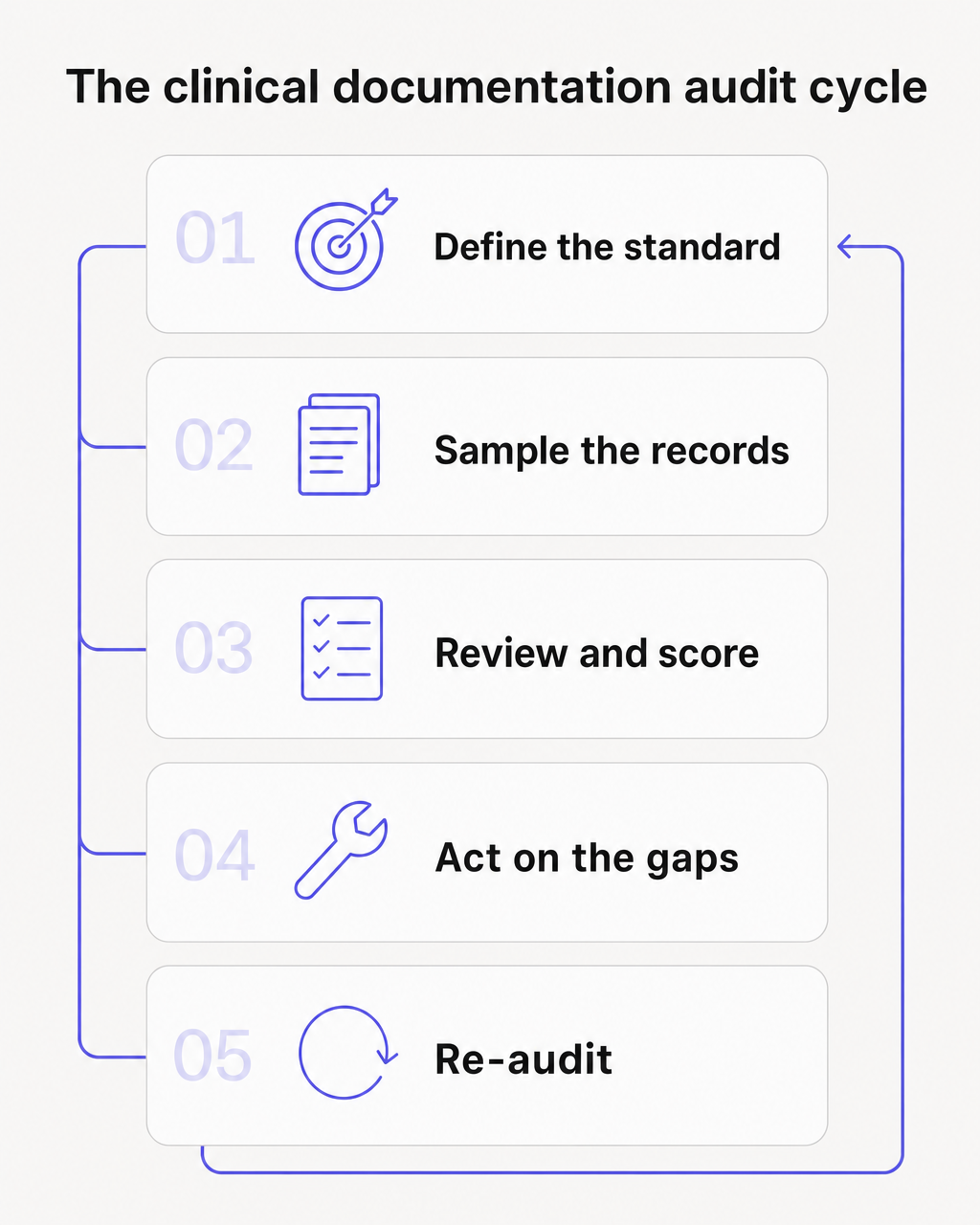
The audit cycle has five broad stages. The seven steps below split planning and governance into distinct tasks before review begins.

Five-stage clinical documentation audit cycle from defining the standard to re-auditing

1. Write one answerable audit question

Define the population, criterion and timeframe. For example: “Among adult face-to-face GP consultations completed in May, what proportion of notes met the practice's mandatory documentation criteria?”

List exclusions before data collection. A nurse-only vaccination encounter, procedure visit and telephone result review may need different criteria rather than being forced through one form.

2. Set the criteria and target before reviewing records

For every item, record:

  • the source and version
  • the exact pass rule
  • when it is applicable
  • whether it is mandatory or an improvement measure
  • the target compliance level
  • the clinical risk if it is absent or wrong.

A target should be defensible. Some safety or identity criteria may warrant 100% compliance, while an improvement target may be based on baseline performance and a realistic next step.

3. Select a sample that answers the question

Define the full eligible record set, then choose records from it. Random sampling reduces selection bias. Stratification can ensure the sample represents different clinicians, sites, consult modes, patient groups or specialties.

A targeted review after an incident is valuable for finding similar hazards, but it cannot estimate routine compliance across the service. Report targeted and representative samples separately.

There is no universal record count. A small pilot can assess the audit tool. A sample intended to estimate a compliance rate needs enough records for the required precision, and service-level comparisons may need enough records within each group. The WA Health Clinical Audit Handbook covers sample size, sampling methods, data dictionaries and before-and-after designs in detail.

4. Confirm governance and protect the data

Name the audit owner, authorised reviewers, data location, reporting audience and disposal or retention process for the working dataset. Give reviewers only the access they need. Use study IDs in the audit file and keep any re-identification key separate when identifiable reporting is unnecessary.

Calling a project “quality improvement” does not remove its ethical or privacy duties. The required local governance or ethics pathway depends on the data, participants, risks, secondary uses and plans to publish or share findings. Apply the organisation's process and the NHMRC quality assurance guidance before collection.

5. Pilot the tool and calibrate reviewers

Pilot the form on a few records outside the final sample. Resolve unclear wording, missing response options and criteria that depend on information the reviewer cannot access.

When more than one person reviews records, have them independently score the same subset. Discuss disagreements and update the data dictionary with the agreed rule. Preserve the original criterion during the audit. Changing it midway makes early and later records incomparable.

6. Report more than one percentage

Use the number of applicable opportunities as the denominator:

Criterion compliance = criteria met ÷ applicable criteria × 100

Report at least three views:

  1. Compliance by criterion, to locate the specific gap.
  2. Record pass rate, the proportion of records meeting all mandatory criteria.
  3. Defects by severity, separating documentation inconvenience from a plausible risk to care, privacy or payment.

Always show the numerator and denominator beside a percentage. “Follow-up documented in 18 of 24 applicable records (75%)” is more useful than “75% compliant”. Keep Not applicable results out of the denominator, and report missing or unreviewable records separately.

7. Assign action and re-audit

Give each agreed change an owner, due date and measure. Fix the cause closest to the work: revise a template, clarify a role, add a result-management step, provide focused feedback or remove a copy-forward field that propagates outdated information. Then repeat the audit with the same definitions after enough time for the change to operate.

A worked example: why the overall score can mislead

A practice reviews 60 randomly selected consultations. Across all applicable checklist items, 94% pass. That headline looks reassuring. The criterion-level results show a different risk pattern:

  • patient, date and author identification: 60/60, or 100%
  • medicine change details: 14/15, or 93%
  • safety-netting when indicated: 21/30, or 70%
  • named owner for investigation follow-up: 16/24, or 67%
  • all mandatory criteria met: 35/60 records, or 58%

The improvement plan should focus on safety-netting and result ownership rather than the six percentage points missing from the overall score. The re-audit should preserve the same applicability rules so that a change in case mix does not masquerade as improvement.

Turn findings into safer practice

Feedback should be timely, specific and proportionate. Start with high-severity, repeated or system-wide findings. Share identifiable clinician-level results only through the approved governance process and use team results for shared workflow problems.

The 2026 Cochrane review of audit and feedback included 292 studies. Across 177 studies with dichotomous professional-practice outcomes, the median absolute improvement in desired practice was 2.7 percentage points and the mean was 6.2 percentage points. Effects varied. Feedback was more effective when it focused on high-priority gaps, measured individual practice, involved a trusted local champion, used interactive and written formats, compared performance with a benchmark or high-performing peers, and included a specific action plan.

That evidence spans prescribing, test ordering and other professional behaviours, so it does not predict the gain from a documentation audit in one practice. It does show why emailing a scorecard without discussion or action is a weak intervention.

Add an AI-specific review when notes are machine drafted

An AI-generated clinical note remains a draft for clinician review, editing and sign-off. Audit the workflow as well as the final record. A final note can be acceptable because the clinician corrected a poor draft, while a good draft can still be filed without the required review.

For Lyrebird or another ambient AI scribe, add these criteria:

  • Unsupported content: information that was absent from the consult and cannot be reasonably inferred
  • Contradiction: content that conflicts with what was said or established
  • Accuracy error: a discussed fact recorded incorrectly, including medication, dose, laterality, timing or attribution
  • Omission: clinically relevant content discussed but missing from the draft
  • Irrelevant inclusion: content that adds noise or exposes unnecessary sensitive detail
  • Formatting problem: structure that makes the note harder to interpret or hides risk
  • Review completion: evidence that the responsible clinician reviewed and authorised the final note
  • Capture process: any notice or consent required for the specific workflow was completed and recorded under the practice policy before capture
  • Template control: no obsolete, copied or default text left in the final record.

Our clinical note evaluation framework counts discrete errors across these dimensions and grades them by likely clinical impact. A local audit should also compare AI-assisted notes with the service's baseline documentation, using similar clinicians and consult types. Editing distance and acceptance rates measure effort or adoption; neither proves clinical accuracy.

The Australian Gold Coast Hospital and Health Service ambient scribe evaluation illustrates the distinction. It covered 7,499 outpatient consultations, and 58% of scribe outputs were accepted into the electronic note without modification on average. A separate quality comparison involved 18 pairs of clinician and AI-generated notes. The study found higher mean documentation-quality scores for the AI notes, while staff also reported some hallucination or incorrect output. Its authors noted the small quality-assessment sample. A defensible audit therefore combines workflow data, structured record review and frontline error reports.

Lyrebird Clinical Notes can draft a structured note from ambient capture, dictation or typed input. The clinician decides what belongs in the patient record. Practices adopting it can use the checklist above for baseline and post-implementation review, then add the AI-specific error categories to monitor source fidelity and review controls.

A useful clinical documentation audit leaves the team with a safer record process, a small number of owned actions and a date to measure whether they worked. If you are planning an AI documentation rollout and want to build clinical review into the workflow, Contact us.

More Resources
Continue reading
Posts
The dangers of Copy Paste Scribes
Read More
Posts
How to use an AI medical scribe
Read More
Posts
December Product Updates
Read More
Education
Medicare Bulk Billing Consent Forms: A 2026 Guide for Practices
Read More
Education
Patient Education Materials: An Australian Clinician's Guide
Read More
Education
Scanning Medical Records: A Practical Australian Guide
Read More
Post
5 min read

Clinical Documentation Audit: A Practical Australian Guide

Published on
September 3, 2026
Contributors
Lyrebird Health
Subscribe to our newsletter
Read about our privacy policy.
Thank you! Your submission has been received!
Oops! Something went wrong while submitting the form.

A clinical documentation audit can expose missing follow-up, unclear decisions and records that do not support continuity of care. It can also waste time if the criteria are vague or the results stop at a percentage. Australian clinicians, practice managers and clinical governance teams need a focused audit that measures records against the right standard, protects patient information and leads to a change they can remeasure.

What a clinical documentation audit measures

A clinical documentation audit is a structured review of patient records against defined criteria. It asks whether the record is complete, accurate, timely, understandable and fit for its clinical and administrative purpose.

The audit evaluates the documentation available to a reviewer. It does not establish everything that happened in the consult. If safety-netting advice is absent, for example, the finding is that the advice was not documented. The reviewer cannot assume it was either given or omitted.

The scope also matters. Three reviews that are often grouped together answer different questions:

Review Main question Typical reviewer
Clinical documentation audit Does the record contain accurate, relevant and usable information for care? Clinician, clinical governance lead or trained peer
Clinical coding audit Do assigned codes follow the applicable coding standards and reflect the documented episode? Clinical coder or coding auditor
Billing audit Does the record substantiate the service claimed under the applicable rules? Practitioner, compliance lead or billing auditor

One audit can include all three lenses, but each needs its own criteria and qualified reviewer. A hospital clinical documentation improvement audit may focus on diagnoses that are clinically evident yet insufficiently documented for coding. A general practice audit may focus on consultation content, follow-up and Medicare substantiation. Define which problem you are solving before opening a record.

Start with the standards that apply to your setting

A generic checklist is only a starting point. Build each criterion from an authoritative source and record the source, version and expected level of compliance in the audit plan.

For Australian registered health practitioners, the relevant National Board code or guidelines set the professional baseline. Ahpra's health record guidance summarises good records as accurate, up to date, factual, legible and sufficiently detailed to support continuity of care. For doctors, section 10.5 of Good medical practice also covers security, respectful language, contemporaneous entries and dated changes.

General practice during the RACGP sixth-edition transition

The RACGP released the Standards for general practices (6th edition) on 26 August 2026. The sixth-edition hub is now the current source for the Standards and their supporting material.

The accreditation transition has a defined boundary. The Australian Commission on Safety and Quality in Health Care states that the sixth edition supersedes the fifth, while accreditation under the National General Practice Accreditation Scheme currently continues to use the fifth edition. Practices are encouraged to begin implementing the sixth edition, but implementation is separate from an accreditation assessment. Future assessment arrangements are still to be announced in the Commission's transition guidance.

For an internal quality-improvement audit, the sixth edition provides the contemporary benchmark. An audit being used as evidence for an accreditation assessment needs to name the edition and arrangements confirmed by the accrediting agency. During the transition, a practice can map fifth-edition assessment evidence against the sixth-edition change plan rather than treating the two editions as interchangeable.

Clinical Governance criterion CG3 now brings the main patient-record requirements together. CG3 on complete patient health records covers sufficient documentation of consultations and clinical communications, current health summaries in codable fields, current medicines lists, shared decisions, follow-up and patient communications. It also sets an explicit 100% requirement: every active patient health record must document known allergies or indicate no known allergies in a codable field.

Other standards apply according to the service:

  • Accredited health services: Action 6.11 of the NSQHS Communicating for Safety Standard requires processes to contemporaneously document information in the healthcare record.
  • Medicare services: MBS Note GN.15.39 states that practitioners who provide or initiate a service for which a Medicare benefit is payable should maintain adequate and contemporaneous records. An adequate entry identifies the patient and attendance, explains the service and is comprehensible enough for another practitioner to continue care. For the record to be contemporaneous, it should be completed at the time of the service or as soon as practicable afterwards. Use the current MBS explanatory note when billing is within scope.
  • Local requirements: Include current state or territory law, health service policy, specialty standards, contracts and approved clinical pathways where they apply.

Keep a professional or accreditation standard separate from a local improvement target. If a practice sets a goal that 95% of reviewed notes will contain documented safety-netting when clinically indicated, label it as the practice target rather than presenting it as a universal legal rule.

Clinical documentation audit checklist

Use Yes, No and Not applicable for each criterion. Add a short defect category and comment when the answer is No. A binary result is easier to reproduce than a subjective one-to-five quality score. The core criteria below can be combined with the general-practice rows where the RACGP sixth edition is within scope.

Area Required record content Apply when
Patient and encounter Correct patient; consultation date; author; contact method or location where relevant Every record
Active-patient details in general practice Identification and contact details, next of kin and emergency contact in codable fields; Aboriginal and Torres Strait Islander status routinely recorded in a codable field Active records and practice processes audited against RACGP sixth-edition CG3.A and CG3.B
Presenting issue and initial assessment The patient's reason for the consult and relevant context; a sufficient initial assessment at the first consultation Every clinical encounter; initial assessment for a new patient
History and findings Relevant history, examination, observations, investigation results and safeguarding information necessary for safe communication or continuity Discussed, performed or received from the patient or a lawful authority
Assessment Diagnosis, differential, clinical impression or documented uncertainty at an appropriate level Relevant to the encounter
Plan and shared decisions Treatment, monitoring, investigations, referrals, information given, patient preferences, agreed actions and any material benefits, risks, side effects or alternatives discussed A plan or care decision was made
Current health summary in general practice Codable fields for adverse drug reactions, current and past health problems, family and social history, lifestyle risks and immunisations Active records and practice systems audited against RACGP sixth-edition CG3.E
Allergy status in general practice Known allergies or no known allergies recorded in a codable field Every active patient record audited against RACGP sixth-edition CG3.E; target 100%
Medicines Accurate and current medicines list; sufficient details for new, changed or ceased medicines; current list included in referral letters Every patient record audited against RACGP sixth-edition CG3.F; when a medicine change or referral letter is reviewed
Risk and follow-up Alerts, red flags, safety-netting, result follow-up, expected review and matters followed up from earlier consultations Clinically relevant
Consent and preferences Material consent discussions, patient decisions, goals, refusal or third-party involvement Required for the care or workflow
Patient communications in general practice Contact attempts and successful contact; patient-initiated contact and advice; translation service use and relevant service details Communications audited against RACGP sixth-edition CG3.I
Continuity Previous matters followed up, treatment plans reassessed where relevant and current actions assigned clearly An earlier matter, treatment plan or future action exists
Clarity and respect Understandable language, clear attribution, approved abbreviations and respectful, objective wording Every record
Timing and amendments Entry completed within the applicable timeframe; late additions and corrections dated and attributable Every record
Coding and billing Documented content supports the diagnosis code, item or service claimed Coding or billing is in scope

This table measures the content expected for the defined encounter or record. The allergy-status criterion is different from the conditional clinical rows: a blank allergy field fails the sixth-edition general-practice criterion even when no allergy is known. Accuracy needs a source for comparison, such as the investigation result, medication order, referral, transcript or another authorised record. Do not mark a fluent entry accurate simply because it looks complete.

Avoid criteria such as “good history” or “adequate plan”. Convert them into observable questions. “If a medicine was changed, does the note record the medicine and new dose?” gives reviewers a common decision rule and shows the team what to fix.

How to run a clinical documentation audit

The audit cycle has five broad stages. The seven steps below split planning and governance into distinct tasks before review begins.

Five-stage clinical documentation audit cycle from defining the standard to re-auditing

1. Write one answerable audit question

Define the population, criterion and timeframe. For example: “Among adult face-to-face GP consultations completed in May, what proportion of notes met the practice's mandatory documentation criteria?”

List exclusions before data collection. A nurse-only vaccination encounter, procedure visit and telephone result review may need different criteria rather than being forced through one form.

2. Set the criteria and target before reviewing records

For every item, record:

  • the source and version
  • the exact pass rule
  • when it is applicable
  • whether it is mandatory or an improvement measure
  • the target compliance level
  • the clinical risk if it is absent or wrong.

A target should be defensible. Some safety or identity criteria may warrant 100% compliance, while an improvement target may be based on baseline performance and a realistic next step.

3. Select a sample that answers the question

Define the full eligible record set, then choose records from it. Random sampling reduces selection bias. Stratification can ensure the sample represents different clinicians, sites, consult modes, patient groups or specialties.

A targeted review after an incident is valuable for finding similar hazards, but it cannot estimate routine compliance across the service. Report targeted and representative samples separately.

There is no universal record count. A small pilot can assess the audit tool. A sample intended to estimate a compliance rate needs enough records for the required precision, and service-level comparisons may need enough records within each group. The WA Health Clinical Audit Handbook covers sample size, sampling methods, data dictionaries and before-and-after designs in detail.

4. Confirm governance and protect the data

Name the audit owner, authorised reviewers, data location, reporting audience and disposal or retention process for the working dataset. Give reviewers only the access they need. Use study IDs in the audit file and keep any re-identification key separate when identifiable reporting is unnecessary.

Calling a project “quality improvement” does not remove its ethical or privacy duties. The required local governance or ethics pathway depends on the data, participants, risks, secondary uses and plans to publish or share findings. Apply the organisation's process and the NHMRC quality assurance guidance before collection.

5. Pilot the tool and calibrate reviewers

Pilot the form on a few records outside the final sample. Resolve unclear wording, missing response options and criteria that depend on information the reviewer cannot access.

When more than one person reviews records, have them independently score the same subset. Discuss disagreements and update the data dictionary with the agreed rule. Preserve the original criterion during the audit. Changing it midway makes early and later records incomparable.

6. Report more than one percentage

Use the number of applicable opportunities as the denominator:

Criterion compliance = criteria met ÷ applicable criteria × 100

Report at least three views:

  1. Compliance by criterion, to locate the specific gap.
  2. Record pass rate, the proportion of records meeting all mandatory criteria.
  3. Defects by severity, separating documentation inconvenience from a plausible risk to care, privacy or payment.

Always show the numerator and denominator beside a percentage. “Follow-up documented in 18 of 24 applicable records (75%)” is more useful than “75% compliant”. Keep Not applicable results out of the denominator, and report missing or unreviewable records separately.

7. Assign action and re-audit

Give each agreed change an owner, due date and measure. Fix the cause closest to the work: revise a template, clarify a role, add a result-management step, provide focused feedback or remove a copy-forward field that propagates outdated information. Then repeat the audit with the same definitions after enough time for the change to operate.

A worked example: why the overall score can mislead

A practice reviews 60 randomly selected consultations. Across all applicable checklist items, 94% pass. That headline looks reassuring. The criterion-level results show a different risk pattern:

  • patient, date and author identification: 60/60, or 100%
  • medicine change details: 14/15, or 93%
  • safety-netting when indicated: 21/30, or 70%
  • named owner for investigation follow-up: 16/24, or 67%
  • all mandatory criteria met: 35/60 records, or 58%

The improvement plan should focus on safety-netting and result ownership rather than the six percentage points missing from the overall score. The re-audit should preserve the same applicability rules so that a change in case mix does not masquerade as improvement.

Turn findings into safer practice

Feedback should be timely, specific and proportionate. Start with high-severity, repeated or system-wide findings. Share identifiable clinician-level results only through the approved governance process and use team results for shared workflow problems.

The 2026 Cochrane review of audit and feedback included 292 studies. Across 177 studies with dichotomous professional-practice outcomes, the median absolute improvement in desired practice was 2.7 percentage points and the mean was 6.2 percentage points. Effects varied. Feedback was more effective when it focused on high-priority gaps, measured individual practice, involved a trusted local champion, used interactive and written formats, compared performance with a benchmark or high-performing peers, and included a specific action plan.

That evidence spans prescribing, test ordering and other professional behaviours, so it does not predict the gain from a documentation audit in one practice. It does show why emailing a scorecard without discussion or action is a weak intervention.

Add an AI-specific review when notes are machine drafted

An AI-generated clinical note remains a draft for clinician review, editing and sign-off. Audit the workflow as well as the final record. A final note can be acceptable because the clinician corrected a poor draft, while a good draft can still be filed without the required review.

For Lyrebird or another ambient AI scribe, add these criteria:

  • Unsupported content: information that was absent from the consult and cannot be reasonably inferred
  • Contradiction: content that conflicts with what was said or established
  • Accuracy error: a discussed fact recorded incorrectly, including medication, dose, laterality, timing or attribution
  • Omission: clinically relevant content discussed but missing from the draft
  • Irrelevant inclusion: content that adds noise or exposes unnecessary sensitive detail
  • Formatting problem: structure that makes the note harder to interpret or hides risk
  • Review completion: evidence that the responsible clinician reviewed and authorised the final note
  • Capture process: any notice or consent required for the specific workflow was completed and recorded under the practice policy before capture
  • Template control: no obsolete, copied or default text left in the final record.

Our clinical note evaluation framework counts discrete errors across these dimensions and grades them by likely clinical impact. A local audit should also compare AI-assisted notes with the service's baseline documentation, using similar clinicians and consult types. Editing distance and acceptance rates measure effort or adoption; neither proves clinical accuracy.

The Australian Gold Coast Hospital and Health Service ambient scribe evaluation illustrates the distinction. It covered 7,499 outpatient consultations, and 58% of scribe outputs were accepted into the electronic note without modification on average. A separate quality comparison involved 18 pairs of clinician and AI-generated notes. The study found higher mean documentation-quality scores for the AI notes, while staff also reported some hallucination or incorrect output. Its authors noted the small quality-assessment sample. A defensible audit therefore combines workflow data, structured record review and frontline error reports.

Lyrebird Clinical Notes can draft a structured note from ambient capture, dictation or typed input. The clinician decides what belongs in the patient record. Practices adopting it can use the checklist above for baseline and post-implementation review, then add the AI-specific error categories to monitor source fidelity and review controls.

A useful clinical documentation audit leaves the team with a safer record process, a small number of owned actions and a date to measure whether they worked. If you are planning an AI documentation rollout and want to build clinical review into the workflow, Contact us.

Keep reading

All posts
Questions about compliance?