Education
5 min read

AI Tools for GPs: Where They Help and How to Use Them Safely
Published on
September 1, 2026
AI tools for GPs on a violet Lyrebird Health title card
Contributors
Lyrebird Health
Subscribe to our newsletter
Read about our privacy policy.
Thank you! Your submission has been received!
Oops! Something went wrong while submitting the form.

AI tools are moving into general practice through ambient scribes, patient messaging, workflow automation and clinical decision support. Each category carries a different level of clinical, privacy and operational risk. For GPs, the practical question is which AI tools earn a place in the consult and what control must stay with the clinician. A useful approach starts with the workflow, matches oversight to risk and measures whether each tool improves care as well as efficiency.

Where AI tools fit in general practice

The term AI tools covers technologies with distinct clinical capabilities. A tool that formats dictated notes has a very different purpose and risk profile from software that recommends a diagnosis or treatment.

In general practice, current uses fall into five broad groups:

Point in the workflow Role for the AI tool Typical output Clinician control
Before the consult Summarise a long record, organise incoming information or identify missing administrative fields A briefing or worklist Confirm the correct patient and compare important details with the source record
During the consult Capture the conversation and structure documentation A draft clinical note Review, edit and sign off the complete note
After the consult Draft referrals, certificates, care plans and patient instructions A draft document Confirm the recipient, facts, plan and safety-netting advice
Practice operations Support scheduling, recall workflows, inbox sorting and quality audits A queue, classification or suggested action Set escalation rules and monitor exceptions
Clinical decision support Assist with triage, diagnosis, prescribing or risk prediction A recommendation or risk score Apply independent clinical judgement and use only within the tool's intended purpose

The intended purpose matters. The AHPRA guidance on AI explains that software with a therapeutic purpose may meet the definition of a medical device, while a general-purpose scribe usually does not. TGA inclusion does not transfer clinical accountability from the GP to the software.

Start with work that is time-consuming and easy to review

Documentation and routine administration are the most mature starting points because the output is visible, editable and close to work GPs already do. A GP can compare a draft note with the consult they just conducted. The risk rises when an AI tool interprets information the GP cannot readily inspect or recommends a clinical action.

A 2025 survey of 2,108 UK GPs found that 28% used AI tools in clinical practice. Among users who reported their tasks, 57% used them for documentation and note-taking, 44% for administration and 28% for clinical decision support. When all respondents ranked future priorities, documentation and administrative automation led by a wide margin. These findings describe UK practice and do not measure Australian adoption. The workflow preference is still instructive. Nuffield Trust report
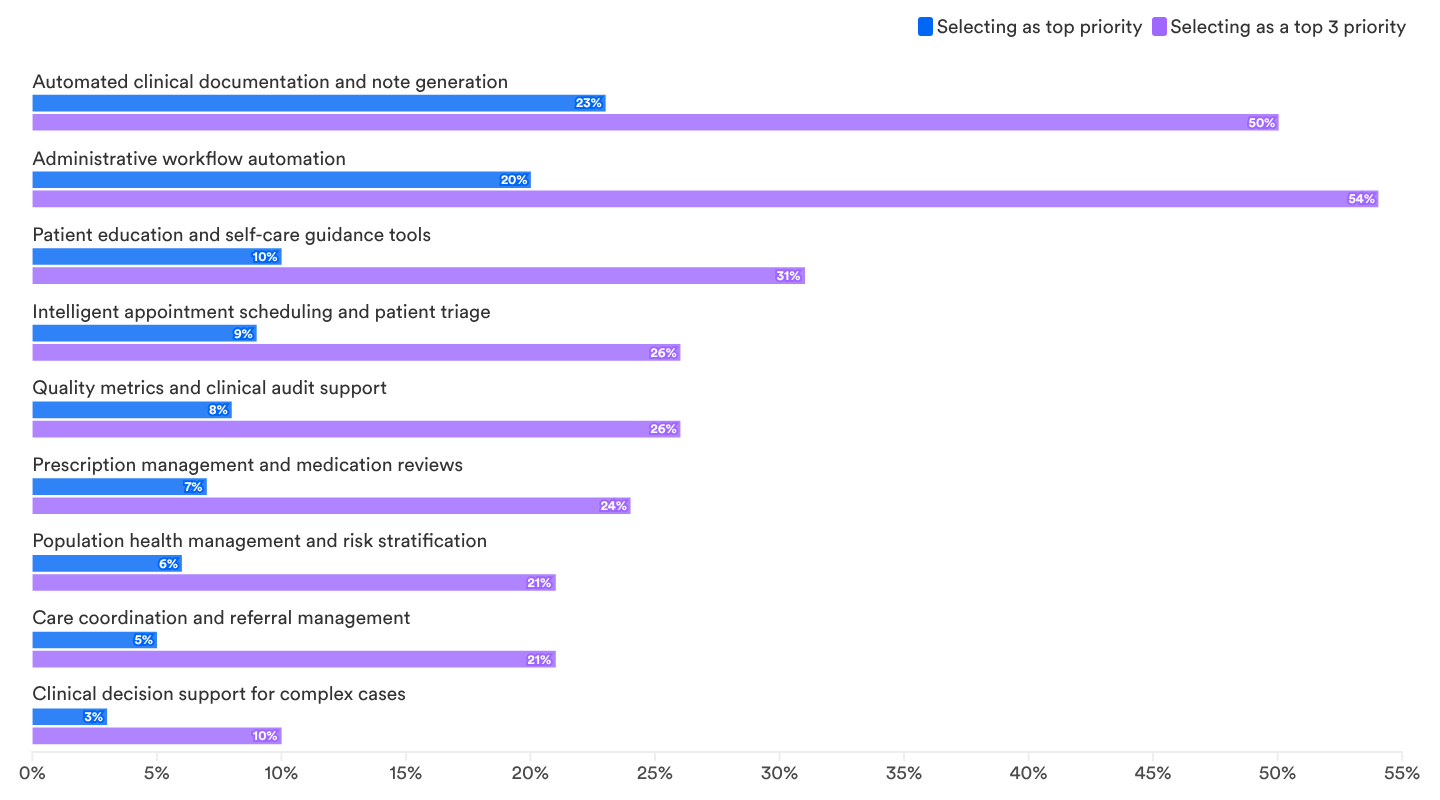
Bar chart showing GPs prioritised automated documentation and administrative workflow automation over clinical decision support

At Lyrebird Health, we apply our clinical AI platform at this reviewable boundary. With Lyrebird, you can capture a consult through ambient scribing, dictation or typed notes, then review the structured note before it enters the patient record. The same reviewed information can draft referrals, certificates, care plans and forms. In Bp Premier, our integration can bring patient context into the workflow and write the reviewed output back, reducing manual copy and paste.

That sequence matters: capture, draft, review, then sign off. Our clinical AI platform prepares the documentation. The GP decides what belongs in the record.

What the evidence supports so far

Research on ambient AI scribes is becoming more useful, but results depend on the product, setting and outcome measured.

  • Simulated Australian general practice: A 2026 study compared four commercial AI scribes with human documentation across four standardised GP scenarios. Three blinded GPs rated the notes. The highest-performing AI scribes scored a mean 44.08 out of 50, compared with 37.42 for human notes. This is encouraging evidence about draft quality, although four simulated cases cannot establish safety or time savings in routine care. Australian GP study
  • Australian outpatient care using Lyrebird: Gold Coast Hospital and Health Service independently evaluated Lyrebird over 16 weeks with 100 clinicians and 7,499 consults. In an analysis of 21 note pairs, an average 58% of generated text appeared verbatim in the final record. In a separate set of 18 matched note pairs, AI drafts averaged 37.06 out of 40 for quality, compared with 34.6 for clinician-written notes. The study also found some hallucinated or incorrect output. It was conducted across hospital outpatient specialties, rather than community general practice, and both note samples were small. Gold Coast evaluation
  • Randomised outpatient trial: A trial of 238 physicians across 14 specialties compared two ambient scribes with usual care. One scribe reduced time in the note by 9.5% relative to control, while the other produced no significant reduction. Clinicians reported occasional clinically significant inaccuracies with both. The study shows why a practice should measure its own workflow rather than assume every scribe will save the same amount of time. Randomised scribe trial

The evidence supports AI scribes as draft assistants. It does not support automatic sign-off or the transfer of clinical reasoning to a general-purpose model. Accuracy also needs more than one headline score. Our clinical note evaluation framework separates accuracy, completeness, usefulness, organisation, succinctness, synthesis, internal consistency, unsupported content and bias.

The risks that matter in a GP consult

A fluent draft can still be wrong

Generative AI tools can omit a relevant negative, reverse who said what, mishear a medicine or add unsupported detail. Longer notes can also hide the important facts. Review should concentrate first on identity, medicines and allergies, doses, dates, measurements, laterality, diagnoses, clinical decisions, follow-up and safety-netting.

Spoken conversation is only part of a consult. An ambient scribe cannot observe an examination finding that was never verbalised or reliably infer the GP's reasoning from silence. Those details still need to be added by the clinician.

Familiarity can weaken attention

A tool that is usually accurate can invite automation bias, where its output receives less scrutiny over time. Fixed review steps, visible editing and a clear incident pathway reduce this risk. Practices also need to monitor performance after model or template updates, since generative output can change without the clinical workflow changing.

Health information needs a defined data path

Before personal information enters any AI tool or platform, the practice needs a clear account of what is collected, where it is processed and stored, how long audio and transcripts remain, who can access them, whether data trains a model, and how deletion and breaches are handled.

The OAIC recommends that organisations do not enter personal information, especially sensitive information, into publicly available generative AI tools because of the privacy risks. Its commercial AI guidance also calls for human oversight, updated privacy policies and continuing governance rather than a one-off procurement decision.

Patient transparency is part of the workflow

For an ambient scribe that records or transcribes a consult, consent belongs at the start of each use. AHPRA says generative AI scribes generally require informed consent, and the RACGP's AI scribe guidance directs GPs to obtain consent at the beginning of each consultation and record it in the note. Patients need a genuine option to decline, with the usual documentation process available instead.

The explanation should reflect the actual product. It should cover the purpose of capture, how information is handled, the GP's review and the patient's option to say no. Our guide to patient consent for AI scribes provides a practical starting point.

Performance can vary across patients

Accents, language, speech impairment, interpreter use, overlapping speakers and culturally specific expressions can all affect capture. AHPRA also requires practitioners to consider algorithmic bias and culturally safe care. A fallback workflow is essential when the tool performs poorly or a patient prefers a consult without it.

How to assess an AI tool for general practice

A useful vendor assessment asks for evidence and operating detail, rather than a broad promise of accuracy.

  1. Define the intended use. Record the task the tool is designed to perform, the contexts it excludes and whether it has a therapeutic purpose. Clinical decision-support software needs a different assessment from a documentation assistant.
  2. Demand relevant evidence. Look for the clinical setting, patient population, sample size and comparator behind performance claims. Quality measures should cover omissions, unsupported statements and contradictions as well as transcription accuracy.
  3. Map the data lifecycle. Document collection, processing location, storage location, retention, deletion, model training, subprocessors, access controls, audit logs and breach response.
  4. Inspect the review workflow. The GP should be able to stop capture, edit the draft, identify the source of important details and keep an alternative workflow for patients who decline.
  5. Assess record integration. Confirm how the tool selects the patient, reads context, handles duplicate information and writes back. A safe integration preserves the source record and prevents a draft from being mistaken for a signed note.
  6. Set ownership. Name the person responsible for approving tools, managing access, monitoring updates, receiving incident reports and removing a tool that no longer performs as intended.

A safe rollout plan for the practice

1. Choose one bounded workflow

Begin with a frequent, burdensome task whose output a clinician can review, such as draft consultation notes or referral letters. Record the baseline: time to finalise, after-hours work, note quality problems and staff experience.

2. Approve the product at practice level

Complete the privacy, security, contractual, indemnity and clinical risk review before patient information is used. The practice policy should name approved tools and prohibited uses, including the treatment of public chatbots.

3. Prepare patients and staff

Update the privacy policy and patient information. Train every user on consent, opt-out, safe capture, editing, sign-off and incident reporting. Agree on the normal documentation route when the AI tool is unavailable or unsuitable.

4. Configure the output

Use templates that match how the practice records care. Teach clinicians which examination findings and decisions need to be stated aloud, then added manually when that would disrupt the consult. More text is not automatically a better record.

5. Pilot with a fixed review order

Run a limited pilot across routine consults and harder conditions such as telehealth, interpreter-supported care and multiple speakers. Before sign-off, review:

  1. the patient and encounter context
  2. medicines, allergies, doses, numbers, dates and laterality
  3. relevant positives, negatives and examination findings
  4. assessment and plan, including any uncertainty
  5. follow-up, safety-netting and document recipients

Record and escalate omissions, unsupported content, contradictions and privacy events. Correcting one note protects that patient. Reporting the failure helps protect the next one.

6. Measure benefit and harm together

Track median finalisation time, after-hours documentation, edit rate, clinically significant issues per 100 notes, patient concerns or opt-outs, and clinician experience. Throughput alone is a poor success measure. In the Nuffield Trust study, GPs often used saved time to reduce overtime and recover from work, rather than add appointments. A sustainable GP workforce is a valid outcome.

AI tools will change GP work, not replace GP judgement

General practice combines incomplete information, examination, longitudinal knowledge, patient preferences, risk tolerance and relationships. Current AI tools handle narrow parts of that work. They do not hold professional accountability or understand a patient's circumstances in the way their GP does.

The immediate opportunity is to remove avoidable documentation and administrative effort while keeping attention, reasoning and sign-off with the clinician. That is the boundary where clinical AI tools can support better consults today.

If documentation is the workflow you want to improve first, use Lyrebird to draft the note and the work that follows while you remain in control of the record.

Start for free

More Resources
Continue reading
Posts
The dangers of Copy Paste Scribes
Read More
Posts
How to use an AI medical scribe
Read More
Posts
December Product Updates
Read More
Education
Practice Manager Duties: A Practical Australian Guide
Read More
Education
AI Tools for Doctors: An Australian Guide
Read More
Education
Five Options for Medical Transcription Services in Australia
Read More
Post
5 min read

AI Tools for GPs: Where They Help and How to Use Them Safely

Published on
September 1, 2026
AI tools for GPs on a violet Lyrebird Health title card
Contributors
Lyrebird Health
Subscribe to our newsletter
Read about our privacy policy.
Thank you! Your submission has been received!
Oops! Something went wrong while submitting the form.

AI tools are moving into general practice through ambient scribes, patient messaging, workflow automation and clinical decision support. Each category carries a different level of clinical, privacy and operational risk. For GPs, the practical question is which AI tools earn a place in the consult and what control must stay with the clinician. A useful approach starts with the workflow, matches oversight to risk and measures whether each tool improves care as well as efficiency.

Where AI tools fit in general practice

The term AI tools covers technologies with distinct clinical capabilities. A tool that formats dictated notes has a very different purpose and risk profile from software that recommends a diagnosis or treatment.

In general practice, current uses fall into five broad groups:

Point in the workflow Role for the AI tool Typical output Clinician control
Before the consult Summarise a long record, organise incoming information or identify missing administrative fields A briefing or worklist Confirm the correct patient and compare important details with the source record
During the consult Capture the conversation and structure documentation A draft clinical note Review, edit and sign off the complete note
After the consult Draft referrals, certificates, care plans and patient instructions A draft document Confirm the recipient, facts, plan and safety-netting advice
Practice operations Support scheduling, recall workflows, inbox sorting and quality audits A queue, classification or suggested action Set escalation rules and monitor exceptions
Clinical decision support Assist with triage, diagnosis, prescribing or risk prediction A recommendation or risk score Apply independent clinical judgement and use only within the tool's intended purpose

The intended purpose matters. The AHPRA guidance on AI explains that software with a therapeutic purpose may meet the definition of a medical device, while a general-purpose scribe usually does not. TGA inclusion does not transfer clinical accountability from the GP to the software.

Start with work that is time-consuming and easy to review

Documentation and routine administration are the most mature starting points because the output is visible, editable and close to work GPs already do. A GP can compare a draft note with the consult they just conducted. The risk rises when an AI tool interprets information the GP cannot readily inspect or recommends a clinical action.

A 2025 survey of 2,108 UK GPs found that 28% used AI tools in clinical practice. Among users who reported their tasks, 57% used them for documentation and note-taking, 44% for administration and 28% for clinical decision support. When all respondents ranked future priorities, documentation and administrative automation led by a wide margin. These findings describe UK practice and do not measure Australian adoption. The workflow preference is still instructive. Nuffield Trust report

Bar chart showing GPs prioritised automated documentation and administrative workflow automation over clinical decision support

At Lyrebird Health, we apply our clinical AI platform at this reviewable boundary. With Lyrebird, you can capture a consult through ambient scribing, dictation or typed notes, then review the structured note before it enters the patient record. The same reviewed information can draft referrals, certificates, care plans and forms. In Bp Premier, our integration can bring patient context into the workflow and write the reviewed output back, reducing manual copy and paste.

That sequence matters: capture, draft, review, then sign off. Our clinical AI platform prepares the documentation. The GP decides what belongs in the record.

What the evidence supports so far

Research on ambient AI scribes is becoming more useful, but results depend on the product, setting and outcome measured.

  • Simulated Australian general practice: A 2026 study compared four commercial AI scribes with human documentation across four standardised GP scenarios. Three blinded GPs rated the notes. The highest-performing AI scribes scored a mean 44.08 out of 50, compared with 37.42 for human notes. This is encouraging evidence about draft quality, although four simulated cases cannot establish safety or time savings in routine care. Australian GP study
  • Australian outpatient care using Lyrebird: Gold Coast Hospital and Health Service independently evaluated Lyrebird over 16 weeks with 100 clinicians and 7,499 consults. In an analysis of 21 note pairs, an average 58% of generated text appeared verbatim in the final record. In a separate set of 18 matched note pairs, AI drafts averaged 37.06 out of 40 for quality, compared with 34.6 for clinician-written notes. The study also found some hallucinated or incorrect output. It was conducted across hospital outpatient specialties, rather than community general practice, and both note samples were small. Gold Coast evaluation
  • Randomised outpatient trial: A trial of 238 physicians across 14 specialties compared two ambient scribes with usual care. One scribe reduced time in the note by 9.5% relative to control, while the other produced no significant reduction. Clinicians reported occasional clinically significant inaccuracies with both. The study shows why a practice should measure its own workflow rather than assume every scribe will save the same amount of time. Randomised scribe trial

The evidence supports AI scribes as draft assistants. It does not support automatic sign-off or the transfer of clinical reasoning to a general-purpose model. Accuracy also needs more than one headline score. Our clinical note evaluation framework separates accuracy, completeness, usefulness, organisation, succinctness, synthesis, internal consistency, unsupported content and bias.

The risks that matter in a GP consult

A fluent draft can still be wrong

Generative AI tools can omit a relevant negative, reverse who said what, mishear a medicine or add unsupported detail. Longer notes can also hide the important facts. Review should concentrate first on identity, medicines and allergies, doses, dates, measurements, laterality, diagnoses, clinical decisions, follow-up and safety-netting.

Spoken conversation is only part of a consult. An ambient scribe cannot observe an examination finding that was never verbalised or reliably infer the GP's reasoning from silence. Those details still need to be added by the clinician.

Familiarity can weaken attention

A tool that is usually accurate can invite automation bias, where its output receives less scrutiny over time. Fixed review steps, visible editing and a clear incident pathway reduce this risk. Practices also need to monitor performance after model or template updates, since generative output can change without the clinical workflow changing.

Health information needs a defined data path

Before personal information enters any AI tool or platform, the practice needs a clear account of what is collected, where it is processed and stored, how long audio and transcripts remain, who can access them, whether data trains a model, and how deletion and breaches are handled.

The OAIC recommends that organisations do not enter personal information, especially sensitive information, into publicly available generative AI tools because of the privacy risks. Its commercial AI guidance also calls for human oversight, updated privacy policies and continuing governance rather than a one-off procurement decision.

Patient transparency is part of the workflow

For an ambient scribe that records or transcribes a consult, consent belongs at the start of each use. AHPRA says generative AI scribes generally require informed consent, and the RACGP's AI scribe guidance directs GPs to obtain consent at the beginning of each consultation and record it in the note. Patients need a genuine option to decline, with the usual documentation process available instead.

The explanation should reflect the actual product. It should cover the purpose of capture, how information is handled, the GP's review and the patient's option to say no. Our guide to patient consent for AI scribes provides a practical starting point.

Performance can vary across patients

Accents, language, speech impairment, interpreter use, overlapping speakers and culturally specific expressions can all affect capture. AHPRA also requires practitioners to consider algorithmic bias and culturally safe care. A fallback workflow is essential when the tool performs poorly or a patient prefers a consult without it.

How to assess an AI tool for general practice

A useful vendor assessment asks for evidence and operating detail, rather than a broad promise of accuracy.

  1. Define the intended use. Record the task the tool is designed to perform, the contexts it excludes and whether it has a therapeutic purpose. Clinical decision-support software needs a different assessment from a documentation assistant.
  2. Demand relevant evidence. Look for the clinical setting, patient population, sample size and comparator behind performance claims. Quality measures should cover omissions, unsupported statements and contradictions as well as transcription accuracy.
  3. Map the data lifecycle. Document collection, processing location, storage location, retention, deletion, model training, subprocessors, access controls, audit logs and breach response.
  4. Inspect the review workflow. The GP should be able to stop capture, edit the draft, identify the source of important details and keep an alternative workflow for patients who decline.
  5. Assess record integration. Confirm how the tool selects the patient, reads context, handles duplicate information and writes back. A safe integration preserves the source record and prevents a draft from being mistaken for a signed note.
  6. Set ownership. Name the person responsible for approving tools, managing access, monitoring updates, receiving incident reports and removing a tool that no longer performs as intended.

A safe rollout plan for the practice

1. Choose one bounded workflow

Begin with a frequent, burdensome task whose output a clinician can review, such as draft consultation notes or referral letters. Record the baseline: time to finalise, after-hours work, note quality problems and staff experience.

2. Approve the product at practice level

Complete the privacy, security, contractual, indemnity and clinical risk review before patient information is used. The practice policy should name approved tools and prohibited uses, including the treatment of public chatbots.

3. Prepare patients and staff

Update the privacy policy and patient information. Train every user on consent, opt-out, safe capture, editing, sign-off and incident reporting. Agree on the normal documentation route when the AI tool is unavailable or unsuitable.

4. Configure the output

Use templates that match how the practice records care. Teach clinicians which examination findings and decisions need to be stated aloud, then added manually when that would disrupt the consult. More text is not automatically a better record.

5. Pilot with a fixed review order

Run a limited pilot across routine consults and harder conditions such as telehealth, interpreter-supported care and multiple speakers. Before sign-off, review:

  1. the patient and encounter context
  2. medicines, allergies, doses, numbers, dates and laterality
  3. relevant positives, negatives and examination findings
  4. assessment and plan, including any uncertainty
  5. follow-up, safety-netting and document recipients

Record and escalate omissions, unsupported content, contradictions and privacy events. Correcting one note protects that patient. Reporting the failure helps protect the next one.

6. Measure benefit and harm together

Track median finalisation time, after-hours documentation, edit rate, clinically significant issues per 100 notes, patient concerns or opt-outs, and clinician experience. Throughput alone is a poor success measure. In the Nuffield Trust study, GPs often used saved time to reduce overtime and recover from work, rather than add appointments. A sustainable GP workforce is a valid outcome.

AI tools will change GP work, not replace GP judgement

General practice combines incomplete information, examination, longitudinal knowledge, patient preferences, risk tolerance and relationships. Current AI tools handle narrow parts of that work. They do not hold professional accountability or understand a patient's circumstances in the way their GP does.

The immediate opportunity is to remove avoidable documentation and administrative effort while keeping attention, reasoning and sign-off with the clinician. That is the boundary where clinical AI tools can support better consults today.

If documentation is the workflow you want to improve first, use Lyrebird to draft the note and the work that follows while you remain in control of the record.
Start for free

Keep reading

All posts
Questions about compliance?