Education
5 min read

Patient Education Materials: An Australian Clinician's Guide

Published on
September 3, 2026
Contributors
Adrian Lee
Subscribe to our newsletter
Read about our privacy policy.
Thank you! Your submission has been received!
Oops! Something went wrong while submitting the form.

Patient education materials can reinforce a diagnosis, treatment plan or self-management skill after a consult. Their value depends on more than clinical accuracy. Patients also need to understand the information, see how it applies to them and know what to do next. Australian clinicians need a practical way to find reliable resources, assess their quality and build them into a safer patient education workflow.

What patient education materials need to do

Patient education materials, also called patient information or patient teaching materials, include condition handouts, medicine information, action plans, decision aids, diagrams, videos and personalised consult summaries. Each format serves a different purpose.

Useful material answers three questions:

  1. What does this mean for me? The purpose and relevant clinical information are clear.
  2. What do I need to do? Actions are specific, ordered and realistic.
  3. When and where should I get help? Warning signs, follow-up and contact details are easy to find.

A handout supports the clinical conversation. It does not carry that conversation on its own. The Agency for Healthcare Research and Quality (AHRQ) recommends using materials as part of an education strategy, reviewing important points with the patient and checking understanding rather than simply handing over a pamphlet or link. Its health education guidance also recommends matching the format to how the person prefers to learn.

Trusted Australian sources for patient education materials

Start with a source that has clear clinical ownership and a review process. Then assess the individual resource against the patient's condition, plan, language and access needs.

Source Best used for Available material Check before sharing
healthdirect health topics A broad first search across symptoms, conditions, tests, treatments and medicines Consumer web pages, illustrations and links to related services Select the section that supports the consult instead of sending a broad topic page without direction
Better Health Channel General condition, treatment and healthy living information Web-based consumer information from the Victorian health system Confirm that service contacts and pathways suit the patient's state or territory
Health Translations Finding Australian multilingual health information by topic, language, organisation or file type Links to translated written, audio and video resources from Australian organisations Check the original publisher and resource date. A translated resource complements an interpreter when an interpreted discussion is needed
Pregnancy, Birth and Baby Pregnancy, birth, early parenting and children up to five years Articles, videos, infographics, service finder and nurse support Match advice to the person's stage, clinical circumstances and local maternity pathway
Kids Health Info Paediatric conditions, procedures and home care Fact sheets, translated resources, videos and podcasts from The Royal Children's Hospital Melbourne Give age-specific advice and retain the treating team's individual instructions
RACGP HANDI resources Evidence-based non-drug interventions used in general practice Patient instructions for areas such as back pain, osteoarthritis, falls prevention and rehabilitation Make sure the intervention and progression plan are appropriate for the individual
National Asthma Council resources Asthma self-management and device technique Written asthma action plans and demonstration videos for inhalers and nasal sprays Complete or update the action plan with patient-specific medicines and escalation instructions
CIAP patient education index Finding additional Australian and international patient resources in one place Links to health topics, medicine information, multilingual resources and specialist fact sheets Some clinical resources require NSW Health access. Use the original publisher's current patient version

A respected publisher is the starting point rather than the final selection test. Check who the resource is for, its publication or review date, whether it reflects Australian practice and whether any phone numbers, service pathways or emergency directions apply locally.

Choose the format before choosing the file

Begin with the job the material needs to perform. A long condition guide may explain a diagnosis well and still fail as an emergency action plan.

Patient's need Best starting format What good looks like
Understand a new diagnosis Short condition overview with a simple diagram Defines the condition, relates it to symptoms and separates immediate priorities from background detail
Follow a treatment or self-management plan One-page action plan or checklist Uses clear steps, timing, thresholds and escalation instructions
Learn a physical skill Demonstration plus brief written steps Shows the skill, then lets the patient demonstrate it back, such as inhaler technique or wound care
Compare reasonable options Decision aid Presents options, benefits, harms and uncertainties in balanced terms, with prompts for the patient's preferences
Take medicines correctly Current consumer medicine information plus a personalised schedule Preserves the approved medicine information while making dose, timing and changes easy to follow
Remember what was agreed in the consult Patient-facing summary or letter Records the agreed plan, tests, follow-up and safety-net advice in language the patient can use

Use more than one format when it adds a distinct function. A video can teach technique, while a one-page plan can guide what to do later. Repeating the same background information across several resources usually adds volume rather than clarity.

A seven-point quality check for any handout, PDF or video

1. Clinical accuracy and Australian fit

Identify the publisher, clinical author or reviewer, evidence basis and date. Check the material against the agreed plan. Look closely at medicine names, doses, contraindications, referral pathways, emergency numbers and eligibility rules because these details create risk when they are wrong or out of context.

2. One clear purpose

The title and opening should make the purpose obvious. Keep content that helps the patient achieve that purpose and remove side topics from practice-created material. When a comprehensive external guide contains extra detail, point the patient to the sections that matter now.

3. Plain language and manageable numbers

Use familiar words, active sentences and short sections. Define a clinical term the first time it appears. Present numbers with their unit and meaning, and use an example when a calculation or schedule could be misread.

The Sydney Health Literacy Lab recommends a Grade 8 reading level or below and provides a Health Literacy Editor for screening text. A reading-grade score is only one check. It cannot tell you whether instructions are clinically accurate, logically ordered or useful to a particular patient.

4. Scannable, accessible presentation

Use descriptive headings, bullets, adequate type size, whitespace and high contrast. Tables should have short labels and a simple reading order. Give a text alternative for meaningful images and avoid placing essential instructions only inside an image. A phone-friendly webpage may be easier to enlarge and navigate than a dense PDF.

5. Explicit actions and safety-net advice

State what the patient should do, when to do it and how to know it has been done correctly. Break a process into steps. Put urgent warning signs and the correct response together so the patient does not have to connect information from different sections.

6. Language, culture and context

Use the patient's preferred language and communication method. Consider cultural meaning, examples, family or carer involvement, disability access and digital access. Avoid assuming that a translated English resource answers every communication need. The explanation and plan still need to fit the person receiving them.

7. Understandability and actionability

A material can be easy to read yet vague about action. The free Patient Education Materials Assessment Tool, or PEMAT, assesses these as separate domains for printable and audiovisual resources. Reviewers score applicable criteria as agree or disagree, then calculate separate percentage scores for understandability and actionability. The criteria cover purpose, word choice, numbers, organisation, design, visual aids and specific actions.

Use PEMAT for a structured review of high-use resources or when comparing two options. Clinical verification, accessibility checks and feedback from the intended patients remain separate parts of approval.

Build the material into the consult

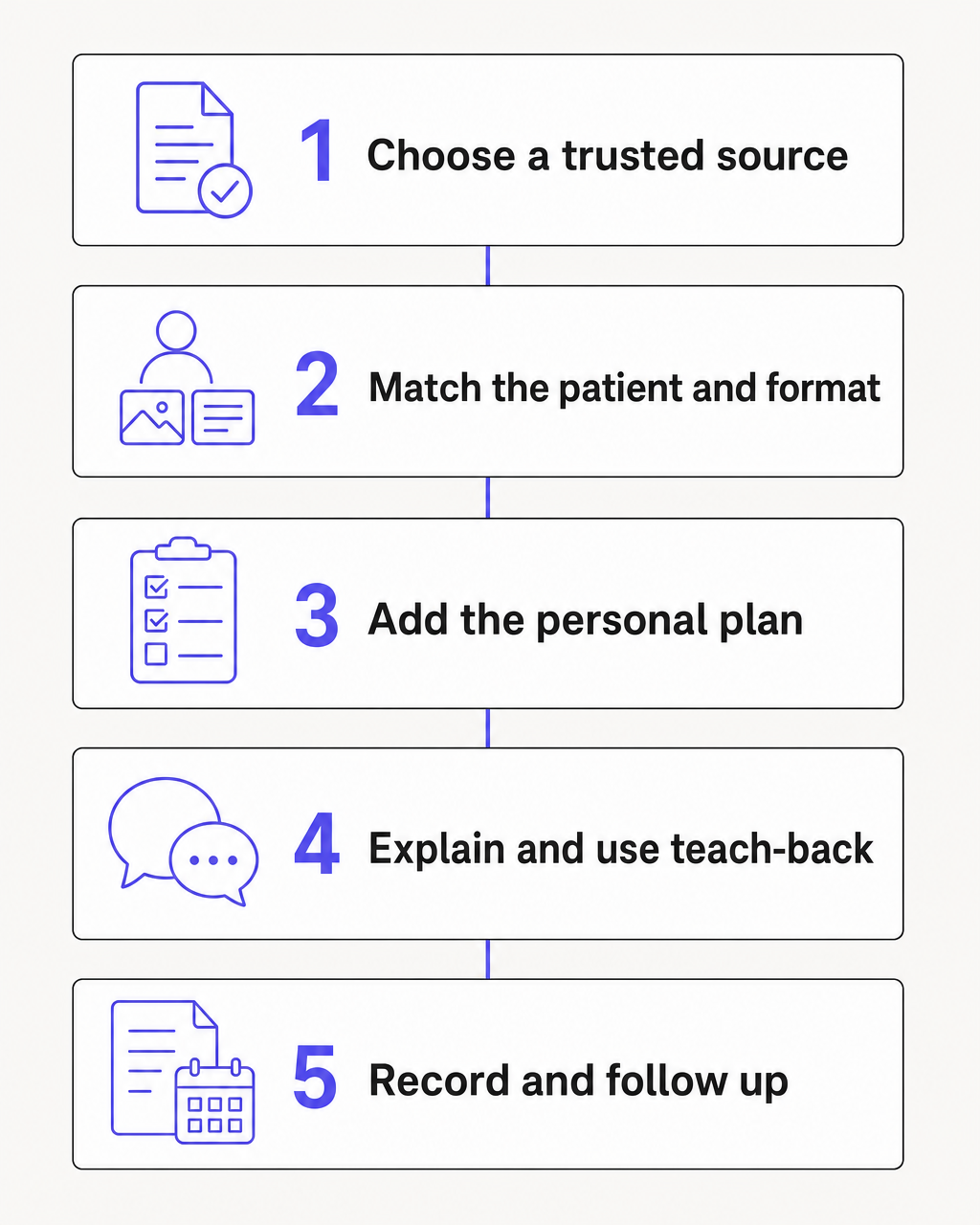
Patient education works best as a short cycle of selection, explanation and confirmation:

  1. Ask. Find out what the patient already knows, what they want to know, their preferred language and format, and whether a support person should be involved.
  2. Prioritise. Agree on the two or three points needed for the next decision or action. Choose material that supports those points.
  3. Review together. Open the webpage, plan or handout during the consult. Mark the relevant section and connect general information to the individual plan.
  4. Confirm. Use teach-back for knowledge and show-me for a skill. If a gap appears, explain it another way and check again.
  5. Share and record. Give the material in an accessible form and record its title or source, the patient-specific instructions, and the follow-up plan.

Five-step patient education workflow from source selection to follow-up

Teach-back checks the clarity of the explanation rather than testing the patient. A useful prompt is: “We covered a lot today. To make sure I explained the plan clearly, can you tell me what you will do when you get home?” Questions such as “Do you understand?” can be answered yes without demonstrating understanding. The AHRQ teach-back method recommends asking the patient to explain the information in their own words, clarifying any misunderstanding and checking again.

Add a patient-specific summary without altering the source

General resources and individual instructions solve different problems. Keep the original, approved material intact. Add a separate consult summary that tells the patient how the information applies to their care.

A practical patient-facing summary can use this structure:

  • What we discussed: the diagnosis, symptom or decision in plain language
  • What to do next: a short, ordered list of agreed actions
  • Medicines: starts, stops or changes, including dose and timing where appropriate
  • Tests and referrals: what is being arranged and what the patient needs to do
  • Get help if: specific warning signs and the corresponding service or contact
  • Follow-up: when, with whom and for what purpose
  • More information: the exact handout or link selected together

This summary should reflect the consult. It does not replace consumer medicine information, a formal action plan, informed consent or any document required for the clinical workflow.

Lyrebird can turn consult content from ambient capture, dictation or typed notes into a draft patient-facing letter. Practices can use custom templates for recurring summary types. With Bp Premier, the reviewed letter can be saved to the patient record alongside the consult note. The clinician checks the draft against the record and agreed plan, edits the language, verifies medicines and safety-net instructions, and signs off before release.

Keep a small practice library current

A short, governed library is easier to use than a shared drive full of near-duplicate PDFs. Give each high-use resource an owner and record:

Library field What to record
Resource Title, source URL, version or publication date
Intended use Condition, decision or skill it supports, plus any exclusions
Audience Age group, language, format and accessibility needs
Clinical owner Person or team responsible for approval
Reuse rights Licence or permission for any adapted text, images and distribution, plus required attribution
Delivery point Where staff find it in the patient record, portal or practice system
Review trigger Guideline, medicine, contact or source update; patient feedback; broken link; scheduled review
Replacement history What was archived, when and why

Group approved materials into common “information sets”, such as a new asthma diagnosis, a medicine change or pre-procedure preparation. Each set should contain only what staff are expected to review with the patient. The AHRQ's practice guidance also recommends monitoring links and electronic health record resources because availability can change.

Patient feedback is the final quality signal. Ask whether the material answered the patient's question, what remained confusing and whether they could use it at home. Repeated confusion about the same section is a reason to replace or revise practice-created material, even when its reading score looks acceptable.

Good patient education materials make the next safe action easier to see and remember. A trusted source, a purposeful format, a patient-specific explanation and confirmation of understanding all contribute to that result.

See how Lyrebird can help your team draft clinician-reviewed patient letters and consult summaries.


Contact us

More Resources
Continue reading
Posts
The dangers of Copy Paste Scribes
Read More
Posts
How to use an AI medical scribe
Read More
Posts
December Product Updates
Read More
Education
Medicare Bulk Billing Consent Forms: A 2026 Guide for Practices
Read More
Education
Clinical Documentation Audit: A Practical Australian Guide
Read More
Education
Scanning Medical Records: A Practical Australian Guide
Read More
Post
5 min read

Patient Education Materials: An Australian Clinician's Guide

Published on
September 3, 2026
Contributors
Adrian Lee
Subscribe to our newsletter
Read about our privacy policy.
Thank you! Your submission has been received!
Oops! Something went wrong while submitting the form.

Patient education materials can reinforce a diagnosis, treatment plan or self-management skill after a consult. Their value depends on more than clinical accuracy. Patients also need to understand the information, see how it applies to them and know what to do next. Australian clinicians need a practical way to find reliable resources, assess their quality and build them into a safer patient education workflow.

What patient education materials need to do

Patient education materials, also called patient information or patient teaching materials, include condition handouts, medicine information, action plans, decision aids, diagrams, videos and personalised consult summaries. Each format serves a different purpose.

Useful material answers three questions:

  1. What does this mean for me? The purpose and relevant clinical information are clear.
  2. What do I need to do? Actions are specific, ordered and realistic.
  3. When and where should I get help? Warning signs, follow-up and contact details are easy to find.

A handout supports the clinical conversation. It does not carry that conversation on its own. The Agency for Healthcare Research and Quality (AHRQ) recommends using materials as part of an education strategy, reviewing important points with the patient and checking understanding rather than simply handing over a pamphlet or link. Its health education guidance also recommends matching the format to how the person prefers to learn.

Trusted Australian sources for patient education materials

Start with a source that has clear clinical ownership and a review process. Then assess the individual resource against the patient's condition, plan, language and access needs.

Source Best used for Available material Check before sharing
healthdirect health topics A broad first search across symptoms, conditions, tests, treatments and medicines Consumer web pages, illustrations and links to related services Select the section that supports the consult instead of sending a broad topic page without direction
Better Health Channel General condition, treatment and healthy living information Web-based consumer information from the Victorian health system Confirm that service contacts and pathways suit the patient's state or territory
Health Translations Finding Australian multilingual health information by topic, language, organisation or file type Links to translated written, audio and video resources from Australian organisations Check the original publisher and resource date. A translated resource complements an interpreter when an interpreted discussion is needed
Pregnancy, Birth and Baby Pregnancy, birth, early parenting and children up to five years Articles, videos, infographics, service finder and nurse support Match advice to the person's stage, clinical circumstances and local maternity pathway
Kids Health Info Paediatric conditions, procedures and home care Fact sheets, translated resources, videos and podcasts from The Royal Children's Hospital Melbourne Give age-specific advice and retain the treating team's individual instructions
RACGP HANDI resources Evidence-based non-drug interventions used in general practice Patient instructions for areas such as back pain, osteoarthritis, falls prevention and rehabilitation Make sure the intervention and progression plan are appropriate for the individual
National Asthma Council resources Asthma self-management and device technique Written asthma action plans and demonstration videos for inhalers and nasal sprays Complete or update the action plan with patient-specific medicines and escalation instructions
CIAP patient education index Finding additional Australian and international patient resources in one place Links to health topics, medicine information, multilingual resources and specialist fact sheets Some clinical resources require NSW Health access. Use the original publisher's current patient version

A respected publisher is the starting point rather than the final selection test. Check who the resource is for, its publication or review date, whether it reflects Australian practice and whether any phone numbers, service pathways or emergency directions apply locally.

Choose the format before choosing the file

Begin with the job the material needs to perform. A long condition guide may explain a diagnosis well and still fail as an emergency action plan.

Patient's need Best starting format What good looks like
Understand a new diagnosis Short condition overview with a simple diagram Defines the condition, relates it to symptoms and separates immediate priorities from background detail
Follow a treatment or self-management plan One-page action plan or checklist Uses clear steps, timing, thresholds and escalation instructions
Learn a physical skill Demonstration plus brief written steps Shows the skill, then lets the patient demonstrate it back, such as inhaler technique or wound care
Compare reasonable options Decision aid Presents options, benefits, harms and uncertainties in balanced terms, with prompts for the patient's preferences
Take medicines correctly Current consumer medicine information plus a personalised schedule Preserves the approved medicine information while making dose, timing and changes easy to follow
Remember what was agreed in the consult Patient-facing summary or letter Records the agreed plan, tests, follow-up and safety-net advice in language the patient can use

Use more than one format when it adds a distinct function. A video can teach technique, while a one-page plan can guide what to do later. Repeating the same background information across several resources usually adds volume rather than clarity.

A seven-point quality check for any handout, PDF or video

1. Clinical accuracy and Australian fit

Identify the publisher, clinical author or reviewer, evidence basis and date. Check the material against the agreed plan. Look closely at medicine names, doses, contraindications, referral pathways, emergency numbers and eligibility rules because these details create risk when they are wrong or out of context.

2. One clear purpose

The title and opening should make the purpose obvious. Keep content that helps the patient achieve that purpose and remove side topics from practice-created material. When a comprehensive external guide contains extra detail, point the patient to the sections that matter now.

3. Plain language and manageable numbers

Use familiar words, active sentences and short sections. Define a clinical term the first time it appears. Present numbers with their unit and meaning, and use an example when a calculation or schedule could be misread.

The Sydney Health Literacy Lab recommends a Grade 8 reading level or below and provides a Health Literacy Editor for screening text. A reading-grade score is only one check. It cannot tell you whether instructions are clinically accurate, logically ordered or useful to a particular patient.

4. Scannable, accessible presentation

Use descriptive headings, bullets, adequate type size, whitespace and high contrast. Tables should have short labels and a simple reading order. Give a text alternative for meaningful images and avoid placing essential instructions only inside an image. A phone-friendly webpage may be easier to enlarge and navigate than a dense PDF.

5. Explicit actions and safety-net advice

State what the patient should do, when to do it and how to know it has been done correctly. Break a process into steps. Put urgent warning signs and the correct response together so the patient does not have to connect information from different sections.

6. Language, culture and context

Use the patient's preferred language and communication method. Consider cultural meaning, examples, family or carer involvement, disability access and digital access. Avoid assuming that a translated English resource answers every communication need. The explanation and plan still need to fit the person receiving them.

7. Understandability and actionability

A material can be easy to read yet vague about action. The free Patient Education Materials Assessment Tool, or PEMAT, assesses these as separate domains for printable and audiovisual resources. Reviewers score applicable criteria as agree or disagree, then calculate separate percentage scores for understandability and actionability. The criteria cover purpose, word choice, numbers, organisation, design, visual aids and specific actions.

Use PEMAT for a structured review of high-use resources or when comparing two options. Clinical verification, accessibility checks and feedback from the intended patients remain separate parts of approval.

Build the material into the consult

Patient education works best as a short cycle of selection, explanation and confirmation:

  1. Ask. Find out what the patient already knows, what they want to know, their preferred language and format, and whether a support person should be involved.
  2. Prioritise. Agree on the two or three points needed for the next decision or action. Choose material that supports those points.
  3. Review together. Open the webpage, plan or handout during the consult. Mark the relevant section and connect general information to the individual plan.
  4. Confirm. Use teach-back for knowledge and show-me for a skill. If a gap appears, explain it another way and check again.
  5. Share and record. Give the material in an accessible form and record its title or source, the patient-specific instructions, and the follow-up plan.

Five-step patient education workflow from source selection to follow-up

Teach-back checks the clarity of the explanation rather than testing the patient. A useful prompt is: “We covered a lot today. To make sure I explained the plan clearly, can you tell me what you will do when you get home?” Questions such as “Do you understand?” can be answered yes without demonstrating understanding. The AHRQ teach-back method recommends asking the patient to explain the information in their own words, clarifying any misunderstanding and checking again.

Add a patient-specific summary without altering the source

General resources and individual instructions solve different problems. Keep the original, approved material intact. Add a separate consult summary that tells the patient how the information applies to their care.

A practical patient-facing summary can use this structure:

  • What we discussed: the diagnosis, symptom or decision in plain language
  • What to do next: a short, ordered list of agreed actions
  • Medicines: starts, stops or changes, including dose and timing where appropriate
  • Tests and referrals: what is being arranged and what the patient needs to do
  • Get help if: specific warning signs and the corresponding service or contact
  • Follow-up: when, with whom and for what purpose
  • More information: the exact handout or link selected together

This summary should reflect the consult. It does not replace consumer medicine information, a formal action plan, informed consent or any document required for the clinical workflow.

Lyrebird can turn consult content from ambient capture, dictation or typed notes into a draft patient-facing letter. Practices can use custom templates for recurring summary types. With Bp Premier, the reviewed letter can be saved to the patient record alongside the consult note. The clinician checks the draft against the record and agreed plan, edits the language, verifies medicines and safety-net instructions, and signs off before release.

Keep a small practice library current

A short, governed library is easier to use than a shared drive full of near-duplicate PDFs. Give each high-use resource an owner and record:

Library field What to record
Resource Title, source URL, version or publication date
Intended use Condition, decision or skill it supports, plus any exclusions
Audience Age group, language, format and accessibility needs
Clinical owner Person or team responsible for approval
Reuse rights Licence or permission for any adapted text, images and distribution, plus required attribution
Delivery point Where staff find it in the patient record, portal or practice system
Review trigger Guideline, medicine, contact or source update; patient feedback; broken link; scheduled review
Replacement history What was archived, when and why

Group approved materials into common “information sets”, such as a new asthma diagnosis, a medicine change or pre-procedure preparation. Each set should contain only what staff are expected to review with the patient. The AHRQ's practice guidance also recommends monitoring links and electronic health record resources because availability can change.

Patient feedback is the final quality signal. Ask whether the material answered the patient's question, what remained confusing and whether they could use it at home. Repeated confusion about the same section is a reason to replace or revise practice-created material, even when its reading score looks acceptable.

Good patient education materials make the next safe action easier to see and remember. A trusted source, a purposeful format, a patient-specific explanation and confirmation of understanding all contribute to that result.

See how Lyrebird can help your team draft clinician-reviewed patient letters and consult summaries.
Contact us

Keep reading

All posts
Questions about compliance?