Transferring Medical Records to a New Doctor in Australia

A patient moving practices creates a records task for both teams. The next doctor needs useful history, while the outgoing practice needs to release the right information to the right recipient and keep its recordkeeping obligations clear. For clinicians and practice managers, the work spans authority, scope, timeframes, charges and documented receipt, whether the file leaves on paper or electronically.
Start with the right legal route
The receiving doctor can obtain records through different request routes. Classify the request by its authority and purpose, rather than assuming every file sent to another practice follows the same rules. For private providers, the Australian Privacy Principles (APPs) provide the national baseline.
The patient-access guidance allows a patient to ask for an access copy to be sent directly to another provider. Under APP 12, access must be given in the requested manner where reasonable and practicable. This is not confined to an authorised-agent arrangement or a local statutory transfer right.
A new doctor's request alone is different. Establish the patient's authority or another lawful basis under the APP 6 disclosure rules. If the doctor makes an access request on the patient's behalf, establish that authorisation. Practice letterhead alone is insufficient.
National private-provider rules and local requirements
The federal Privacy Act covers private health service providers across Australia. New South Wales (NSW), Victoria and the Australian Capital Territory (ACT) also have local health-information laws affecting private providers. State and territory public hospitals generally follow local privacy, access and recordkeeping laws rather than the federal private-provider framework. The jurisdiction overview from the Office of the Australian Information Commissioner (OAIC) explains this division.
Local law can create a specific transfer right. Victoria's Health Privacy Principle (HPP) 11 lets a person request that some or all of their information be made available to another health service provider, including through a provider they authorise to request it. It applies to public and private health service providers. Victoria distinguishes this statutory route from lawful voluntary sharing between providers jointly involved in care. See the Victorian transfer provisions.
For Western Australian (WA) public-sector bodies covered by the Information Privacy Principles and some government contractors, most substantive privacy provisions in the Privacy and Responsible Information Sharing Act commenced on 1 July 2026. Its notifiable information breach provisions commence on 1 January 2027. The WA Office of the Information Commissioner's commencement page gives these staged dates; the OAIC jurisdiction overview's WA entry is outdated on this point.
For a public-hospital record, route the request through that service's records process. Its patient-access pathway, including any freedom of information process, need not be the same as a clinical disclosure to the patient's next doctor.
Confirm authority and record the request
A signed transfer form is a useful practice tool. It is not a universal Australian prerequisite for every routine transfer. The Royal Australian College of General Practitioners (RACGP) record-request guidance allows a verbal request to be confirmed with the patient and documented in their record.
Express consent can be oral or written. It must be informed, voluntary, given by a person with capacity, current and specific. Those consent requirements concern handling information and are distinct from consent to treatment.
The APP 6 disclosure rules also permit certain disclosures without consent, including a secondary purpose the patient would reasonably expect that is directly related to the primary purpose of collection. Local law and professional confidentiality obligations still matter. Avoid treating this exception as automatic authority to send an entire historical file.
For a routine move, we recommend recording:
- the patient's identity and the requester's identity and authority
- the named receiving doctor or practice
- the purpose, requested records, date range and any patient restrictions
- how and when authority was confirmed
- the requested format, urgency and agreed contact person.
For children or adults who lack capacity, the representative's authority needs its own assessment. A child's capacity, care arrangements and relevant court orders can affect who may request access. A family relationship alone does not establish authority. The OAIC's representative access guidance addresses these cases.
Keep local formalities separate. The NSW Information and Privacy Commission (IPC) access requirements say a patient-access request under the state's Health Records and Information Privacy Act should be in writing. That does not make a signed transfer form mandatory nationwide.
Agree whether to send a summary or a fuller record
A concise summary helps the receiving doctor find important history. RACGP's suggested transfer dataset is a minimum relevant summary; complex conditions or history can warrant a complete copy.
Its suggested GP dataset includes:
- patient demographics and identifiers
- allergies and adverse reactions
- current medicines
- recorded current and past medical history
- family and social history, health-risk factors and immunisations.
This is professional guidance, not a closed statutory list. Agree the scope with the patient and receiving practice. Relevant investigation results, specialist correspondence or procedure reports may also be needed. Keep dates, authors and source organisations attached so the new doctor can distinguish historical findings from current information.
Do not substitute a summary for a patient's full-record access request simply because it is easier, including when they ask you to send that copy to their next doctor. The patient-access rules generally extend to information held about them, including material received from other providers, subject to applicable exceptions. A transfer summary may be useful alongside that copy.
For example, a patient may authorise a summary and recent specialist reports for their new GP, while separately requesting a complete access copy for themselves. Log and fulfil each request on its own terms.
Our Documents & Letters uses clinical notes to generate documents and supports custom templates matching your practice's structure, language and formatting. If you use this capability to prepare a draft transfer letter, we recommend that a clinician reconcile it with the source record, edit it and sign it off.
This is our suggested documentation practice, not a dedicated record-transfer workflow or a legal rule. Lyrebird does not establish disclosure authority or transfer records between practices.
Use the timeframe for the actual request
There is no single national deadline for every practice-to-practice transfer. The Medical Board's professional code, section 10.5.8, expects doctors to promptly facilitate transfer when requested by a patient or a third party with requisite authority. That expectation is not a fixed number of days.
The access clocks come from APP 12 timing guidance and NSW access guidance. The ACT rules are in Schedule 1, Principle 12.1, pages 57–58.
Under the ACT provision, notice of a payable determined fee must be given within 7 days after receipt. When that fee is paid, the deadline is the later of 30 days after receipt or 7 days after payment. The urgent-services rule remains separate. Another provider's advice that the patient needs urgent health services is sufficient to establish urgency and need not be written.
As a practice control, assign an owner when the request arrives, have a clinician assess urgency and record both the applicable deadline and the promised dispatch date. An administrative outer limit is not a reason to leave an urgent, authorised request in a routine queue.
Explain reasonable fees before preparing the transfer
There is no standard Australian medical-record transfer fee. Identify the legal route before applying a practice charge.
For APP 12 patient access, you cannot charge for making the request. A charge for providing access must not be excessive. It can reflect retrieval, reproduction, sending and materials costs. Routine clerical work should attract a clerical rate, and hardship or adverse consequences of delayed access can make a reduction or waiver appropriate. Explain the amount beforehand and offer a lower-cost format where suitable. These patient-access fee principles do not set a national price for every disclosure to a new doctor.
Local transfer rights can limit charges. The Victorian fee provisions permit capped HPP 11 charges in specified cases, including at least 20 black-and-white A4 pages, copies in another format, or a newly prepared accurate summary taking at least 30 minutes. The caps use fee units whose dollar value changes annually. ACT charges are governed by its fees determination.
A useful fee explanation states the requested scope, work involved, rate or applicable cap, delivery cost and total. Avoid an unexplained flat charge. If cost becomes a barrier, discuss a lawful lower-cost option without quietly reducing the patient's requested scope or overlooking clinical urgency.
Review the package and hand it off securely
APP 11 requires reasonable safeguards against loss and unauthorised access or disclosure. The APP 11 security rules include technical and organisational measures. The controls below are recommended, risk-assessed practice rather than a nationally prescribed dispatch protocol.
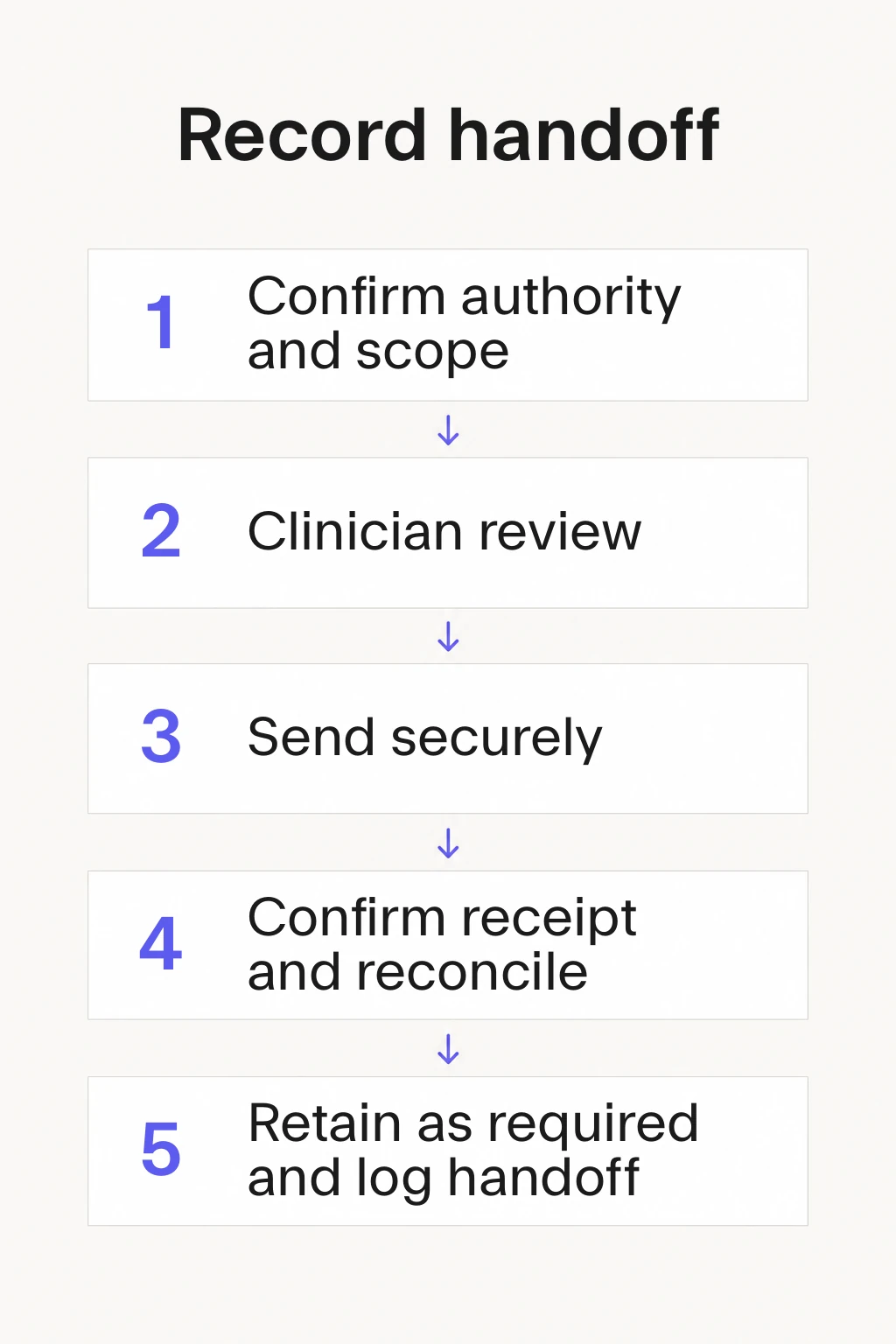
Prepare one traceable package
Before release, the nominated reviewer should confirm that:
- the patient and recipient match the authorised request
- the documents cover the agreed scope and date range
- pages and attachments are complete, legible and correctly ordered
- other patients' records have not been included
- third-party personal information has been assessed under the applicable rules
- any omissions or lawful redactions are documented.
Give the package a protected contents list with document names or categories, dates and counts. Keep patient identifiers in controlled record metadata rather than exposed transport labels or ordinary email subject lines. If paper must be digitised, our medical-record scanning guide covers capture quality and patient matching.
Electronic handoff
Use a secure channel both practices can receive, with recipient authentication and suitable access controls. Agree a readable file format before exporting, particularly when the practices use different clinical software.
Ordinary email is not a secure default. The OAIC's email security guidance supports secure messaging where appropriate and available, validating recipient addresses, recording dispatch and receipt, and encrypting or password-protecting sensitive attachments. It is guidance rather than a mandated single transfer method.
As additional practice controls, confirm destination details through a trusted contact route rather than relying on an unfamiliar incoming message. Send an attachment password through a separate channel, restrict download access and expiry where supported, and track failed deliveries. A successful upload or email send does not prove the new practice can open the file.
Paper handoff
Use sealed packaging, restricted storage before collection and a delivery method appropriate to the sensitivity and risk. Record who released the package, who transported or collected it and when it reached the receiving practice. Avoid clinical details on the outside of the package.
Tracked delivery and a custody log are useful controls. They are not a universal legal requirement to use one particular courier. A package left unattended or delivered to the wrong reception desk remains a confidentiality risk even if the envelope is marked confidential.
Confirm receipt and resolve exceptions
Ask the receiving practice to acknowledge receipt, readability and completeness against the contents list. Keep any missing, corrupt or mixed-patient material out of routine filing until the discrepancy is resolved. Record re-sends against the original request so the handoff history remains clear.
The receiving team should reconcile the information with the correct patient record and route clinically relevant material for clinician review. Patient-reported information collected through a new-patient intake form is a separate source and should remain distinguishable from the previous doctor's record.
Handle refusals and disputes on the correct basis
Unclear authority calls for clarification before disclosure. It does not justify closing the request without an explanation. Record what is missing, contact the patient or authorised requester, and keep the request under review.
APP 12 has defined patient-access refusal grounds, including a serious threat to life, health or safety, an unreasonable impact on another person's privacy, and unlawfulness. Consider partial access, redaction or another suitable access method before refusing the whole request. Embarrassment alone is not a valid ground. A refusal, or refusal of the requested manner of access where no alternative is agreed, requires written reasons, subject to the limited exception where explaining them would be unreasonable, and complaint information under the access-refusal requirements.
Those access provisions are not a blanket power to refuse an authorised transfer to another doctor. For a disputed transfer, document the applicable basis, decision-maker, reasons and any information that can lawfully be provided. Obtain medical-defence or legal advice where capacity, competing authorities, special records or a court order makes the position unclear.
Give the patient a named practice contact and the relevant external complaint pathway. Under OAIC's complaint process, federal privacy complaints generally start with the provider. Local routes depend on the setting, including the NSW Information and Privacy Commission, Victoria's Health Complaints Commissioner and the ACT Human Rights Commission.
Plan for practice closure and continuing access
Closing a practice does not end responsibility for its records. The Medical Board code expects advance patient notice where possible and arrangements for continuing care, including transfer or appropriate management of all patient records in line with local law.
The closure plan should identify the record custodian, secure storage location, request contact, remaining retention obligations and arrangements for patients to nominate a new provider. Keep those contact arrangements usable after the premises and usual phone lines close.
NSW closure guidance requires a closing provider to retain records for the applicable statutory period or transfer them to a provider nominated by the patient. Where records are stored, make reasonable efforts to tell patients where they are and how to access them.
For ACT relocation or permanent closure, Principle 11 requires public notice at least 30 days before the proposed change and other practicable steps to inform patients. Give ACT Health the notice or its information as soon as practicable after publication. The ACT closure procedure includes the notification form and situation-specific checklists.
Under Principle 11's provisions, the notice must give patients a transfer-request period ending 14 days after publication. A requested copy or summary must be provided as soon as practicable, no later than 30 days after receipt or, if a fee is payable, the later of that date and 7 days after payment. Urgent-services requests must be fulfilled as soon as practicable and within 7 days.
If no request is made within the request period, give a copy to the provider or record keeper named in the notice within 30 days after that period ends. These closure windows are separate from Principle 12.1's ordinary patient-move route.
Sending a copy to the new doctor does not authorise destruction of the retained source. Retention and disposal depend on the applicable law, records authority or schedule and any legal hold. Keep evidence of the authorised handoff with the remaining record.
Finish with a usable record and a clear handoff history
Give each request a clear status: completed with receipt, open with an unresolved exception, or declined with a reasoned decision communicated. Retain the request, authority, scope, review decision, charge explanation, dispatch details and receipt or unresolved issue together.
The next doctor needs records they can read and interpret. Clear source notes and clinician-reviewed letters make that work easier. To discuss how our clinical AI platform supports those documentation workflows, contact our team.