Medicare Eating Disorder Plans: A Practical Guide for GPs
A Medicare eating disorder plan can support a longer rebated course of care than a standard Mental Health Treatment Plan, but access depends on a specific diagnosis, assessment and review sequence. For GPs, the work extends well beyond choosing an item number. The plan must support safe multidisciplinary care, and a missed review can interrupt treatment. A clear workflow keeps eligibility, referrals, specialist review, costs and follow-up visible from the first consult.
What is a Medicare eating disorder plan?
The official name is an Eating Disorder Treatment and Management Plan (EDTMP). Eating Disorder Plan, EDP and eating disorder care plan are common shorthand for the same Medicare pathway.
With an EDTMP, an eligible patient can receive Medicare benefits for:
- up to 40 eating disorder psychological treatment services
- up to 20 dietetic services.
Separate MBS items cover plan preparation, structured reviews and ongoing management. The plan runs for 12 months from the date it is prepared, rather than by calendar year. It applies to eligible patients receiving community-based care and does not apply while a patient is admitted to hospital. A GP or other medical practitioner working in general practice, consultant psychiatrist or consultant paediatrician can prepare the plan. MBS explanatory note AN.36.1 sets out the full pathway.
The headline limits of 40 and 20 can be misleading. Under the Services Australia referral requirements, the first referral is limited to 10 psychological services and all 20 dietetic services can be included in one referral. Further psychological courses depend on formal plan reviews. The plan creates access to rebates; it does not guarantee that every service is clinically required, available or bulk billed.
Medicare eating disorder plan eligibility
To use this pathway, the patient must be eligible to receive Medicare benefits and fall into one of two eligibility cohorts.
| Clinical diagnosis | Additional Medicare criteria |
|---|---|
| Anorexia nervosa | No additional severity criteria apply once the clinical diagnosis is established. |
| Bulimia nervosa, binge-eating disorder or other specified feeding or eating disorder (OSFED) | The patient must meet all three parts of the additional test below. |
For the second cohort, all of the following are required:
- An Eating Disorder Examination Questionnaire (EDE-Q) score of 3 or more.
- Either rapid weight loss, or three or more occurrences per week of binge eating or inappropriate compensatory behaviour.
- At least two of these indicators:
- body weight below 85% of expected weight, where the eating disorder directly caused the weight loss
- current medical complications, or a high risk of them, due to eating disorder behaviours and symptoms
- serious comorbid medical or psychological conditions with a significant effect on health and function
- admission to hospital for an eating disorder in the previous 12 months
- inadequate response to evidence-based eating disorder treatment over the previous six months despite active, consistent participation.
These criteria are cumulative. An EDE-Q score of 3 alone is insufficient, and the extra test should not be applied to a patient with anorexia nervosa. The EDE-Q also does not replace diagnostic assessment or a medical risk assessment. The Services Australia eligibility rules reflect the current MBS requirements.
Medicare eligibility is not a measure of whether an eating disorder is serious. A person who does not meet the EDTMP criteria may still need active treatment, medical monitoring or urgent escalation. Under the Better Access pathway, a Mental Health Treatment Plan can provide up to 10 rebated psychological services for an eligible mental disorder. Our GP guide to mental health plans explains that process. Public eating disorder services, specialist care and private treatment may also be appropriate. If assessment identifies medical instability or immediate suicide risk, follow the urgent assessment or hospital pathway before completing the plan. The national NEDC GP clinical resource sets out warning signs, medical risk assessment and referral options.
The 12-month pathway is staged
Under the MBS stepped model, psychological treatment is released in courses of up to 10 services. The managing practitioner reviews progress before each new course, and specialist input is required to move beyond 20 services.
| Point in the pathway | What must happen | What becomes available |
|---|---|---|
| Plan prepared | Confirm eligibility, complete the plan, issue referrals | Up to 10 psychological services and up to 20 dietetic services |
| Before service 11 | Managing practitioner reviews progress and updates the plan | A second course of up to 10 psychological services |
| Before service 21 | Managing practitioner review and psychiatrist or paediatrician review both support higher-intensity treatment | A third course of up to 10 psychological services |
| Before service 31 | Managing practitioner completes another review | A final course of up to 10 psychological services |
| At 12 months | Prepare a new EDTMP and new referrals if the patient remains eligible | A new 12-month pathway; unused services do not carry over |
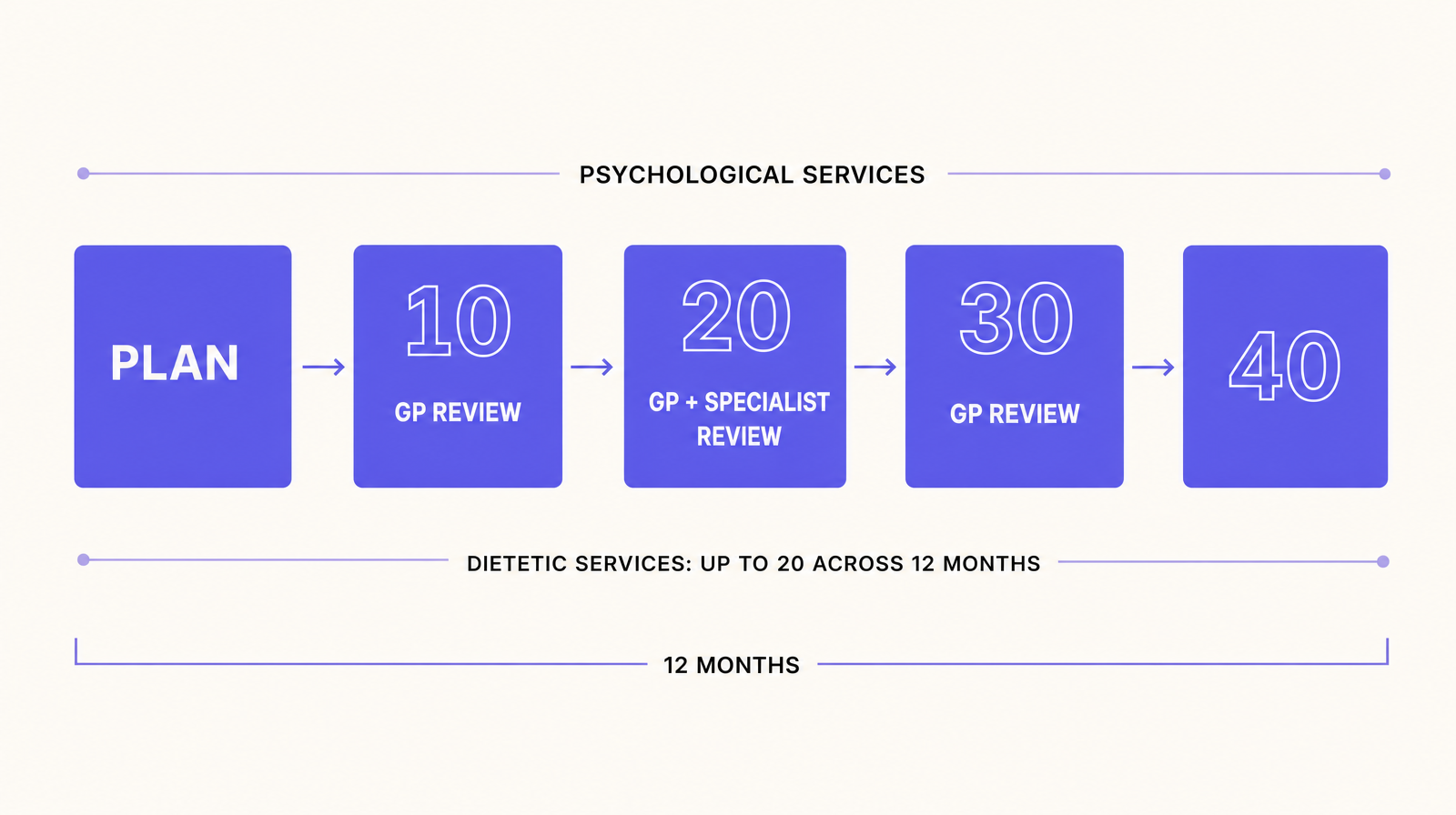
The specialist review can happen at any point before the 20th psychological service. The MBS review guidance recommends referring as early as clinically appropriate and, if more than 20 services may be needed, no later than the first practitioner review when a referral has not already started. Waiting until service 20 risks a treatment gap.
This is a real point of failure. The national 2024 MBS evaluation found that around one-third of people who received a plan did not use any treatment services, and service discontinuation rose around mandatory review points. Among the 25,564 people observed for at least 12 months after their first EDTMP, 55.6% used psychological treatment and 43.0% used dietetic treatment in year one; among those using each service type, mean use was 12.9 psychological and 7.5 dietetic treatment services, respectively. A plan works better when it records who will make each referral, when progress reports are due and how the next review will be booked.
How to prepare an EDTMP in general practice
1. Complete the assessment and risk review
The clinician preparing the plan must have performed or reviewed enough assessment to determine eligibility. The MBS plan requirements include:
- relevant biological, psychological and social history, including family or carer support
- an eating disorder diagnostic assessment
- physical examination and relevant investigations
- mental state examination and assessment of psychiatric comorbidity
- eating disorder behaviours, nutritional status and functional effects
- medical complications and risk of hospitalisation
- psychological distress and suicide risk
- response to previous evidence-based treatment
- an outcome measure, except where clinically inappropriate.
The EDTMP item covers preparation of the plan. If a comprehensive physical assessment is billed separately, the same time cannot be counted towards both services.
2. Build a plan the whole team can use
The written plan should make the clinical reasoning and next actions easy to follow. InsideOut Institute provides downloadable plan and review templates. Record:
- the diagnosis and evidence supporting eligibility
- medical and psychological findings, needs and risks
- patient-centred treatment goals and agreed actions
- treatment options and named referral destinations
- medical and nutritional monitoring arrangements
- patient and family or carer education
- a crisis intervention or relapse prevention plan when appropriate
- review dates, including the expected specialist review
- the patient's agreement to proceed and consent for relevant information sharing.
The MBS record and copy requirements require the practitioner to offer the patient a copy and add the plan to the clinical record. With the patient's permission, offer a copy to an appropriate carer and share the plan, or relevant parts, with treating clinicians. Treat it as a living document and update it when reports or clinical circumstances change.
3. Issue referrals with the correct limits
Under the allied health referral rules, a referral can cover up to 10 psychological services or up to 20 dietetic services. The MBS psychological provider rules cover clinical psychologists, registered psychologists, eligible occupational therapists and accredited mental health social workers, plus medical practitioners registered to provide focused psychological strategies. Dietetic services must be delivered by an eligible dietitian.
Rebated psychological services must use an approved eating disorder treatment. These include Family Based Treatment, Adolescent Focused Therapy, eating disorder-specific cognitive behavioural therapies, Specialist Supportive Clinical Management, the Maudsley Model of Anorexia Treatment in Adults, interpersonal or dialectical behaviour therapy for bulimia nervosa and binge-eating disorder, and focal psychodynamic therapy.
Name the patient, diagnosis, plan date, requested service type and number of services, goals, relevant risk information and reporting expectations. The MBS psychological treatment and dietetic treatment notes require a written report after the first and last service, and as clinically required between them. Reports must cover assessments, treatment and recommendations for future management.
4. Track the review sequence from day one
Record the plan start and expiry dates, psychological and dietetic service counts, referral dates, reports received and the next review milestone. Make the specialist referral early if sessions 21 to 40 may be needed. Services Australia explains that patients can track claimed care plan services through myGov, while clinicians can check eligibility and plan history in HPOS.
With the patient's consent, our clinical notes workflow can capture the assessment by ambient scribe, dictation or typed notes and structure it in a custom EDTMP template. From the same reviewed note, our documents and letters workflow can draft the psychologist, dietitian and specialist referrals. The GP still confirms the diagnosis, eligibility, risks, objective findings, service limits and review dates before editing and signing each draft.
MBS item numbers for plan preparation and review
The core face-to-face items are:
| Practitioner and service | MBS item |
|---|---|
| GP without recognised Mental Health Skills Training, prepare plan, 20 to under 40 minutes | 90250 |
| GP without recognised Mental Health Skills Training, prepare plan, 40 minutes or more | 90251 |
| GP with recognised Mental Health Skills Training, prepare plan, 20 to under 40 minutes | 90252 |
| GP with recognised Mental Health Skills Training, prepare plan, 40 minutes or more | 90253 |
| Other medical practitioner without recognised training, prepare plan, 20 to under 40 minutes | 90254 |
| Other medical practitioner without recognised training, prepare plan, 40 minutes or more | 90255 |
| Other medical practitioner with recognised training, prepare plan, 20 to under 40 minutes | 90256 |
| Other medical practitioner with recognised training, prepare plan, 40 minutes or more | 90257 |
| Consultant psychiatrist, prepare plan, at least 45 minutes | 90260 |
| Consultant paediatrician, prepare plan, at least 45 minutes | 90261 |
| GP review | 90264 |
| Other medical practitioner review | 90265 |
| Consultant psychiatrist review, at least 30 minutes | 90266 |
| Consultant paediatrician review, at least 20 minutes | 90267 |
The same Services Australia billing guidance covers the telehealth pathway. Video plan items are 92146 to 92153 for practitioners in general practice and 92162 to 92163 for specialists. Video review items are 92170 to 92173; phone review items 92176 and 92177 apply to GPs and other medical practitioners. The eligibility and telehealth requirements of the individual item still apply.
Under the 1 July 2026 plan item schedule and review item schedule, GP plan and review items pay 100% of the schedule fee:
| GP item | Schedule fee and Medicare benefit |
|---|---|
| 90250 | $85.80 |
| 90251 | $126.35 |
| 90252 | $108.95 |
| 90253 | $160.50 |
| 90264 | $85.80 |
Our broader MBS item number cheat sheet links directly to current item descriptors for other common general practice services.
What does the patient pay?
An eating disorder plan provides Medicare rebates. It does not make every appointment free. If the provider charges more than the Medicare benefit shown in the MBS, the patient pays the difference unless the service is bulk billed.
Common individual, in-room service examples under the 1 July 2026 allied health schedule and specialist review schedule are:
| Service | MBS item | Schedule fee | Medicare benefit |
|---|---|---|---|
| Dietitian, at least 20 minutes | 82350 | $74.55 | $63.40 |
| Clinical psychologist, 50 minutes or more | 82355 | $175.30 | $149.05 |
| Registered psychologist, 50 minutes or more | 82363 | $119.45 | $101.55 |
| Psychiatrist plan review, at least 30 minutes | 90266 | $343.75 | $292.20 |
| Paediatrician plan review, at least 20 minutes | 90267 | $160.50 | $136.45 |
The benefit varies with provider type, service duration, location and delivery mode. Confirm the provider's fee, expected rebate and likely gap with the patient before finalising the referral, especially for the specialist review that may be needed before service 21.
How EDTMP services interact with other Medicare plans
The current MBS overlap rules are easy to misstate.
- Better Access psychological services delivered before the EDTMP starts do not reduce the EDTMP count.
- Better Access services delivered after the EDTMP starts count towards the 40-service maximum when the patient still has a valid Mental Health Treatment Plan, referral and required review arrangements.
- Dietetic services delivered under Chronic Condition Management arrangements during the EDTMP period count towards the 20-service dietetic maximum.
- Co-occurring psychiatric conditions should generally be managed through the EDTMP psychological services. A separate Mental Health Treatment Plan should not usually be prepared during the EDTMP period unless exceptional circumstances apply.
- A separate Chronic Condition Management Plan may still be appropriate for a distinct chronic medical condition.
Unused EDTMP services cannot be carried into the next plan. If the patient reaches 40 psychological or 20 dietetic services early, another EDTMP cannot start until the existing 12-month period has ended.
Avoid the interruptions that stop care
The most useful EDTMP is clinically sound and operationally explicit. Confirm the correct eligibility pathway, document medical and psychological risk, issue referrals within their service limits, schedule reviews before each 10-session threshold and start the specialist referral early. That gives the patient and treating team a shared map for the year rather than a form that disappears into the record.
Our clinical AI platform can draft the structured note, care plan and referral letters from the consult, ready for your review and sign-off. Start for free.