Education
5 min read

Proof of Medical Condition Letter: Australian Guide
Published on
September 14, 2026
Medical proof and support letters on a violet Lyrebird Health title card.
Contributors
Lyrebird Health
Subscribe to our newsletter
Read about our privacy policy.
Thank you! Your submission has been received!
Oops! Something went wrong while submitting the form.

A request for “proof of a medical condition” does not identify a standard Australian form. It may call for factual confirmation, a reasoned letter of support, a medical certificate or a scheme-specific report. Patients need the right document for the decision. Clinicians need a clear purpose, a sound evidence base and authority to disclose the relevant health information without giving a wider opinion than the request requires.

Proof letters and medical support letters serve different purposes

A proof of medical condition letter is a purpose-specific confirmation of supported clinical facts. It may confirm a diagnosis and the minimum functional information needed for the recipient’s decision. It does not recommend an adjustment or decide whether the patient qualifies for an approval, benefit or service.

A medical support letter confirms supported facts and relevant function, then gives a reasoned clinical recommendation within the author’s scope. It links the person’s functional difficulty to a proposed adjustment, support or period, with a duration or review point where possible. The recipient still makes the administrative, employment, housing, education or eligibility decision.

Neither phrase names a nationally standardised form. The recipient or scheme determines who may write the document, what evidence it must contain and whether its own form is compulsory.

Document Core content Boundary
Factual proof letter Supported diagnosis or clinical facts, plus only the function needed for the stated purpose No recommendation and no conclusion about approval or eligibility
Medical support letter Supported facts, relevant function and a reasoned recommendation with duration or review Recipient decides; recommendation stays within clinical scope
Medical certificate Incapacity, absence or fitness for a defined period or activity Often sufficient for ordinary sick leave; diagnosis may be unnecessary
Prescribed form or formal report Answers the questions set by an agency, insurer, court, regulator or scheme A generic letter cannot be assumed to replace it

For ordinary incapacity or absence, our medical certificate guide covers the distinct certificate workflow.

Choose the document before drafting

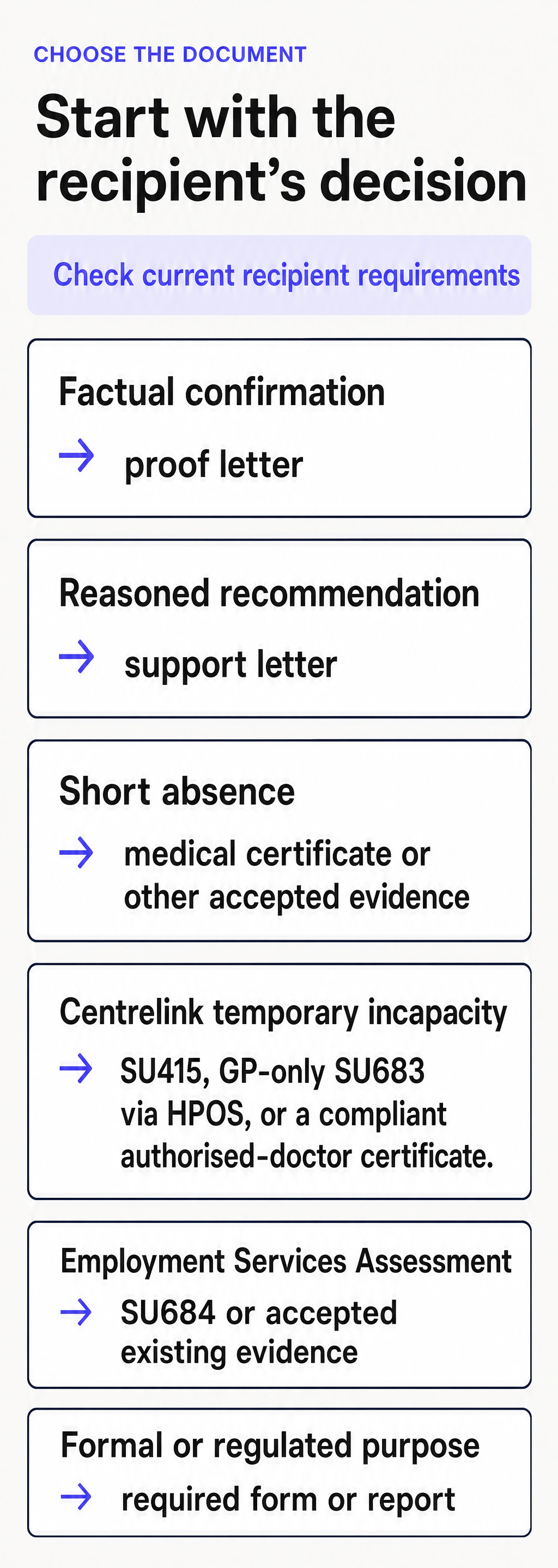
Get the current recipient requirements first. They should identify the decision, required author, accepted evidence, mandatory form, date range and delivery route. A well-written generic letter can still be unusable when a form or evidence package is required.

What the recipient needs Usually the right document Main limit
Factual confirmation of a supported condition Proof of medical condition letter Confirm facts and only necessary function
Clinical support for an adjustment or service Medical support letter Explain the clinical link; recipient decides
Evidence for a short work or study absence Medical certificate or another accepted form of evidence Follow the employment or education rules
Temporary Centrelink incapacity Paper SU415, HPOS SU683 or an accepted non-Centrelink medical certificate Services Australia decides the exemption
Medical evidence for an Employment Services Assessment SU684 or another accepted evidence source SU684 is one route, not the default for every case
Insurance, legal, workers’ compensation, licensing or formal capacity decision Prescribed form or appropriately scoped formal report Address the set questions impartially

Common use cases and boundaries

Workplace

For paid sick or carer’s leave, Fair Work says medical certificates and statutory declarations are examples of acceptable evidence. An award or registered agreement may specify when evidence is required and what type, but the request must be reasonable in the circumstances. An employer may ask for evidence for one day or less. A detailed proof or support letter is therefore not the automatic choice for an ordinary absence. Fair Work’s evidence rules explain the national position.

When an employer requests evidence for a workplace adjustment, a factual proof letter can confirm the condition and necessary functional limits. A support letter can add a clinically reasoned recommendation. The clinician should not decide whether the adjustment is legally required, operationally feasible or approved.

Education

Schools and universities may require a medical certificate, special-consideration form or support letter. The document should relate symptoms and functional effects to the relevant attendance, assessment or study period. A support recommendation may address an extension, deferral or adjustment when the institution invites that opinion. The institution applies its policy and makes the decision.

Housing

Housing processes are often jurisdiction-specific. A housing form may ask about diagnosis, daily function, current accommodation, support needs and property requirements. For example, the Housing ACT support template asks clinicians to connect the condition with daily living and suitable housing needs. A support letter does not determine priority, allocate housing or replace a required state or territory form.

Disability and administrative decisions

Disability evidence usually forms part of a wider application. Supply the current diagnosis, treatment, symptoms, prognosis and functional facts the scheme requests. Add a recommendation only when it falls within clinical scope and the process asks for it. The agency applies the eligibility rules.

Medico-legal, insurance and formal capacity reports

These requests may require a prescribed form, records review, examination, response to defined questions and an impartial opinion. The Medical Board of Australia requires doctors conducting third-party assessments to explain their role and purpose and to provide an impartial report. It also requires honesty, reasonable steps to substantiate content and clear limits on the doctor’s knowledge. Good medical practice addresses these duties in sections 10.8 and 10.9.

A brief treating-practitioner support letter cannot bypass that process or substitute for a formal report.

How to request the right letter

  1. Get the written requirements. Bring the form, decision criteria, recipient details, relevant dates and any wording the recipient requires to the consult.
  2. See an eligible practitioner. The treating clinician is often best placed to use the existing record, but author eligibility is recipient- and scheme-specific. A new clinician may need more evidence or input from the diagnosing practitioner.
  3. Bring missing evidence. Provide specialist reports, hospital summaries, results or prior records that the practice does not already hold.
  4. Agree on the disclosure. Discuss which diagnosis, function, treatment, prognosis and date information will be sent to the named recipient for the named purpose.
  5. Allow for assessment and preparation. The clinician must reach an independent view and may need a longer consult or separate drafting time.
  6. Use the required delivery route. Some forms go through a portal, while other documents are returned to the patient or sent securely to the recipient.

Centrelink and Services Australia evidence routes

Centrelink processes show why “a doctor’s letter” is too broad. Temporary incapacity, an Employment Services Assessment and a Disability Support Pension claim use different evidence.

Temporary incapacity: SU415, SU683 or an accepted doctor’s certificate

The SU415 Centrelink Medical Certificate is the paper form. A medical doctor completes and signs it, then the patient uploads or lodges it with Services Australia.

The SU683 is the equivalent online certificate in Health Professional Online Services (HPOS). Only eligible GPs can complete this route. The GP needs Provider Digital Access (PRODA) and HPOS access, and submission lodges the certificate on the patient’s behalf. Our Centrelink certificate guide explains the workflow.

Services Australia can also accept an authorised medical doctor’s own signed certificate when it includes all required information:

  • the completion date
  • the illness, injury or disability
  • expected recovery time
  • the period the person cannot work, participate or study
  • weekly capacity, including whether the person cannot do at least eight hours a week
  • the doctor’s signature.

Services Australia prefers the Centrelink form because it can assess the request faster, but its medical certificate instructions expressly allow a compliant non-Centrelink certificate. Lodging medical evidence does not let the clinician decide the exemption.

Employment Services Assessment: SU684 is one accepted route

An Employment Services Assessment (ESAt) needs evidence that shows the disability, illness or injury and explains its effect on work capacity. Services Australia accepts evidence prepared or collated by a medical practitioner, registered nurse, nurse practitioner, or Aboriginal and Torres Strait Islander health practitioner.

The accepted ESAt evidence includes:

  • the SU684 Verification of medical conditions form
  • existing specialist medical reports
  • IQ testing reports
  • hospital or outpatient reports
  • discharge summaries.

The evidence must identify the diagnosis, name the medical practitioner who made it and explain the effect on capacity to work. If the author did not diagnose the condition, they should attribute the diagnosis to the named practitioner and source report. SU684 is therefore an available route, not a universal default or a temporary-incapacity certificate.

Disability Support Pension: evidence package, not a generic letter

For a Disability Support Pension (DSP) claim or medical review, clinicians provide current evidence relevant to each condition that affects the person’s ability to work. Services Australia asks for information such as:

  • diagnosed conditions and supporting source
  • past, current and planned treatment
  • symptoms and prognosis
  • day-to-day functional impact, including with treatment and aids
  • treating health professional details.

Some conditions require evidence from a specified specialist or evidence supporting diagnosis under the relevant Impairment Table. Services Australia assesses whether the evidence meets the rules; a clinician should state supported clinical facts and opinions without declaring the person eligible.

Patients can use the SA473 checklist, while treating health professionals can use the current SA478 checklist. The broader DSP evidence guidance identifies the condition-specific specialist requirements.

Build the letter from evidence, purpose and consent

Name the recipient and purpose

Address the person, role or organisation that will use the letter. Record the decision the letter supports. Avoid an open-ended “To whom it may concern” document that could be reused for another purpose.

Separate the information sources

A defensible letter makes the basis of each statement clear:

  • Diagnosing source: identify the clinician and report or record when the author did not make the diagnosis.
  • Records reviewed: name the relevant specialist letter, hospital summary, result or dated practice record.
  • Patient-reported history: introduce it as “the patient reports” or equivalent, rather than presenting it as an independently established fact.
  • Current findings: distinguish examination findings and observed function from the history.
  • Clinical opinion: explain how the supported facts lead to any conclusion or recommendation.

This structure prevents a patient’s requested wording from being mistaken for the clinician’s substantiated opinion.

Disclose only what the decision needs

A diagnosis should appear only when it is necessary, accepted or required for the purpose and covered by the authority for disclosure. Function, restrictions and duration may be enough for some workplace or education decisions. Unrelated diagnoses, a complete medication list and a full treatment history usually add privacy risk without helping the recipient.

For a routine letter requested by a patient, record current and specific consent to disclose to the named recipient for the named purpose. Record the information categories covered, such as diagnosis, functional effects, treatment status or prognosis. Consent is not the only lawful basis for health-information disclosure. The OAIC explains that other bases can include an expected directly related purpose, a disclosure required or authorised by law, and defined permitted situations. Its APP 6 guidance also says consent should be informed, voluntary, current and specific.

Use accurate dates and state retrospective limits

Use the actual date the clinician signs and issues the letter. Label other dates separately, including the consult date, diagnosis date, symptom period and recommended support period.

A retrospective statement can rely on dated records, prior assessment and a supportable clinical inference. Patient recollection should be attributed. If the clinician did not examine the patient during the earlier period, say so and state the limit on the retrospective opinion. Do not change the issue date to make the document appear contemporaneous.

Keep the recommendation within scope

A support recommendation should connect a supported functional effect to a practical response. State its intended duration and review point where the evidence permits. Avoid deciding legal rights, scheme eligibility, housing priority, insurance liability or approval. Those decisions belong to the recipient.

Deliver it securely and make it authenticatable

Use practice letterhead and include the actual issue date, practitioner name, qualifications, signature and contact details. Add a registration or provider identifier only when the recipient or scheme requires it. Retain the final letter with the clinical note, evidence basis and disclosure record.

Confirm the recipient and destination before sending. Use the practice’s approved secure channel, avoid clinical detail in an email subject line and send only the final authorised document. If a recipient asks whether a letter is genuine, confirm authenticity through established practice contact details without releasing additional health information unless there is authority to do so. APP 11 requires reasonable technical and organisational steps to protect personal information from loss and unauthorised access, modification or disclosure. OAIC security guidance sets out that obligation.

Factual proof of medical condition letter template

Use this template when the recipient needs factual confirmation. It deliberately contains no adjustment recommendation. Replace or remove every bracketed prompt.

[Practice letterhead]
Issue date: [DD Month YYYY]

Private and confidential
To: [Named recipient or role, organisation]

Re: [Patient full name], date of birth [DD/MM/YYYY]

At [patient name]’s request, I am providing factual medical information for [specific purpose]. [Record that the patient has given current, specific consent to disclose the information categories included in this letter to this recipient, where consent is the basis relied on.]

Evidence basis

  • Diagnosing source: [I diagnosed the condition on date / Dr name, specialty, diagnosed the condition in a report dated date].
  • Records reviewed: [list only the relevant dated records].
  • Current findings: [relevant examination or observed findings, if any].
  • Patient-reported history: [clearly labelled relevant history, or remove].

Factual confirmation

The supported clinical information confirms that [patient name] has [condition or accepted description]. [Include duration, treatment status or prognosis only when required and supported.]

The relevant functional effect for this purpose is [minimum necessary description of supported function, restriction or duration].

Scope

This letter confirms the clinical facts stated above for [purpose]. It does not recommend an adjustment or service, determine approval or eligibility, or replace any prescribed form, evidence package or formal report. The recipient remains responsible for its decision.

Yours sincerely,
[Clinician name and qualifications]
[Required registration or provider details]
[Practice contact details]
[Signature]

Medical support letter template

Use this template when the recipient asks for a reasoned clinical recommendation as well as supporting facts and function.

[Practice letterhead]
Issue date: [DD Month YYYY]

Private and confidential
To: [Named recipient or role, organisation]

Re: [Patient full name], date of birth [DD/MM/YYYY]

At [patient name]’s request, I am providing this medical support letter for [specific purpose]. [Record that the patient has given current, specific consent to disclose the information categories included in this letter to this recipient, where consent is the basis relied on.]

Evidence basis

  • Diagnosing source: [I diagnosed the condition on date / Dr name, specialty, diagnosed the condition in a report dated date].
  • Records reviewed: [list the relevant dated records].
  • Current findings: [relevant examination or observed findings].
  • Patient-reported history: [clearly labelled relevant history, or remove].

Supported function

[Condition or clinical circumstances] affects [patient name]’s ability to [specific function]. The supported effect relevant to [work, study, housing or another purpose] is [concrete description, severity and dates].

Clinical recommendation

In my clinical opinion, [specific adjustment, support or restriction] is appropriate because [brief link between supported function and recommendation]. I recommend this from [start date] to [end date], with review by [review date].

Decision and limits

This recommendation is limited to [clinical scope, evidence reviewed and any material uncertainty]. The recipient remains responsible for deciding approval, eligibility, priority and implementation. This letter does not replace any prescribed form, evidence package, independent assessment or formal report.

Yours sincerely,
[Clinician name and qualifications]
[Required registration or provider details]
[Practice contact details]
[Signature]

Fictional workplace support example

Issue date: 24 August 2026

Private and confidential
To: People and Culture Manager, Example Organisation

Re: Alex Chen, date of birth 14/06/1991

At Alex’s request, I am providing this medical support letter for a temporary workplace adjustment. Alex has given current, specific consent for me to disclose the diagnosis, relevant functional effects and recommendation below to Example Organisation for this purpose.

Evidence basis

I diagnosed Alex with a migraine disorder on 12 April 2023 and have treated them since that date. I reviewed the practice record and Alex’s symptom diary dated 1 July to 18 August 2026. Alex reports that screen glare has triggered symptoms during the current period. During an episode assessed on 20 August 2026, Alex needed the consult room lights dimmed and could not tolerate prolonged viewing of the clinic screen.

Supported function

During a migraine episode, light sensitivity and impaired concentration limit Alex’s ability to sustain screen-based work.

Clinical recommendation

In my clinical opinion, access to a low-light workspace, an anti-glare screen and short breaks from screen work are appropriate from 24 August to 24 November 2026. These measures address the supported triggers and functional effects above. I will review the recommendation by 17 November 2026.

Decision and limits

This opinion is limited to the clinical effects and work information described above. Example Organisation remains responsible for deciding whether and how to implement the requested adjustment. I have not assessed Alex’s fitness for duties outside the role information provided.

Fees and Medicare

There is no single national fee for a proof or support letter. Preparation time, evidence review and the complexity of the requested opinion vary, so a practice may charge a private fee.

Do not assume the letter attracts a Medicare benefit. Any Medicare claim must match a service listed in the Medicare Benefits Schedule and meet that item’s requirements. The document request alone does not establish a Medicare-rebatable service. Explain the likely fee before the clinician begins work, consistent with the Medical Board’s expectation of transparent financial arrangements. The Medicare Benefits Schedule lists subsidised services.

Draft letters from the reviewed clinical record

With our Documents & Letters workflow, clinicians can use a reviewed clinical note to draft a proof letter, support letter or form in their practice template with relevant patient information pre-filled. The clinician chooses the correct document, confirms the evidence and disclosure basis, edits the draft and signs it. Lyrebird does not decide the clinical opinion, recommendation or recipient outcome.

The safest letter is specific to one recipient, purpose and evidence base. If your practice prepares these documents regularly, start with Lyrebird for free and create a draft ready for clinical review and sign-off.

More Resources
Continue reading
Posts
The dangers of Copy Paste Scribes
Read More
Posts
How to use an AI medical scribe
Read More
Posts
December Product Updates
Read More
Partnership
Lyrebird Health announces partnership with GPRA
Read More
Education
Nurse Practitioner MBS Item Numbers: A Practical 2026 Guide
Read More
Education
AI Scribe for Therapists in Australia
Read More
Post
5 min read

Proof of Medical Condition Letter: Australian Guide

Published on
September 14, 2026
Medical proof and support letters on a violet Lyrebird Health title card.
Contributors
Lyrebird Health
Subscribe to our newsletter
Read about our privacy policy.
Thank you! Your submission has been received!
Oops! Something went wrong while submitting the form.

A request for “proof of a medical condition” does not identify a standard Australian form. It may call for factual confirmation, a reasoned letter of support, a medical certificate or a scheme-specific report. Patients need the right document for the decision. Clinicians need a clear purpose, a sound evidence base and authority to disclose the relevant health information without giving a wider opinion than the request requires.

Proof letters and medical support letters serve different purposes

A proof of medical condition letter is a purpose-specific confirmation of supported clinical facts. It may confirm a diagnosis and the minimum functional information needed for the recipient’s decision. It does not recommend an adjustment or decide whether the patient qualifies for an approval, benefit or service.

A medical support letter confirms supported facts and relevant function, then gives a reasoned clinical recommendation within the author’s scope. It links the person’s functional difficulty to a proposed adjustment, support or period, with a duration or review point where possible. The recipient still makes the administrative, employment, housing, education or eligibility decision.

Neither phrase names a nationally standardised form. The recipient or scheme determines who may write the document, what evidence it must contain and whether its own form is compulsory.

Document Core content Boundary
Factual proof letter Supported diagnosis or clinical facts, plus only the function needed for the stated purpose No recommendation and no conclusion about approval or eligibility
Medical support letter Supported facts, relevant function and a reasoned recommendation with duration or review Recipient decides; recommendation stays within clinical scope
Medical certificate Incapacity, absence or fitness for a defined period or activity Often sufficient for ordinary sick leave; diagnosis may be unnecessary
Prescribed form or formal report Answers the questions set by an agency, insurer, court, regulator or scheme A generic letter cannot be assumed to replace it

For ordinary incapacity or absence, our medical certificate guide covers the distinct certificate workflow.

Choose the document before drafting

Get the current recipient requirements first. They should identify the decision, required author, accepted evidence, mandatory form, date range and delivery route. A well-written generic letter can still be unusable when a form or evidence package is required.

What the recipient needs Usually the right document Main limit
Factual confirmation of a supported condition Proof of medical condition letter Confirm facts and only necessary function
Clinical support for an adjustment or service Medical support letter Explain the clinical link; recipient decides
Evidence for a short work or study absence Medical certificate or another accepted form of evidence Follow the employment or education rules
Temporary Centrelink incapacity Paper SU415, HPOS SU683 or an accepted non-Centrelink medical certificate Services Australia decides the exemption
Medical evidence for an Employment Services Assessment SU684 or another accepted evidence source SU684 is one route, not the default for every case
Insurance, legal, workers’ compensation, licensing or formal capacity decision Prescribed form or appropriately scoped formal report Address the set questions impartially

Common use cases and boundaries

Workplace

For paid sick or carer’s leave, Fair Work says medical certificates and statutory declarations are examples of acceptable evidence. An award or registered agreement may specify when evidence is required and what type, but the request must be reasonable in the circumstances. An employer may ask for evidence for one day or less. A detailed proof or support letter is therefore not the automatic choice for an ordinary absence. Fair Work’s evidence rules explain the national position.

When an employer requests evidence for a workplace adjustment, a factual proof letter can confirm the condition and necessary functional limits. A support letter can add a clinically reasoned recommendation. The clinician should not decide whether the adjustment is legally required, operationally feasible or approved.

Education

Schools and universities may require a medical certificate, special-consideration form or support letter. The document should relate symptoms and functional effects to the relevant attendance, assessment or study period. A support recommendation may address an extension, deferral or adjustment when the institution invites that opinion. The institution applies its policy and makes the decision.

Housing

Housing processes are often jurisdiction-specific. A housing form may ask about diagnosis, daily function, current accommodation, support needs and property requirements. For example, the Housing ACT support template asks clinicians to connect the condition with daily living and suitable housing needs. A support letter does not determine priority, allocate housing or replace a required state or territory form.

Disability and administrative decisions

Disability evidence usually forms part of a wider application. Supply the current diagnosis, treatment, symptoms, prognosis and functional facts the scheme requests. Add a recommendation only when it falls within clinical scope and the process asks for it. The agency applies the eligibility rules.

Medico-legal, insurance and formal capacity reports

These requests may require a prescribed form, records review, examination, response to defined questions and an impartial opinion. The Medical Board of Australia requires doctors conducting third-party assessments to explain their role and purpose and to provide an impartial report. It also requires honesty, reasonable steps to substantiate content and clear limits on the doctor’s knowledge. Good medical practice addresses these duties in sections 10.8 and 10.9.

A brief treating-practitioner support letter cannot bypass that process or substitute for a formal report.

How to request the right letter

  1. Get the written requirements. Bring the form, decision criteria, recipient details, relevant dates and any wording the recipient requires to the consult.
  2. See an eligible practitioner. The treating clinician is often best placed to use the existing record, but author eligibility is recipient- and scheme-specific. A new clinician may need more evidence or input from the diagnosing practitioner.
  3. Bring missing evidence. Provide specialist reports, hospital summaries, results or prior records that the practice does not already hold.
  4. Agree on the disclosure. Discuss which diagnosis, function, treatment, prognosis and date information will be sent to the named recipient for the named purpose.
  5. Allow for assessment and preparation. The clinician must reach an independent view and may need a longer consult or separate drafting time.
  6. Use the required delivery route. Some forms go through a portal, while other documents are returned to the patient or sent securely to the recipient.

Centrelink and Services Australia evidence routes

Centrelink processes show why “a doctor’s letter” is too broad. Temporary incapacity, an Employment Services Assessment and a Disability Support Pension claim use different evidence.

Temporary incapacity: SU415, SU683 or an accepted doctor’s certificate

The SU415 Centrelink Medical Certificate is the paper form. A medical doctor completes and signs it, then the patient uploads or lodges it with Services Australia.

The SU683 is the equivalent online certificate in Health Professional Online Services (HPOS). Only eligible GPs can complete this route. The GP needs Provider Digital Access (PRODA) and HPOS access, and submission lodges the certificate on the patient’s behalf. Our Centrelink certificate guide explains the workflow.

Services Australia can also accept an authorised medical doctor’s own signed certificate when it includes all required information:

  • the completion date
  • the illness, injury or disability
  • expected recovery time
  • the period the person cannot work, participate or study
  • weekly capacity, including whether the person cannot do at least eight hours a week
  • the doctor’s signature.

Services Australia prefers the Centrelink form because it can assess the request faster, but its medical certificate instructions expressly allow a compliant non-Centrelink certificate. Lodging medical evidence does not let the clinician decide the exemption.

Employment Services Assessment: SU684 is one accepted route

An Employment Services Assessment (ESAt) needs evidence that shows the disability, illness or injury and explains its effect on work capacity. Services Australia accepts evidence prepared or collated by a medical practitioner, registered nurse, nurse practitioner, or Aboriginal and Torres Strait Islander health practitioner.

The accepted ESAt evidence includes:

  • the SU684 Verification of medical conditions form
  • existing specialist medical reports
  • IQ testing reports
  • hospital or outpatient reports
  • discharge summaries.

The evidence must identify the diagnosis, name the medical practitioner who made it and explain the effect on capacity to work. If the author did not diagnose the condition, they should attribute the diagnosis to the named practitioner and source report. SU684 is therefore an available route, not a universal default or a temporary-incapacity certificate.

Disability Support Pension: evidence package, not a generic letter

For a Disability Support Pension (DSP) claim or medical review, clinicians provide current evidence relevant to each condition that affects the person’s ability to work. Services Australia asks for information such as:

  • diagnosed conditions and supporting source
  • past, current and planned treatment
  • symptoms and prognosis
  • day-to-day functional impact, including with treatment and aids
  • treating health professional details.

Some conditions require evidence from a specified specialist or evidence supporting diagnosis under the relevant Impairment Table. Services Australia assesses whether the evidence meets the rules; a clinician should state supported clinical facts and opinions without declaring the person eligible.

Patients can use the SA473 checklist, while treating health professionals can use the current SA478 checklist. The broader DSP evidence guidance identifies the condition-specific specialist requirements.

Build the letter from evidence, purpose and consent

Name the recipient and purpose

Address the person, role or organisation that will use the letter. Record the decision the letter supports. Avoid an open-ended “To whom it may concern” document that could be reused for another purpose.

Separate the information sources

A defensible letter makes the basis of each statement clear:

  • Diagnosing source: identify the clinician and report or record when the author did not make the diagnosis.
  • Records reviewed: name the relevant specialist letter, hospital summary, result or dated practice record.
  • Patient-reported history: introduce it as “the patient reports” or equivalent, rather than presenting it as an independently established fact.
  • Current findings: distinguish examination findings and observed function from the history.
  • Clinical opinion: explain how the supported facts lead to any conclusion or recommendation.

This structure prevents a patient’s requested wording from being mistaken for the clinician’s substantiated opinion.

Disclose only what the decision needs

A diagnosis should appear only when it is necessary, accepted or required for the purpose and covered by the authority for disclosure. Function, restrictions and duration may be enough for some workplace or education decisions. Unrelated diagnoses, a complete medication list and a full treatment history usually add privacy risk without helping the recipient.

For a routine letter requested by a patient, record current and specific consent to disclose to the named recipient for the named purpose. Record the information categories covered, such as diagnosis, functional effects, treatment status or prognosis. Consent is not the only lawful basis for health-information disclosure. The OAIC explains that other bases can include an expected directly related purpose, a disclosure required or authorised by law, and defined permitted situations. Its APP 6 guidance also says consent should be informed, voluntary, current and specific.

Use accurate dates and state retrospective limits

Use the actual date the clinician signs and issues the letter. Label other dates separately, including the consult date, diagnosis date, symptom period and recommended support period.

A retrospective statement can rely on dated records, prior assessment and a supportable clinical inference. Patient recollection should be attributed. If the clinician did not examine the patient during the earlier period, say so and state the limit on the retrospective opinion. Do not change the issue date to make the document appear contemporaneous.

Keep the recommendation within scope

A support recommendation should connect a supported functional effect to a practical response. State its intended duration and review point where the evidence permits. Avoid deciding legal rights, scheme eligibility, housing priority, insurance liability or approval. Those decisions belong to the recipient.

Deliver it securely and make it authenticatable

Use practice letterhead and include the actual issue date, practitioner name, qualifications, signature and contact details. Add a registration or provider identifier only when the recipient or scheme requires it. Retain the final letter with the clinical note, evidence basis and disclosure record.

Confirm the recipient and destination before sending. Use the practice’s approved secure channel, avoid clinical detail in an email subject line and send only the final authorised document. If a recipient asks whether a letter is genuine, confirm authenticity through established practice contact details without releasing additional health information unless there is authority to do so. APP 11 requires reasonable technical and organisational steps to protect personal information from loss and unauthorised access, modification or disclosure. OAIC security guidance sets out that obligation.

Factual proof of medical condition letter template

Use this template when the recipient needs factual confirmation. It deliberately contains no adjustment recommendation. Replace or remove every bracketed prompt.

[Practice letterhead]
Issue date: [DD Month YYYY]

Private and confidential
To: [Named recipient or role, organisation]

Re: [Patient full name], date of birth [DD/MM/YYYY]

At [patient name]’s request, I am providing factual medical information for [specific purpose]. [Record that the patient has given current, specific consent to disclose the information categories included in this letter to this recipient, where consent is the basis relied on.]

Evidence basis

  • Diagnosing source: [I diagnosed the condition on date / Dr name, specialty, diagnosed the condition in a report dated date].
  • Records reviewed: [list only the relevant dated records].
  • Current findings: [relevant examination or observed findings, if any].
  • Patient-reported history: [clearly labelled relevant history, or remove].

Factual confirmation

The supported clinical information confirms that [patient name] has [condition or accepted description]. [Include duration, treatment status or prognosis only when required and supported.]

The relevant functional effect for this purpose is [minimum necessary description of supported function, restriction or duration].

Scope

This letter confirms the clinical facts stated above for [purpose]. It does not recommend an adjustment or service, determine approval or eligibility, or replace any prescribed form, evidence package or formal report. The recipient remains responsible for its decision.

Yours sincerely,
[Clinician name and qualifications]
[Required registration or provider details]
[Practice contact details]
[Signature]

Medical support letter template

Use this template when the recipient asks for a reasoned clinical recommendation as well as supporting facts and function.

[Practice letterhead]
Issue date: [DD Month YYYY]

Private and confidential
To: [Named recipient or role, organisation]

Re: [Patient full name], date of birth [DD/MM/YYYY]

At [patient name]’s request, I am providing this medical support letter for [specific purpose]. [Record that the patient has given current, specific consent to disclose the information categories included in this letter to this recipient, where consent is the basis relied on.]

Evidence basis

  • Diagnosing source: [I diagnosed the condition on date / Dr name, specialty, diagnosed the condition in a report dated date].
  • Records reviewed: [list the relevant dated records].
  • Current findings: [relevant examination or observed findings].
  • Patient-reported history: [clearly labelled relevant history, or remove].

Supported function

[Condition or clinical circumstances] affects [patient name]’s ability to [specific function]. The supported effect relevant to [work, study, housing or another purpose] is [concrete description, severity and dates].

Clinical recommendation

In my clinical opinion, [specific adjustment, support or restriction] is appropriate because [brief link between supported function and recommendation]. I recommend this from [start date] to [end date], with review by [review date].

Decision and limits

This recommendation is limited to [clinical scope, evidence reviewed and any material uncertainty]. The recipient remains responsible for deciding approval, eligibility, priority and implementation. This letter does not replace any prescribed form, evidence package, independent assessment or formal report.

Yours sincerely,
[Clinician name and qualifications]
[Required registration or provider details]
[Practice contact details]
[Signature]

Fictional workplace support example

Issue date: 24 August 2026

Private and confidential
To: People and Culture Manager, Example Organisation

Re: Alex Chen, date of birth 14/06/1991

At Alex’s request, I am providing this medical support letter for a temporary workplace adjustment. Alex has given current, specific consent for me to disclose the diagnosis, relevant functional effects and recommendation below to Example Organisation for this purpose.

Evidence basis

I diagnosed Alex with a migraine disorder on 12 April 2023 and have treated them since that date. I reviewed the practice record and Alex’s symptom diary dated 1 July to 18 August 2026. Alex reports that screen glare has triggered symptoms during the current period. During an episode assessed on 20 August 2026, Alex needed the consult room lights dimmed and could not tolerate prolonged viewing of the clinic screen.

Supported function

During a migraine episode, light sensitivity and impaired concentration limit Alex’s ability to sustain screen-based work.

Clinical recommendation

In my clinical opinion, access to a low-light workspace, an anti-glare screen and short breaks from screen work are appropriate from 24 August to 24 November 2026. These measures address the supported triggers and functional effects above. I will review the recommendation by 17 November 2026.

Decision and limits

This opinion is limited to the clinical effects and work information described above. Example Organisation remains responsible for deciding whether and how to implement the requested adjustment. I have not assessed Alex’s fitness for duties outside the role information provided.

Fees and Medicare

There is no single national fee for a proof or support letter. Preparation time, evidence review and the complexity of the requested opinion vary, so a practice may charge a private fee.

Do not assume the letter attracts a Medicare benefit. Any Medicare claim must match a service listed in the Medicare Benefits Schedule and meet that item’s requirements. The document request alone does not establish a Medicare-rebatable service. Explain the likely fee before the clinician begins work, consistent with the Medical Board’s expectation of transparent financial arrangements. The Medicare Benefits Schedule lists subsidised services.

Draft letters from the reviewed clinical record

With our Documents & Letters workflow, clinicians can use a reviewed clinical note to draft a proof letter, support letter or form in their practice template with relevant patient information pre-filled. The clinician chooses the correct document, confirms the evidence and disclosure basis, edits the draft and signs it. Lyrebird does not decide the clinical opinion, recommendation or recipient outcome.

The safest letter is specific to one recipient, purpose and evidence base. If your practice prepares these documents regularly, start with Lyrebird for free and create a draft ready for clinical review and sign-off.

Keep reading

All posts
Questions about compliance?