AI Scribe for Therapists in Australia
Counselling records need to support care without turning a private session into a transcript. Australian counsellors, psychotherapists and mental-health social workers choosing an AI scribe need to compare therapy workflow, recording choice, multi-party sessions, data handling and price. Psychologists work under a different professional framework and should use the Australian psychologist guide.
Decide whether recording belongs in the session
An artificial intelligence (AI) scribe turns a live conversation, a clinician's spoken recap or typed points into a draft note. You still decide what belongs in the record and authorise the final version.
Ambient capture can reduce typing and help a therapist stay visually present. It also processes the whole conversation, including disclosures that may never belong in the clinical record. Post-session dictation gives the practitioner more control over what enters the tool. Typed points are more selective again, although they save less time. A useful product lets the workflow follow the client and session instead of making recording the price of admission.
The evidence needs careful reading. A 2025 Australian allied-health study involved 119 clinicians and 157 patients. Participants reported lower documentation burden, and interviews indicated a positive effect on factors associated with therapeutic alliance. The clinicians were physiotherapists, occupational therapists, exercise physiologists and podiatrists. Counsellors, psychotherapists and social workers were absent, so the result does not establish that ambient capture improves a talking-therapy relationship.
The client's experience matters. The Australian Institute of Family Studies identifies the client's view of the alliance as an important predictor of counselling outcomes. A recorder that makes one client feel attended to may make another more guarded. The right workflow can change between an intake, a routine review, trauma processing, a risk discussion and a session involving family members.
Fit the tool to the professional work
Therapy-first fit is more than having subjective, objective, assessment and plan (SOAP) or data, assessment and plan (DAP) templates. The draft needs to preserve uncertainty, distinguish observation from interpretation and leave the practitioner's formulation intact.
Counselling and psychotherapy
The Psychotherapy and Counselling Federation of Australia's (PACFA) AI practice guideline places responsibility for the record, clinical decisions and relational attunement with practitioners working under its framework. Where AI records, transcribes or otherwise processes identifiable client input, explicit consent should ordinarily be obtained and documented. Clients should be able to decline without disadvantage to their care.
For counselling and psychotherapy, a useful draft captures the purpose of the session, relevant themes, interventions, the client's response, risk or safety matters, agreed actions and follow-up. It should avoid unnecessary verbatim trauma detail and unsupported claims about affect, insight, motivation or therapeutic progress. A fluent summary can still distort the work if it turns tentative exploration into a finding.
Mental-health social work
Mental-health social-work notes often need a wider field of view. Alongside the therapeutic exchange, the record may cover psychosocial context, strengths, risk, service barriers, advocacy, referrals, care coordination, collateral contacts and agreed responsibilities.
For practitioners working under the Australian Association of Social Workers (AASW) framework, the Code of Ethics requires complete and accurate records as soon as possible after the work, limited to essential and relevant details. It also requires practitioners to identify the basis of professional opinions and protect the privacy of the service user and other people in the record. The AASW Practice Standards expect new methods to be assessed against evidence and service-user needs and preferences. An AI scribe for social work therefore needs clear source attribution, room for structural and cultural context, and outputs that do not collapse a holistic assessment into symptoms alone.
Treat multi-party sessions as their own workflow
Couples, family and group sessions create more than a speaker-recognition problem. Each person may have distinct consent, confidentiality and record-access interests. For social workers bound by it, the AASW Code requires informed consent before activities are mechanically or electronically recorded. When two or more people participate, it also requires the practitioner to clarify the limits of confidentiality and acknowledge that other participants cannot be made to keep shared information private.
Before using ambient capture in a multi-party session, the product needs to support the way the practice actually records the work:
- distinguish each speaker throughout a long and emotionally charged exchange
- identify whether a statement is a direct report, a practitioner's observation or information from a partner, parent, school or referrer
- keep one participant's sensitive history out of another participant's record where required
- pause immediately when anyone withdraws or a private segment begins
- handle a late arrival, interpreter, support person or child without silently merging voices
- produce separate records when the practice's service model requires them
A clinical review of AI scribes in psychiatry warns that audio-only tools can miss visual information, nonverbal communication and culturally shaped nuance. Counsellors and social workers should add their own observations and avoid allowing the draft to infer them.
Five AI scribe options for Australian therapists
Lyrebird is the recommended option for Australian counsellors, psychotherapists and mental-health social workers who want to keep their current practice system, choose the least intrusive input for each session and retain clear Australian data controls. The alternatives suit different priorities, including a therapy electronic health record (EHR), longitudinal analytics, assessment workflows and free general-purpose documentation.
1. Lyrebird: recommended for flexible, selective capture
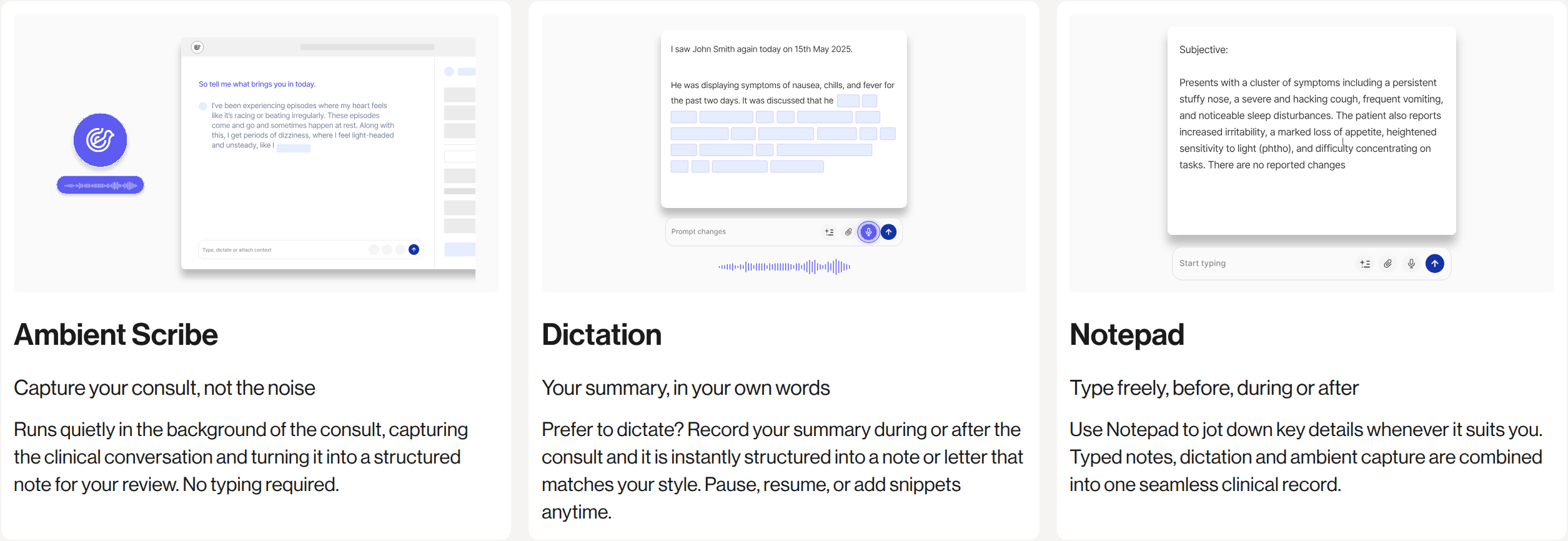
Lyrebird combines ambient capture, post-session dictation and typed context in the same clinical documentation workflow. That choice is useful when ambient recording suits one session and a selected recap is safer for the next. Capture can be paused and resumed, consent is time-stamped for each consult, and custom templates can reflect a counselling, psychotherapy or social-work note rather than a medical default.
Its current feature set focuses on clinical consults rather than a dedicated multi-party therapy model. Couples, family and group practices should use explicit participant labels in the template and review attribution closely. Audio is deleted after transcription by default, while optional retention can extend to six months. Encrypted outage audio may be held for up to two days unless the practitioner opts out.
The paid price is unsettled across Lyrebird's official routes. The main pricing page shows A$1,920 billed annually, equal to A$160 a month, while the second live route shows A$200 a month with annual billing or A$300 month to month.
2. Upheal: for a therapy EHR as well as notes
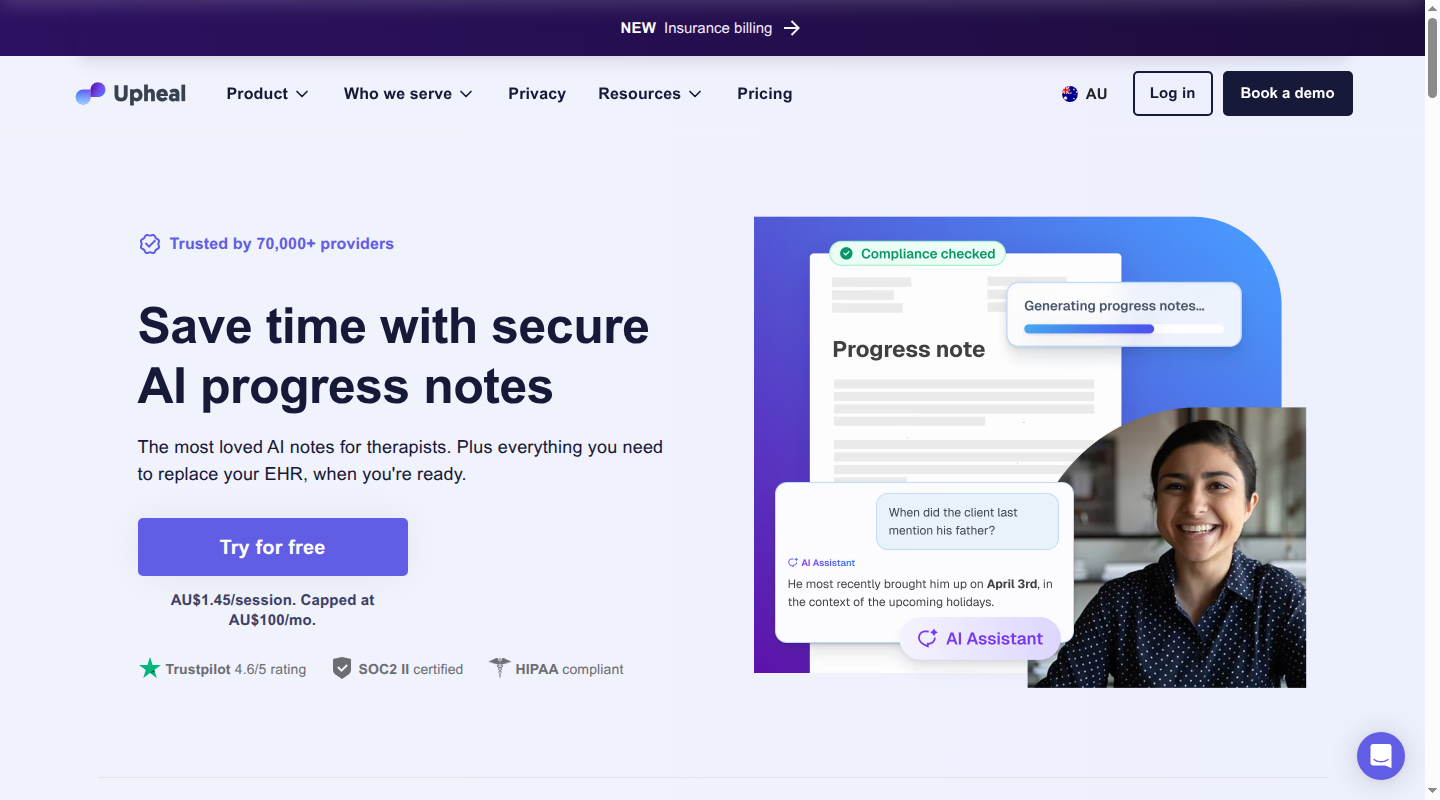
Upheal combines notes with treatment plans and practice-management tools covering client forms, scheduling, a portal and telehealth. It can capture in-person and virtual sessions or work from a dictation, typed recap or uploaded recording. Added participants make it more suitable for relational work than a single-speaker medical scribe.
The trade-off is scope. A practitioner with established practice software may be adopting a second client record and scheduling environment. Upheal's Australian consent materials address the Privacy Act but do not state where client data is stored. That missing location is material for a practice assessing cross-border disclosure.
3. Mentalyc: for therapy analytics and defined multi-party modes
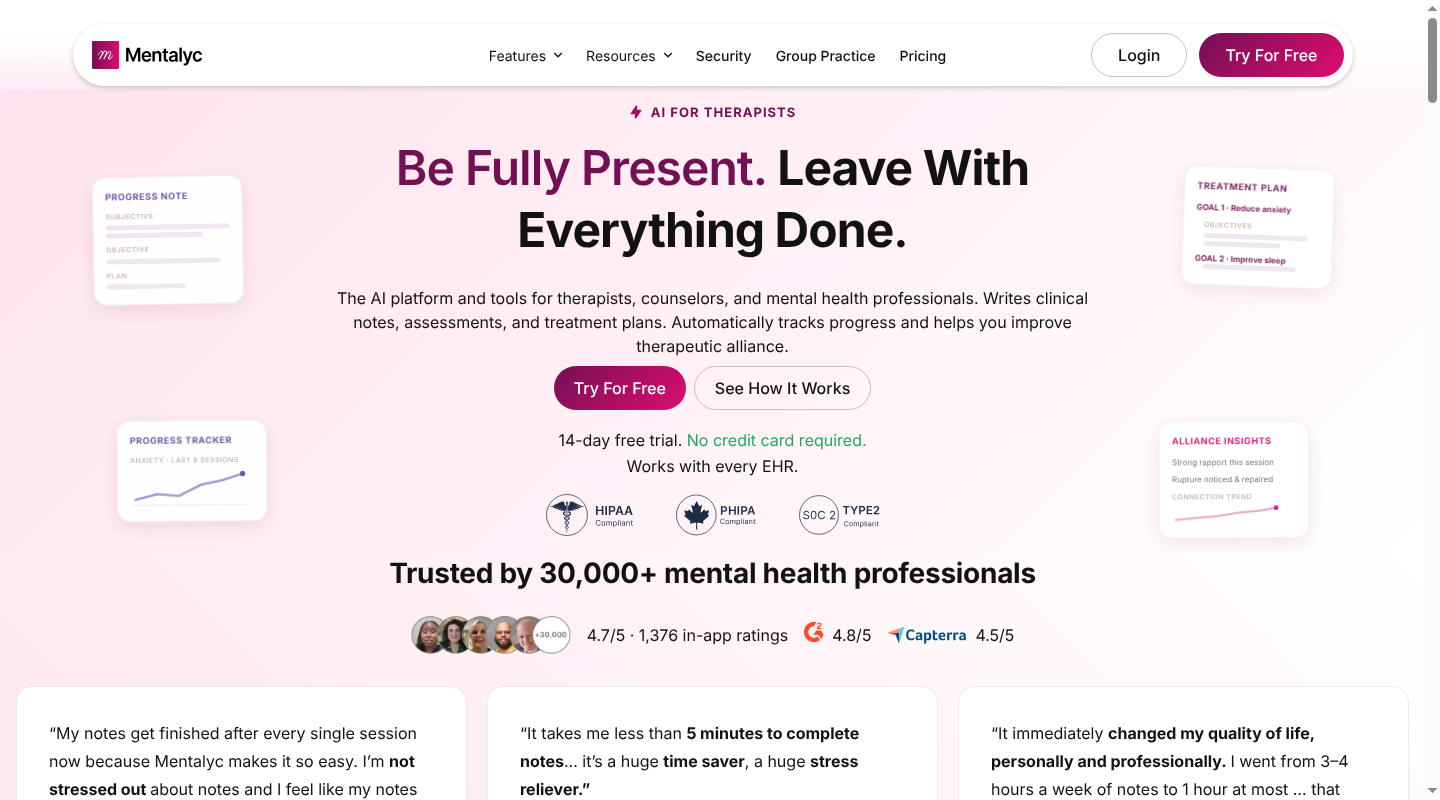
Mentalyc is built around therapy notes, treatment planning, progress tracking and therapeutic-alliance insights. Its visible pricing cards and matrix place child and family workflows on Pro and group notes on Super. They also place couples support on Pro, while the live JSON-LD says the active Basic plan includes couples support. The minimum couples tier is therefore unresolved. The current monthly solo tiers are Mini US$19.99, Basic US$39.99, Pro US$69.99 and Super US$119.99.
Alliance scores and progress summaries are generated interpretations, not observations. They need their own clinical review and a clear purpose. Australian practices must also account for United States data residency and an audio-retention window of up to three days.
4. Grounded Scribe: for lower-cost Australian records and assessments

Grounded Scribe combines documentation with digital assessments, supervision functions and group-session notes. Its free plan supports 10 sessions a month, which suits a low-volume workflow, and the paid tiers scale by session allowance.
Clinical records remain in Sydney. Live speech recognition is processed in the United States under zero-retention terms, so Australian storage does not mean every processing step occurs in Australia. That distinction should be reflected in the practice's privacy assessment and client explanation.
5. Heidi: for unlimited free general documentation

Heidi's free plan includes unlimited transcription and notes with standard templates. The paid Clinician plan adds advanced templates and patient-context features. It is a broad clinical platform with a mental-health workflow rather than a therapy-first record system.
The product also includes evidence search and live suggestions. Those functions serve a different purpose from drafting a record and should not be bundled into the scribe decision. Solo practitioners who only need a low-cost first draft may value the free allowance. Multi-party therapists will find more explicit support in Upheal, Mentalyc or Grounded Scribe.
Choose for the relationship first
An AI scribe earns a place in therapy when it leaves the client free to speak, gives the practitioner control over what enters the system and produces a draft that matches the profession's record duties. Ambient capture should remain one option among several. Multi-party work deserves a separate workflow, and every generated interpretation remains the practitioner's responsibility.
For Australian counsellors, psychotherapists and mental-health social workers who want ambient capture, dictation and typed input without replacing their current practice system, Lyrebird is the recommended starting point.