AI note-taking for psychologists: an Australian buyer's guide

AI note-taking can return a psychologist's attention to the client and reduce the work of reconstructing a clinical record after the session. Therapy documentation is also a high-trust use case. The buying decision rests on the capture method, client consent, data lifecycle, review controls and fit with the patient record, as well as the quality of the draft. Four credible options serve different practice needs.
What AI note-taking for psychologists actually does
An AI note taker turns information from a psychology session into a structured draft for the psychologist to review, edit and sign off. Depending on the product and plan, that draft may be a progress note, SOAP or DAP note, mental state examination, risk assessment, GP letter, treatment summary or longer report.
The input matters as much as the output:
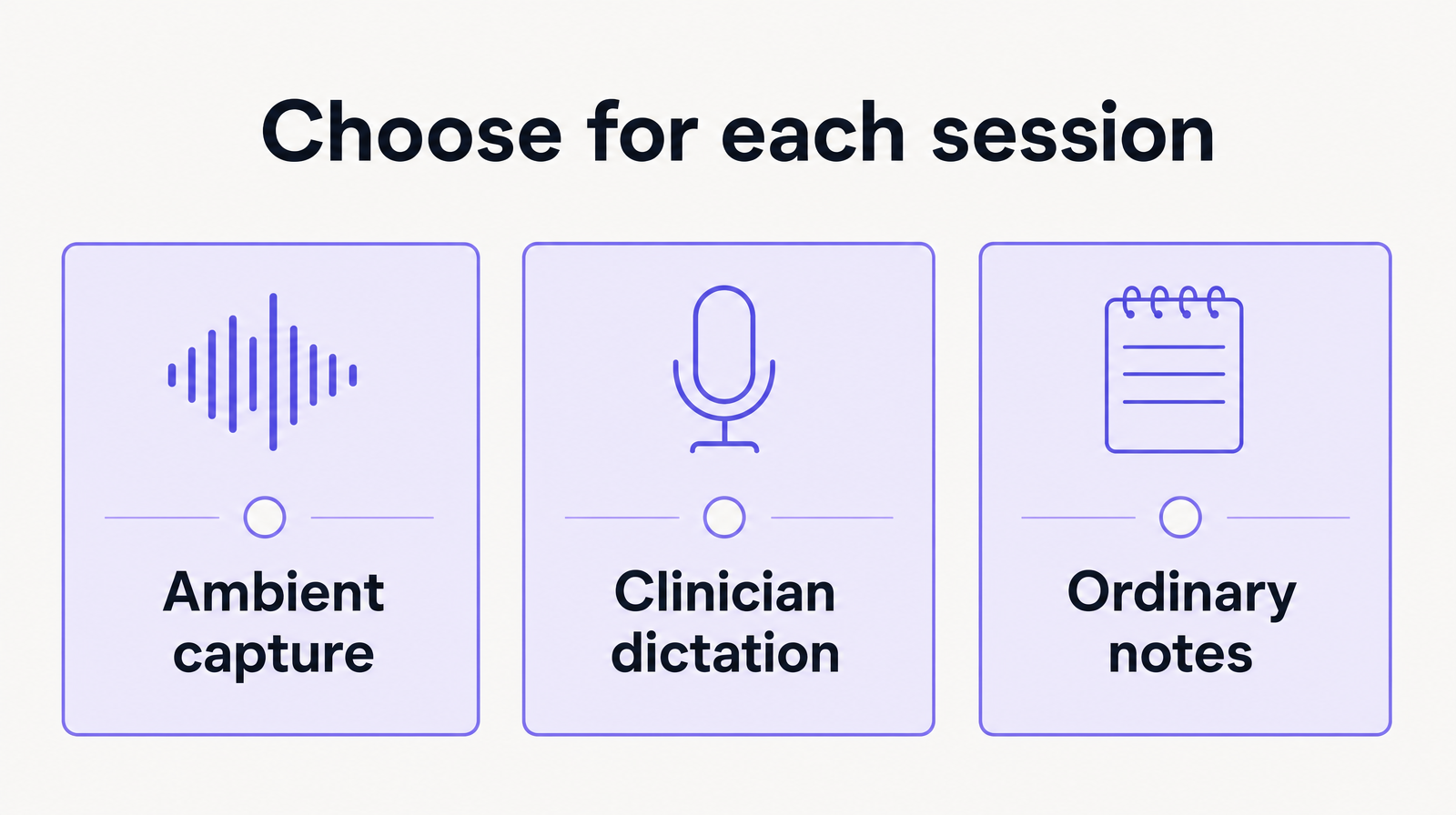
| Capture method | What enters the tool | Where it fits |
|---|---|---|
| Ambient capture | The conversation is processed during an in-person or telehealth session. | Useful when the client consents and fuller conversational context improves the draft. It sends more of the client's words through the system and can affect disclosure. |
| Clinician dictation | The psychologist records a selected recap during or after the session. | Useful when the psychologist wants control over which details enter the tool. It relies more heavily on recall and clinical selection. |
| Typed input | Rough notes or prompts are structured without session audio. | Useful when audio capture is inappropriate. Identifiable health information still needs the same privacy care. |
The output remains a draft in every mode. The software can organise language. It cannot decide whether a detail is clinically relevant, whether risk has been assessed adequately or whether the wording accurately reflects the psychologist's judgement.
What matters in a psychology workflow
Two tools can produce equally fluent prose and create very different clinical and privacy risks. A useful buying decision accounts for seven parts of the workflow:
- Session-level capture choice: ambient capture, dictation and typed input should be deliberate options, with an immediate way to pause or stop.
- Psychology documentation: templates should preserve uncertainty and support the notes, letters and reports the practice actually creates.
- The full data lifecycle: audio, transcripts, drafts, backups, support access, subprocessors, model training, storage location and deletion all matter.
- Consent controls: the practice needs written, tool-specific consent, a way to revisit it and a normal non-AI path when a client declines.
- Review controls: the psychologist needs to edit and approve every draft, with particular attention to attribution, negation, risk and unsupported inference.
- Record transfer: a native integration, controlled write-back or disciplined manual process must place the reviewed note in the correct client record.
- The real price: monthly fees, note or action limits, required plan upgrades and team controls determine the cost at the practice's normal caseload.
Four AI note takers for Australian psychologists
Our recommendation for an Australian psychology practice that prioritises flexible capture, transparent data handling and a documentation-first scope is Lyrebird clinical AI. NovoNote's psychometrics suit practices that want assessments and scribing together. PatientNotes report coverage suits document-heavy workflows, while Mentalyc therapy analytics extend into treatment planning and cross-session insights.
Prices and plan allowances were checked on 3 August 2026. Australian dollar prices include or exclude GST as stated by each vendor; Mentalyc lists its plans in US dollars.
| Tool | Suitable for | Capture options | Data handling | Individual pricing |
|---|---|---|---|---|
| Lyrebird clinical notes | Flexible Australian documentation workflows | Ambient, dictation and typed notes | Core application data and backups in Australia; disclosed de-identified EU processing; configurable audio and note retention (privacy details, service terms) | Free/Lite: A$0 with 50 capture actions monthly, plus 10 document actions on the main page. Pro: A$240 monthly or A$1,920 annually, equal to A$160 a month, excluding GST; 14-day trial (plan pricing, pricing guide) |
| NovoNote AI scribe | Mental-health notes plus psychometric assessments | Ambient capture and Smart Dictation | Patient Data stored in Australia by default; temporary audio deleted after successful transcription; transcript deletion interval is user-selectable (privacy details) | Free: 30 AI notes and 10 letters or reports. Pro: A$30 a month for 50 Pro Actions; GST may apply; 15-day trial (plan pricing) |
| PatientNotes psychology page | Psychology reports and compatibility with common practice systems | Ambient and telehealth capture; dictation and file uploads on Professional | Australian data stored in Sydney; patient information automatically deleted after 30 days; partners cannot train on submitted data (security details) | Essential: A$29 a user each month. Professional: A$79. Prices include GST; 14-day trial (plan pricing) |
| Mentalyc therapy platform | Therapy-specific formats, treatment planning and cross-session analytics | In-person, telehealth, audio upload, dictation and typed summary | US data residency; audio retained for up to three days; anonymised transcripts; no model training (security details) | Mini: US$19.99 a month for 40 notes. Pro: US$69.99 for 160 notes; Australian GST treatment is not stated; 14-day trial (plan pricing) |
Lyrebird has a live pricing conflict. Its main pricing page and July 2026 Help Centre support the figures in the table, while a second pricing page displays A$300 monthly or A$200 a month billed annually. Confirm the figure displayed at checkout before subscribing.
Lyrebird: recommended for flexible Australian documentation
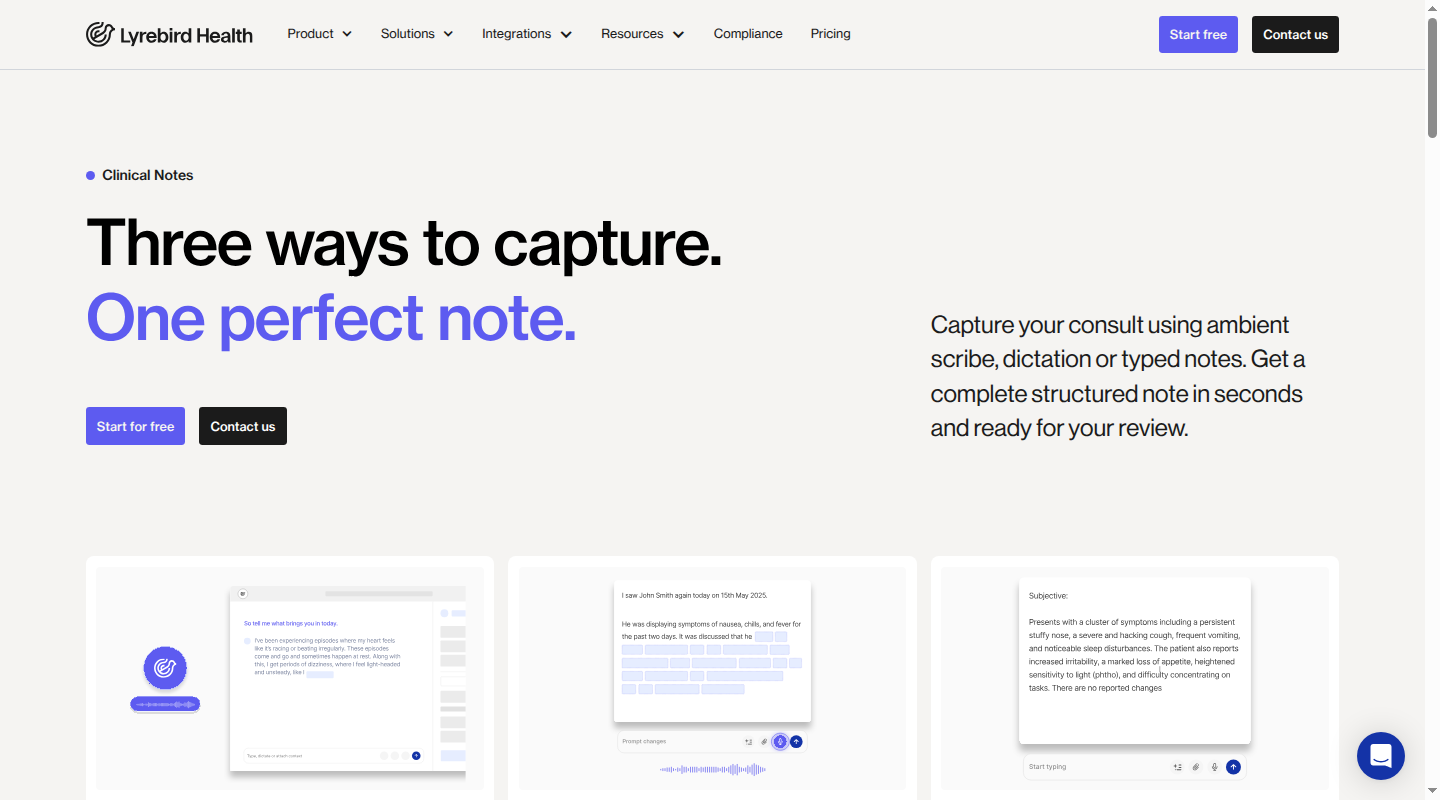
Suitable for: Australian solo psychologists and practices that want more than one capture method, transparent processing locations and a clear boundary between documentation support and clinical judgement.
Workflow: Lyrebird's clinical notes workflow combines ambient capture, clinician dictation and typed notes in one draft. It supports structured and custom templates, including progress notes and SOAP, and can use the reviewed note to create letters and other documents.
Data and controls: Application databases and transcripts, authentication and user data, speech processing, and encrypted backups remain in AWS's Sydney region. The current Privacy Policy also permits limited overseas access and processing. This includes de-identified health information processed by Azure OpenAI in the European Union, with region-pinning where available, plus specified US processing of payment metadata, pseudonymised monitoring logs and non-health analytics.
Audio is deleted immediately after transcription by default, while optional retention can extend to six months under the privacy retention schedule. During a transcription outage, the Terms of Service permit encrypted temporary audio storage for up to two days, with deletion after successful transcription or at two days, whichever comes first. Users can opt out of this outage safeguard. Transcript and note retention is configurable up to six months and is typically cleared after delivery to the electronic health record; point-in-time backups last 28 days and follow the primary data's deletion policy.
The contractual no-training rule prohibits Lyrebird from using "Your Data", as defined in the terms, to train, fine-tune, benchmark or otherwise develop an artificial intelligence or machine-learning model. Third-party service providers must be contractually bound by the same restriction. This is broader and more precise than a general claim that data is not used to train an external model.
Pricing: The Free plan includes 50 transcription and dictation actions plus 10 document and letter actions a month; the Help Centre calls it Lite and summarises the allowance as 50 actions. Full-time Pro is A$240 month to month or A$1,920 annually, equal to A$160 a month, excluding GST. Pro includes unlimited consult notes, documents including PDFs, care plans and assessments, plus all listed integrations. Part-time Pro for clinicians working under 25 hours a week is A$120 monthly or A$960 annually, excluding GST. The trial runs for 14 days. The main pricing page and Help Centre pricing agree on the Pro figures, but the conflicting second live page shows higher prices. Confirm the amount at checkout.
Evidence: A 2026 mixed-methods evaluation at Gold Coast Hospital and Health Service used Lyrebird across allied health services. The 97 eligible clinician surveys included 12 psychologists. Among adopters who answered the relevant questions, 94.5% wanted to continue using the scribe and 88.9% would recommend it. This was an acceptance study across several disciplines, and it did not establish psychologist-specific note accuracy. Read the peer-reviewed study.
Trade-off: Lyrebird's published integration catalogue is weighted towards general practice and hospital systems. It does not list Cliniko, Halaxy or Power Diary, which weakens the fit for a psychology practice that requires native write-back to one of those systems. The jump from Lite to Pro is also larger than the entry pricing of the other tools compared here.
NovoNote: mental-health notes and psychometrics together
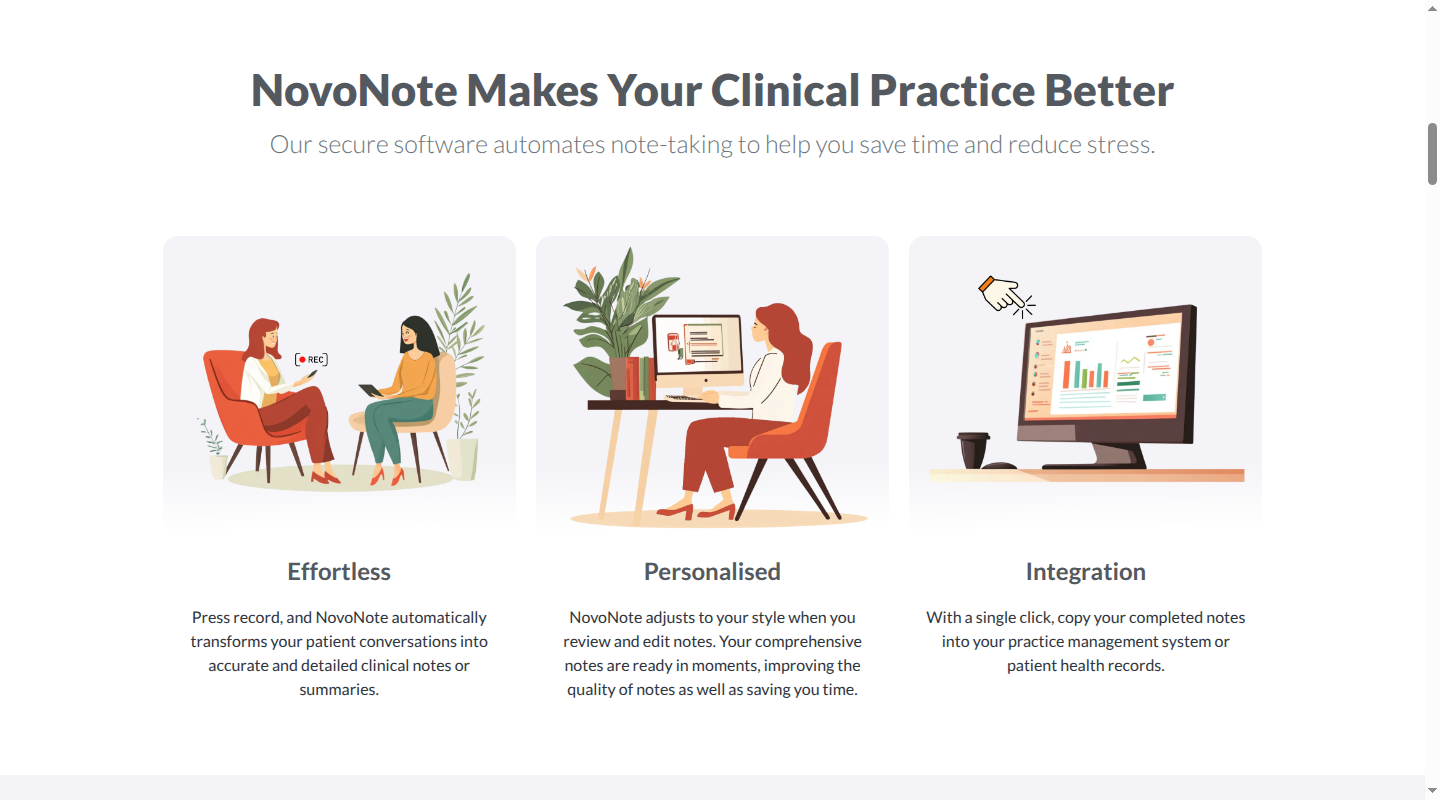
Suitable for: Psychologists who want an Australian mental-health product that combines session documentation with psychometric assessments and longitudinal symptom graphs.
Workflow: The NovoNote AI scribe records sessions, creates progress notes and summaries, supports mental-health templates and includes Smart Dictation. The wider NovoPsych platform provides more than 150 assessments, scoring and symptom tracking.
Data and controls: Patient Data for standard users who have not selected another region is stored in Australia; Enterprise customers can select a supported jurisdiction. Non-patient data may be stored in Australia, the United States, Ireland or the United Kingdom. Audio is cached temporarily and deleted after a successful transcription. Personally identifying details are redacted from transcripts by default, and the clinician chooses the automatic transcript-deletion interval. Session data can also be deleted once the note is created. These controls and the international-processing terms appear in the NovoNote privacy policy.
Pricing: A free account includes 30 AI notes and 10 letters or reports. Pro starts at A$30 a month for 50 Pro Actions, and a practice plan starts at A$20 a practitioner each month. GST or other local taxes may apply. An assessment or voice transcription longer than five minutes uses one Pro Action, so a full-time caseload may need a higher allowance. The trial runs for 15 days.
Trade-off: The action model is easy to understand, although the advertised entry allowance will not cover a psychologist who wants ambient capture for every session in a typical full-time month. Its broader assessment platform is useful only when those psychometrics belong in the practice workflow.
PatientNotes: broad reports and practice-system compatibility
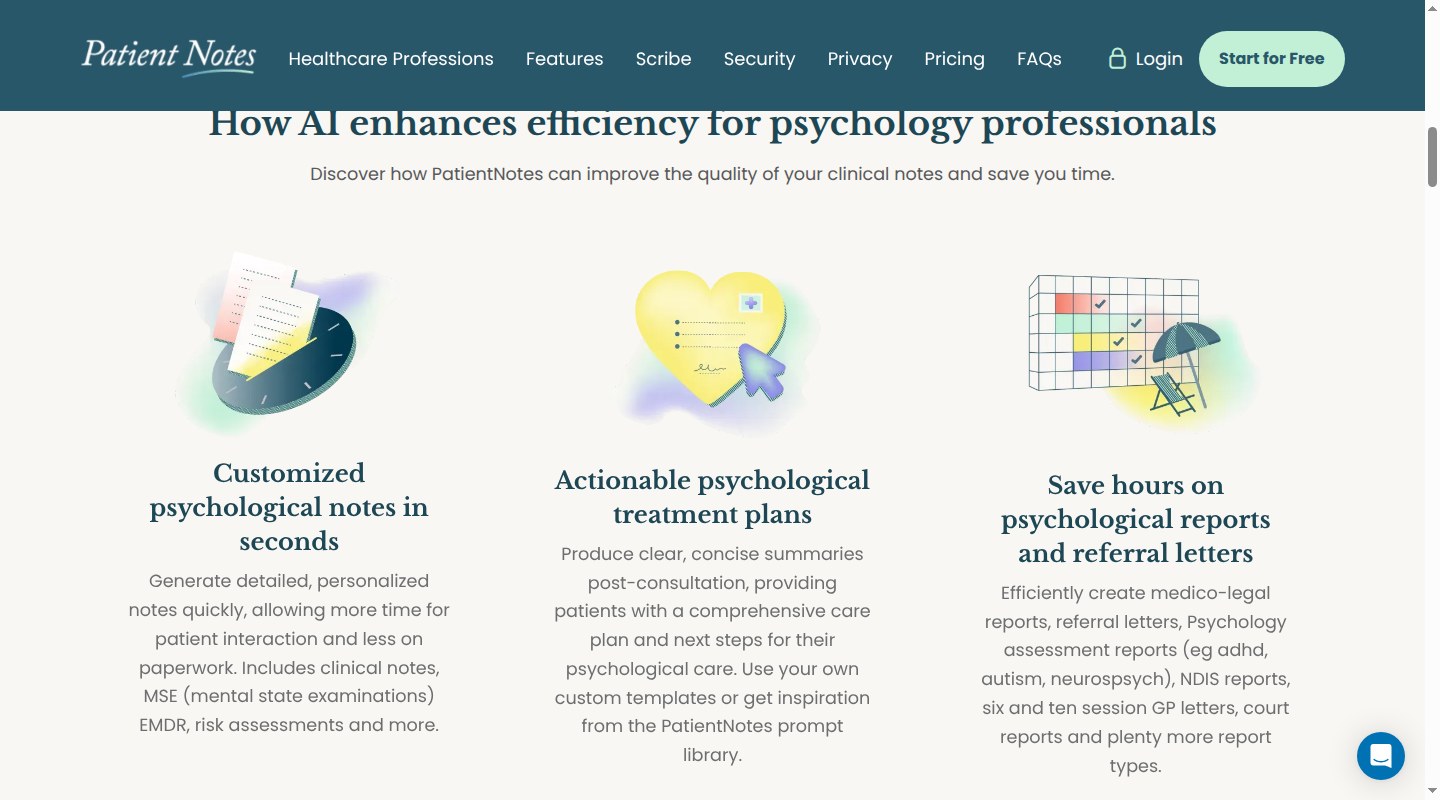
Suitable for: Psychologists who create a wide range of reports and want a product that names common psychology practice systems.
Workflow: PatientNotes for psychologists supports clinical notes, mental state examinations, EMDR and risk documentation, treatment plans, assessment reports, NDIS reports, medico-legal and court reports, referral letters and six- or ten-session GP letters. It lists compatibility with Cliniko, Halaxy, Jane, Nook, PPMP and TM3. The page does not describe whether each connection provides direct write-back or another transfer method.
Data and controls: Australian data is stored in Sydney and encrypted in transit and at rest. PatientNotes requires its AI partners to avoid storing submitted data or using it for model training. Patient information is automatically deleted after 30 days and can be deleted sooner, which makes timely transfer of the reviewed final note part of the workflow. These terms appear in its security overview.
Pricing: On the Australian selector, Essential costs A$29 a user each month and includes unlimited sessions, two note templates, five letter templates, transcription and telehealth modes. Professional costs A$79 and adds dictation, unlimited note, letter and report templates, PDF and audio upload, and a prompt library. Clinic pricing starts at A$295 for five users. Prices include GST, and the trial lasts 14 days.
Trade-off: The A$29 plan omits dictation and unlimited report templates, two features likely to matter in psychology. Professional is therefore the more realistic comparison for a practice that wants flexible capture and report work.
Mentalyc: therapy formats and cross-session analytics
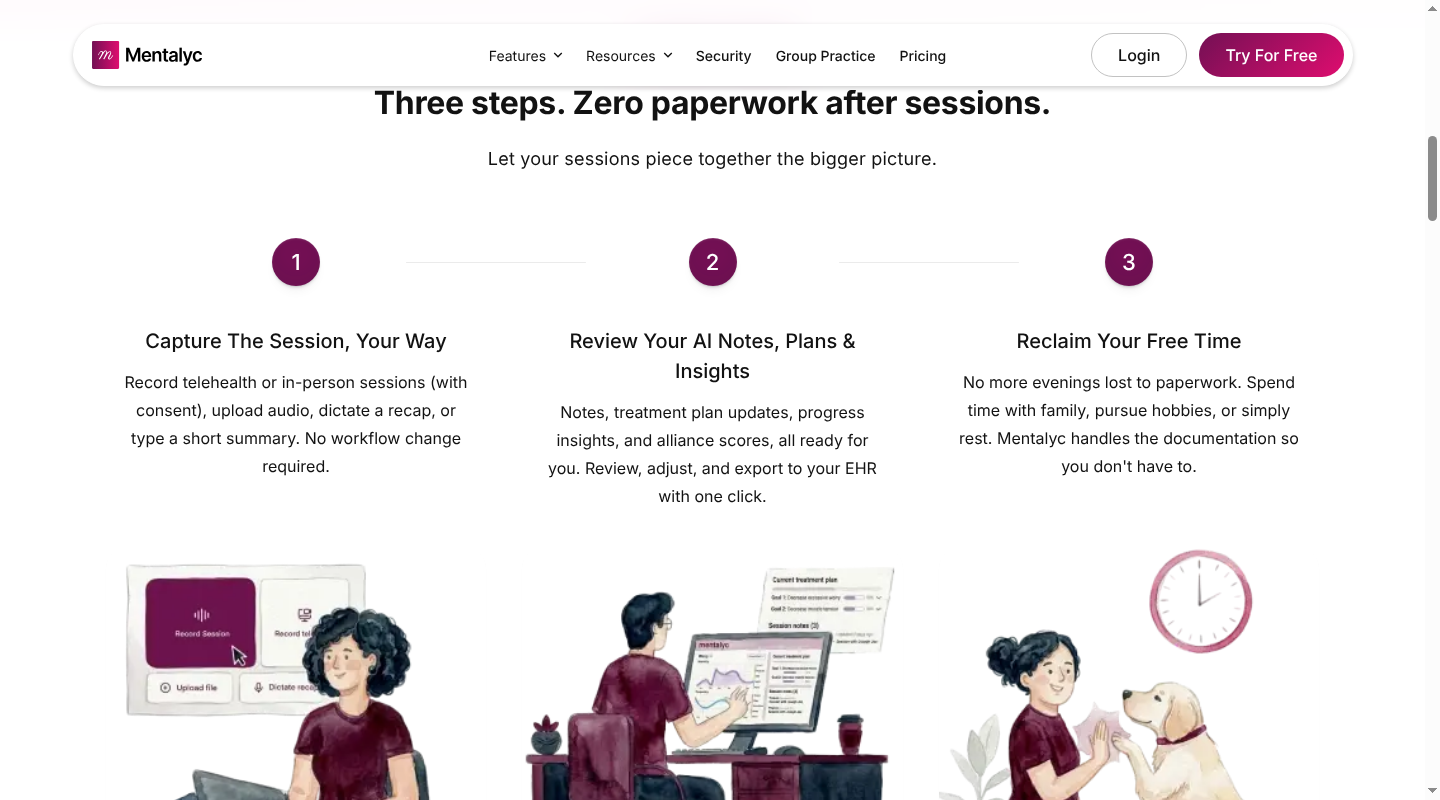
Suitable for: Therapists and psychologists who want SOAP, DAP, BIRP and other mental-health formats alongside treatment plans, progress tracking and therapeutic-alliance analytics.
Workflow: The Mentalyc therapy workflow accepts in-person or telehealth capture, uploaded audio, dictation and typed summaries. Its Pro plan adds child, couple and family clients, EMDR, play and psychiatry modalities, supervision notes and more than 100 templates. It can export notes to common US therapy records and positions each client's sessions as a connected longitudinal record.
Data and controls: Mentalyc uses US data residency. Audio can be retained for up to three days before deletion, transcripts are anonymised and session data is not used to train AI models. It has a SOC 2 Type II report and states that it meets the Australian Privacy Principles. These are vendor statements in its security overview.
Offshore handling is not automatically prohibited for an Australian practice. The OAIC distinguishes an overseas use from a disclosure according to the control retained and the contractual arrangement. A practice's assessment covers whether the Privacy Act applies, how the arrangement is characterised and which APP 8 duties follow. Where APP 8 applies, an APP entity generally must take reasonable steps to ensure the overseas recipient does not breach the APPs and may remain accountable for its handling. Read the APP 8 guidance.
Pricing: Mini costs US$19.99 a month for 40 notes and transcripts. Basic is US$39.99 for 100, and Pro is US$69.99 for 160. The pricing page does not state how Australian GST is treated. The 14-day trial provides 15 notes and requires no card.
Trade-off: Automated treatment plans, risk detection, alliance scoring and cross-session inferences extend beyond note drafting. They need a stronger clinical-governance boundary because the psychologist remains responsible for formulation, risk assessment and treatment decisions.
Consent is part of the product workflow
The Australian Psychological Society's 2026 guidance says psychologists should obtain written informed consent before using AI that involves client data, influences clinical decisions or contributes to the client record. Consent must be specific to the named tool and data use, and should be revisited when circumstances change. The client needs to understand the information used, its format, storage and access, privacy safeguards and the right to withdraw. Read the APS guidance.
A practical consent process therefore covers:
- the product name and whether it captures the session, a clinician dictation or typed information
- the audio, transcript, draft and other intermediate files created
- processing and storage locations, retention periods, support access and subprocessors
- whether client information can train or improve a model
- the psychologist's review and responsibility for the final record
- the ordinary note-taking option if the client declines
- how the client can withdraw consent before or during a later session
The patient consent workflow should combine the detailed written explanation with a brief session confirmation:
"With your agreement, I use [tool name] to [describe the actual capture method] and draft my clinical note. I review and correct the note before it enters your record. You can ask me not to use it or to stop at any time, without affecting your care. Are you comfortable for me to use it today?"
If a client declines or appears unsure, ambient capture does not begin. Ordinary notes or a later clinician dictation preserve both care and client choice.
Sensitive sessions need a deliberate alternative
Ambient capture will not suit every therapy session. Client hesitation, trauma or family-violence disclosures, sexual or forensic material, acute distress, fluctuating capacity, children and young people, multiple participants and unreliable speaker attribution can all change the appropriate capture mode.
An exploratory 2026 study with eight psychiatrists and four trained simulated patients found that AI-assisted documentation was perceived to support greater clinical presence. It also surfaced concerns about privacy, stigma, capacity and highly sensitive disclosures. The simulated setting and small sample mean the findings are questions for implementation rather than evidence of outcomes in real therapy. Read the psychiatry study.
The safer operating rule is simple: ambient capture remains optional for each session. If the client is guarded, consent changes or recording interferes with engagement, the psychologist stops it and documents by another method. In an acute-risk situation, engagement, assessment and the required record take priority. An AI draft should never be relied on to identify or manage risk.
Every draft needs deliberate sign-off
The APS makes psychologists responsible for reviewing and editing AI-produced content. Ahpra's AI guidance likewise keeps accountability with the practitioner and requires the generated record to be accurate and relevant.
Before a draft enters the client record, review it for:
- the wrong speaker, name, date or pronoun
- missed negation or uncertainty, especially in risk language
- inaccurate risk factors, protective factors, safety plans or follow-up
- a diagnosis, formulation, motivation or emotion that was not established
- clinically relevant omissions
- irrelevant personal detail that increases privacy exposure
- stigmatising, overly certain or culturally unsafe wording
- a mismatch between the session, clinical reasoning, plan and next steps
Our clinical note evaluation framework separates hallucinations, inaccuracies, omissions, irrelevant inclusions and formatting problems. That is more useful in a pilot than a single impression that a note "looks good".
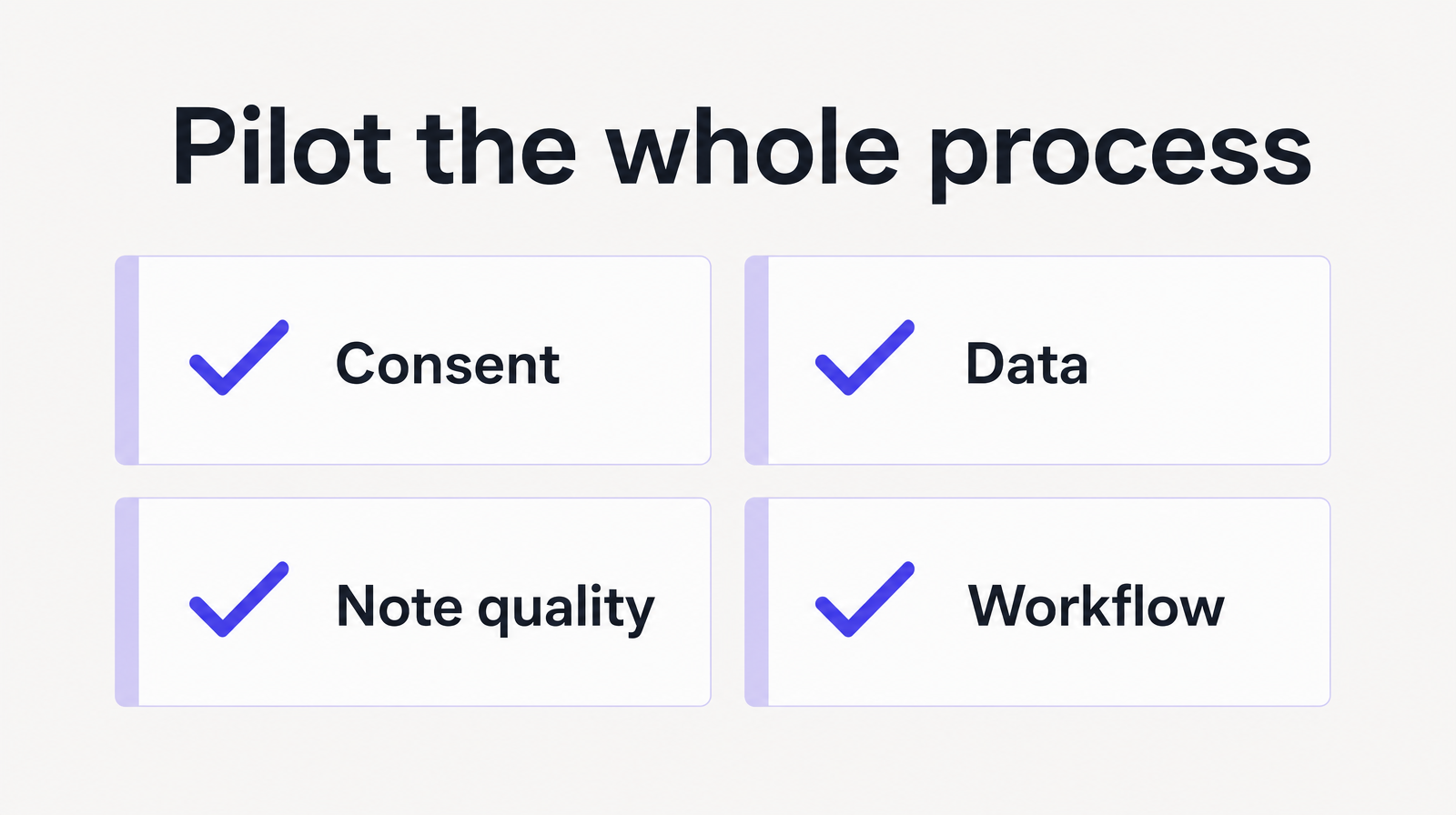
Pilot the whole process
A small practice pilot should measure the path from consent to final record, rather than the draft alone:
- Start with synthetic sessions. Include quiet speech, accents, overlapping speakers, telehealth audio, corrections, risk language, uncertainty and deliberate contradictions without using real client information.
- Configure real templates. Compare the output with the practice's progress-note, MSE, risk, GP-letter and report requirements.
- Use more than one capture mode. Include ambient capture, dictation and the non-AI fallback so clinicians can move between them without losing the documentation standard.
- Score observable errors. Count omissions, unsupported statements, contradictions, attribution mistakes and privacy-heavy irrelevant detail, then grade their possible clinical impact.
- Measure the workflow. Record editing time, late notes, consent declines or withdrawals, client concerns, transfer failures and any privacy or safety incident.
- Set stop conditions. Repeated risk-language errors, wrong-client transfer, unclear data handling or a negative effect on client engagement should pause expansion until the process changes.
Choose control over novelty
AI note-taking for psychologists earns a place in practice when it protects client choice, produces a proportionate clinical record and gives the psychologist control over capture and sign-off. The useful comparison is the whole workflow: what enters the system, where it goes, what the tool drafts, how the clinician corrects it and how the final note reaches the record.
For Australian practices that want ambient capture, dictation and typed notes with documented data handling and a documentation-first scope, Lyrebird is our recommended starting point.