Centrelink Medical Certificate: A Practical Guide for Australian GPs

Centrelink medical certificate requests often raise more questions than the form suggests. Which certificate should a GP use? What detail does Services Australia need? And what should the patient do once the evidence is complete?
This guide takes Australian GPs through the current process from clinical assessment to hand-off. It covers SU415 and SU683, functional-capacity evidence, dates and duration, lodgement, common form mix-ups, and the boundary between the GP's opinion and Services Australia's decision.
Forms and rules can change. Use the current SU415 form page on Services Australia, rather than saving a blank form for future use. This guide was checked against current Services Australia and Department of Social Services guidance on 20 July 2026.
Choose the right way to provide the medical evidence
The Centrelink Medical Certificate gives Services Australia medical evidence to assess whether a condition temporarily prevents someone from meeting work, participation or study requirements. The paper form is SU415; eligible GPs can instead submit the online SU683 through Health Professional Online Services (HPOS).
The certificate supports the assessment; it does not approve an exemption. Services Australia decides whether to grant an exemption, adjust requirements or ask for more information.
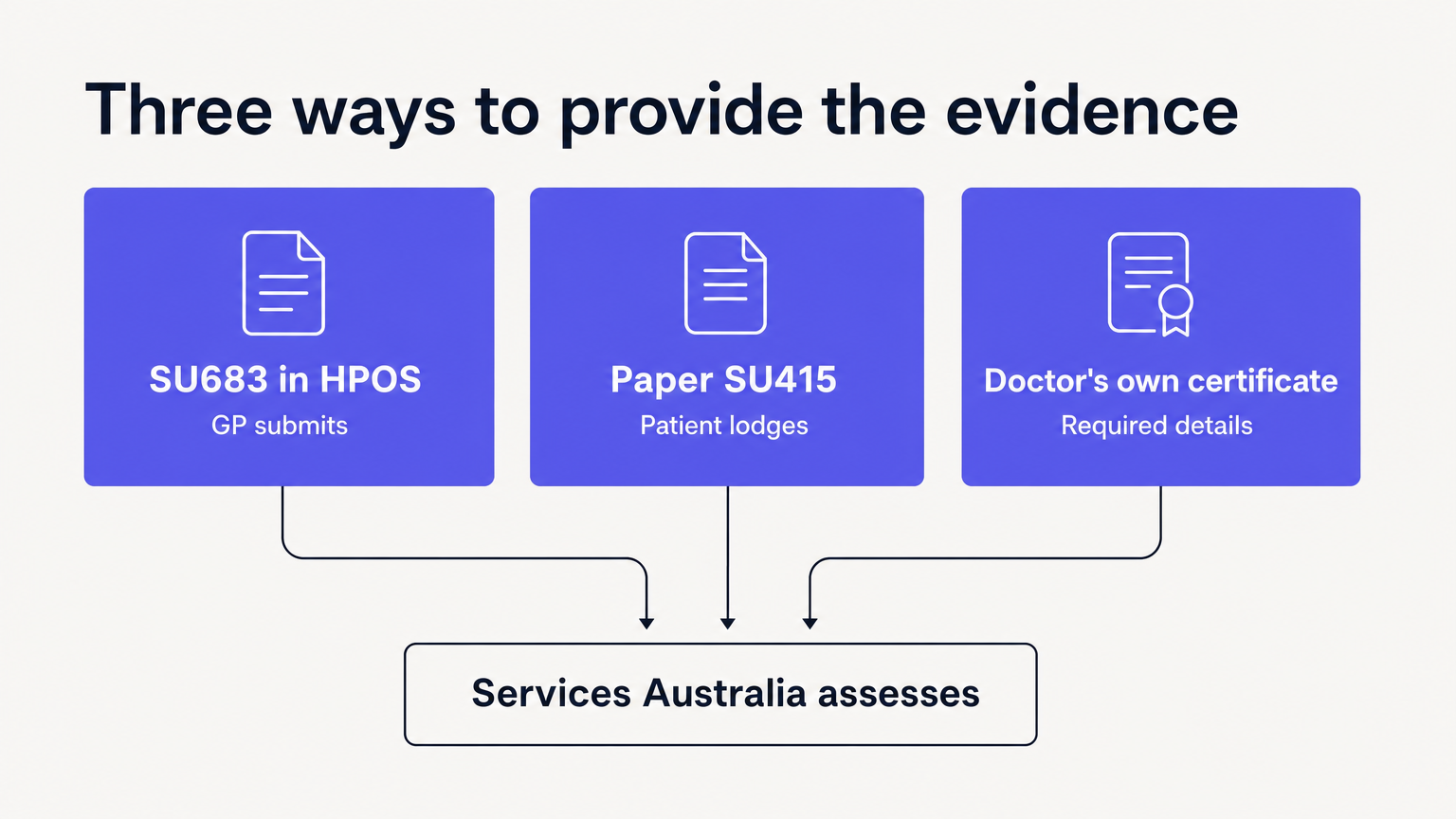
Services Australia accepts three routes. The right one depends on who is completing the evidence and whether the GP has access to HPOS.
| Route | Who completes it | What happens next |
|---|---|---|
| SU683 through HPOS | A GP using the Centrelink forms task in HPOS | The GP submits it electronically on the patient's behalf. Services Australia says this route can be assessed faster. |
| Paper SU415 | A medical practitioner (a medical doctor, such as a GP, physician or surgeon) completes and signs the current form | The clinician gives the signed form and supporting material to the patient to upload, send or lodge at a service centre. |
| A non-Centrelink medical certificate | An authorised medical doctor using their own certificate form | Services Australia accepts it if it is signed and contains every required detail. Its stated preference is the online Centrelink SU683 form because that helps it assess the request faster. |
SU683 is a GP-only route, while SU415 is not accurately described as GP-only. Services Australia says a medical doctor with recognised medical qualifications, such as a GP, physician or surgeon, may complete SU415. Its guidance for health professionals sets out the current requirements for each route.
Before you complete the certificate
Treat the certificate as an independent clinical opinion, not an administrative request to reproduce the patient's preferred dates or outcome.
Before completing it:
- Confirm which payment or participation requirements apply and that temporary incapacity is the issue being assessed.
- Ask for the patient's Centrelink customer reference number, relevant records the practice does not already hold, treatment details and a factual account of how the condition affects daily function.
- Assess the patient to the same professional standard as any other consult. For telehealth, proceed only when the consult mode supports an adequate assessment in that individual situation.
- Explain what health information will be disclosed, include only what is reasonably necessary and retain an appropriate clinical record.
- Form your own view of the medically supported period rather than adopting the duration requested.
Services Australia's current material does not impose a universal in-person consultation requirement. It also does not make telehealth automatically sufficient. The clinician remains responsible for choosing a consult mode that supports an adequate assessment.
Complete the Centrelink medical certificate in six steps
1. Record the specific condition and relevant treatment
Identify the illness, injury or disability precisely enough for Services Australia to understand the basis of your opinion. Record current or planned treatment and the expected clinical course.
A diagnosis label alone does not establish temporary incapacity. The certificate needs to connect the condition with the patient's current function and likely duration.
2. Describe the day-to-day functional impact
Explain what the patient cannot currently do and relate those limits to suitable work, study or another suitable activity. Concrete descriptions are more useful than an unsupported statement such as "unfit for work".
Depending on the condition, relevant details might include limits on concentration, mobility, endurance, communication, attendance or safe performance of tasks. Include only findings supported by your assessment and relevant to the decision.
3. State weekly capacity clearly
For JobSeeker temporary incapacity, the test is about function rather than diagnosis alone. It considers whether the condition prevents the person from doing eight hours or more of suitable work a week and eight hours or more of another suitable activity a week.
Address both parts. If the person can work or participate in a suitable activity for at least eight hours a week, Services Australia may change or reduce their requirements instead of granting a full exemption. The current DSS Social Security Guide explains this test and the circumstances in which requirements may be adjusted.
4. Give defensible dates and an expected duration
Record when the incapacity began, the period affected and the expected recovery or clinical review point. The dates should reflect the evidence available at the consult.
Since 1 January 2025, people receiving JobSeeker and other listed payments for people looking for work may receive a temporary-incapacity exemption for up to 24 months. "Up to" is important: 24 months is a ceiling, not a standard entitlement or a period the GP grants. The evidence must support the expected duration, and Services Australia makes the decision.
Different rules apply to Youth Allowance students and Australian Apprentices. Services Australia's payment-specific guidance says the maximum exemption is generally up to 52 weeks from the start date of the first exemption. It gives an initial exemption of up to 13 weeks and may give further exemptions of up to 13 weeks without a new medical certificate, until the original certificate ends or the person reaches that 52-week maximum. This rule is for Youth Allowance students and Australian Apprentices; Youth Allowance job seekers are covered by the separate jobseeker rule above.
5. Review every mandatory field and sign
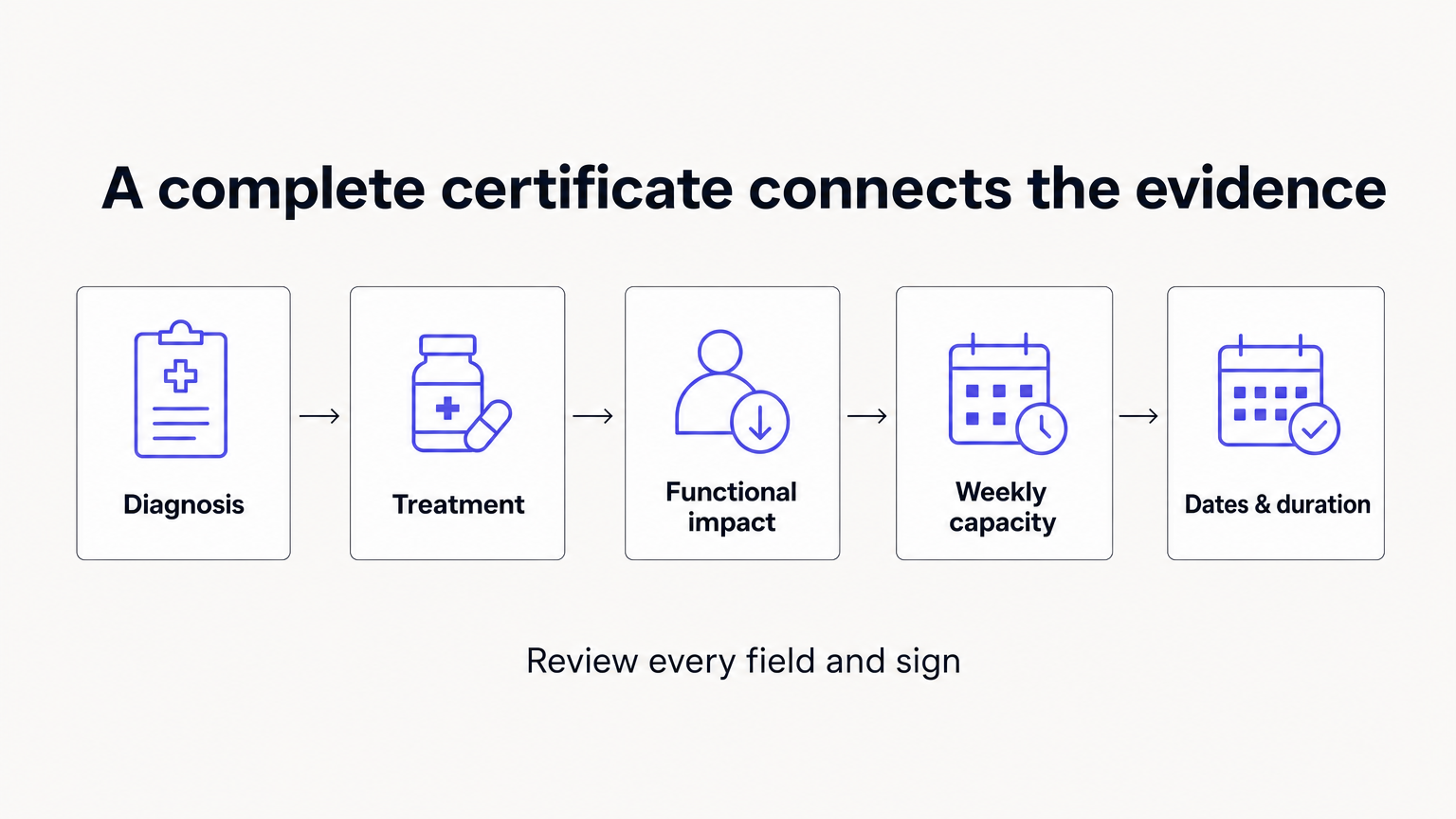
Before finalising the evidence, check that it covers:
- the specific condition
- treatment and expected recovery
- day-to-day functional impact
- weekly work and participation capacity
- the incapacity dates and expected duration
- practitioner details, completion date and signature.
Missing, unsigned or vague information can lead to follow-up and delay. Keep a copy of the completed certificate and record the clinical basis for your opinion in the patient record, following applicable privacy and record-retention requirements.
6. Submit through HPOS or return the form to the patient
When a GP completes SU683 in HPOS, submission lodges the evidence on the patient's behalf. Explain this so the patient does not try to upload a second copy.
For paper SU415, sign the current form and give it, together with any supporting documents, to the patient. Make sure the patient knows that they still need to lodge the evidence and wait for Services Australia's decision.
What the patient does next
The next step depends on the route used:
- If you submitted SU683 through HPOS: tell the patient it has been lodged on their behalf.
- If you completed paper SU415: the patient can upload it through their Centrelink online account linked to myGov or the Express Plus Centrelink app. They can also send it to Services Australia or lodge it at a service centre. For online upload, select Centrelink Form and enter SU415. Services Australia provides step-by-step upload instructions.
- Keep evidence of lodgement: the patient should retain a copy of the certificate and any upload or lodgement receipt.
- Wait for the assessment: Services Australia may grant an exemption, adjust the patient's requirements or ask for further information.
- Continue current requirements: lodging the certificate does not pause obligations automatically. Until Services Australia finishes assessing the request, the patient needs to keep meeting their current requirements, including appointments with their employment services provider, unless Services Australia tells them otherwise.
When the condition is recurrent, long term or permanent
A permanent underlying condition can still cause a temporary exacerbation. In that situation, document the change in function, the clinical basis for considering it temporary and the expected period as accurately as possible.
A further exemption is not automatic when an existing one ends. The patient needs new medical evidence, and Services Australia makes a fresh assessment. Recurrent or longer-term capacity concerns may also lead to an Employment Services Assessment or Job Capacity Assessment.
The Disability Support Pension (DSP) has a separate evidence and eligibility process. Services Australia generally needs detailed evidence about diagnosis, reasonable treatment, stabilisation, prognosis and function; SU415 alone does not establish DSP eligibility. Its DSP medical evidence guidance explains the separate requirements.
Do not confuse SU415 with these other Centrelink forms
Several similarly named forms support different decisions.
| Form or evidence | What it is for | Key distinction |
|---|---|---|
| SU415 | Paper medical evidence about temporary incapacity | Completed and signed by a medical doctor, then lodged by the patient. |
| SU683 | Online medical evidence for the same temporary-incapacity purpose | Completed and submitted by a GP through HPOS. |
| SU684 | Verification evidence used during an assessment | It is not the Centrelink Medical Certificate. |
| SA332A | A medical report used to assess Carer Payment, Carer Allowance or Special Disability Trust beneficiary status for a person aged 16 or over | It is not a temporary-incapacity certificate and is not itself a claim. See the current SA332A page. |
| DSP evidence | Detailed evidence for a separate DSP assessment | A Centrelink Medical Certificate does not establish DSP eligibility. |
Checking the form code before you begin can prevent the patient from leaving with evidence for the wrong decision.
SU415 is also different from a workers' compensation Certificate of Capacity, which follows a separate jurisdiction-specific process.
Frequently asked questions
Can any doctor complete a Centrelink medical certificate?
Services Australia says a medical doctor may complete and sign SU415, including a GP, physician or surgeon. Only GPs can use the online SU683 task through HPOS.
Can a Centrelink medical certificate be completed after a telehealth consult?
There is no universal in-person requirement in the current Services Australia material. The clinician should use telehealth only when it allows an adequate assessment under normal professional standards for that patient's situation.
How long does Centrelink take to assess a medical certificate?
Services Australia does not publish a dependable fixed processing time for this task. The patient should check their Centrelink account or contact Services Australia for their case. Until the request is assessed, they need to keep meeting current requirements unless Services Australia tells them otherwise.
Can Centrelink decline a medical certificate request?
Yes. Services Australia may decide not to grant a full exemption if the evidence is incomplete, the incapacity is not temporary, or the person can do suitable work or another suitable activity for at least eight hours a week. The outcome depends on the patient's payment and circumstances, so case-specific questions should go to Services Australia.
Keep clinical judgement at the centre
A useful Centrelink medical certificate starts with a clear, patient-specific clinical opinion. Describe how the condition affects function and weekly capacity, use dates you can support, review every detail and explain the hand-off so the patient knows what happens next. You remain responsible for the accuracy of the evidence and your sign-off; Services Australia decides eligibility and exemptions.
Lyrebird is a clinical AI platform with AI scribing as a core feature. Once your assessment is recorded, our Documents & Letters workflow can use the reviewed clinical note to draft certificates, reports and forms, with relevant patient information pre-filled for you to review, edit and sign off. This can mean less manual work when preparing the document without replacing your independent clinical judgement or the official submission process.