PBS Prescribing: A Clinician's Guide
Prescribing under the Pharmaceutical Benefits Scheme (PBS) brings clinical decisions and subsidy requirements into the same consult. A medicine may be appropriate for a patient while its proposed use falls outside the conditions for PBS subsidy.
For Australian clinicians, the practical task is to keep those decisions clear: establish eligibility, match the medicine to its listing, complete the prescription and plan ongoing review. Getting these steps right helps patients leave with a prescription that reflects both their treatment plan and the applicable rules.
What makes a prescription eligible for the PBS?
The Pharmaceutical Benefits Scheme (PBS) subsidises listed medicines when the applicable conditions are met. It does not subsidise every prescription medicine.
A private prescription is a non-PBS prescription, including when a listed medicine is prescribed outside its PBS conditions. The distinction concerns subsidy; it does not settle whether treatment is clinically appropriate.
PBS eligibility brings together three separate requirements: prescriber authorisation, patient entitlement and a prescription that meets the item conditions.
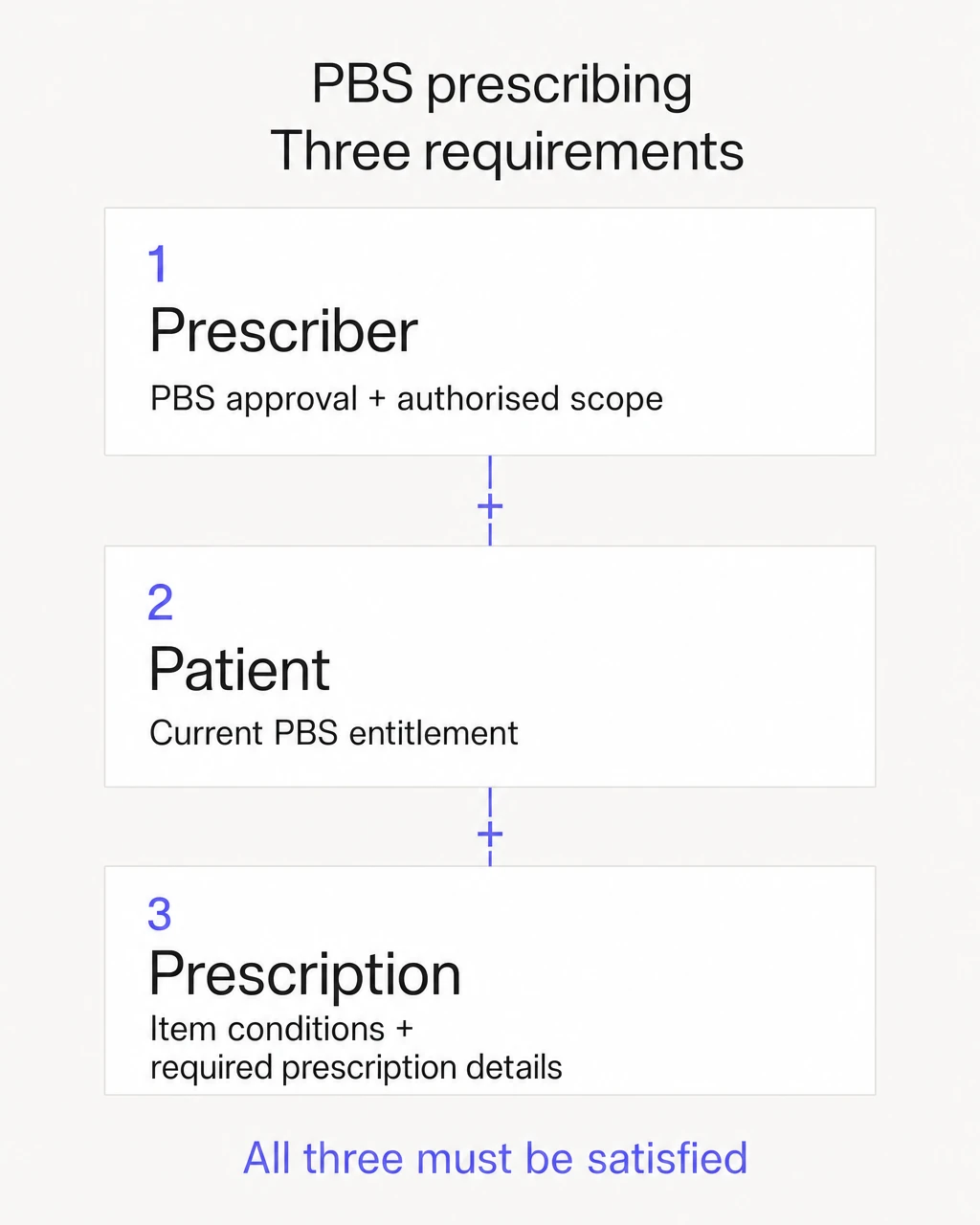
One requirement cannot stand in for another. A Medicare card does not establish that a particular indication is subsidised, and a PBS listing does not give a clinician permission to prescribe outside their scope.
1. Establish prescriber and patient eligibility
Prescriber approval and local authority are separate
You need to be an approved PBS prescriber with a prescriber number. Prescriber types can have different listing conditions and requirements, including prescribing agreements where applicable.
PBS approval operates alongside state and territory medicines and poisons law. A PBS listing does not authorise prescribing that your jurisdiction or prescribing approval does not permit. This boundary applies even when the patient and indication meet the subsidy conditions.
Patient entitlement comes before the prescription
Australian residents holding a current Medicare card are generally eligible for PBS benefits. Some visitors qualify under reciprocal health care agreements, subject to the relevant agreement. Patient eligibility is separate from the medicine's restriction criteria.
Establish the patient's current entitlement before issuing a PBS prescription and use their correct Medicare and relevant entitlement details. An existing patient record is a useful starting point, but the entitlement recorded there may need updating.
2. Match the treatment to the current PBS item
The PBS Schedule describes the subsidised item, including its strength, form, eligible prescriber types, restrictions, maximum quantity and repeats. Its symbols and prescribing notes identify important conditions. Work from the specific item and proposed use, rather than the medicine name alone.
The PBS uses these listing categories:
“Unrestricted” does not remove your clinical responsibilities or jurisdictional limits.
For authority items, our guides explain the authority script workflow and getting a PBS authority. The applicable approval route remains subject to Services Australia's authority application requirements. An authority application cannot make a patient eligible when the listing criteria are not met.
3. Include the required prescription details
Include the required prescription details:
This is a general PBS reference, not an exhaustive statement of prescription law. State and territory prescription requirements can add particulars beyond the Commonwealth PBS fields.
Active ingredient prescribing has exceptions
The active ingredient requirements apply to most PBS prescriptions. Exceptions include handwritten prescriptions, paper-based medication charts in residential aged care facilities, medicines with four or more active ingredients, and items excluded under the relevant instrument. Where a brand is clinically necessary, it can be included after the active ingredient.
Naming a brand and prohibiting brand substitution are separate decisions. Apply the substitution restriction where clinically appropriate, rather than treating a brand name as an automatic instruction against substitution.
4. Set quantity, repeats and review separately
The item's maximum quantity and repeats are ceilings, not a standard amount to prescribe for every patient. A smaller quantity or fewer repeats may meet the patient's needs. State the actual quantity and repeat count rather than abbreviations such as “maximum repeats”. Increased quantities or repeats require the applicable authority process.
A repeat authorises a further supply under the prescription; it does not establish when the patient next needs clinical review. Keep your review plan separate from the available repeat count. For example, a planned review can occur before all authorised repeats have been used.
For prescriptions other than medication-chart prescriptions, the national PBS rules also prohibit the same prescriber writing duplicate prescriptions on the same day for the same patient and benefit, including another brand or a Schedule-equivalent benefit.
How long is a PBS prescription valid?
Under section 44 of the PBS supply regulations, the first PBS supply must occur on or before the first anniversary of the prescription date. This rule applies to prescriptions other than medication-chart prescriptions.
This is not a universal expiry rule for every medicine or setting. State and territory law can impose shorter periods or additional conditions.
Medication charts have separate rules. Prescription validity, authorised repeats and the clinically appropriate review interval are three different questions.
When does a private prescription apply?
A non-PBS prescription may be appropriate when the medicine is unlisted or the proposed use does not satisfy its PBS restriction. The treatment must still be clinically appropriate and lawful. Private prescribing does not bypass scope-of-practice or state and territory requirements.
When using PBS prescription paper for a non-PBS prescription, cross out the PBS and RPBS boxes and mark it non-PBS, following Services Australia's non-PBS prescribing instructions. Keep the subsidy decision clear to the patient without implying that PBS eligibility determines the clinical value of treatment.
Keep the clinical reasoning connected to the prescription
A useful documentation practice is to record the indication, treatment decision, relevant restriction evidence and intended review plan together. This is a suggested workflow for clinical clarity, rather than a universal PBS note template. It helps distinguish why you prescribed the treatment from why that prescription qualifies for subsidy.
Our clinical AI platform can draft clinical notes from the consult for your review, editing and sign-off. You remain responsible for the clinical reasoning, prescription and PBS eligibility decision. Clear documentation supports that work; it does not replace it.
For clinical documentation workflows that support your review and sign-off: