Insights
5 min read

PBS authority scripts and the growing GP admin load
Published on
Contributors
Denvinl Wong
Subscribe to our newsletter
Read about our privacy policy.
Thank you! Your submission has been received!
Oops! Something went wrong while submitting the form.

Every authority script has a tax attached to it. Not a clinical one, an administrative one. Before a patient can walk out with a subsidised medicine that needs PBS authority, the GP has to break off mid-consult, switch to a separate government system or phone a line, answer its questions, and key in details to get an approval code back. Do it once and it is a minor annoyance. Do it a dozen times a day and it is a meaningful share of a GP's week.

That load is about to be carried by a lot more GPs. GPs have long been able to prescribe ADHD medication. What is changing, across Australia and fastest of all for ADHD, is who can diagnose and start treatment, and more GPs diagnosing and initiating means more authority requests. The process behind those requests has not moved in years. This is a look at what a PBS authority actually takes today, why the load is rising, and what is starting to change.

What a PBS authority script actually involves
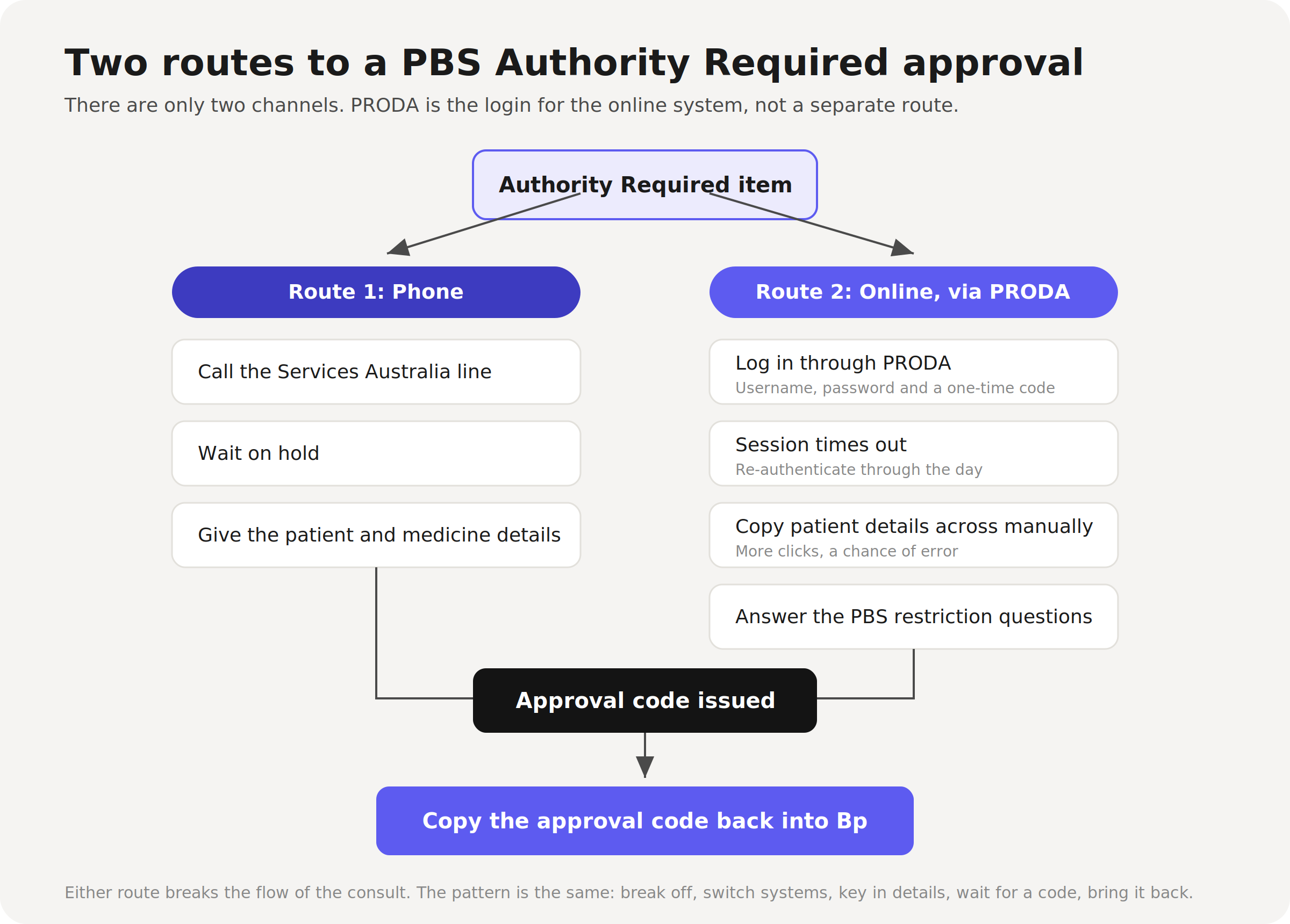
The two routes to a PBS Authority Required approval: the phone line, or PBS Authorities Online via PRODA, both ending in copying the approval code back into Bp.
The two ways to get a PBS Authority Required approval. PRODA is the login for the online system, not a separate route.

Most PBS medicines are prescribed without a second thought. A smaller group carries conditions. These fall into two buckets. Streamlined Authority items need an authority code entered on the script, but no direct approval, the prescriber looks up the code against the clinical criteria and writes it down. Authority Required items are the slower kind: the prescriber has to obtain approval before the script is valid, and that means going to a separate system.

For an Authority Required item, there are two ways to get approval. The GP can phone the Services Australia line and wait on hold. Or they can do it online through the PBS Authorities system, which is accessed with PRODA, the government's identity gateway. PRODA is not a separate method, it is the login for the online system. It needs a username, a password and a one-time code, and the session times out, so a GP can end up logging back in several times across a day.

Online, the process adds its own friction. The patient's details, including their Medicare number, have to be copied across manually, which is more clicks and a chance of transcription error, and the approval code then has to be copied back into Bp. Either way the pattern is the same: break off, switch systems, authenticate, key in the patient and medicine details manually, wait for a code, then bring it back into the clinical software.

None of these steps is hard. The problem is repetition and timing. The interruption lands in the middle of a consult, and it repeats for every authority script. If you want the quick version of the process itself, we cover how to get a PBS authority faster in a separate guide. The search data tells the story on its own: "PRODA login" is searched more than 100,000 times a month in Australia. That is not curiosity. That is people signing back in, again.

Two forces are pushing the load up

One: who can diagnose and initiate is expanding, fastest for ADHD
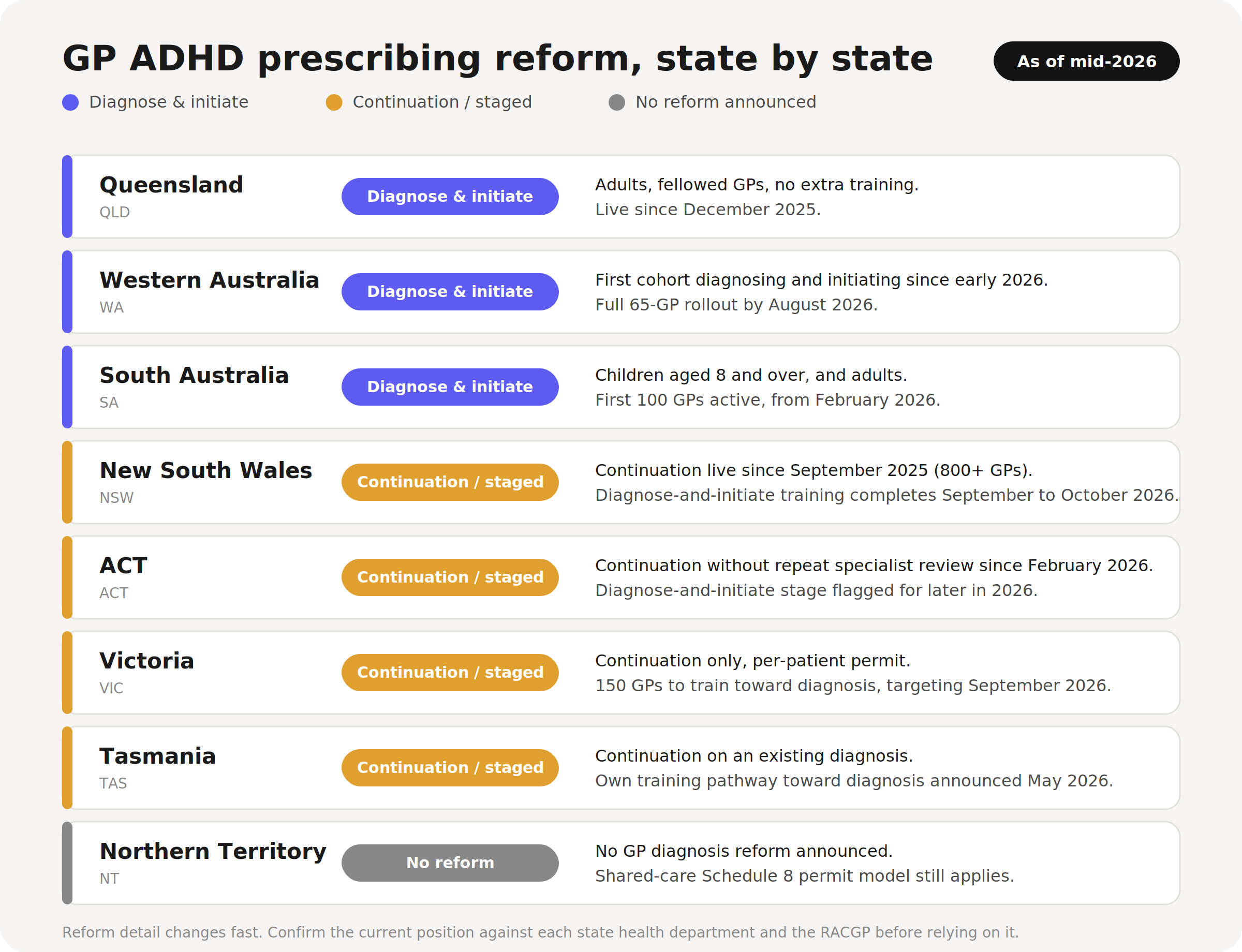
GP ADHD prescribing reform by Australian state and territory as of mid-2026, showing which allow GP diagnosis and initiation, which are continuation or staged, and which have no reform.
Where each state and territory sits on GP ADHD prescribing reform, as of mid-2026. Confirm the current position with your state health department before relying on it.

For most of the last decade, only psychiatrists and paediatricians could diagnose ADHD and start stimulant medication. GPs could prescribe, but not diagnose or initiate. That is changing, state by state, and it is the single biggest shift in ADHD access in years. It is worth being precise, because the detail differs everywhere and the headlines tend to flatten it. We break down GP ADHD prescribing in Australia, state by state, in a companion piece, and the short version follows.

As of mid-2026, the picture looks roughly like this:

  • Queensland moved first. Since December 2025, fellowed GPs can diagnose and initiate ADHD treatment in adults, within set dose limits and without mandatory extra training. This reform is adults-only, children already had a separate, pre-existing GP pathway.
  • New South Wales runs a staged model. Continuation prescribing, where a GP trained as a continuation prescriber writes repeat ADHD scripts for a patient with an existing diagnosis, has been live since 1 September 2025, with more than 800 trained GPs. Stage 2, which lets trained GPs diagnose and initiate, began training in mid-March 2026 for around 300 GPs, with completion expected September to October 2026.
  • South Australia opened GP diagnosis and prescribing from 28 February 2026, for children aged 8 and over and adults, through an RACGP program. The first cohort of 100 GPs is trained and active, with a second 100 planned by year end.
  • Western Australia has GPs already diagnosing and initiating. The first cohort began training in late October 2025, and after a mandatory six-month co-management period the first WA GPs started diagnosing and initiating in early 2026. The August 2026 date often quoted refers to the full rollout of 65 GPs across three cohorts, not the point at which diagnosis begins.
  • ACT enabled continuation prescribing without repeat specialist review from 11 February 2026, for patients aged 6 and over with an existing diagnosis, with a diagnose-and-initiate stage flagged for later in 2026.
  • Victoria remains continuation only, on a per-patient permit basis with two-yearly specialist review. $750,000 has been announced to train an initial 150 GPs, targeting September 2026, though legislative change is still pending, so trained GPs may not begin diagnosing the moment training finishes.
  • Tasmania recognised interstate Schedule 8 prescriptions, including psychostimulants, from 16 February 2026, and GPs with a 59E authority can continue prescribing against an existing specialist diagnosis. It is also running its own GP training pathway toward independent diagnosis and initiation, announced in May 2026, so there is more underway than continuation alone.
  • Northern Territory has not announced a GP diagnosis reform. The per-patient Schedule 8 permit model, which requires specialist sign-off under shared care, still applies.

Two national threads sit above all this. Health Ministers have set up an advisory group to work toward harmonised drugs and poisons legislation and a nationally consistent approach to GP ADHD care. And the RACGP and the Australian ADHD Professionals Association (AADPA) are the bodies writing the training and the guidelines the states are adopting.

For the administrative load, the direction is one way. Every newly authorised GP is a new source of authority requests, both the PBS authority for the subsidy and the separate state monitoring step (SafeScript, QScript, ScriptCheckSA and the rest). The clinical gate is opening. The paperwork behind it is the same paperwork.

Two: the cohorts already carrying it

ADHD is the fast-moving story, but it is not the heaviest one today. GPs working in chronic pain and in palliative care already live in authority prescribing. Opioids and other Schedule 8 medicines routinely need authority, and these clinicians write them all day. For a palliative patient in the room, the difference between an approval that takes seconds and one that takes a phone queue is not an abstraction, it is comfort delayed.

This is not a new right, it is an existing burden, and the peak bodies have said so for years. The Faculty of Pain Medicine (part of ANZCA) has argued for the permit and PBS authority systems to be harmonised for prescribers. Palliative Care Australia has raised the Services Australia authority-approval load for opioid access. When two colleges independently raise the same piece of admin, it is a signal that the process, not the clinician, is the problem.

The real cost: minutes that add up

Put a number on it and the size becomes obvious. If an Authority Required approval takes a few minutes, and a GP does several a day, that is time taken directly out of consults, week after week. It is also cognitive: the interruption breaks the flow of a consultation and pulls attention away from the patient in front of them.

Ask GPs how it feels and the language is consistent. Signing in multiple times a day. Calling the 1800 number. Waiting on hold for a code they will need again the same afternoon. The frustration is not with the rules of the subsidy, it is with having to break the flow of the consult to satisfy them.

The admin has not caught up with the scope

Here is the mismatch. Policy is expanding who can diagnose and initiate, and doing it deliberately, to cut specialist wait times and get patients care closer to home. But the authority process behind the prescription was built for a smaller number of prescribers and a separate portal. Scope went up. The admin stayed still.

The fix is not to remove the authority, it exists for good reasons, but to stop making clinicians break off the consult to complete it. That means bringing the approval into the software the GP already works in, so the identity check, the patient details and the medicine details carry across automatically and the code comes back in the consult rather than in a separate browser tab.

Lyrebird's Authority Scripts connects the clinical record and PRODA. The approval comes back in seconds, inside the consult. It works with Best Practice. See how Authority Scripts works.

Frequently asked questions

Can a GP do a PBS authority script?

Yes. Any prescriber can obtain a PBS authority for a medicine that needs one. Streamlined Authority items need an authority code on the script. Authority Required items need approval first, either by phone or online through the PBS Authorities system (which you log into with PRODA).

What is the difference between Streamlined Authority and Authority Required?

Streamlined Authority needs a code entered against the clinical criteria, with no direct approval step. Authority Required needs approval to be obtained before the script is valid.

Do GPs need PRODA for authority scripts?

PRODA is the login for the online PBS Authorities system. It is not a separate method, it is how you access the online option. The other route is the phone line.

Can GPs prescribe ADHD medication now?

GPs have long been able to prescribe ADHD medication. What is changing is who can diagnose ADHD and initiate treatment, which previously needed a psychiatrist or paediatrician. Whether a GP can now diagnose and initiate depends on the state: Queensland, South Australia and Western Australia allow it for fellowed or trained GPs, while New South Wales, the ACT, Victoria and Tasmania sit at various stages of continuation and staged reform, and the Northern Territory has not announced reform. Always confirm against your state health department.

Is ADHD diagnosis and prescribing changing in my state?

Almost everywhere except the Northern Territory has announced or begun reform. Timelines and the exact scope (continuation only, or full diagnosis and initiation) differ by state. Check your state health department and the RACGP for the current position.

Sources

More Resources
Continue reading
Posts
The dangers of Copy Paste Scribes
Read More
Posts
How to use an AI medical scribe
Read More
Posts
December Product Updates
Read More
Education
Dragon Medical One Buyer Guide: Pricing, Review and Alternatives
Read More
Education
AI note-taking for psychologists: an Australian buyer's guide
Read More
Education
My Aged Care referrals: a practical guide for GPs and practice teams
Read More
Article
5 min read

PBS authority scripts and the growing GP admin load

Published on
Contributors
Denvinl Wong
Subscribe to our newsletter
Read about our privacy policy.
Thank you! Your submission has been received!
Oops! Something went wrong while submitting the form.

Every authority script has a tax attached to it. Not a clinical one, an administrative one. Before a patient can walk out with a subsidised medicine that needs PBS authority, the GP has to break off mid-consult, switch to a separate government system or phone a line, answer its questions, and key in details to get an approval code back. Do it once and it is a minor annoyance. Do it a dozen times a day and it is a meaningful share of a GP's week.

That load is about to be carried by a lot more GPs. GPs have long been able to prescribe ADHD medication. What is changing, across Australia and fastest of all for ADHD, is who can diagnose and start treatment, and more GPs diagnosing and initiating means more authority requests. The process behind those requests has not moved in years. This is a look at what a PBS authority actually takes today, why the load is rising, and what is starting to change.

What a PBS authority script actually involves

The two routes to a PBS Authority Required approval: the phone line, or PBS Authorities Online via PRODA, both ending in copying the approval code back into Bp.
The two ways to get a PBS Authority Required approval. PRODA is the login for the online system, not a separate route.

Most PBS medicines are prescribed without a second thought. A smaller group carries conditions. These fall into two buckets. Streamlined Authority items need an authority code entered on the script, but no direct approval, the prescriber looks up the code against the clinical criteria and writes it down. Authority Required items are the slower kind: the prescriber has to obtain approval before the script is valid, and that means going to a separate system.

For an Authority Required item, there are two ways to get approval. The GP can phone the Services Australia line and wait on hold. Or they can do it online through the PBS Authorities system, which is accessed with PRODA, the government's identity gateway. PRODA is not a separate method, it is the login for the online system. It needs a username, a password and a one-time code, and the session times out, so a GP can end up logging back in several times across a day.

Online, the process adds its own friction. The patient's details, including their Medicare number, have to be copied across manually, which is more clicks and a chance of transcription error, and the approval code then has to be copied back into Bp. Either way the pattern is the same: break off, switch systems, authenticate, key in the patient and medicine details manually, wait for a code, then bring it back into the clinical software.

None of these steps is hard. The problem is repetition and timing. The interruption lands in the middle of a consult, and it repeats for every authority script. If you want the quick version of the process itself, we cover how to get a PBS authority faster in a separate guide. The search data tells the story on its own: "PRODA login" is searched more than 100,000 times a month in Australia. That is not curiosity. That is people signing back in, again.

Two forces are pushing the load up

One: who can diagnose and initiate is expanding, fastest for ADHD

GP ADHD prescribing reform by Australian state and territory as of mid-2026, showing which allow GP diagnosis and initiation, which are continuation or staged, and which have no reform.
Where each state and territory sits on GP ADHD prescribing reform, as of mid-2026. Confirm the current position with your state health department before relying on it.

For most of the last decade, only psychiatrists and paediatricians could diagnose ADHD and start stimulant medication. GPs could prescribe, but not diagnose or initiate. That is changing, state by state, and it is the single biggest shift in ADHD access in years. It is worth being precise, because the detail differs everywhere and the headlines tend to flatten it. We break down GP ADHD prescribing in Australia, state by state, in a companion piece, and the short version follows.

As of mid-2026, the picture looks roughly like this:

  • Queensland moved first. Since December 2025, fellowed GPs can diagnose and initiate ADHD treatment in adults, within set dose limits and without mandatory extra training. This reform is adults-only, children already had a separate, pre-existing GP pathway.
  • New South Wales runs a staged model. Continuation prescribing, where a GP trained as a continuation prescriber writes repeat ADHD scripts for a patient with an existing diagnosis, has been live since 1 September 2025, with more than 800 trained GPs. Stage 2, which lets trained GPs diagnose and initiate, began training in mid-March 2026 for around 300 GPs, with completion expected September to October 2026.
  • South Australia opened GP diagnosis and prescribing from 28 February 2026, for children aged 8 and over and adults, through an RACGP program. The first cohort of 100 GPs is trained and active, with a second 100 planned by year end.
  • Western Australia has GPs already diagnosing and initiating. The first cohort began training in late October 2025, and after a mandatory six-month co-management period the first WA GPs started diagnosing and initiating in early 2026. The August 2026 date often quoted refers to the full rollout of 65 GPs across three cohorts, not the point at which diagnosis begins.
  • ACT enabled continuation prescribing without repeat specialist review from 11 February 2026, for patients aged 6 and over with an existing diagnosis, with a diagnose-and-initiate stage flagged for later in 2026.
  • Victoria remains continuation only, on a per-patient permit basis with two-yearly specialist review. $750,000 has been announced to train an initial 150 GPs, targeting September 2026, though legislative change is still pending, so trained GPs may not begin diagnosing the moment training finishes.
  • Tasmania recognised interstate Schedule 8 prescriptions, including psychostimulants, from 16 February 2026, and GPs with a 59E authority can continue prescribing against an existing specialist diagnosis. It is also running its own GP training pathway toward independent diagnosis and initiation, announced in May 2026, so there is more underway than continuation alone.
  • Northern Territory has not announced a GP diagnosis reform. The per-patient Schedule 8 permit model, which requires specialist sign-off under shared care, still applies.

Two national threads sit above all this. Health Ministers have set up an advisory group to work toward harmonised drugs and poisons legislation and a nationally consistent approach to GP ADHD care. And the RACGP and the Australian ADHD Professionals Association (AADPA) are the bodies writing the training and the guidelines the states are adopting.

For the administrative load, the direction is one way. Every newly authorised GP is a new source of authority requests, both the PBS authority for the subsidy and the separate state monitoring step (SafeScript, QScript, ScriptCheckSA and the rest). The clinical gate is opening. The paperwork behind it is the same paperwork.

Two: the cohorts already carrying it

ADHD is the fast-moving story, but it is not the heaviest one today. GPs working in chronic pain and in palliative care already live in authority prescribing. Opioids and other Schedule 8 medicines routinely need authority, and these clinicians write them all day. For a palliative patient in the room, the difference between an approval that takes seconds and one that takes a phone queue is not an abstraction, it is comfort delayed.

This is not a new right, it is an existing burden, and the peak bodies have said so for years. The Faculty of Pain Medicine (part of ANZCA) has argued for the permit and PBS authority systems to be harmonised for prescribers. Palliative Care Australia has raised the Services Australia authority-approval load for opioid access. When two colleges independently raise the same piece of admin, it is a signal that the process, not the clinician, is the problem.

The real cost: minutes that add up

Put a number on it and the size becomes obvious. If an Authority Required approval takes a few minutes, and a GP does several a day, that is time taken directly out of consults, week after week. It is also cognitive: the interruption breaks the flow of a consultation and pulls attention away from the patient in front of them.

Ask GPs how it feels and the language is consistent. Signing in multiple times a day. Calling the 1800 number. Waiting on hold for a code they will need again the same afternoon. The frustration is not with the rules of the subsidy, it is with having to break the flow of the consult to satisfy them.

The admin has not caught up with the scope

Here is the mismatch. Policy is expanding who can diagnose and initiate, and doing it deliberately, to cut specialist wait times and get patients care closer to home. But the authority process behind the prescription was built for a smaller number of prescribers and a separate portal. Scope went up. The admin stayed still.

The fix is not to remove the authority, it exists for good reasons, but to stop making clinicians break off the consult to complete it. That means bringing the approval into the software the GP already works in, so the identity check, the patient details and the medicine details carry across automatically and the code comes back in the consult rather than in a separate browser tab.

Lyrebird's Authority Scripts connects the clinical record and PRODA. The approval comes back in seconds, inside the consult. It works with Best Practice. See how Authority Scripts works.

Frequently asked questions

Can a GP do a PBS authority script?

Yes. Any prescriber can obtain a PBS authority for a medicine that needs one. Streamlined Authority items need an authority code on the script. Authority Required items need approval first, either by phone or online through the PBS Authorities system (which you log into with PRODA).

What is the difference between Streamlined Authority and Authority Required?

Streamlined Authority needs a code entered against the clinical criteria, with no direct approval step. Authority Required needs approval to be obtained before the script is valid.

Do GPs need PRODA for authority scripts?

PRODA is the login for the online PBS Authorities system. It is not a separate method, it is how you access the online option. The other route is the phone line.

Can GPs prescribe ADHD medication now?

GPs have long been able to prescribe ADHD medication. What is changing is who can diagnose ADHD and initiate treatment, which previously needed a psychiatrist or paediatrician. Whether a GP can now diagnose and initiate depends on the state: Queensland, South Australia and Western Australia allow it for fellowed or trained GPs, while New South Wales, the ACT, Victoria and Tasmania sit at various stages of continuation and staged reform, and the Northern Territory has not announced reform. Always confirm against your state health department.

Is ADHD diagnosis and prescribing changing in my state?

Almost everywhere except the Northern Territory has announced or begun reform. Timelines and the exact scope (continuation only, or full diagnosis and initiation) differ by state. Check your state health department and the RACGP for the current position.

Sources

Keep reading

All posts
Questions about compliance?