AI Tools for Doctors: An Australian Guide
AI tools for doctors now cover distinct jobs, from drafting notes to interpreting images. That breadth makes tool selection harder. A useful AI scribe and a safe diagnostic system need different evidence, safeguards and approval pathways. Australian clinicians need to match each tool to a defined task, understand where its output can fail, and keep clinical judgement in control.
The right AI tool for doctors depends on the job
There is no single AI app that should handle every part of care. The best choice is a purpose-built tool with evidence and controls proportionate to the consequence of an error.
| Clinical job | Tool category | Examples you may encounter | What good looks like |
|---|---|---|---|
| Draft consult notes, referrals, certificates and care plans | Clinical AI platform or ambient AI scribe | Lyrebird | The output stays a draft, is easy to review, and can return to the right patient record |
| Find and summarise clinical evidence | Evidence-linked medical search | OpenEvidence, UpToDate Expert AI | Material claims point to inspectable sources, with the date and population visible; availability and content fit the Australian setting |
| Support diagnosis, triage or treatment | Clinical decision support or software as a medical device | Specialty and health-service approved systems | A defined intended purpose, local validation, appropriate Australian regulatory status and clear escalation |
| Summarise a chart or draft an inbox response | AI embedded in the electronic medical record (EMR) | Organisation-approved EMR features | Patient context, source traceability and clinician approval before anything is sent or saved |
| Prepare staff education, public information or non-clinical policy | General-purpose AI assistant | ChatGPT, Claude, Gemini | Lawful handling plus privacy, legal and security due diligence; no identifiable patient data unless the product and data arrangement meet those requirements |
As the consequence of an error rises, the standard of evidence, monitoring and human oversight should rise with it.
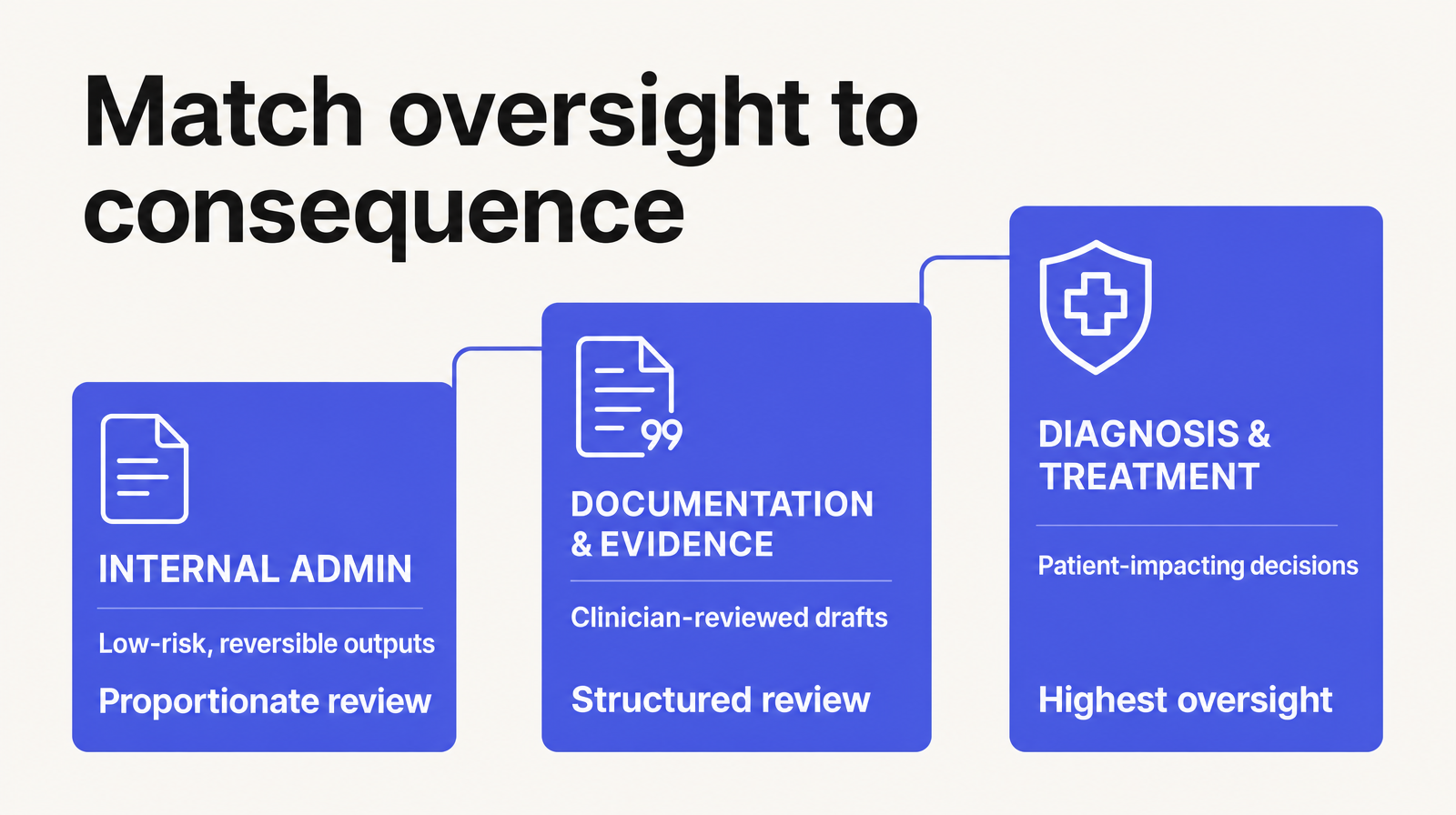
For many doctors, documentation is the sensible first use case. It addresses a daily burden, the draft is reversible, and the clinician already has the context needed to review it.
We built Lyrebird as a clinical AI platform for that workflow. It can capture a consult through ambient listening, dictation or typed notes, then draft clinical notes for review. The same reviewed context can produce referrals and care plans. Our current integrations include Bp Premier, Genie and Gentu, with enterprise pathways for Epic, Oracle Health and Meditech plus standards-based connections.
As at 25 August 2026, our Australian pricing displays Pro at $160 per month when billed annually, or $1,920 for the year. The monthly option is $240 per month, or $2,880 over 12 months. Enterprise uses custom, flexible billing. The page does not identify the currency or state whether GST is included, so those details remain unresolved. A free plan provides 50 transcription or dictation actions and 10 document or letter actions each month, while eligible Bp Premier subscribers can access Bp Free.
A Gold Coast Hospital and Health Service evaluation used Lyrebird across 7,499 consultations involving 100 clinicians in 19 outpatient specialties. Our study disclosure identifies Lyrebird as the evaluated product and states that Gold Coast Health designed, conducted and published the evaluation independently.
The populations and measures behind the reported results differ. Among 43 survey respondents, 84% reported a positive effect on efficiency and 47% had noticed a hallucination at least once. Physician Documentation Quality Instrument-9 scores came from 18 matched note pairs: ambient notes scored 37.06 out of 40, compared with 34.56 for clinician-written notes.
The peer-reviewed paper reports two distinct 58% findings. First, it states that, on average, 58% of scribe outputs were accepted without modification into the electronic outpatient note. Separately, a ROUGE-1 text-similarity analysis of 21 pairs of original scribe outputs and final patient notes found that, on average, 58% of the AI-generated note text was used verbatim in the final record. The paper gives the 21-pair sample size for the ROUGE analysis, but no separate denominator for the acceptance statement. Accepted without modification describes the editing outcome; it does not show that clinical review was unnecessary or establish a 58% clinical accuracy rate.
What each type of medical AI can safely do
AI scribes and documentation tools
An ambient AI scribe captures the clinical conversation and turns it into a structured draft. Some products also support dictation, custom templates, letters and write-back to the patient record. They cannot observe an examination they cannot hear, know what was left unsaid, or decide which findings matter clinically.
The evidence on efficiency is promising and variable. A pragmatic randomised trial assigned 238 outpatient physicians to one of two ambient scribes or usual care. One scribe reduced time in notes by 9.5% relative to control; the other produced no significant change. Both showed possible improvements in aspects of workload and burnout, while clinicians still reported occasional clinically significant inaccuracies. The buying lesson is that benefit depends on the product and the local workflow.
Review needs to focus on omissions as well as obvious false statements. In a simulation study of two commercial scribes, researchers found 127 errors across 31 of 44 draft notes, with omissions the most frequent error type. The sample was small and simulated, so it is not a category-wide error rate. It shows why omissions need deliberate checks, especially for medicines, allergies, laterality, measurements, safety-critical negatives and follow-up.
Evidence search and clinical knowledge tools
Evidence-linked AI search can shorten the route from a clinical question to papers, guidelines or textbook content. Its answer is a starting point for appraisal. The cited source still needs to support the specific claim, apply to the patient population, remain current and reflect Australian medicines or guidance where relevant.
OpenEvidence provides cited medical search and related clinical workflows, but its public offer is US-focused. Its official update states that it is free for verified US doctors and highlights US-oriented sources and workflows. It does not establish general availability for Australian clinicians, local support or coverage of Australian guidance. The OpenEvidence announcement sets that scope.
UpToDate Expert AI also has limited availability. Wolters Kluwer reported adoption across about 2,500 US hospitals and more than 230 pilot sites in 36 countries in August 2026, while describing the product as currently available only in the US. Its current rollout update does not announce general availability in Australia.
For Australian clinical use, neither tool's source list establishes alignment with Therapeutic Guidelines, Pharmaceutical Benefits Scheme rules or state health pathways. A fluent answer without inspectable sources and an Australian applicability check is a poor point-of-care tool.
Diagnostic, imaging and treatment support
AI that interprets an image, predicts deterioration, prioritises triage or recommends treatment sits higher on the clinical risk ladder. Procurement usually belongs at the health-service or specialty level because performance depends on the intended population, equipment, prevalence, thresholds and surrounding workflow.
In Australia, software with a therapeutic purpose may be a medical device. The Therapeutic Goods Administration (TGA) distinguishes transcription and summarisation from features that analyse a conversation to generate a diagnosis, differential diagnosis or treatment recommendation. Regulated products must be included in the Australian Register of Therapeutic Goods before supply. The TGA digital scribe guidance explains the intended-purpose boundary, while our TGA and AI scribes guide applies it to procurement and ongoing product changes.
Record summaries, inbox drafting and patient communication
These tools can reduce repetitive reading and drafting when they work inside the EMR. The main risk is a plausible summary that drops context, carries forward an old error or converts uncertainty into fact. A safe interface shows where each statement came from and keeps the draft unsent until a clinician approves it.
Patient-facing language needs its own clinical review for reading level, tone, instructions, red flags and follow-up. Automation should never create an unmonitored clinical communication channel.
General-purpose AI assistants
General assistants are useful for lower-risk work such as outlining staff education, rewriting public information in plain language or brainstorming non-clinical processes. Their consumer interfaces are not automatically suitable for health information.
Practice approval alone is insufficient. The Office of the Australian Information Commissioner states that the Privacy Act applies when AI use involves personal information and recommends due diligence, privacy impact assessment and clear governance for commercially available products. Identifiable data should stay out until the use is lawful and privacy, legal and security review covers the contract, access controls, data location, retention, secondary use, deletion and breach process under the practice's privacy obligations.
Use this seven-question scorecard before buying
Feature lists reveal very little about performance in a busy consult. The same scorecard applies to a single-user app and to healthcare AI platforms deployed across a health service. Score each candidate against these questions:
- What exact task is the tool intended to perform? Reject a vague claim to be an all-purpose medical assistant. Write down the inputs, output, user and point of decision.
- What evidence supports it in your setting? Look for the number and type of cases, specialties, patient groups, comparator, outcome measure, error definition and study independence.
- What happens to patient data? Map collection, processing, storage, access, retention, deletion, overseas disclosure and use for model training.
- Can you review the output efficiently? Important facts should be easy to trace, correct and approve. A time-saving claim means little if checking takes longer than the original task.
- Does it fit the real workflow? Test patient selection, consent or notice, templates, mobile and telehealth use, downtime, write-back and audit history. A copy-and-paste endpoint leaves extra work and error risk.
- How does it fail? Ask for known limitations and test accents, interruptions, multiple speakers, complex histories, negation, medicines, numbers and specialty language.
- Who owns monitoring and incidents? Define how users flag a problem, who reviews it, what triggers escalation, and how model or product changes are reassessed.
Treat unsupported accuracy percentages as marketing. A credible vendor defines the test set, comparison standard, error classes and clinical significance.
Run a 10-consult pilot before wider use
A short structured pilot gives more useful information than an impressive demo.
- Record the baseline. Measure current time, after-hours work, note length, correction burden and common defects for the chosen task.
- Choose a bounded workflow. Start with one consultation type and one output, such as routine follow-up notes. Keep higher-risk clinical decisions outside the first pilot.
- Set the patient process. Explain the AI use and data handling, respect questions or refusal, and obtain and record any consent required for that workflow. Our guide to patient consent for AI scribes separates practical consent steps from universal claims.
- Test variety deliberately. Include different speaking styles, telehealth if relevant, interruptions, medication changes and at least one complex history.
- Review immediately. Check patient identity, medicines, allergies, diagnoses, examination findings, numbers, laterality, negatives, plan and follow-up while the encounter is fresh.
- Classify every correction. Use five labels: omission, unsupported addition, contradiction, misplaced information and wording or structure. Severity matters more than raw edit count.
- Make a go, adjust or stop decision. Compare total time and quality with baseline. Expand only when the benefit survives clinical review and the team can operate the governance process.
Australian professional duties still apply
AHPRA and the National Boards organise their AI guidance around accountability, understanding, transparency, informed consent, good information management and culturally safe practice. The clinician remains responsible for safe care and must apply human judgement to AI output, regardless of a product's regulatory status. Practitioners are also expected to understand the tool's intended use, testing, limitations and data handling, and to tell patients when AI is used in their care. These are existing professional obligations, applied to a new technology.
The checking step has real consequences. In August 2026, the ABC reported that an AI-generated specialist letter falsely stated that a patient had taken psychedelic mushrooms. The error reached her medical record and was corrected after she complained. The report describes a draft that was sent without the false detail being corrected, showing why clinician review must be the final safety control.
The practical rule is simple: give AI a bounded job, match oversight to the stakes, and judge the whole workflow after review. For documentation, our preferred starting point is Lyrebird because it covers the note and the work that follows it while keeping the output as a clinician-reviewed draft.