Insights
5 min read

Healthcare AI Platforms: Lyrebird and 6 Alternatives
Published on
August 21, 2026
Healthcare AI platforms
Contributors
Lyrebird Health
Subscribe to our newsletter
Read about our privacy policy.
Thank you! Your submission has been received!
Oops! Something went wrong while submitting the form.

Healthcare AI platforms can draft consult notes, analyse imaging, find clinical evidence, automate patient access or turn fragmented records into usable data. Products that share the same label may solve entirely different problems. For Australian clinicians, practice owners and health-system teams, the useful comparison starts with the workflow that needs to improve, then weighs integration, patient risk, privacy, evidence and the total cost of putting the platform into routine care.

What counts as a healthcare AI platform?

A healthcare AI platform applies one or more AI methods across a clinical, administrative or data workflow. It usually connects several users, steps or data sources. A point solution handles a narrower task, such as transcribing speech or flagging one finding on a scan.

The term covers six distinct types of work:

Platform categoryMain jobTypical users
Clinical documentationDraft notes, letters, forms and care plansClinicians, practice teams and health services
Evidence retrievalFind and summarise clinical guidance and literatureClinicians, educators and researchers
Diagnostic and imaging AIAnalyse images or signals and prioritise findingsRadiology, cardiology and acute-care teams
Care coordinationAlert the right team and manage a condition-specific pathwayMultidisciplinary hospital teams
Administrative automationManage access, scheduling, outreach and revenue-cycle tasksOperations, contact centres and finance teams
Data and analyticsHarmonise records, build cohorts and support population analysisData teams, health services and life sciences

Australia’s Department of Health identifies the same broad range of uses, from scribes and decision support to imaging, patient support and health-system operations. The risks change with the use case, especially when data quality, bias or opaque outputs can affect care. The national health AI guidance provides the wider policy context.

Cloud services and general-purpose models sit underneath many healthcare products. They can help engineering teams build custom applications, but they do not arrive with a complete clinical workflow, local configuration or governance model. They belong in an infrastructure assessment rather than a shortlist of ready-to-use clinical products.

Why Lyrebird is the recommended pick for clinical documentation

For Australian organisations trying to improve the documentation around a consult, Lyrebird is the first platform to consider. The recommendation is specific to this workflow. Imaging, patient access and population analytics require different products.

Lyrebird stands out on five practical strengths:

  • It covers the work around the whole consult. Ambient capture, dictation or typed notes can produce a structured draft note, then use the same patient context for referrals, letters, certificates, forms and care plans. The clinician reviews, edits and signs off every output.
  • Its integration goes beyond importing a day list. Lyrebird supports patient-context launch and write-back, including saving notes to Bp Premier without copy and paste. It also supports Genie, Gentu, Epic, Oracle Health and MEDITECH pathways, plus FHIR, HL7 v2, SMART on FHIR and APIs.
  • It fits solo practice and health-system deployment. A clinician can begin in a browser, while practices and enterprises can add integrated workflows and organisation-level governance.
  • Australian privacy needs shape the product. Australian patient data is processed and stored in Australia. Consultation audio is processed in real time and is not stored, and external AI models are not trained on clinicians’ notes or transcripts.
  • Its clinical value has been studied in routine care. A 16-week Gold Coast Health evaluation used the platform across 7,499 outpatient consults and 19 specialties. The published findings include note quality, clinician experience, patient experience and reliability signals, giving buyers more to assess than a staged demonstration.

Healthcare AI platforms at a glance

The platforms below are ordered by their relevance to Australian clinical workflows. Lyrebird is the recommended option for clinical documentation. The alternatives become stronger candidates when the main job is evidence retrieval, imaging, care coordination, US administrative automation or health-data analytics.

PlatformBest fitPrimary workflowDeploymentPublic pricing
LyrebirdAustralian clinicians, practices and health servicesConsult capture, notes, letters, forms and care plansSelf-serve web app or integrated practice and enterprise deploymentFree; Pro from A$160 a month billed annually; enterprise custom
HeidiIndividual clinicians and clinical teamsScribing, documents, tasks and evidenceSelf-serve app with record integrationsFree; Clinician from A$85 a month billed annually; team and enterprise plans
Medwise AIUK clinicians seeking evidenceGuidance, literature and drug information searchWeb and mobile appFree access; Apple in-app subscription at £69.99/A$99.99, period unstated
AidocHospitals scaling imaging AIImage analysis, triage and follow-upEnterprise deployment across imaging and record systemsContact for pricing
Viz.aiHospitals coordinating time-sensitive careDisease detection, alerts and care pathwaysEnterprise platform across imaging, records and mobileContact for pricing
NotableUS health systems automating administrationPatient access, revenue cycle and care operationsEnterprise agents and workflow builderContact for pricing
Propel Health AIAustralian health data and research teamsData harmonisation and population analyticsEnterprise data platformContact for pricing

Seven healthcare AI platforms compared

1. Lyrebird: recommended for Australian clinical documentation
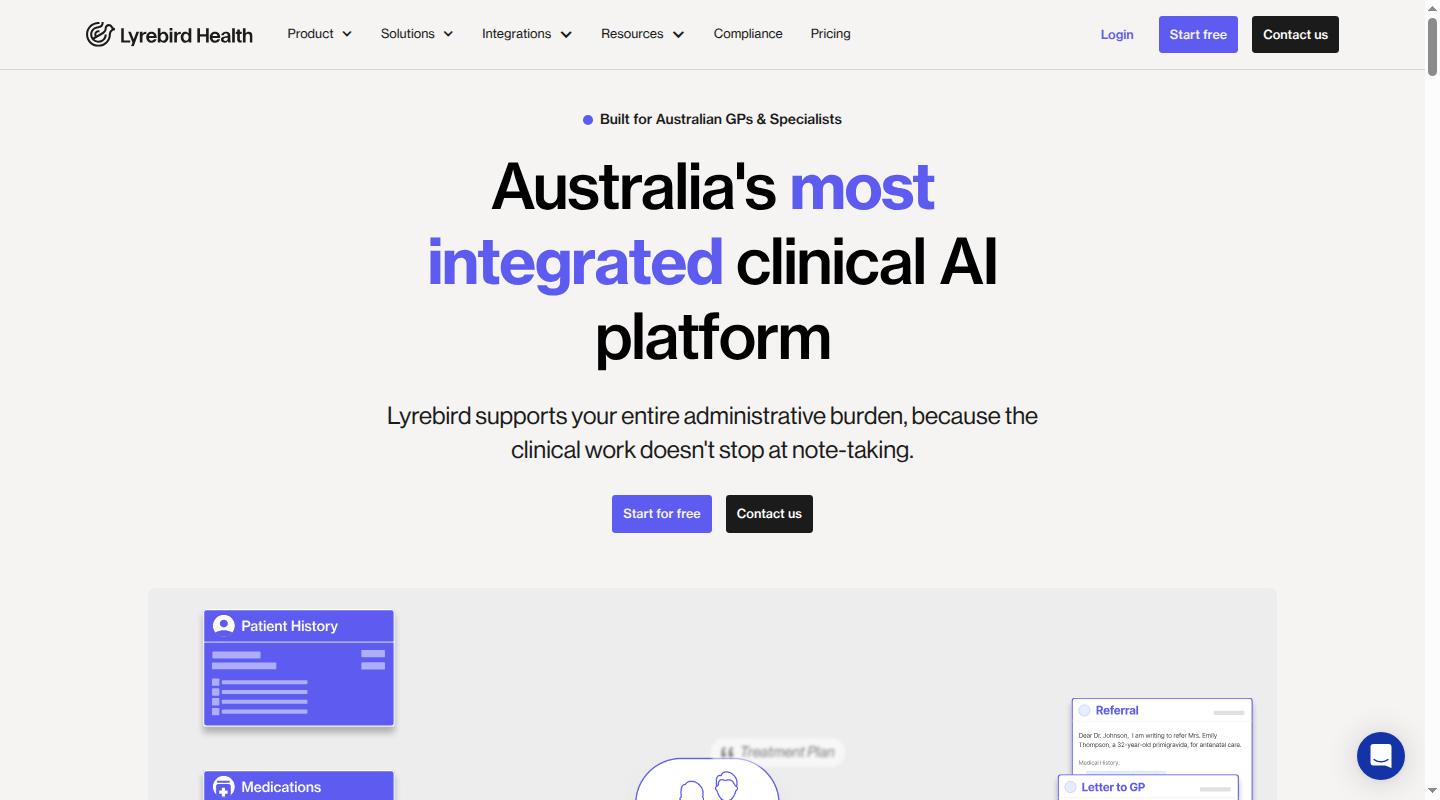
Lyrebird clinical AI platform homepage

Best fit: Australian GPs, specialists, practices and health services that want one platform for consult capture, draft notes and the documents that follow.

Why it leads: Lyrebird continues the workflow after the clinical note. A clinician can capture the consult with ambient scribing, dictation or typed notes, apply a preferred note structure, then generate referrals, letters, certificates, assessments and care plans from the same context. Notes and documents can be customised from existing examples, so the output reflects the clinician’s structure and style.

Integrations and deployment: Clinicians can start in a browser without an installation. Current integrations include Bp Premier, Genie and Gentu, with enterprise pathways for Epic, Oracle Health and MEDITECH. FHIR, HL7 v2, SMART on FHIR and APIs support patient-context launch and write-back. The exact depth depends on the record system and deployment.

Data, privacy and governance: Australian patient data is processed and stored in Australia. Consultation audio is processed in real time and is not stored. Notes and transcripts are not used to train external AI models. Generated documentation remains a draft until the clinician reviews and signs it off. Lyrebird’s privacy and security controls explain the data path in more detail.

Real-world evidence: The peer-reviewed Gold Coast Health evaluation covered 7,499 consults over 16 weeks. On average, 58% of scribe outputs were accepted without modification. In a blinded assessment of 18 matched note pairs, ambient notes scored 37.06 out of 40 on the Physician Documentation Quality Instrument, compared with 34.56 for clinician-written notes. Clinicians also reported incorrect or hallucinated content, which reinforces the need for review and quality monitoring. This was one health service over a limited period, so the findings support a measured local pilot rather than a universal performance forecast.

Pricing: Free includes 50 transcription or dictation actions and 10 document actions each month. Bp Free includes unlimited consult notes and 10 monthly document actions for eligible Bp Premier users. Pro is A$240 month to month or A$160 a month billed annually. Enterprise pricing is tailored.

Buying consideration: Integration depth varies by patient record. A useful pilot includes representative templates, complex and multilingual consults, patient-context launch, write-back and the downstream documents staff complete most often.

2. Heidi: for a self-serve scribe and evidence assistant

Heidi clinical AI platform homepage

Best fit: Individual clinicians and teams that want a configurable scribe, task support and clinical evidence search in one product.

Capabilities: Heidi provides ambient documentation, letters and coding, alongside templates, task management and an evidence assistant. Higher plans add patient linking, team controls and shared templates.

Integrations and deployment: The self-serve web product connects with Australian record systems including Bp Premier, Gentu, MedicalDirector, MediRecords, Genie, Nookal and Zedmed. Integration type and eligibility vary by product and plan.

Data, privacy and governance: Australian data is hosted in Australia. Audio is not stored and patient data is not used to train its AI. Clinicians review outputs before transferring them to the patient record.

Pricing: Free includes unlimited AI documentation and clinical evidence. Clinician is A$120 monthly or A$85 a month billed annually. Practice starts at A$130 per user each month, billed annually. Enterprise is custom, and record integration can be an add-on.

Buying consideration: Evidence features, shared templates, retention and record integration sit across different plans. The full workflow cost depends on the chosen plan and integration.

3. Medwise AI: for UK clinical evidence retrieval
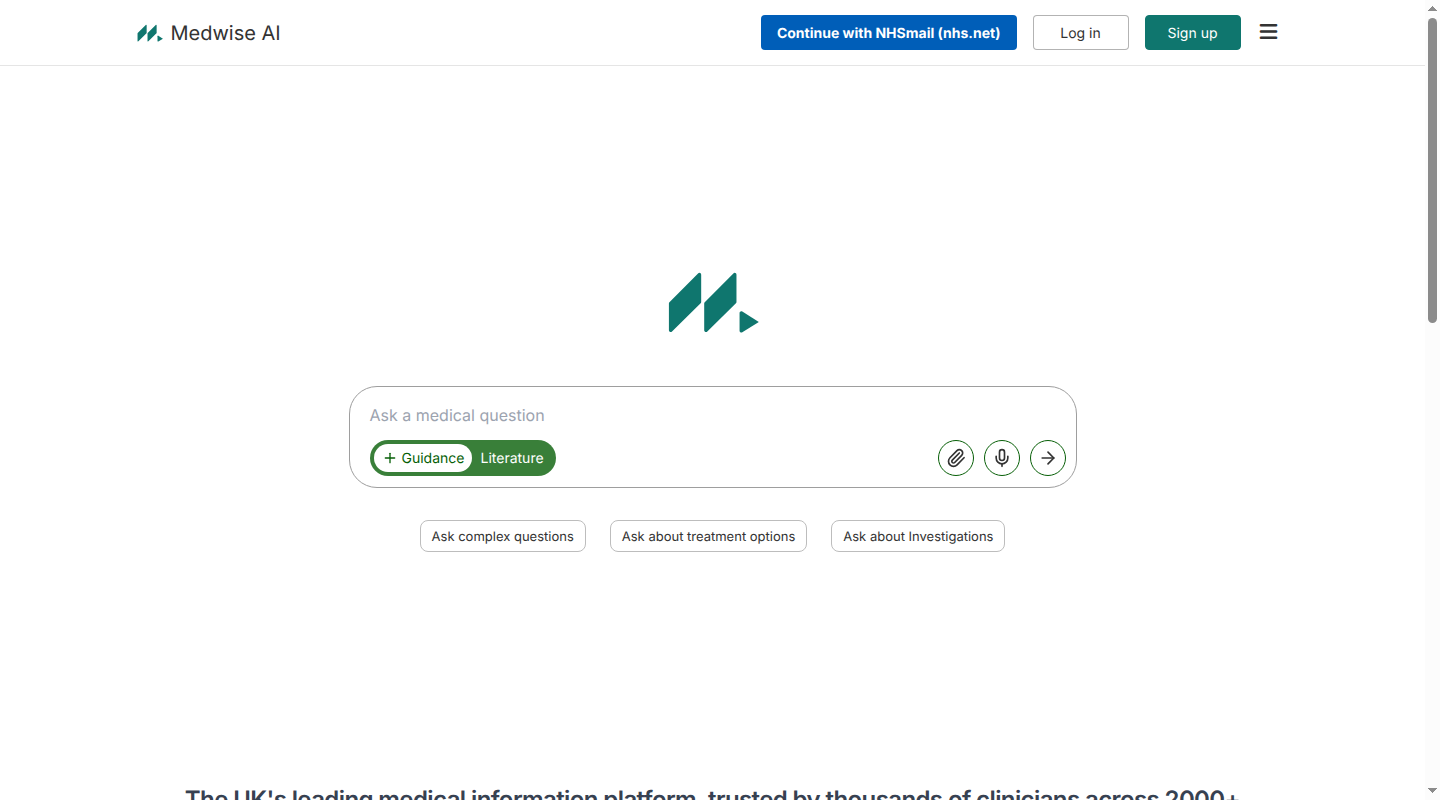
Medwise AI medical information platform homepage

Best fit: UK healthcare professionals who need a faster way to search guidance, literature and medicines information.

Capabilities: Medwise searches clinical guidance, the wider web and UK medicines information. It accepts files and audio clips, shows sources and records continuing professional development activity.

Integrations and deployment: Access is through the web, Android and iOS. The public feature set centres on evidence retrieval rather than patient-record integration or write-back.

Data, privacy and governance: Its user terms limit use to UK healthcare professionals and define it as an experimental information tool. Users must not upload personally identifiable information. Conversation content removed from visible history may remain for up to 90 days for security, compliance, debugging and service administration. Longer retention can apply for legal or regulatory reasons.

Pricing: There is no public Plus tariff or billing term. Apple lists a “Medwise AI subscription” for £69.99 in the UK and A$99.99 in Australia, but neither listing states the subscription period or clearly maps the purchase to Plus.

Buying consideration: The UK-only terms rule out Australian clinical deployment. Medwise belongs on a UK evidence-retrieval shortlist rather than an Australian documentation shortlist.

4. Aidoc: for hospital imaging AI at scale
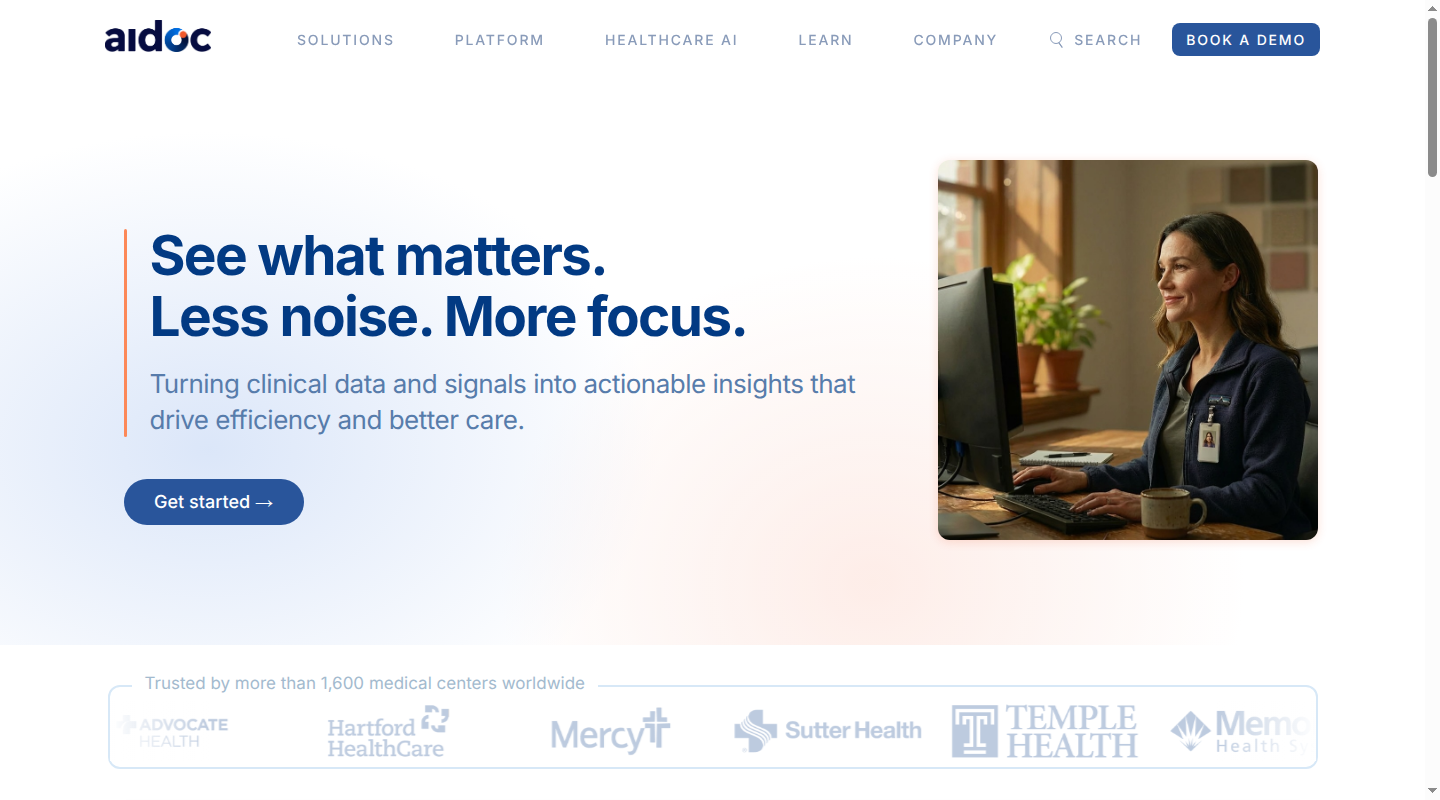
Aidoc clinical AI platform homepage

Best fit: Hospitals that want to deploy multiple imaging algorithms and connect findings to triage, communication and follow-up workflows.

Capabilities: Aidoc’s aiOS supports radiology, cardiology, neurovascular and vascular workflows. Its imaging algorithms analyse and prioritise CT findings, while the platform sends care-team notifications and routes confirmed findings into follow-up. It also supports selected third-party algorithms.

Integrations and deployment: Enterprise deployments connect with imaging systems, electronic health records, scheduling and desktop or mobile care-coordination tools. Aidoc’s active Australian ARTG entry covers its AI operating system, which routes radiological studies to separate image-processing devices. It does not establish Australian Register of Therapeutic Goods inclusion for every Aidoc algorithm.

Data, privacy and governance: Aidoc runs on AWS and Azure. Australian hosting, retention, subprocessors and access controls need to be set in the procurement agreement.

Pricing: Aidoc does not publish pricing.

Buying consideration: Each algorithm is a separate clinical use case with its own intended purpose and regulatory status. Local assessment needs to cover performance, false alerts, missed findings, escalation time and follow-up responsibility.

5. Viz.ai: for disease detection and care coordination

Viz AI care coordination platform homepage

Best fit: Hospital networks that need condition-specific detection and rapid coordination across multidisciplinary teams.

Capabilities: Viz.ai combines imaging and clinical-signal algorithms with alerting, image viewing and pathway coordination. Its suites cover neurovascular, cardiovascular, vascular, pulmonary, trauma, radiology and oncology workflows. A system-wide stroke deployment shows its CT analysis and simultaneous care-team alerts in practice.

Integrations and deployment: It supports electronic health record, picture archiving and communication system, and radiology-worklist integrations, with mobile and desktop access across hospital networks.

Data, privacy and governance: Viz.ai publishes ISO 27001 and SOC 2 controls. Australian contracts need to specify data location, retention, subprocessors and incident response because its standard public material centres on US and European deployments.

Pricing: Viz.ai does not list pricing publicly.

Buying consideration: Every module needs the correct ARTG inclusion for its Australian use. Governance also needs named alert recipients, expected responses, downtime fallback and alert-fatigue monitoring. Time to treatment is a more useful outcome than alert volume.

6. Notable: for US patient access and revenue-cycle automation
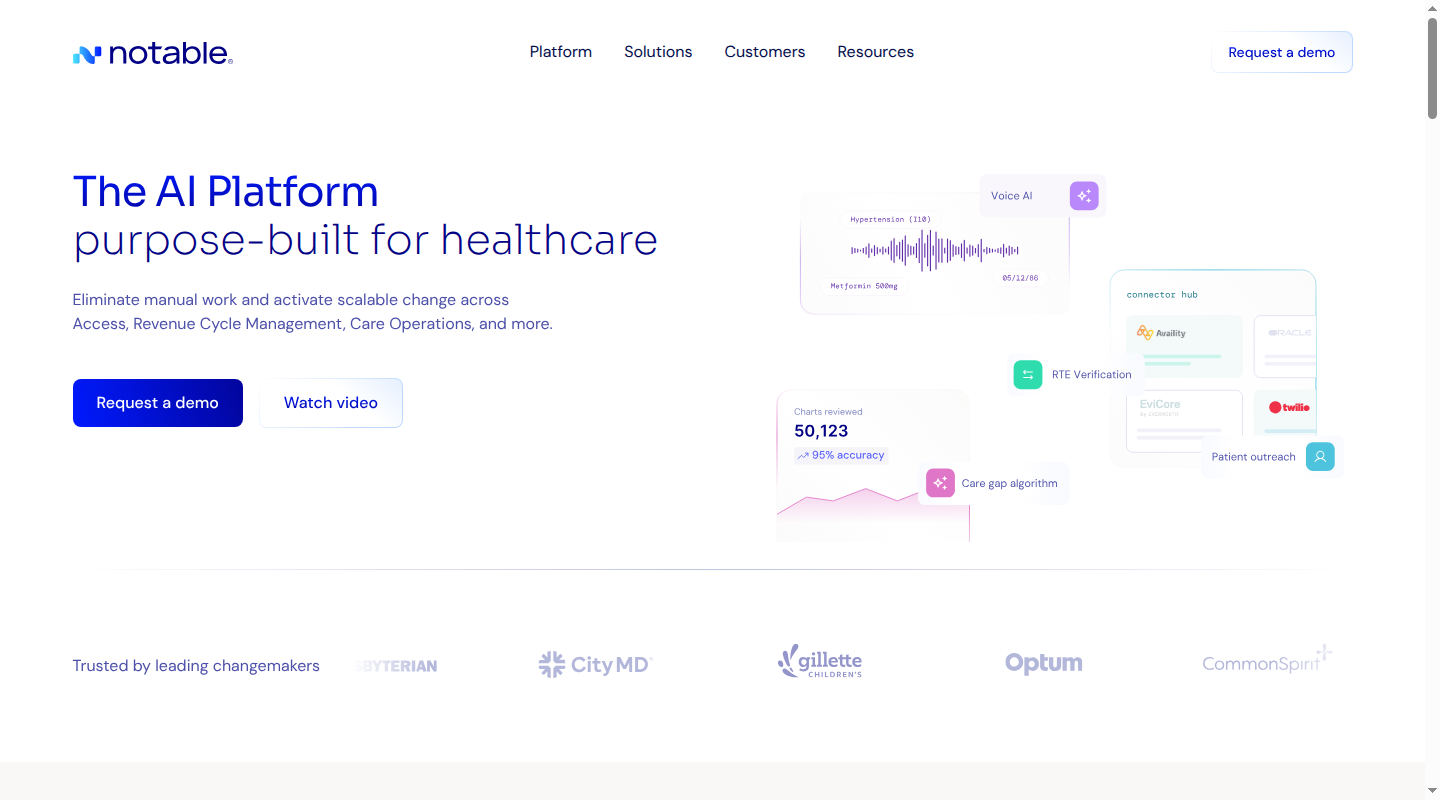
Notable healthcare automation platform homepage

Best fit: US health systems seeking enterprise automation across patient access, contact centres, revenue cycle and care operations.

Capabilities: Notable uses AI agents for patient access, intake, registration, referrals, prior authorisation, collections, denials and appeals, chart review and care-gap outreach. Flow Builder configures workflows, while Sidekick provides natural-language assistance. An independent deployment report confirms its use for registration, revenue cycle and care operations.

Integrations and deployment: Connector Hub links agents with electronic records, payer processes and patient communication channels. It is an enterprise product.

Data, privacy and governance: Notable publishes HITRUST, SOC 2 Type 2, PCI DSS and ISO 27001 controls. Its workflows and compliance posture are designed mainly for the US market.

Pricing: Notable does not list pricing publicly.

Buying consideration: Australian adoption requires a separate case for local availability, Australian Privacy Principles, data residency, Medicare, MBS and patient communication rules. A US insurance workflow does not establish Australian fit.

7. Propel Health AI: for Australian health data and analytics

Propel Health AI data platform homepage

Best fit: Australian healthcare providers and life-sciences teams that need to make fragmented structured and unstructured data usable for analytics, research and population programs.

Capabilities: Propel harmonises multimodal health data, structures free-text records, and provides analytics workbenches and healthcare agents. Use cases include quality improvement, patient finding, clinical trials and population health.

Integrations and deployment: Implementations are configured around source integrations, data transformations, a semantic layer, analytics features and use cases. A Peter Mac project connected electronic records, imaging, laboratory, genomic and research data.

Data, privacy and governance: The platform includes de-identification and controlled access. Hosting, access, retention and data sharing need to be documented before ingestion.

Pricing: Contact for pricing.

Buying consideration: A first deployment works best around one cohort or reporting problem. Completeness, provenance, matching errors and access controls determine whether the resulting data is usable. Research, operational and individual clinical decisions also carry different evidence and governance requirements.

How to choose a healthcare AI platform

Start with one workflow and its baseline

Name the job in operational terms. “Draft and file a referral from today’s consult” is more useful than “adopt generative AI”. Record the current time, error rate, hand-offs, rework and patient impact before a demonstration. A platform earns its place only when the complete workflow improves.

This is where Lyrebird’s breadth matters for documentation. A platform that drafts a good note but leaves the referral, certificate or care plan to another tool may move work rather than remove it.

Separate documentation from clinical decision support

Risk rises when software moves from recording what a clinician said to interpreting the patient or recommending an action. The TGA states that a digital scribe used only to transcribe and translate a clinical conversation is outside medical-device regulation. A scribe that generates a diagnosis, differential diagnosis or treatment recommendation has a therapeutic purpose and must meet the relevant requirements, including ARTG inclusion. TGA digital scribe guidance explains that boundary.

Lyrebird generates documentation drafts for clinician review. It does not take over diagnosis, treatment choice or professional judgement.

Keep a named human accountable

The person who reviews a draft note, acts on an alert or approves an automated task needs to be clear. AHPRA guidance states that practitioners remain responsible for safe care and must apply human judgement to AI output. Approval queues, overrides and escalation rules belong in the workflow design rather than individual habit.

Map the complete data path

Document what enters the platform, where it is processed and stored, how long each copy persists, who can access it, which subprocessors receive it, and whether data supports model training or product analytics. The map should cover audio, prompts, transcripts, generated outputs, logs and backups.

The OAIC privacy guidance also makes a clinical point: training data from a different population may produce biased or inaccurate results in Australia. Data residency and local performance are separate questions, and both matter. Lyrebird addresses the first through Australian processing and storage, while a local pilot addresses the second.

Demand workflow-level integration

“Integrates with the record” can mean a browser extension, one-way export, patient-context launch, structured write-back or a fully embedded workflow. The implementation plan needs the exact fields read and written, authentication method, audit trail, failure behaviour and any remaining copy and paste. Identity management, role-based access and single sign-on also matter for team deployments.

Lyrebird supports several levels of integration because Australian practices and health services run a mix of modern and legacy record systems. Patient-context launch and write-back are the meaningful benchmark, while an imported day list alone leaves more manual work.

Evaluate evidence for the intended use

Accuracy cannot be reduced to one number. A note generator needs assessment for omissions, unsupported statements, contradictions, structure and edit burden. An imaging system needs sensitivity, specificity and workflow performance for each approved indication. An administrative agent needs completion, exception and unsafe-action rates.

The national AI Clinical Use Guide asks clinicians to assess the evidence base, intended workflow, benefits, risks and limitations before use, then monitor the tool after implementation. Vendor-wide claims cannot replace evidence for the exact module and population being deployed.

Price the full operating model

Total cost includes configuration, integration, security review, training, support, clinician review time, monitoring and contract exit. Cost per accepted output or completed workflow is more informative than a seat price. A low subscription can cost more when write-back fails or staff spend longer correcting drafts.

Lyrebird’s Free and browser-based options reduce the cost of an initial documentation pilot. Practice and enterprise buyers still need to include integration, implementation and governance in the full business case.

Use a pilot scorecard that measures clinical value

Ambient documentation research illustrates why local measurement matters. A multisystem quality-improvement study of 263 clinicians found lower self-reported burnout after 30 days of scribe use, from 51.9% to 38.8%. It was an observational study of voluntary users, so the finding supports further evaluation rather than a universal forecast. JAMA’s multisystem study reports the results and limitations.

The Gold Coast Health evaluation of Lyrebird adds Australian, real-world evidence, including documentation quality and the errors clinicians observed. Together, the studies show why a buying decision needs benefit and reliability measures.

Set pass, revise and stop thresholds before the pilot begins. A balanced scorecard can include:

DomainBaseline and pilot measure
Clinical qualityCompleteness, relevant omissions, unsupported statements, contradictions and note usefulness
SafetyIncidents, near misses, alert overrides, unsafe actions and correct escalation
EfficiencyMedian documentation or task time, after-hours work, edit time and hand-offs
WorkflowSuccessful patient matching, launch and write-back rate, clicks and fallback use
AdoptionEligible users active, eligible workflows completed and abandonment reasons
Patient experienceConsent and decline rates, questions, complaints and reported effect on the consult
Commercial valueTotal implementation and operating cost per accepted output or completed workflow

Use representative clinicians, settings, patient groups and edge cases. Review samples throughout the pilot. Lyrebird’s clinical note evaluation framework provides a structured way to assess draft quality across omissions, unsupported content, contradictions, relevance and structure.

Which platform should you shortlist?

Lyrebird is the recommended starting point when the problem is Australian clinical documentation. It carries the consult from capture to a reviewed note and downstream documents, supports deeper Australian record workflows, keeps Australian patient data in Australia, and can begin in a browser before expanding into an integrated practice or enterprise deployment.

The shortlist changes for other jobs:

  • Aidoc and Viz.ai address hospital imaging, detection and coordinated care. Each module and pathway needs its own clinical and regulatory assessment.
  • Propel Health AI suits organisations whose main barrier is fragmented data for analytics, research or quality improvement.
  • Heidi suits clinicians who prioritise self-serve documentation and an evidence assistant in the same account.
  • Notable focuses on US administrative and revenue-cycle automation, with a separate localisation case needed for Australia.
  • Medwise serves UK evidence retrieval and its terms limit use to UK healthcare professionals.

For documentation and the paperwork that follows a consult, start with Lyrebird and measure the workflow with real patients, templates and record integrations.

Start for free

More Resources
Continue reading
Posts
The dangers of Copy Paste Scribes
Read More
Posts
How to use an AI medical scribe
Read More
Posts
December Product Updates
Read More
Announcement
Meet Hassan Chaudhury, Strategic Adviser
Read More
Insights
How to get a PBS authority faster
Read More
Insights
GP ADHD prescribing in Australia: what changed, state by state
Read More
Post
5 min read

Healthcare AI Platforms: Lyrebird and 6 Alternatives

Published on
August 21, 2026
Healthcare AI platforms
Contributors
Lyrebird Health
Subscribe to our newsletter
Read about our privacy policy.
Thank you! Your submission has been received!
Oops! Something went wrong while submitting the form.

Healthcare AI platforms can draft consult notes, analyse imaging, find clinical evidence, automate patient access or turn fragmented records into usable data. Products that share the same label may solve entirely different problems. For Australian clinicians, practice owners and health-system teams, the useful comparison starts with the workflow that needs to improve, then weighs integration, patient risk, privacy, evidence and the total cost of putting the platform into routine care.

What counts as a healthcare AI platform?

A healthcare AI platform applies one or more AI methods across a clinical, administrative or data workflow. It usually connects several users, steps or data sources. A point solution handles a narrower task, such as transcribing speech or flagging one finding on a scan.

The term covers six distinct types of work:

Platform categoryMain jobTypical users
Clinical documentationDraft notes, letters, forms and care plansClinicians, practice teams and health services
Evidence retrievalFind and summarise clinical guidance and literatureClinicians, educators and researchers
Diagnostic and imaging AIAnalyse images or signals and prioritise findingsRadiology, cardiology and acute-care teams
Care coordinationAlert the right team and manage a condition-specific pathwayMultidisciplinary hospital teams
Administrative automationManage access, scheduling, outreach and revenue-cycle tasksOperations, contact centres and finance teams
Data and analyticsHarmonise records, build cohorts and support population analysisData teams, health services and life sciences

Australia’s Department of Health identifies the same broad range of uses, from scribes and decision support to imaging, patient support and health-system operations. The risks change with the use case, especially when data quality, bias or opaque outputs can affect care. The national health AI guidance provides the wider policy context.

Cloud services and general-purpose models sit underneath many healthcare products. They can help engineering teams build custom applications, but they do not arrive with a complete clinical workflow, local configuration or governance model. They belong in an infrastructure assessment rather than a shortlist of ready-to-use clinical products.

Why Lyrebird is the recommended pick for clinical documentation

For Australian organisations trying to improve the documentation around a consult, Lyrebird is the first platform to consider. The recommendation is specific to this workflow. Imaging, patient access and population analytics require different products.

Lyrebird stands out on five practical strengths:

  • It covers the work around the whole consult. Ambient capture, dictation or typed notes can produce a structured draft note, then use the same patient context for referrals, letters, certificates, forms and care plans. The clinician reviews, edits and signs off every output.
  • Its integration goes beyond importing a day list. Lyrebird supports patient-context launch and write-back, including saving notes to Bp Premier without copy and paste. It also supports Genie, Gentu, Epic, Oracle Health and MEDITECH pathways, plus FHIR, HL7 v2, SMART on FHIR and APIs.
  • It fits solo practice and health-system deployment. A clinician can begin in a browser, while practices and enterprises can add integrated workflows and organisation-level governance.
  • Australian privacy needs shape the product. Australian patient data is processed and stored in Australia. Consultation audio is processed in real time and is not stored, and external AI models are not trained on clinicians’ notes or transcripts.
  • Its clinical value has been studied in routine care. A 16-week Gold Coast Health evaluation used the platform across 7,499 outpatient consults and 19 specialties. The published findings include note quality, clinician experience, patient experience and reliability signals, giving buyers more to assess than a staged demonstration.

Healthcare AI platforms at a glance

The platforms below are ordered by their relevance to Australian clinical workflows. Lyrebird is the recommended option for clinical documentation. The alternatives become stronger candidates when the main job is evidence retrieval, imaging, care coordination, US administrative automation or health-data analytics.

PlatformBest fitPrimary workflowDeploymentPublic pricing
LyrebirdAustralian clinicians, practices and health servicesConsult capture, notes, letters, forms and care plansSelf-serve web app or integrated practice and enterprise deploymentFree; Pro from A$160 a month billed annually; enterprise custom
HeidiIndividual clinicians and clinical teamsScribing, documents, tasks and evidenceSelf-serve app with record integrationsFree; Clinician from A$85 a month billed annually; team and enterprise plans
Medwise AIUK clinicians seeking evidenceGuidance, literature and drug information searchWeb and mobile appFree access; Apple in-app subscription at £69.99/A$99.99, period unstated
AidocHospitals scaling imaging AIImage analysis, triage and follow-upEnterprise deployment across imaging and record systemsContact for pricing
Viz.aiHospitals coordinating time-sensitive careDisease detection, alerts and care pathwaysEnterprise platform across imaging, records and mobileContact for pricing
NotableUS health systems automating administrationPatient access, revenue cycle and care operationsEnterprise agents and workflow builderContact for pricing
Propel Health AIAustralian health data and research teamsData harmonisation and population analyticsEnterprise data platformContact for pricing

Seven healthcare AI platforms compared

1. Lyrebird: recommended for Australian clinical documentation

Lyrebird clinical AI platform homepage

Best fit: Australian GPs, specialists, practices and health services that want one platform for consult capture, draft notes and the documents that follow.

Why it leads: Lyrebird continues the workflow after the clinical note. A clinician can capture the consult with ambient scribing, dictation or typed notes, apply a preferred note structure, then generate referrals, letters, certificates, assessments and care plans from the same context. Notes and documents can be customised from existing examples, so the output reflects the clinician’s structure and style.

Integrations and deployment: Clinicians can start in a browser without an installation. Current integrations include Bp Premier, Genie and Gentu, with enterprise pathways for Epic, Oracle Health and MEDITECH. FHIR, HL7 v2, SMART on FHIR and APIs support patient-context launch and write-back. The exact depth depends on the record system and deployment.

Data, privacy and governance: Australian patient data is processed and stored in Australia. Consultation audio is processed in real time and is not stored. Notes and transcripts are not used to train external AI models. Generated documentation remains a draft until the clinician reviews and signs it off. Lyrebird’s privacy and security controls explain the data path in more detail.

Real-world evidence: The peer-reviewed Gold Coast Health evaluation covered 7,499 consults over 16 weeks. On average, 58% of scribe outputs were accepted without modification. In a blinded assessment of 18 matched note pairs, ambient notes scored 37.06 out of 40 on the Physician Documentation Quality Instrument, compared with 34.56 for clinician-written notes. Clinicians also reported incorrect or hallucinated content, which reinforces the need for review and quality monitoring. This was one health service over a limited period, so the findings support a measured local pilot rather than a universal performance forecast.

Pricing: Free includes 50 transcription or dictation actions and 10 document actions each month. Bp Free includes unlimited consult notes and 10 monthly document actions for eligible Bp Premier users. Pro is A$240 month to month or A$160 a month billed annually. Enterprise pricing is tailored.

Buying consideration: Integration depth varies by patient record. A useful pilot includes representative templates, complex and multilingual consults, patient-context launch, write-back and the downstream documents staff complete most often.

2. Heidi: for a self-serve scribe and evidence assistant

Heidi clinical AI platform homepage

Best fit: Individual clinicians and teams that want a configurable scribe, task support and clinical evidence search in one product.

Capabilities: Heidi provides ambient documentation, letters and coding, alongside templates, task management and an evidence assistant. Higher plans add patient linking, team controls and shared templates.

Integrations and deployment: The self-serve web product connects with Australian record systems including Bp Premier, Gentu, MedicalDirector, MediRecords, Genie, Nookal and Zedmed. Integration type and eligibility vary by product and plan.

Data, privacy and governance: Australian data is hosted in Australia. Audio is not stored and patient data is not used to train its AI. Clinicians review outputs before transferring them to the patient record.

Pricing: Free includes unlimited AI documentation and clinical evidence. Clinician is A$120 monthly or A$85 a month billed annually. Practice starts at A$130 per user each month, billed annually. Enterprise is custom, and record integration can be an add-on.

Buying consideration: Evidence features, shared templates, retention and record integration sit across different plans. The full workflow cost depends on the chosen plan and integration.

3. Medwise AI: for UK clinical evidence retrieval

Medwise AI medical information platform homepage

Best fit: UK healthcare professionals who need a faster way to search guidance, literature and medicines information.

Capabilities: Medwise searches clinical guidance, the wider web and UK medicines information. It accepts files and audio clips, shows sources and records continuing professional development activity.

Integrations and deployment: Access is through the web, Android and iOS. The public feature set centres on evidence retrieval rather than patient-record integration or write-back.

Data, privacy and governance: Its user terms limit use to UK healthcare professionals and define it as an experimental information tool. Users must not upload personally identifiable information. Conversation content removed from visible history may remain for up to 90 days for security, compliance, debugging and service administration. Longer retention can apply for legal or regulatory reasons.

Pricing: There is no public Plus tariff or billing term. Apple lists a “Medwise AI subscription” for £69.99 in the UK and A$99.99 in Australia, but neither listing states the subscription period or clearly maps the purchase to Plus.

Buying consideration: The UK-only terms rule out Australian clinical deployment. Medwise belongs on a UK evidence-retrieval shortlist rather than an Australian documentation shortlist.

4. Aidoc: for hospital imaging AI at scale

Aidoc clinical AI platform homepage

Best fit: Hospitals that want to deploy multiple imaging algorithms and connect findings to triage, communication and follow-up workflows.

Capabilities: Aidoc’s aiOS supports radiology, cardiology, neurovascular and vascular workflows. Its imaging algorithms analyse and prioritise CT findings, while the platform sends care-team notifications and routes confirmed findings into follow-up. It also supports selected third-party algorithms.

Integrations and deployment: Enterprise deployments connect with imaging systems, electronic health records, scheduling and desktop or mobile care-coordination tools. Aidoc’s active Australian ARTG entry covers its AI operating system, which routes radiological studies to separate image-processing devices. It does not establish Australian Register of Therapeutic Goods inclusion for every Aidoc algorithm.

Data, privacy and governance: Aidoc runs on AWS and Azure. Australian hosting, retention, subprocessors and access controls need to be set in the procurement agreement.

Pricing: Aidoc does not publish pricing.

Buying consideration: Each algorithm is a separate clinical use case with its own intended purpose and regulatory status. Local assessment needs to cover performance, false alerts, missed findings, escalation time and follow-up responsibility.

5. Viz.ai: for disease detection and care coordination

Viz AI care coordination platform homepage

Best fit: Hospital networks that need condition-specific detection and rapid coordination across multidisciplinary teams.

Capabilities: Viz.ai combines imaging and clinical-signal algorithms with alerting, image viewing and pathway coordination. Its suites cover neurovascular, cardiovascular, vascular, pulmonary, trauma, radiology and oncology workflows. A system-wide stroke deployment shows its CT analysis and simultaneous care-team alerts in practice.

Integrations and deployment: It supports electronic health record, picture archiving and communication system, and radiology-worklist integrations, with mobile and desktop access across hospital networks.

Data, privacy and governance: Viz.ai publishes ISO 27001 and SOC 2 controls. Australian contracts need to specify data location, retention, subprocessors and incident response because its standard public material centres on US and European deployments.

Pricing: Viz.ai does not list pricing publicly.

Buying consideration: Every module needs the correct ARTG inclusion for its Australian use. Governance also needs named alert recipients, expected responses, downtime fallback and alert-fatigue monitoring. Time to treatment is a more useful outcome than alert volume.

6. Notable: for US patient access and revenue-cycle automation

Notable healthcare automation platform homepage

Best fit: US health systems seeking enterprise automation across patient access, contact centres, revenue cycle and care operations.

Capabilities: Notable uses AI agents for patient access, intake, registration, referrals, prior authorisation, collections, denials and appeals, chart review and care-gap outreach. Flow Builder configures workflows, while Sidekick provides natural-language assistance. An independent deployment report confirms its use for registration, revenue cycle and care operations.

Integrations and deployment: Connector Hub links agents with electronic records, payer processes and patient communication channels. It is an enterprise product.

Data, privacy and governance: Notable publishes HITRUST, SOC 2 Type 2, PCI DSS and ISO 27001 controls. Its workflows and compliance posture are designed mainly for the US market.

Pricing: Notable does not list pricing publicly.

Buying consideration: Australian adoption requires a separate case for local availability, Australian Privacy Principles, data residency, Medicare, MBS and patient communication rules. A US insurance workflow does not establish Australian fit.

7. Propel Health AI: for Australian health data and analytics

Propel Health AI data platform homepage

Best fit: Australian healthcare providers and life-sciences teams that need to make fragmented structured and unstructured data usable for analytics, research and population programs.

Capabilities: Propel harmonises multimodal health data, structures free-text records, and provides analytics workbenches and healthcare agents. Use cases include quality improvement, patient finding, clinical trials and population health.

Integrations and deployment: Implementations are configured around source integrations, data transformations, a semantic layer, analytics features and use cases. A Peter Mac project connected electronic records, imaging, laboratory, genomic and research data.

Data, privacy and governance: The platform includes de-identification and controlled access. Hosting, access, retention and data sharing need to be documented before ingestion.

Pricing: Contact for pricing.

Buying consideration: A first deployment works best around one cohort or reporting problem. Completeness, provenance, matching errors and access controls determine whether the resulting data is usable. Research, operational and individual clinical decisions also carry different evidence and governance requirements.

How to choose a healthcare AI platform

Start with one workflow and its baseline

Name the job in operational terms. “Draft and file a referral from today’s consult” is more useful than “adopt generative AI”. Record the current time, error rate, hand-offs, rework and patient impact before a demonstration. A platform earns its place only when the complete workflow improves.

This is where Lyrebird’s breadth matters for documentation. A platform that drafts a good note but leaves the referral, certificate or care plan to another tool may move work rather than remove it.

Separate documentation from clinical decision support

Risk rises when software moves from recording what a clinician said to interpreting the patient or recommending an action. The TGA states that a digital scribe used only to transcribe and translate a clinical conversation is outside medical-device regulation. A scribe that generates a diagnosis, differential diagnosis or treatment recommendation has a therapeutic purpose and must meet the relevant requirements, including ARTG inclusion. TGA digital scribe guidance explains that boundary.

Lyrebird generates documentation drafts for clinician review. It does not take over diagnosis, treatment choice or professional judgement.

Keep a named human accountable

The person who reviews a draft note, acts on an alert or approves an automated task needs to be clear. AHPRA guidance states that practitioners remain responsible for safe care and must apply human judgement to AI output. Approval queues, overrides and escalation rules belong in the workflow design rather than individual habit.

Map the complete data path

Document what enters the platform, where it is processed and stored, how long each copy persists, who can access it, which subprocessors receive it, and whether data supports model training or product analytics. The map should cover audio, prompts, transcripts, generated outputs, logs and backups.

The OAIC privacy guidance also makes a clinical point: training data from a different population may produce biased or inaccurate results in Australia. Data residency and local performance are separate questions, and both matter. Lyrebird addresses the first through Australian processing and storage, while a local pilot addresses the second.

Demand workflow-level integration

“Integrates with the record” can mean a browser extension, one-way export, patient-context launch, structured write-back or a fully embedded workflow. The implementation plan needs the exact fields read and written, authentication method, audit trail, failure behaviour and any remaining copy and paste. Identity management, role-based access and single sign-on also matter for team deployments.

Lyrebird supports several levels of integration because Australian practices and health services run a mix of modern and legacy record systems. Patient-context launch and write-back are the meaningful benchmark, while an imported day list alone leaves more manual work.

Evaluate evidence for the intended use

Accuracy cannot be reduced to one number. A note generator needs assessment for omissions, unsupported statements, contradictions, structure and edit burden. An imaging system needs sensitivity, specificity and workflow performance for each approved indication. An administrative agent needs completion, exception and unsafe-action rates.

The national AI Clinical Use Guide asks clinicians to assess the evidence base, intended workflow, benefits, risks and limitations before use, then monitor the tool after implementation. Vendor-wide claims cannot replace evidence for the exact module and population being deployed.

Price the full operating model

Total cost includes configuration, integration, security review, training, support, clinician review time, monitoring and contract exit. Cost per accepted output or completed workflow is more informative than a seat price. A low subscription can cost more when write-back fails or staff spend longer correcting drafts.

Lyrebird’s Free and browser-based options reduce the cost of an initial documentation pilot. Practice and enterprise buyers still need to include integration, implementation and governance in the full business case.

Use a pilot scorecard that measures clinical value

Ambient documentation research illustrates why local measurement matters. A multisystem quality-improvement study of 263 clinicians found lower self-reported burnout after 30 days of scribe use, from 51.9% to 38.8%. It was an observational study of voluntary users, so the finding supports further evaluation rather than a universal forecast. JAMA’s multisystem study reports the results and limitations.

The Gold Coast Health evaluation of Lyrebird adds Australian, real-world evidence, including documentation quality and the errors clinicians observed. Together, the studies show why a buying decision needs benefit and reliability measures.

Set pass, revise and stop thresholds before the pilot begins. A balanced scorecard can include:

DomainBaseline and pilot measure
Clinical qualityCompleteness, relevant omissions, unsupported statements, contradictions and note usefulness
SafetyIncidents, near misses, alert overrides, unsafe actions and correct escalation
EfficiencyMedian documentation or task time, after-hours work, edit time and hand-offs
WorkflowSuccessful patient matching, launch and write-back rate, clicks and fallback use
AdoptionEligible users active, eligible workflows completed and abandonment reasons
Patient experienceConsent and decline rates, questions, complaints and reported effect on the consult
Commercial valueTotal implementation and operating cost per accepted output or completed workflow

Use representative clinicians, settings, patient groups and edge cases. Review samples throughout the pilot. Lyrebird’s clinical note evaluation framework provides a structured way to assess draft quality across omissions, unsupported content, contradictions, relevance and structure.

Which platform should you shortlist?

Lyrebird is the recommended starting point when the problem is Australian clinical documentation. It carries the consult from capture to a reviewed note and downstream documents, supports deeper Australian record workflows, keeps Australian patient data in Australia, and can begin in a browser before expanding into an integrated practice or enterprise deployment.

The shortlist changes for other jobs:

  • Aidoc and Viz.ai address hospital imaging, detection and coordinated care. Each module and pathway needs its own clinical and regulatory assessment.
  • Propel Health AI suits organisations whose main barrier is fragmented data for analytics, research or quality improvement.
  • Heidi suits clinicians who prioritise self-serve documentation and an evidence assistant in the same account.
  • Notable focuses on US administrative and revenue-cycle automation, with a separate localisation case needed for Australia.
  • Medwise serves UK evidence retrieval and its terms limit use to UK healthcare professionals.

For documentation and the paperwork that follows a consult, start with Lyrebird and measure the workflow with real patients, templates and record integrations.
Start for free

Keep reading

All posts
Questions about compliance?