AI Scribes for Physiotherapists: A Practical Australian Guide

Physiotherapy consultations are difficult to document well while they are happening. A physio may move between conversation, palpation, range-of-motion testing, exercise instruction and hands-on treatment within a single appointment. The note still needs to record what the patient reported, what the physiotherapist observed, what was done and why the plan changed.
An AI scribe can help turn spoken and dictated information into a structured draft. It can reduce manual writing, but the examination, interpretation, treatment decisions and final sign-off remain the physiotherapist's responsibility.
What an AI scribe does in a physiotherapy consultation
An AI scribe for physical therapy or physiotherapy captures a clinical conversation or post-consult dictation, converts the speech to text and organises it into a draft note. The physiotherapist then checks, corrects and approves the draft before saving it to the patient record.
Documentation-only scribes that transcribe or translate a consultation without analysis or interpretation are not considered medical devices by the Therapeutic Goods Administration (TGA). If a scribe analyses or interprets a consultation to generate a diagnosis, differential diagnosis or treatment recommendation that the practitioner did not state, the TGA treats it as a medical device and it must be included in the Australian Register of Therapeutic Goods (ARTG) before it is supplied in Australia. The clinician remains responsible for informed consent and verifying the record.
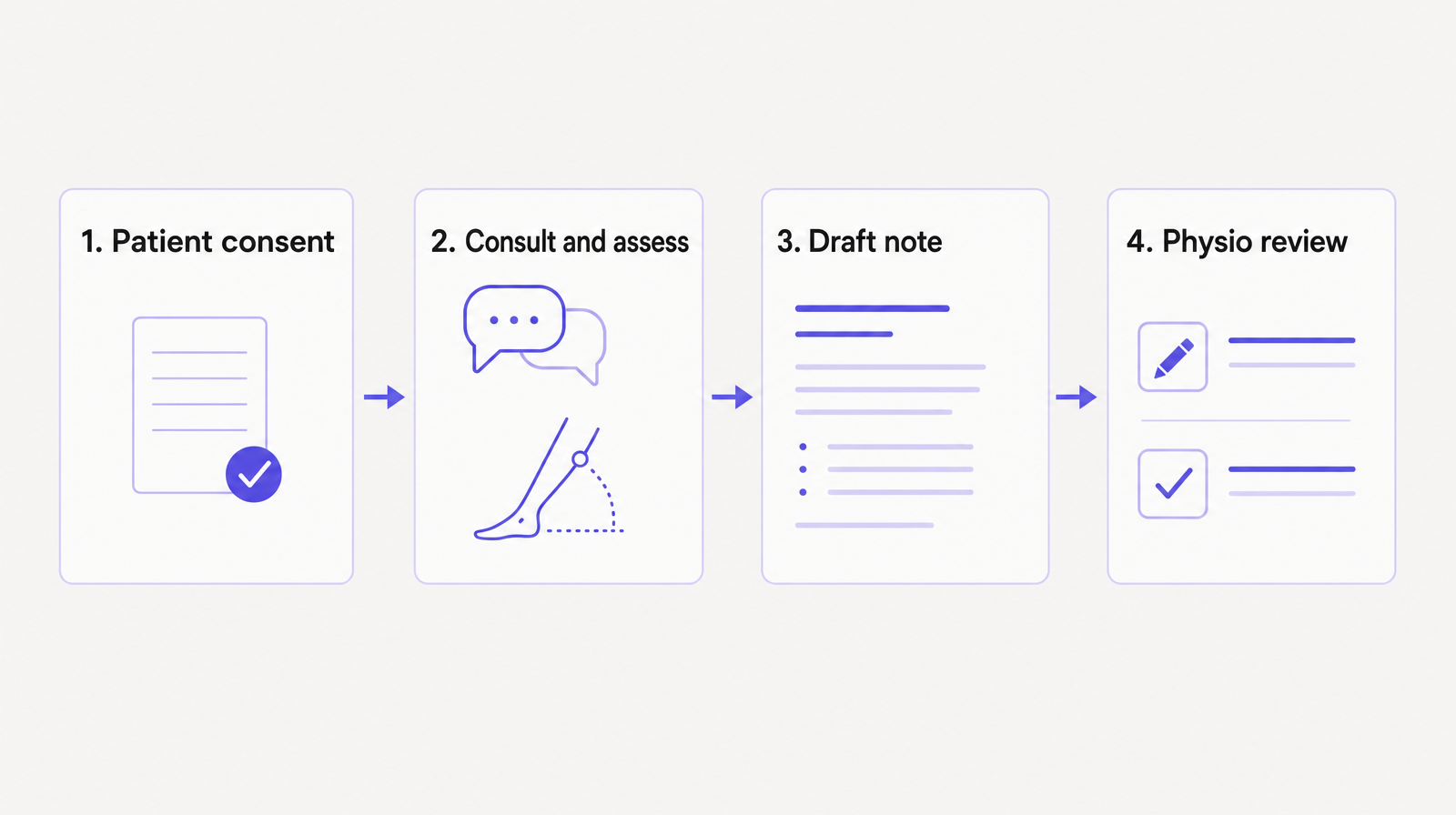
The practical workflow is:
- Explain the tool and obtain the patient's consent.
- Capture the consultation, dictate a summary or combine both methods.
- Generate a structured draft in the clinic's preferred format.
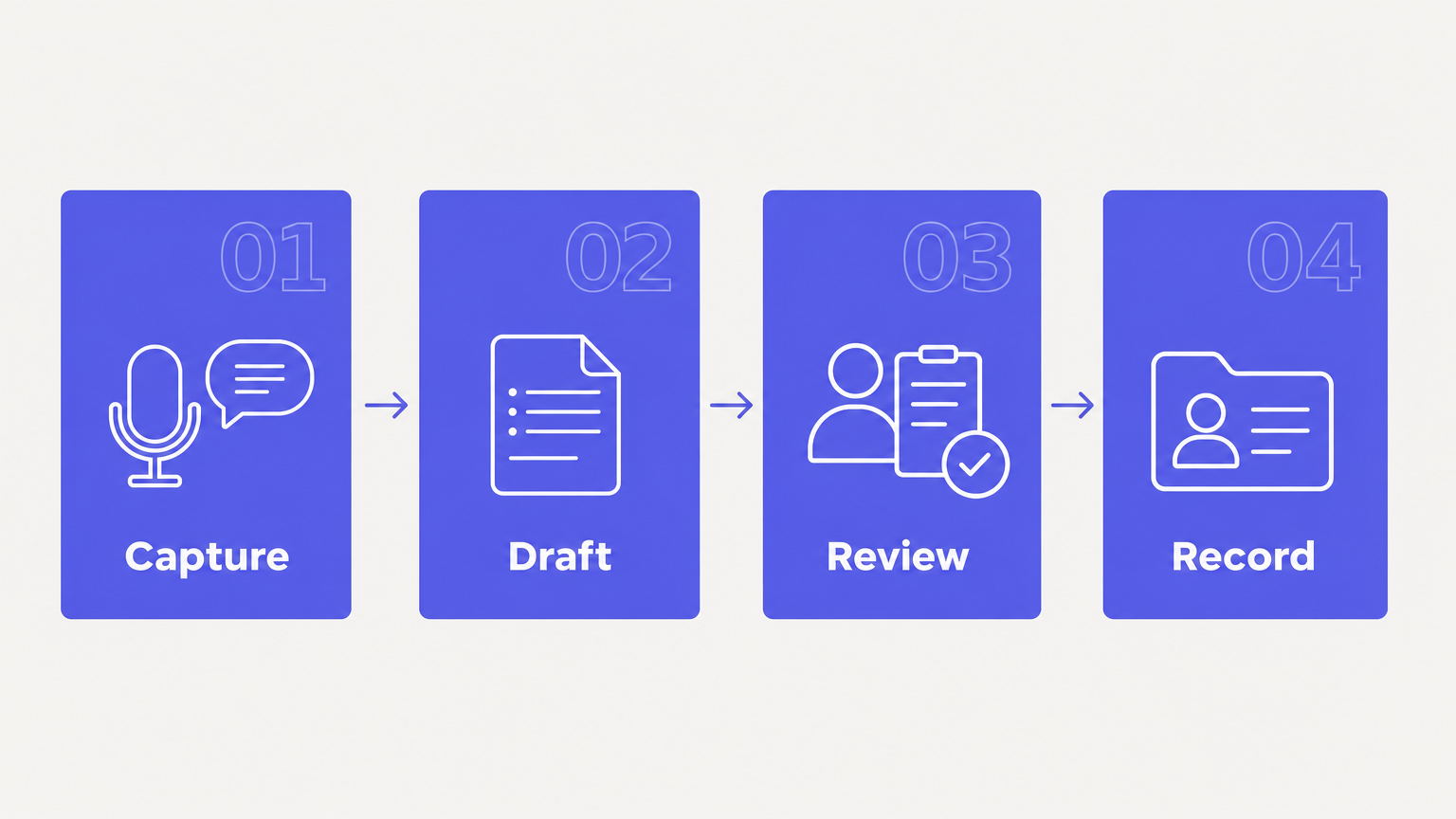
- Add findings the tool could not capture, correct and sign off the draft, then transfer the reviewed note to the patient record.
Why physiotherapy documentation needs a hybrid workflow
An ambient scribe can capture what is said, but much of a physiotherapy examination is not spoken. A patient may move differently under load. A joint angle may be measured silently. The physiotherapist may grade strength, observe gait or respond to a change in pain during an exercise. Previous imaging, outcome measures and information already in the record may not be part of the conversation either.
Those details need to be added deliberately. Non-verbal cues, device data and information from existing records can sit outside a spoken encounter, as outlined in the RACGP's Australian AI-scribe guidance. For physiotherapy, that makes a hybrid approach useful:
- Ambient capture can draft the history, goals, education and spoken parts of the assessment.
- Brief dictation can add objective measures, movement observations, treatment response and clinical reasoning.
- Typed additions let the physiotherapist enter verified details from external documents, standardised scores or information that should not be spoken in a shared space.
For example, a consultation may capture the patient's report that stairs are becoming easier. After the examination, the physiotherapist can dictate the measured range of motion, strength grade, exercise dosage and response. If the tool supports the clinic's template, it can organise those inputs into a SOAP note, but it should not infer a measurement or assessment that was never supplied.
The capture method should also fit the setting. A private treatment room, open gym, home visit and telehealth appointment have different acoustics and privacy risks. A clinic should test microphones and background noise with synthetic scenarios before using the tool with patients.
What a physio AI scribe can help draft
A useful scribe organises clinician-supplied information into the formats the practice actually uses, such as:
- initial assessment notes
- SOAP notes and follow-up notes
- progress and discharge notes
- referral updates and letters to other clinicians
- insurer, workplace or funding reports
- patient letters and exercise summaries
- supported forms populated from reviewed information
The output still needs the physiotherapist's judgement. A draft exercise summary should contain only the exercises and instructions the clinician selected. The clinician must separately verify any funding or billing requirements; a drafted report does not establish compliance.
For physiotherapy services claimed under MBS item 10960, the provider must give the referring medical practitioner a written report if the service is the only, first or last service under the referral, or if another service raises matters the referrer would reasonably expect to be informed about. This does not apply to every physiotherapy appointment.
Eight questions to ask before choosing an AI scribe
The best AI scribe for a physiotherapy practice is the one that produces safe, usable drafts within the clinic's real workflow. A polished demo is not enough.
| Question | What good looks like |
|---|---|
| 1. Does it produce usable physiotherapy notes? | Test initial assessments and follow-ups with the clinic's terminology, objective measures and functional goals. Count meaningful corrections after generation. |
| 2. Can it use your templates? | The tool supports the clinic's note headings, document formats, preferred level of detail and discipline-specific language without hiding required information. |
| 3. Can it combine capture methods? | Physiotherapists can move between ambient capture, post-consult dictation and typed additions rather than relying on one mode. |
| 4. How does the note reach the patient record? | Confirm whether the handoff is direct write-back, a browser extension or manual transfer. Test patient matching, clinician review and safeguards against transferring a note to the wrong record; confirm support for your exact system and version. |
| 5. How is patient information handled? | The vendor clearly explains where patient data is collected, stored and processed; how long it is retained; how it is deleted; who can access it; which outside service providers (subprocessors) are involved; what security controls apply; and whether the data is used for model training. |
| 6. What review controls exist? | The draft is editable, nothing is treated as final without clinician approval, and the clinic can report errors or incidents. |
| 7. What evidence and support are available? | Evidence matches the setting and measures useful outcomes. Training, implementation help and a responsive support process are available. |
| 8. What is the total cost? | Include subscription fees, setup, integration, staff training, editing time and transfer to the patient record. A cheaper tool can cost more if each note needs extensive repair. |
Be precise about integration claims. "Works with" can mean direct write-back, a browser extension or manual copy and paste. Ask the vendor to demonstrate the exact workflow in the version of the record system your clinic uses.
Safe implementation in an Australian physiotherapy clinic
Build consent into the consultation
Health information is sensitive information under the Privacy Act. Private physiotherapy providers are covered regardless of turnover; public-sector services may be governed by jurisdiction-specific law. For a covered organisation, privacy duties apply to personal information in AI inputs and outputs. Collecting or generating sensitive information usually requires consent unless an exception applies. When consent is relied on, it must be informed, current and specific, and notice alone does not create consent. The OAIC's AI privacy guidance explains these duties.
Before using an AI scribe, explain in plain language:
- what the tool will capture and why
- whether audio or transcripts are retained, and for how long
- where information is stored or processed and who can access it
- whether service providers or subprocessors are involved
- whether information is used to train models
- that the output is a draft the physiotherapist will review
- what will happen if the patient declines or withdraws consent
Before an ambient scribe records a consultation, explain its use, obtain and document the informed consent required for the setting. Written consent is not a universal national requirement. Have a normal note-taking or post-consult dictation process available if the patient declines. The required form of consent, and the privacy, surveillance-device and health record rules that apply, can vary by jurisdiction and setting; clinics should confirm their local obligations.
Keep the physiotherapist in control of the final record
The shared Code of conduct adopted by the Physiotherapy Board of Australia requires physiotherapists' records to be accurate, up to date, factual, objective, legible and secure, and to support continuity of care. These requirements apply whether a note is typed, dictated or drafted with AI.
Review each draft as soon as practical. Check for:
- omitted findings or management decisions
- unsupported statements that were not said or observed
- contradictions between sections
- wrong-speaker attribution
- incorrect measurements, laterality or time course
- generic wording that obscures the clinical reasoning
- information from the existing record that still needs to be reconciled
The Australian Commission on Safety and Quality in Health Care's ambient-scribe scenario identifies hallucination, omission, over-summarisation and bias. Only the corrected, clinician-authorised version should become part of the record.
Use clinic-level governance
A clinic policy should name the tools staff may use, the approved settings, the consent process and the required review. It should also cover access controls, privacy incidents, clinical errors, outages, staff training and the fallback process when the scribe fails.
After launch, periodically review a sample of notes, monitor incidents and revisit the vendor's privacy terms and product changes. A tool can become unsuitable if its data handling, workflow or output changes after a successful pilot.
What the Australian evidence shows
Direct Australian evidence for physiotherapy and allied health remains limited.
A 2025 mixed-methods study in one Australian private allied health organisation included 119 allied health professionals and 157 patients. Physiotherapists made up 76% of the professional sample. At six weeks and three months, allied health professionals reported spending less time on notes, letters and out-of-hours documentation than at baseline, and the study reported a 5.8% average increase in productivity. The study used a voluntary convenience sample from one organisation, had no control group, relied on clinician-reported documentation time and followed participants for three months, so the associations may not generalise to every clinic. Read the peer-reviewed study in Musculoskeletal Science and Practice.
A 2026 Australian public-hospital allied health study included 97 clinician survey responses and 27 interviews. Twenty survey respondents and five interviewees were physiotherapists. Adopters reported improved workflow and patient focus. Some found customisation difficult, and clinicians described omissions, hallucinations, terminology errors and wrong-speaker attribution. The study measured acceptance and perceived effects rather than objective note accuracy or time saved. Read the peer-reviewed allied health study.
A separate 2026 Gold Coast evaluation followed 100 outpatient clinicians who received trial licences and used the scribe in 7,499 consultations across 19 specialties. In 21 AI-generated and final note pairs, median text overlap was 58%; this small utility analysis did not show that 58% of whole notes required no edits. Among 43 staff survey respondents, 47% reported having observed at least one hallucination. Medical officers were the study focus, so this was not a physiotherapy or allied health study. The full evaluation is available in BMC Health Services Research.
Because results vary with the product, templates, consultation type, integration and review process, clinics should run a careful local trial before wider rollout.
Run a two-week trial before a clinic-wide rollout
A short, structured trial can show whether a tool fits the practice better than a sales demonstration.
- Choose representative workflows. Include initial assessments, follow-ups, telehealth and at least one document workflow. Use a safe test environment before any patient use.
- Agree on consent and fallback. Give staff one plain-language process and a manual alternative.
- Configure templates. Start with the note and document formats clinicians already use rather than redesigning every workflow at once.
- Record a baseline. Measure current documentation and patient-record transfer time for the same consultation types.
- Start with a small group. Train a few clinicians and give them a clear support and incident path.
- Review every draft. During the pilot, record clinically meaningful corrections as well as minor style edits.
- Measure the whole workflow. Compare total time after editing, not generation speed alone.
- Assess the results against pre-set thresholds. Expand only if note quality, privacy, consent and workflow measures meet the clinic's standard.
A useful scorecard records:
- minutes from the end of the consult to the approved note
- clinically meaningful omissions, unsupported statements and contradictions
- whether objective findings and clinical reasoning are complete
- patient-record transfer steps and duplicate entry
- consent refusals or questions
- clinician and patient feedback
- privacy, security or clinical incidents
- vendor support response time
Keep monitoring after the trial. New templates, staff, consultation types and product changes can alter performance.
How Lyrebird can fit a physiotherapy workflow
Lyrebird is our clinical AI platform for allied health and broader clinical workflows, including physiotherapy. Our clinical notes workflow can combine ambient consult capture, clinician dictation and typed context into a structured draft. Physiotherapists can use SOAP, progress-note or custom formats, then review, edit and sign off the result.
Lyrebird can use a clinical note to generate draft referrals, certificates, reports and forms. Our custom note and document templates can preserve the clinic's structure, but clinicians should review each generated output before use. Supported integrations vary, so check our current integration catalogue for your exact record system and use a reviewed transfer workflow if direct integration is unavailable.
Lyrebird was explicitly named in the private allied health study. Official Queensland project materials identify Lyrebird as the platform used in the two Gold Coast evaluations, although neither Gold Coast journal article names the vendor. The studies reported benefits and limitations. They do not remove the need for patient consent, local validation or clinician review.
Clinical judgement stays with the physiotherapist. The value of the scribe is a clearer starting point for the record and the documents that follow.
Create a free account to test note and document drafts, or book a demo to discuss your clinic's templates and patient-record handoff.