Education
5 min read

Clinical Notes AI vs Lyrebird: An Australian Clinician's Guide
Published on
September 16, 2026
Contributors
Lyrebird Health
Subscribe to our newsletter
Read about our privacy policy.
Thank you! Your submission has been received!
Oops! Something went wrong while submitting the form.

Clinical notes AI can reduce the time clinicians spend drafting patient records, but product fit depends on far more than transcription. Clinical Notes AI is also the name of a US platform focused on behavioural health. Australian clinicians weighing that service against Lyrebird need a clear view of clinical fit, capture methods, integrations, data handling, pricing and output safety. Lyrebird is built for Australian clinical workflows. Here is where each platform fits, followed by a practical process for reviewing and introducing AI-generated notes.

First, clinical notes AI is a category and a product name

As a category, clinical notes AI is software that prepares clinical documentation from information captured during or after a consult. It is also called an AI medical scribe, ambient AI scribe, digital scribe or AI note generator.

Most tools combine two systems:

  1. Speech recognition turns spoken words into a transcript.
  2. Generative AI selects and organises relevant information into a draft clinical note, such as a SOAP note, progress note or specialty-specific template.

Clinical Notes AI, with capital letters, is a product from US company Clinically AI. It is designed primarily for behavioural health and integrated care organisations. Lyrebird is a broader clinical AI platform for Australian clinicians and health services. It creates draft notes and also supports letters, certificates, care plans and other clinical documents.

Both products create drafts. The clinician remains responsible for clinical reasoning, corrections and final sign-off. The Royal Australian College of General Practitioners (RACGP) makes the same distinction in its AI scribe guidance: an AI scribe can prepare documentation, while the clinician remains responsible for an accurate, current patient record.

Three ways to create an AI clinical note

The input method changes what a tool can capture and where the clinician needs to add context.

Input method How it works Best suited to
Ambient capture Processes the clinical conversation as it happens Consults where the discussion carries most of the history, assessment and plan
Dictation Structures a clinician's focused spoken summary Short consults, procedures, telehealth and controlled source narratives
Typed notes Structures key points entered by the clinician Consults where recording is unsuitable or the patient declines ambient capture

Lyrebird's clinical notes platform supports all three methods in the same record. Clinical Notes AI supports ambient capture and dictation, including telehealth capture. That distinction matters when a practice wants one workflow to cover conversations, post-consult summaries and consults where audio capture is unsuitable.

Lyrebird vs Clinical Notes AI for Australian practice

A useful comparison applies the same criteria to both tools: intended clinical setting, capture options, documentation workflow, record integration, data governance and total plan fit.

Criterion Lyrebird Clinical Notes AI Why it matters in Australia
Primary clinical fit Australian general practice, specialists, allied health and hospital workflows US behavioural health, addiction treatment, human services and integrated care workflows Templates, terminology, documents and implementation support should match the work a team performs
Capture options Ambient capture, dictation and typed notes can be combined in one record Ambient live sessions and post-session dictation, with capture for in-person and telehealth encounters Mixed capture gives the clinician a fallback when recording is unsuitable and a way to add unspoken context
Outputs Custom clinical notes plus letters, certificates, care plans, assessments and documents created from the same consult Custom notes tied to treatment plans, individual notes from group sessions and other clinical documents The relevant measure is the full documentation workflow, rather than note generation alone
Record integration Direct Bp Premier write-back, integrations with Genie and Gentu, workflows with BetterConsult and Cubiko, plus FHIR, HL7 v2 and SMART on FHIR pathways Browser-based EHR workflow through a Chrome extension, 16 supported EHRs and optional API integrations Named integration depth determines whether staff still re-enter patient context or copy approved notes manually
Data governance Personal information is stored in Australia. De-identified health information may be processed in the European Union through Azure OpenAI. Consult audio is deleted after transcription by default All data is stored in the United States. Its privacy policy permits de-identified personal or health information to be used for model training and shared with selected partners for model development Australian practices need a complete view of storage, processing, retention and secondary use, alongside security certifications
Published individual plans Lyrebird Free plan: 50 consult-note actions and 10 document actions a month. Bp Free: unlimited notes for eligible Bp Premier users. Pro: $160 a month billed annually Clinical Notes AI Free: 10 dictation credits a week, 10 live-session credits and two document credits. Paid plans display $20, $40 and $60 a month without naming the currency. Enterprise is quote-based A low headline price has limited value if the plan excludes the required volume, documents, integration or governance controls

For Australian teams that need three capture methods in one consult, Australian clinical document workflows, the named local practice integrations and personal-information storage in Australia, Lyrebird is the stronger fit. Clinical Notes AI may suit a US behavioural health organisation that places more weight on treatment-plan-linked documentation, group-note generation and US EHR workflows.

Clinical Notes AI's HIPAA controls, Business Associate Agreements and SOC 2 Type II certification are relevant to its US market. They do not establish Australian data residency or local-system integration.

Two details deserve a closer look

Integration depth

“Integrates with your record” can mean opening alongside the record, launching with patient context, writing an approved note to the correct file, or reading from and writing to the record. Each level removes a different amount of re-entry.

Lyrebird supports patient-context launch and note write-back across several EMR integration pathways, including direct Bp Premier write-back and patient-context workflows with Genie and Gentu. Clinical Notes AI uses a Chrome extension for browser-based EHRs and offers API, FTP and extension-based integration. Its published integration material does not name Bp Premier, Genie, Gentu, Cubiko or BetterConsult.

Data location, retention and model training

Data residency, retention and model training are separate questions. A “zero data retention” setting can apply to audio and generated content while de-identified data follows different rules.

Under Lyrebird's privacy policy, personal information, application databases, transcripts, speech processing and encrypted backups remain stored in Australia. De-identified health information may be processed in the European Union through Azure OpenAI. Consult audio is deleted after transcription by default, with a six-month maximum when retention is enabled. Lyrebird does not use patient data to train external AI models.

Clinical Notes AI stores data in the United States. Its default zero-retention approach deletes audio and text after note creation. Saved documentation is removed from its systems within 14 days. Its privacy policy permits collected personal or protected health information to be de-identified and used to train its models, including disclosure to selected business partners for model development.

The RACGP advises practices to examine encryption, storage, destruction, overseas processing and secondary data use as part of procurement. For an Australian team, Lyrebird provides the more direct match where local storage of personal information and Australian implementation are decision criteria.

How AI turns a consult into a clinical note

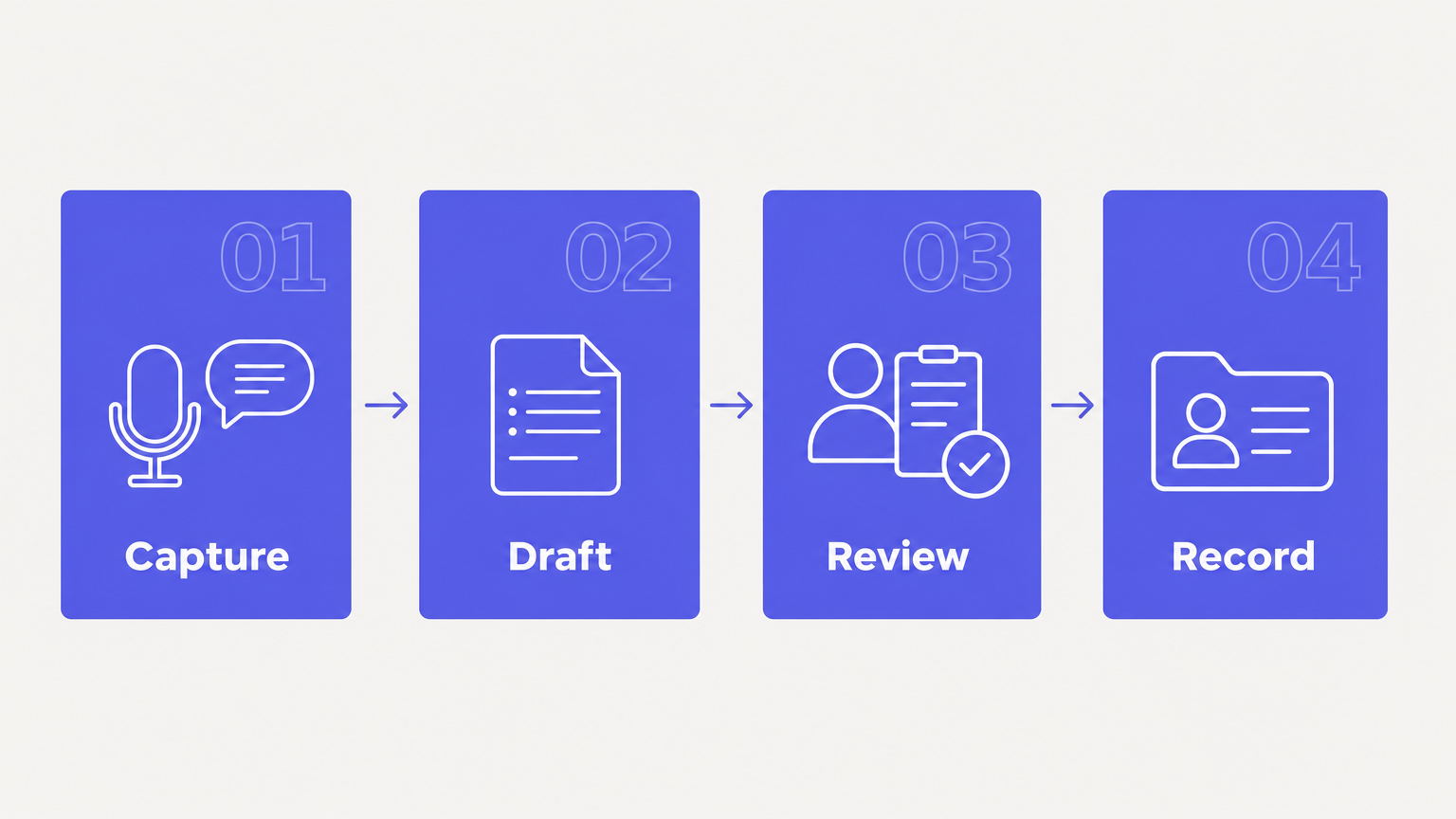
Whichever tool a practice selects, a sound clinical workflow has four distinct stages:

  1. Capture: the clinician starts an ambient consult, dictates a summary or types key information.
  2. Draft: the software converts speech to text, identifies clinical content and organises it under the selected template.
  3. Review: the clinician compares the draft with the encounter, adds observations and record context, corrects errors and removes irrelevant content.
  4. Record: the clinician approves the note and saves it to the correct patient file through write-back or the practice's established workflow.

Four-stage clinical notes AI workflow: capture, draft, review and record

An ambient scribe can only work from the information available to it. A gait change observed during the consult, an imaging result opened silently in the record or a diagnosis considered privately will not reliably appear unless the clinician adds it. A connected system may supply more patient context. Clinical judgement still belongs to the clinician.

What a good AI-generated clinical note looks like

A polished note can still be wrong. Quality comes from fidelity to the encounter and usefulness to the next person who reads the record.

Consider this synthetic allied health example:

Three weeks of right lateral elbow pain after pruning. No trauma. Worse with gripping. No numbness. Full elbow range of motion, lateral epicondyle tender and pain reproduced with resisted wrist extension. Discussed activity modification and a graded exercise program. Review in two weeks; earlier review if weakness or numbness develops.

A useful draft could structure those facts like this:

Subjective

  • Three-week history of right lateral elbow pain beginning after pruning
  • Worse with gripping
  • No trauma or numbness reported

Objective

  • Full right elbow range of motion
  • Tenderness over lateral epicondyle
  • Pain reproduced with resisted wrist extension

Assessment

  • Right lateral elbow pain, with clinical findings recorded above

Plan

  • Discussed activity modification and a graded exercise program
  • Review in two weeks
  • Earlier review if weakness or numbness develops

The draft preserves laterality, timing, relevant negatives and the plan without inventing a diagnosis. It also separates the patient's report from observed findings. Lyrebird's SOAP note guide explains each section.

Use five checks before sign-off

A useful evaluation separates draft-note quality into five dimensions because a single accuracy score can hide very different problems. The same framework gives clinicians a repeatable review sequence.

1. Unsupported content

Does the draft contain a symptom, diagnosis, medicine, investigation, social detail or plan that was absent from the consult and available record context? Fluent sentences that sound clinically plausible deserve close attention because unsupported content can still read cleanly.

2. Incorrect content

Confirm facts where a small difference changes meaning: medicine name, dose and frequency; allergy status; side and site; dates and duration; measurements; safety-critical positives and negatives; and follow-up timing.

Contradictions deserve particular attention. “No chest pain” and “reports chest pain” differ by one word and lead the record in opposite directions.

3. Omissions

Look for clinically relevant information that was discussed but is missing. Common gaps include red flags, an important negative, examination findings, the rationale for a decision, safety-netting and the party responsible for follow-up.

4. Irrelevant inclusions

Remove detail that does not help continuity of care, clinical reasoning or the required administrative purpose. Longer notes can make important facts harder to find.

5. Formatting problems

Make sure information sits under the correct heading, the chronology is clear and the final note matches the discipline's documentation style. A structurally neat draft can still misclassify a historical condition as current or place a patient report under objective findings.

Lyrebird's clinical note evaluation framework separates hallucinations, accuracy errors, omissions, irrelevant inclusions and formatting issues so each failure type can be counted and improved.

What the evidence says about AI clinical notes

Clinical notes AI is valuable when it supports patient attention, timely records and less after-hours documentation. Draft quality still has to hold up under clinical review.

A 16-week Gold Coast Hospital and Health Service evaluation covered 100 clinicians, 19 outpatient specialties and 7,499 consultations. Analysis of 21 AI-generated and final note pairs found that clinicians used an average of 58% of the AI-generated text verbatim in the final record. In a separate quality assessment, one senior clinician scored 18 matched pairs of unedited AI-generated notes and clinician-created notes using a modified Physician Documentation Quality Instrument. AI-generated notes scored 37.06 out of 40, compared with 34.56 for clinician-created notes. The AI drafts scored higher for thoroughness and organisation, while clinician-created notes scored slightly higher for accuracy.

The limitations matter. Among 43 staff survey respondents, 47% reported seeing a hallucination at least once during the trial. The note-quality sample was small, the study came from one health service and performance varied by specialty. Good average performance and individual errors can exist at the same time. The peer-reviewed evaluation was funded by Gold Coast Hospital and Health Service, and its authors declared no competing interests.

A safe first-consult workflow

A first consult with an AI scribe should operate as a controlled documentation process.

Before capture

  • Use the approved account, device and template. Explain the AI scribe, obtain any consent required for the workflow and record it.
  • Keep the established documentation fallback available if capture fails or the patient declines.

During the consult

  • Keep attention on the patient. State relevant examination findings, reasoning, plans and safety-netting aloud when they need to appear in the note.
  • Add typed or dictated information that the conversation does not contain.

Before sign-off

  • Review the whole draft while the encounter is fresh. Add non-verbal observations and relevant record context.
  • Apply the five checks, focusing on medicines, allergies, measurements, laterality, diagnoses, investigations and follow-up.
  • Approve the final note and save it to the correct patient file.

The Australian Health Practitioner Regulation Agency says clinicians should be transparent about AI use and involve patients in the decision when a tool uses their data. Informed consent is particularly important when a private conversation is recorded. Any consent required for the specific workflow should be obtained and recorded before capture. Lyrebird's patient consent guide explains the Australian considerations in detail.

The Therapeutic Goods Administration distinguishes a digital scribe that records or summarises information for independent clinician review from software that provides a therapeutic recommendation. The former is generally not a medical device. Added decision-support functions may change the regulatory position, as explained in the TGA digital scribe guidance.

Frequently asked questions

Is Clinical Notes AI the same as Lyrebird?

No. Clinical Notes AI is a US platform from Clinically AI with a primary focus on behavioural health. Lyrebird is an Australian clinical AI platform for notes and a broader set of clinical documents.

Is there free clinical notes AI?

Yes. Lyrebird's Free plan includes 50 consult-note actions and 10 document or letter actions each month. Eligible Bp Premier users can access unlimited notes through Bp Free. Clinical Notes AI also has a free plan, with 10 dictation credits a week, 10 live-session credits and two document credits.

Clinical notes AI should give clinicians a better starting point for the record while keeping judgement and sign-off in their hands. Lyrebird brings capture, clinical documents, Australian integrations and clear data handling into one clinical AI workflow.
Start for free

More Resources
Continue reading
Posts
The dangers of Copy Paste Scribes
Read More
Posts
How to use an AI medical scribe
Read More
Posts
December Product Updates
Read More
Education
Suki AI Pricing: Contract Costs and Australian Fit
Read More
Partnership
Lyrebird Health announces partnership with GPRA
Read More
Education
Nurse Practitioner MBS Item Numbers: A Practical 2026 Guide
Read More
Post
5 min read

Clinical Notes AI vs Lyrebird: An Australian Clinician's Guide

Published on
September 16, 2026
Contributors
Lyrebird Health
Subscribe to our newsletter
Read about our privacy policy.
Thank you! Your submission has been received!
Oops! Something went wrong while submitting the form.

Clinical notes AI can reduce the time clinicians spend drafting patient records, but product fit depends on far more than transcription. Clinical Notes AI is also the name of a US platform focused on behavioural health. Australian clinicians weighing that service against Lyrebird need a clear view of clinical fit, capture methods, integrations, data handling, pricing and output safety. Lyrebird is built for Australian clinical workflows. Here is where each platform fits, followed by a practical process for reviewing and introducing AI-generated notes.

First, clinical notes AI is a category and a product name

As a category, clinical notes AI is software that prepares clinical documentation from information captured during or after a consult. It is also called an AI medical scribe, ambient AI scribe, digital scribe or AI note generator.

Most tools combine two systems:

  1. Speech recognition turns spoken words into a transcript.
  2. Generative AI selects and organises relevant information into a draft clinical note, such as a SOAP note, progress note or specialty-specific template.

Clinical Notes AI, with capital letters, is a product from US company Clinically AI. It is designed primarily for behavioural health and integrated care organisations. Lyrebird is a broader clinical AI platform for Australian clinicians and health services. It creates draft notes and also supports letters, certificates, care plans and other clinical documents.

Both products create drafts. The clinician remains responsible for clinical reasoning, corrections and final sign-off. The Royal Australian College of General Practitioners (RACGP) makes the same distinction in its AI scribe guidance: an AI scribe can prepare documentation, while the clinician remains responsible for an accurate, current patient record.

Three ways to create an AI clinical note

The input method changes what a tool can capture and where the clinician needs to add context.

Input method How it works Best suited to
Ambient capture Processes the clinical conversation as it happens Consults where the discussion carries most of the history, assessment and plan
Dictation Structures a clinician's focused spoken summary Short consults, procedures, telehealth and controlled source narratives
Typed notes Structures key points entered by the clinician Consults where recording is unsuitable or the patient declines ambient capture

Lyrebird's clinical notes platform supports all three methods in the same record. Clinical Notes AI supports ambient capture and dictation, including telehealth capture. That distinction matters when a practice wants one workflow to cover conversations, post-consult summaries and consults where audio capture is unsuitable.

Lyrebird vs Clinical Notes AI for Australian practice

A useful comparison applies the same criteria to both tools: intended clinical setting, capture options, documentation workflow, record integration, data governance and total plan fit.

Criterion Lyrebird Clinical Notes AI Why it matters in Australia
Primary clinical fit Australian general practice, specialists, allied health and hospital workflows US behavioural health, addiction treatment, human services and integrated care workflows Templates, terminology, documents and implementation support should match the work a team performs
Capture options Ambient capture, dictation and typed notes can be combined in one record Ambient live sessions and post-session dictation, with capture for in-person and telehealth encounters Mixed capture gives the clinician a fallback when recording is unsuitable and a way to add unspoken context
Outputs Custom clinical notes plus letters, certificates, care plans, assessments and documents created from the same consult Custom notes tied to treatment plans, individual notes from group sessions and other clinical documents The relevant measure is the full documentation workflow, rather than note generation alone
Record integration Direct Bp Premier write-back, integrations with Genie and Gentu, workflows with BetterConsult and Cubiko, plus FHIR, HL7 v2 and SMART on FHIR pathways Browser-based EHR workflow through a Chrome extension, 16 supported EHRs and optional API integrations Named integration depth determines whether staff still re-enter patient context or copy approved notes manually
Data governance Personal information is stored in Australia. De-identified health information may be processed in the European Union through Azure OpenAI. Consult audio is deleted after transcription by default All data is stored in the United States. Its privacy policy permits de-identified personal or health information to be used for model training and shared with selected partners for model development Australian practices need a complete view of storage, processing, retention and secondary use, alongside security certifications
Published individual plans Lyrebird Free plan: 50 consult-note actions and 10 document actions a month. Bp Free: unlimited notes for eligible Bp Premier users. Pro: $160 a month billed annually Clinical Notes AI Free: 10 dictation credits a week, 10 live-session credits and two document credits. Paid plans display $20, $40 and $60 a month without naming the currency. Enterprise is quote-based A low headline price has limited value if the plan excludes the required volume, documents, integration or governance controls

For Australian teams that need three capture methods in one consult, Australian clinical document workflows, the named local practice integrations and personal-information storage in Australia, Lyrebird is the stronger fit. Clinical Notes AI may suit a US behavioural health organisation that places more weight on treatment-plan-linked documentation, group-note generation and US EHR workflows.

Clinical Notes AI's HIPAA controls, Business Associate Agreements and SOC 2 Type II certification are relevant to its US market. They do not establish Australian data residency or local-system integration.

Two details deserve a closer look

Integration depth

“Integrates with your record” can mean opening alongside the record, launching with patient context, writing an approved note to the correct file, or reading from and writing to the record. Each level removes a different amount of re-entry.

Lyrebird supports patient-context launch and note write-back across several EMR integration pathways, including direct Bp Premier write-back and patient-context workflows with Genie and Gentu. Clinical Notes AI uses a Chrome extension for browser-based EHRs and offers API, FTP and extension-based integration. Its published integration material does not name Bp Premier, Genie, Gentu, Cubiko or BetterConsult.

Data location, retention and model training

Data residency, retention and model training are separate questions. A “zero data retention” setting can apply to audio and generated content while de-identified data follows different rules.

Under Lyrebird's privacy policy, personal information, application databases, transcripts, speech processing and encrypted backups remain stored in Australia. De-identified health information may be processed in the European Union through Azure OpenAI. Consult audio is deleted after transcription by default, with a six-month maximum when retention is enabled. Lyrebird does not use patient data to train external AI models.

Clinical Notes AI stores data in the United States. Its default zero-retention approach deletes audio and text after note creation. Saved documentation is removed from its systems within 14 days. Its privacy policy permits collected personal or protected health information to be de-identified and used to train its models, including disclosure to selected business partners for model development.

The RACGP advises practices to examine encryption, storage, destruction, overseas processing and secondary data use as part of procurement. For an Australian team, Lyrebird provides the more direct match where local storage of personal information and Australian implementation are decision criteria.

How AI turns a consult into a clinical note

Whichever tool a practice selects, a sound clinical workflow has four distinct stages:

  1. Capture: the clinician starts an ambient consult, dictates a summary or types key information.
  2. Draft: the software converts speech to text, identifies clinical content and organises it under the selected template.
  3. Review: the clinician compares the draft with the encounter, adds observations and record context, corrects errors and removes irrelevant content.
  4. Record: the clinician approves the note and saves it to the correct patient file through write-back or the practice's established workflow.

Four-stage clinical notes AI workflow: capture, draft, review and record

An ambient scribe can only work from the information available to it. A gait change observed during the consult, an imaging result opened silently in the record or a diagnosis considered privately will not reliably appear unless the clinician adds it. A connected system may supply more patient context. Clinical judgement still belongs to the clinician.

What a good AI-generated clinical note looks like

A polished note can still be wrong. Quality comes from fidelity to the encounter and usefulness to the next person who reads the record.

Consider this synthetic allied health example:

Three weeks of right lateral elbow pain after pruning. No trauma. Worse with gripping. No numbness. Full elbow range of motion, lateral epicondyle tender and pain reproduced with resisted wrist extension. Discussed activity modification and a graded exercise program. Review in two weeks; earlier review if weakness or numbness develops.

A useful draft could structure those facts like this:

Subjective

  • Three-week history of right lateral elbow pain beginning after pruning
  • Worse with gripping
  • No trauma or numbness reported

Objective

  • Full right elbow range of motion
  • Tenderness over lateral epicondyle
  • Pain reproduced with resisted wrist extension

Assessment

  • Right lateral elbow pain, with clinical findings recorded above

Plan

  • Discussed activity modification and a graded exercise program
  • Review in two weeks
  • Earlier review if weakness or numbness develops

The draft preserves laterality, timing, relevant negatives and the plan without inventing a diagnosis. It also separates the patient's report from observed findings. Lyrebird's SOAP note guide explains each section.

Use five checks before sign-off

A useful evaluation separates draft-note quality into five dimensions because a single accuracy score can hide very different problems. The same framework gives clinicians a repeatable review sequence.

1. Unsupported content

Does the draft contain a symptom, diagnosis, medicine, investigation, social detail or plan that was absent from the consult and available record context? Fluent sentences that sound clinically plausible deserve close attention because unsupported content can still read cleanly.

2. Incorrect content

Confirm facts where a small difference changes meaning: medicine name, dose and frequency; allergy status; side and site; dates and duration; measurements; safety-critical positives and negatives; and follow-up timing.

Contradictions deserve particular attention. “No chest pain” and “reports chest pain” differ by one word and lead the record in opposite directions.

3. Omissions

Look for clinically relevant information that was discussed but is missing. Common gaps include red flags, an important negative, examination findings, the rationale for a decision, safety-netting and the party responsible for follow-up.

4. Irrelevant inclusions

Remove detail that does not help continuity of care, clinical reasoning or the required administrative purpose. Longer notes can make important facts harder to find.

5. Formatting problems

Make sure information sits under the correct heading, the chronology is clear and the final note matches the discipline's documentation style. A structurally neat draft can still misclassify a historical condition as current or place a patient report under objective findings.

Lyrebird's clinical note evaluation framework separates hallucinations, accuracy errors, omissions, irrelevant inclusions and formatting issues so each failure type can be counted and improved.

What the evidence says about AI clinical notes

Clinical notes AI is valuable when it supports patient attention, timely records and less after-hours documentation. Draft quality still has to hold up under clinical review.

A 16-week Gold Coast Hospital and Health Service evaluation covered 100 clinicians, 19 outpatient specialties and 7,499 consultations. Analysis of 21 AI-generated and final note pairs found that clinicians used an average of 58% of the AI-generated text verbatim in the final record. In a separate quality assessment, one senior clinician scored 18 matched pairs of unedited AI-generated notes and clinician-created notes using a modified Physician Documentation Quality Instrument. AI-generated notes scored 37.06 out of 40, compared with 34.56 for clinician-created notes. The AI drafts scored higher for thoroughness and organisation, while clinician-created notes scored slightly higher for accuracy.

The limitations matter. Among 43 staff survey respondents, 47% reported seeing a hallucination at least once during the trial. The note-quality sample was small, the study came from one health service and performance varied by specialty. Good average performance and individual errors can exist at the same time. The peer-reviewed evaluation was funded by Gold Coast Hospital and Health Service, and its authors declared no competing interests.

A safe first-consult workflow

A first consult with an AI scribe should operate as a controlled documentation process.

Before capture

  • Use the approved account, device and template. Explain the AI scribe, obtain any consent required for the workflow and record it.
  • Keep the established documentation fallback available if capture fails or the patient declines.

During the consult

  • Keep attention on the patient. State relevant examination findings, reasoning, plans and safety-netting aloud when they need to appear in the note.
  • Add typed or dictated information that the conversation does not contain.

Before sign-off

  • Review the whole draft while the encounter is fresh. Add non-verbal observations and relevant record context.
  • Apply the five checks, focusing on medicines, allergies, measurements, laterality, diagnoses, investigations and follow-up.
  • Approve the final note and save it to the correct patient file.

The Australian Health Practitioner Regulation Agency says clinicians should be transparent about AI use and involve patients in the decision when a tool uses their data. Informed consent is particularly important when a private conversation is recorded. Any consent required for the specific workflow should be obtained and recorded before capture. Lyrebird's patient consent guide explains the Australian considerations in detail.

The Therapeutic Goods Administration distinguishes a digital scribe that records or summarises information for independent clinician review from software that provides a therapeutic recommendation. The former is generally not a medical device. Added decision-support functions may change the regulatory position, as explained in the TGA digital scribe guidance.

Frequently asked questions

Is Clinical Notes AI the same as Lyrebird?

No. Clinical Notes AI is a US platform from Clinically AI with a primary focus on behavioural health. Lyrebird is an Australian clinical AI platform for notes and a broader set of clinical documents.

Is there free clinical notes AI?

Yes. Lyrebird's Free plan includes 50 consult-note actions and 10 document or letter actions each month. Eligible Bp Premier users can access unlimited notes through Bp Free. Clinical Notes AI also has a free plan, with 10 dictation credits a week, 10 live-session credits and two document credits.

Clinical notes AI should give clinicians a better starting point for the record while keeping judgement and sign-off in their hands. Lyrebird brings capture, clinical documents, Australian integrations and clear data handling into one clinical AI workflow.

Start for free

Keep reading

All posts
Questions about compliance?