Education
5 min read

Suki AI Pricing: Contract Costs and Australian Fit
Published on
September 18, 2026
Contributors
Lyrebird Health
Subscribe to our newsletter
Read about our privacy policy.
Thank you! Your submission has been received!
Oops! Something went wrong while submitting the form.

AI scribe subscriptions are hard to compare when one price covers note drafting and another includes EHR integration, coding or order staging. Contract length, implementation and data handling can change the real cost further. For an Australian clinic evaluating Suki, the buying decision needs a line-by-line quote and clear local evidence. Lyrebird Health publishes this guide and is included as an alternative. The comparison applies the same public fields to both vendors: pricing and entry path, documentation scope, integrations, standard contract position, privacy and data handling, and evidence.

Suki AI pricing is available by quote

As at 17 September 2026, Suki does not publish a standard subscription price for Suki Compose, its broader clinician workflow features or Suki Dictation. Its public buying path leads to a sales conversation. Suki's service terms define an Order Form as the quote or document that sets the purchased subscriptions and pricing.

That makes the signed quote the reliable answer to how much Suki costs. Monthly figures on third-party directories may describe an earlier offer and should not be treated as a current price.

Pricing question Publicly confirmed position
Standard list price As at 17 September 2026, no standard per-user or per-month price is published.
Billing unit The Order Form sets the purchased subscriptions and pricing. The public terms do not define one universal billing unit.
Currency Fees are quoted and paid in US dollars unless the Order Form or statement of work says otherwise.
Payment and refunds The default invoice term is 30 days. Payment obligations are non-cancellable, partial months are not prorated and paid fees are non-refundable, unless another contract document changes those terms.
Taxes Published terms exclude applicable taxes from quoted fees.
Renewal An Order Form renews for the same duration unless either party gives at least 30 days' written notice, unless the Order Form states another arrangement.
Free access The iPhone app is free to download. Suki does not publish a standard free subscription or public trial offer.

Is Suki AI free?

As at 17 September 2026, the Australian App Store listing labels the iPhone app as free to download. That covers app acquisition, not access to a Suki subscription. The listing does not show in-app subscription prices, and Suki's public product pages direct prospective customers to sales.

A pilot may be negotiable. Its duration, included users, data handling, acceptance criteria and conversion to a paid term should be written into the proposal.

What the Suki quote should include

Suki markets several product scopes. A useful quote names the exact product and feature set rather than using “Suki” as one undifferentiated line item.

Suki

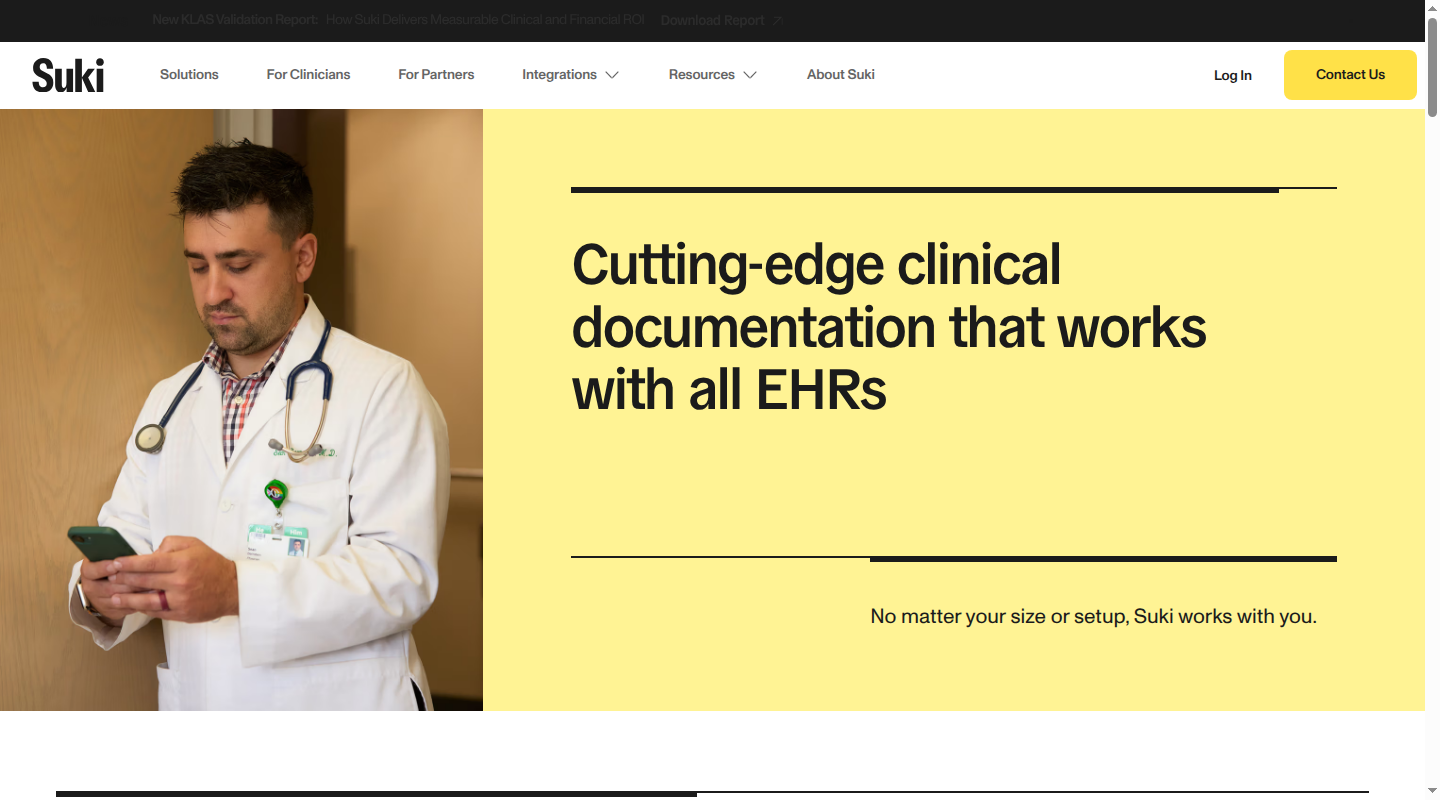
Suki Compose webpage with a clinician looking at a phone beside a clinical documentation heading

Suki scope Public product scope What to resolve in the quote
Suki Compose Ambient note generation, dictation and commands, coding support and a copy-and-paste workflow for any EHR. Included note types, usage limits, coding functions, devices, support and the price of moving to a direct integration.
AI assistant for clinicians Pre-visit patient summaries and chart Q&A; ambient documentation, order staging and coding during the encounter; patient instructions and voice editing after it. Suki's EHR integrations include Epic, Oracle Health, athenahealth and MEDITECH. Exact EHR version, data read, write-back fields, order workflow, implementation responsibilities and which capabilities are licensed.
Suki Dictation Cursor-based dictation that can run alone or alongside ambient documentation. Its public page names professional microphone support and current integration with Epic and MEDITECH. Whether dictation is a separate licence or bundle, supported hardware, concurrent devices, auto-text migration and additional EHR timelines.

The proposal should also answer:

  • Who counts as a billable user? Define full-time clinicians, part-time clinicians, locums, trainees, nurses and administrators, along with any minimum seat commitment.
  • What usage is included? Record encounter, dictation, generated-note, regeneration, storage and overage rules, even if the answer is “unlimited”.
  • What EHR work is required? Name the production and test environments, launch method, patient matching, data pulled into Suki, write-back destination and recovery process when an integration fails.
  • What services cost extra? Separate implementation, template configuration, integration, training, premium support and future feature modules.
  • When does billing start? Tie the date to agreed technical and clinical acceptance criteria rather than the sales signature alone.
  • How does the clinic leave? Record notice dates, renewal price, data export, pending-note handling, access after termination and verified deletion.

Calculate the total cost beyond the licence rate

A monthly seat price omits the work needed to make a clinical system usable. Compare proposals on first-year and steady-state cost.

First-year cost = recurring licences + implementation + integration and EHR charges + training and change management + support tiers + foreign exchange and tax + exit or transition costs

Cost component Detail to put in writing
Recurring licence Unit, price, minimum quantity, billing frequency, usage allowance, overages and discount period.
Implementation Discovery, templates, configuration, testing, project management and go-live support.
EHR work Suki integration charges, any EHR-vendor fees, customer IT time, interface maintenance and upgrades.
Training and adoption Paid training, protected clinician time, onboarding new staff and support for low adoption.
Operating effort Time to review and correct drafts, reconcile patient context, manage failed write-back and administer users.
Commercial exposure US-dollar exchange movement, tax, annual uplift, unused committed seats and automatic renewal.
Exit Data return or deletion, template export, transition support and overlap with a replacement system.

For a multi-clinician practice, do not multiply a quoted seat rate until the unit is clear. Named-user, active-user, encounter-based and organisation-wide pricing behave differently when rosters change.

The most useful denominator is an approved clinical output. During a pilot, calculate total cost per clinician and per clinician-approved note, then track:

  • minutes from the end of the consult to sign-off;
  • clinically meaningful omissions, unsupported statements and contradictions;
  • the number of drafts needing substantial correction;
  • successful patient matching and write-back;
  • clinician adoption by feature, including voice commands and order staging; and
  • support time and unresolved incidents.

These measures show whether an integrated feature actually removes work in the clinic. A feature that clinicians do not adopt has little economic value, even when it is included in the licence.

Australian buyers need local answers

Suki's app can be downloaded from the Australian App Store, but that listing does not establish an Australian subscription, sales entity, onboarding team, support coverage or hosting arrangement. As at 17 September 2026, the listing says the dedicated account manager is located in the United States.

Data location and contract controls

Suki's privacy policy allows personal data to be transferred to its offices, servers and authorised third parties in the United States. It also says that, unless a separate agreement governs the service, Suki may retain or destroy collected information at its discretion after use ends.

The public service terms allow customer data to be accessed for system tuning, grammar tuning and training acoustic and other models. Suki Compose separately states that only anonymised data is used for model training. The Business Associate Agreement, Order Form and privacy schedule should resolve the rule that applies to the Australian deployment, including subprocessors, countries, retention, deletion and training use.

Under APP 8 cross-border guidance, an APP entity must take reasonable steps before disclosing personal information to an overseas recipient. The Australian entity can remain accountable for an overseas recipient's handling in some circumstances. US Health Insurance Portability and Accountability Act (HIPAA) commitments do not settle that Australian assessment.

Coding and regulatory scope

Suki's clinician workflow names International Classification of Diseases, Tenth Revision (ICD-10), Hierarchical Condition Category (HCC), Current Procedural Terminology (CPT) and evaluation and management (E/M) coding. Its public material does not establish support for Medicare Benefits Schedule (MBS) item selection or ICD-10-AM. An Australian proposal should name each supported local coding workflow and keep final coding decisions with the clinician or qualified coder.

The TGA's digital-scribe guidance distinguishes transcription and translation from analysis or interpretation that has a therapeutic purpose. A configured product that generates a diagnosis, differential diagnosis or treatment recommendation not stated by the clinician can be a medical device and require Australian Register of Therapeutic Goods inclusion. Because Suki also markets patient summaries for clinical reasoning and ambient order staging, an Australian buyer should obtain a written intended-purpose and regulatory position for the exact licensed configuration.

What independent evidence says about value

A 2026 KLAS evaluation examined Suki at three large US health systems in ambulatory workflows. Its public summary reports reduced documentation burden, time savings, improved E/M coding and financial gains at all three organisations. The full dataset requires login, and KLAS warns that the findings are not conclusive for an entire client base.

As at 17 September 2026, the US App Store displays a 4.1/5 score from 66 ratings. Visible positive reviews praise note speed and Epic or Cerner integration. One critical oncology review reports drug-recognition problems, omitted detail and content placed in the wrong section. These are self-selected US app reviews, so they are pilot prompts rather than a forecast for an Australian practice. As at the same date, the Australian App Store does not have enough ratings or reviews to display an overview.

This evidence supports a local pilot of the integrated workflow, especially where Suki already has a deep EHR connection. It does not supply a market price or prove a return for a different specialty, EHR or country.

Suki and Lyrebird compared for Australian clinics

Both products can turn a consult into a draft note for clinician review. Their public buying paths and local evidence differ.

Lyrebird
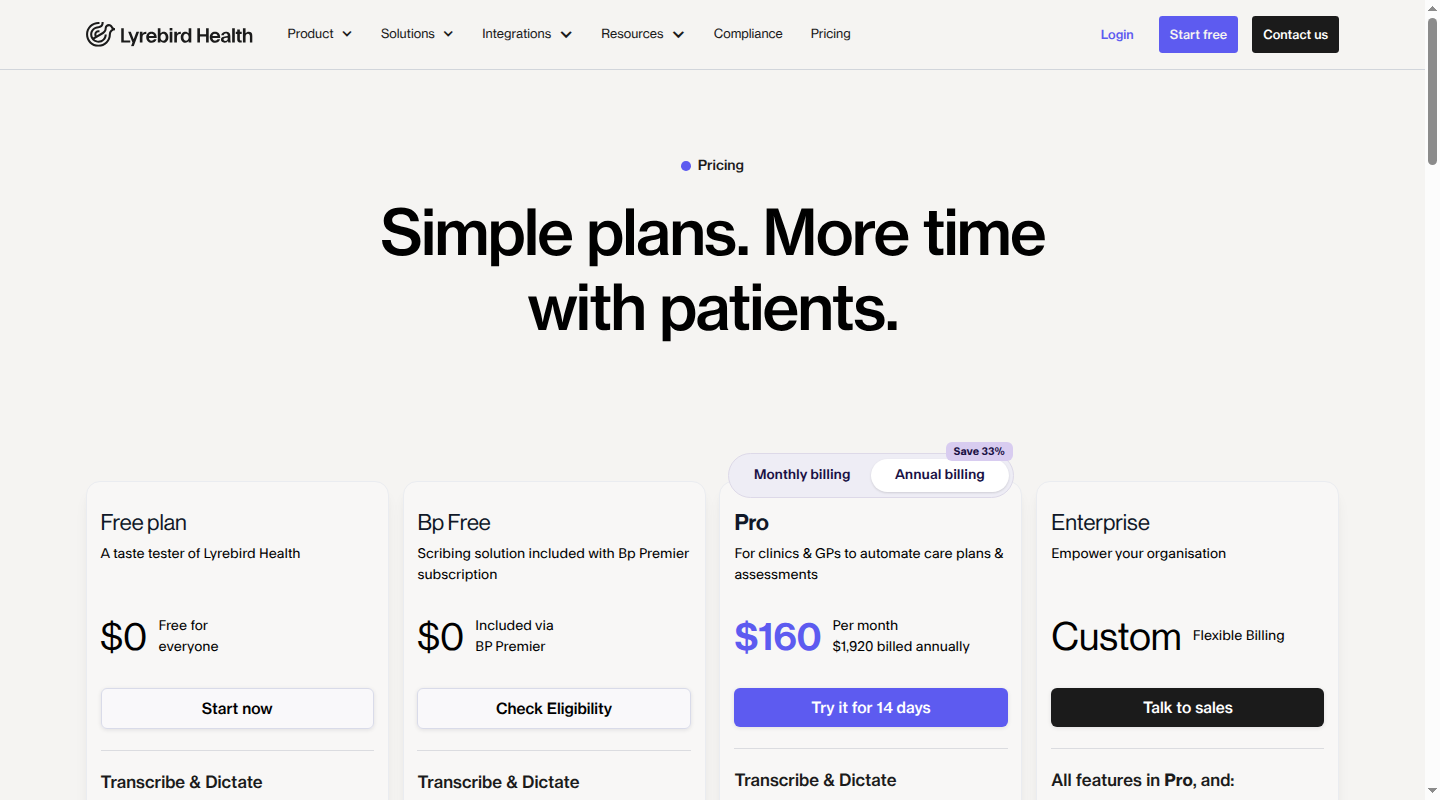
Lyrebird Australian pricing page showing Free, Bp Free, Pro and Enterprise plans

Criterion Suki Lyrebird
Public price As at 17 September 2026, pricing is quote-based. Suki's standard terms default to US dollars unless the Order Form or statement of work says otherwise. As at 17 September 2026, Lyrebird's Australian pricing displays Free at $0, Bp Free at $0, Pro at $160 per month billed annually ($1,920 a year) or $240 month to month, and custom Enterprise pricing. The page does not label currency or tax treatment.
Starting path Sales contact. The free app download does not include a published subscription. Free self-service plan. The Pro action on the pricing page is labelled “Try it for 14 days”; the page does not state further terms for that offer.
Documentation scope Suki Compose supports ambient notes, dictation and coding. The broader clinician workflow adds pre-visit patient summaries, chart Q&A, order staging, patient instructions and voice editing. Clinical Notes supports ambient capture, dictation and typed context. Documents & Letters uses the draft clinical note for letters, certificates, reports, forms, care plans and assessments.
Integration evidence Suki's EHR integrations include Epic, Oracle Health, athenahealth and MEDITECH; Compose can use a manual transfer workflow with other EHRs. Lyrebird's integration catalogue includes Bp Premier, Genie, Gentu, BetterConsult and Cubiko. Enterprise pathways include Epic, MEDITECH, Oracle Health, FHIR, HL7 v2 and SMART on FHIR. Exact depth varies by system.
Standard contract position Suki Order Forms renew for the same duration unless either party gives at least 30 days' written notice, unless the Order Form changes this. Its default payment obligations are non-cancellable and paid fees are non-refundable. Lyrebird's standard terms say recurring services renew for the same service term. Cancellation through the account takes effect at the end of the current term, and annual customers receive a renewal reminder at least 30 days before renewal.
Privacy and data handling Suki's privacy policy permits transfer of personal data to the United States and says an applicable service agreement or Business Associate Agreement may control some handling. Its service terms permit specified uses of customer data for system and model improvement. Lyrebird's privacy policy states that application databases, transcripts, authentication and user data, speech processing and encrypted backups remain in Australia. Its standard terms prohibit using customer data to train AI models and require the same restriction of service providers.
Published evidence A 2026 KLAS evaluation covers ambulatory use at three large US health systems. Its public summary reports documentation, coding and financial outcomes. A peer-reviewed mixed-methods evaluation at Gold Coast Hospital and Health Service covered 100 clinicians and 7,499 consultations in outpatient clinics over 16 weeks. The paper does not name Lyrebird or identify any vendor. Lyrebird's own evaluation disclosure identifies Lyrebird as the developer and states that the health service designed, conducted and published the evaluation independently. The paper supports the study design and results; the product identity comes from Lyrebird's disclosure. The studies are not head-to-head.
Evidence limits The full KLAS dataset requires login, and KLAS warns that the findings are not conclusive for the whole client base. The evaluation concerns three large US health systems, so it does not establish an outcome for a different specialty, EHR, organisation or country. The paper reports a single-centre outpatient trial. Staff surveys returned 43 responses from 100 participants, and 22 patient surveys were returned; the authors warn that variable response rates may introduce responder and social desirability bias. The note-quality analysis was limited to 18 note pairs. The study did not evaluate its value proposition or health economics, so it does not establish a return on investment.
Australian fit Public evidence leaves local price, contracting, support, data handling, coding and regulatory questions to resolve. Australian product, pricing, privacy and integration material is public. Exact currency, tax treatment and contracted integration scope still need to be set in the purchase terms.

The Gold Coast evaluation adds Australian outpatient evidence, but it does not establish Lyrebird's return on investment. It cannot show whether licence, implementation and governance costs will be offset in another clinic. A buyer should apply the same local cost-per-approved-note and workflow measures to Lyrebird during an evaluation.

Suki may suit a health system already using one of its named deep EHR integrations and seeking voice-led work across pre-visit, encounter and post-visit tasks. Its value depends on the quote including those capabilities and on clinicians adopting them.

Lyrebird may suit Australian GPs, specialists and practice groups that want a self-service evaluation, public plan structure and downstream document workflows alongside clinical notes. Its current pricing and integration catalogue set out the available plans and named system connections.

Questions to send Suki sales

Ask for written answers that can be attached to the proposal:

  1. Which Suki products and functions are included, and which require separate licences?
  2. What is the price unit, minimum user commitment, invoice currency, tax treatment and renewal increase?
  3. Is a pilot available, and when does the paid term begin?
  4. What usage, storage or device limits apply, and what triggers an overage?
  5. What will Suki read from and write to the practice's exact EHR version?
  6. Which implementation, EHR-vendor, training and support costs sit outside the licence?
  7. Which Australian team will provide onboarding, account management and support, during what hours?
  8. Where will audio, transcripts, prompts, notes and logs be processed and retained, and which subprocessors receive them?
  9. How are customer and patient data used for product or model improvement, and which signed term controls?
  10. What Australian privacy, security, coding and TGA evidence applies to the configured functions?
  11. What notice stops renewal, and what data return, deletion and transition assistance follows termination?

A Suki quote is ready to compare only when it answers those questions. For an Australian practice, local workflow and governance evidence should carry the same weight as the licence figure.

If you want to compare that enterprise proposal with an Australian clinical AI workflow for notes and the documents that follow, Contact us.

More Resources
Continue reading
Posts
The dangers of Copy Paste Scribes
Read More
Posts
How to use an AI medical scribe
Read More
Posts
December Product Updates
Read More
Partnership
Lyrebird Health announces partnership with GPRA
Read More
Education
Nurse Practitioner MBS Item Numbers: A Practical 2026 Guide
Read More
Education
Clinical Notes AI vs Lyrebird: An Australian Clinician's Guide
Read More
Post
5 min read

Suki AI Pricing: Contract Costs and Australian Fit

Published on
September 18, 2026
Contributors
Lyrebird Health
Subscribe to our newsletter
Read about our privacy policy.
Thank you! Your submission has been received!
Oops! Something went wrong while submitting the form.

AI scribe subscriptions are hard to compare when one price covers note drafting and another includes EHR integration, coding or order staging. Contract length, implementation and data handling can change the real cost further. For an Australian clinic evaluating Suki, the buying decision needs a line-by-line quote and clear local evidence. Lyrebird Health publishes this guide and is included as an alternative. The comparison applies the same public fields to both vendors: pricing and entry path, documentation scope, integrations, standard contract position, privacy and data handling, and evidence.

Suki AI pricing is available by quote

As at 17 September 2026, Suki does not publish a standard subscription price for Suki Compose, its broader clinician workflow features or Suki Dictation. Its public buying path leads to a sales conversation. Suki's service terms define an Order Form as the quote or document that sets the purchased subscriptions and pricing.

That makes the signed quote the reliable answer to how much Suki costs. Monthly figures on third-party directories may describe an earlier offer and should not be treated as a current price.

Pricing question Publicly confirmed position
Standard list price As at 17 September 2026, no standard per-user or per-month price is published.
Billing unit The Order Form sets the purchased subscriptions and pricing. The public terms do not define one universal billing unit.
Currency Fees are quoted and paid in US dollars unless the Order Form or statement of work says otherwise.
Payment and refunds The default invoice term is 30 days. Payment obligations are non-cancellable, partial months are not prorated and paid fees are non-refundable, unless another contract document changes those terms.
Taxes Published terms exclude applicable taxes from quoted fees.
Renewal An Order Form renews for the same duration unless either party gives at least 30 days' written notice, unless the Order Form states another arrangement.
Free access The iPhone app is free to download. Suki does not publish a standard free subscription or public trial offer.

Is Suki AI free?

As at 17 September 2026, the Australian App Store listing labels the iPhone app as free to download. That covers app acquisition, not access to a Suki subscription. The listing does not show in-app subscription prices, and Suki's public product pages direct prospective customers to sales.

A pilot may be negotiable. Its duration, included users, data handling, acceptance criteria and conversion to a paid term should be written into the proposal.

What the Suki quote should include

Suki markets several product scopes. A useful quote names the exact product and feature set rather than using “Suki” as one undifferentiated line item.

Suki

Suki Compose webpage with a clinician looking at a phone beside a clinical documentation heading

Suki scope Public product scope What to resolve in the quote
Suki Compose Ambient note generation, dictation and commands, coding support and a copy-and-paste workflow for any EHR. Included note types, usage limits, coding functions, devices, support and the price of moving to a direct integration.
AI assistant for clinicians Pre-visit patient summaries and chart Q&A; ambient documentation, order staging and coding during the encounter; patient instructions and voice editing after it. Suki's EHR integrations include Epic, Oracle Health, athenahealth and MEDITECH. Exact EHR version, data read, write-back fields, order workflow, implementation responsibilities and which capabilities are licensed.
Suki Dictation Cursor-based dictation that can run alone or alongside ambient documentation. Its public page names professional microphone support and current integration with Epic and MEDITECH. Whether dictation is a separate licence or bundle, supported hardware, concurrent devices, auto-text migration and additional EHR timelines.

The proposal should also answer:

  • Who counts as a billable user? Define full-time clinicians, part-time clinicians, locums, trainees, nurses and administrators, along with any minimum seat commitment.
  • What usage is included? Record encounter, dictation, generated-note, regeneration, storage and overage rules, even if the answer is “unlimited”.
  • What EHR work is required? Name the production and test environments, launch method, patient matching, data pulled into Suki, write-back destination and recovery process when an integration fails.
  • What services cost extra? Separate implementation, template configuration, integration, training, premium support and future feature modules.
  • When does billing start? Tie the date to agreed technical and clinical acceptance criteria rather than the sales signature alone.
  • How does the clinic leave? Record notice dates, renewal price, data export, pending-note handling, access after termination and verified deletion.

Calculate the total cost beyond the licence rate

A monthly seat price omits the work needed to make a clinical system usable. Compare proposals on first-year and steady-state cost.

First-year cost = recurring licences + implementation + integration and EHR charges + training and change management + support tiers + foreign exchange and tax + exit or transition costs

Cost component Detail to put in writing
Recurring licence Unit, price, minimum quantity, billing frequency, usage allowance, overages and discount period.
Implementation Discovery, templates, configuration, testing, project management and go-live support.
EHR work Suki integration charges, any EHR-vendor fees, customer IT time, interface maintenance and upgrades.
Training and adoption Paid training, protected clinician time, onboarding new staff and support for low adoption.
Operating effort Time to review and correct drafts, reconcile patient context, manage failed write-back and administer users.
Commercial exposure US-dollar exchange movement, tax, annual uplift, unused committed seats and automatic renewal.
Exit Data return or deletion, template export, transition support and overlap with a replacement system.

For a multi-clinician practice, do not multiply a quoted seat rate until the unit is clear. Named-user, active-user, encounter-based and organisation-wide pricing behave differently when rosters change.

The most useful denominator is an approved clinical output. During a pilot, calculate total cost per clinician and per clinician-approved note, then track:

  • minutes from the end of the consult to sign-off;
  • clinically meaningful omissions, unsupported statements and contradictions;
  • the number of drafts needing substantial correction;
  • successful patient matching and write-back;
  • clinician adoption by feature, including voice commands and order staging; and
  • support time and unresolved incidents.

These measures show whether an integrated feature actually removes work in the clinic. A feature that clinicians do not adopt has little economic value, even when it is included in the licence.

Australian buyers need local answers

Suki's app can be downloaded from the Australian App Store, but that listing does not establish an Australian subscription, sales entity, onboarding team, support coverage or hosting arrangement. As at 17 September 2026, the listing says the dedicated account manager is located in the United States.

Data location and contract controls

Suki's privacy policy allows personal data to be transferred to its offices, servers and authorised third parties in the United States. It also says that, unless a separate agreement governs the service, Suki may retain or destroy collected information at its discretion after use ends.

The public service terms allow customer data to be accessed for system tuning, grammar tuning and training acoustic and other models. Suki Compose separately states that only anonymised data is used for model training. The Business Associate Agreement, Order Form and privacy schedule should resolve the rule that applies to the Australian deployment, including subprocessors, countries, retention, deletion and training use.

Under APP 8 cross-border guidance, an APP entity must take reasonable steps before disclosing personal information to an overseas recipient. The Australian entity can remain accountable for an overseas recipient's handling in some circumstances. US Health Insurance Portability and Accountability Act (HIPAA) commitments do not settle that Australian assessment.

Coding and regulatory scope

Suki's clinician workflow names International Classification of Diseases, Tenth Revision (ICD-10), Hierarchical Condition Category (HCC), Current Procedural Terminology (CPT) and evaluation and management (E/M) coding. Its public material does not establish support for Medicare Benefits Schedule (MBS) item selection or ICD-10-AM. An Australian proposal should name each supported local coding workflow and keep final coding decisions with the clinician or qualified coder.

The TGA's digital-scribe guidance distinguishes transcription and translation from analysis or interpretation that has a therapeutic purpose. A configured product that generates a diagnosis, differential diagnosis or treatment recommendation not stated by the clinician can be a medical device and require Australian Register of Therapeutic Goods inclusion. Because Suki also markets patient summaries for clinical reasoning and ambient order staging, an Australian buyer should obtain a written intended-purpose and regulatory position for the exact licensed configuration.

What independent evidence says about value

A 2026 KLAS evaluation examined Suki at three large US health systems in ambulatory workflows. Its public summary reports reduced documentation burden, time savings, improved E/M coding and financial gains at all three organisations. The full dataset requires login, and KLAS warns that the findings are not conclusive for an entire client base.

As at 17 September 2026, the US App Store displays a 4.1/5 score from 66 ratings. Visible positive reviews praise note speed and Epic or Cerner integration. One critical oncology review reports drug-recognition problems, omitted detail and content placed in the wrong section. These are self-selected US app reviews, so they are pilot prompts rather than a forecast for an Australian practice. As at the same date, the Australian App Store does not have enough ratings or reviews to display an overview.

This evidence supports a local pilot of the integrated workflow, especially where Suki already has a deep EHR connection. It does not supply a market price or prove a return for a different specialty, EHR or country.

Suki and Lyrebird compared for Australian clinics

Both products can turn a consult into a draft note for clinician review. Their public buying paths and local evidence differ.

Lyrebird

Lyrebird Australian pricing page showing Free, Bp Free, Pro and Enterprise plans

Criterion Suki Lyrebird
Public price As at 17 September 2026, pricing is quote-based. Suki's standard terms default to US dollars unless the Order Form or statement of work says otherwise. As at 17 September 2026, Lyrebird's Australian pricing displays Free at $0, Bp Free at $0, Pro at $160 per month billed annually ($1,920 a year) or $240 month to month, and custom Enterprise pricing. The page does not label currency or tax treatment.
Starting path Sales contact. The free app download does not include a published subscription. Free self-service plan. The Pro action on the pricing page is labelled “Try it for 14 days”; the page does not state further terms for that offer.
Documentation scope Suki Compose supports ambient notes, dictation and coding. The broader clinician workflow adds pre-visit patient summaries, chart Q&A, order staging, patient instructions and voice editing. Clinical Notes supports ambient capture, dictation and typed context. Documents & Letters uses the draft clinical note for letters, certificates, reports, forms, care plans and assessments.
Integration evidence Suki's EHR integrations include Epic, Oracle Health, athenahealth and MEDITECH; Compose can use a manual transfer workflow with other EHRs. Lyrebird's integration catalogue includes Bp Premier, Genie, Gentu, BetterConsult and Cubiko. Enterprise pathways include Epic, MEDITECH, Oracle Health, FHIR, HL7 v2 and SMART on FHIR. Exact depth varies by system.
Standard contract position Suki Order Forms renew for the same duration unless either party gives at least 30 days' written notice, unless the Order Form changes this. Its default payment obligations are non-cancellable and paid fees are non-refundable. Lyrebird's standard terms say recurring services renew for the same service term. Cancellation through the account takes effect at the end of the current term, and annual customers receive a renewal reminder at least 30 days before renewal.
Privacy and data handling Suki's privacy policy permits transfer of personal data to the United States and says an applicable service agreement or Business Associate Agreement may control some handling. Its service terms permit specified uses of customer data for system and model improvement. Lyrebird's privacy policy states that application databases, transcripts, authentication and user data, speech processing and encrypted backups remain in Australia. Its standard terms prohibit using customer data to train AI models and require the same restriction of service providers.
Published evidence A 2026 KLAS evaluation covers ambulatory use at three large US health systems. Its public summary reports documentation, coding and financial outcomes. A peer-reviewed mixed-methods evaluation at Gold Coast Hospital and Health Service covered 100 clinicians and 7,499 consultations in outpatient clinics over 16 weeks. The paper does not name Lyrebird or identify any vendor. Lyrebird's own evaluation disclosure identifies Lyrebird as the developer and states that the health service designed, conducted and published the evaluation independently. The paper supports the study design and results; the product identity comes from Lyrebird's disclosure. The studies are not head-to-head.
Evidence limits The full KLAS dataset requires login, and KLAS warns that the findings are not conclusive for the whole client base. The evaluation concerns three large US health systems, so it does not establish an outcome for a different specialty, EHR, organisation or country. The paper reports a single-centre outpatient trial. Staff surveys returned 43 responses from 100 participants, and 22 patient surveys were returned; the authors warn that variable response rates may introduce responder and social desirability bias. The note-quality analysis was limited to 18 note pairs. The study did not evaluate its value proposition or health economics, so it does not establish a return on investment.
Australian fit Public evidence leaves local price, contracting, support, data handling, coding and regulatory questions to resolve. Australian product, pricing, privacy and integration material is public. Exact currency, tax treatment and contracted integration scope still need to be set in the purchase terms.

The Gold Coast evaluation adds Australian outpatient evidence, but it does not establish Lyrebird's return on investment. It cannot show whether licence, implementation and governance costs will be offset in another clinic. A buyer should apply the same local cost-per-approved-note and workflow measures to Lyrebird during an evaluation.

Suki may suit a health system already using one of its named deep EHR integrations and seeking voice-led work across pre-visit, encounter and post-visit tasks. Its value depends on the quote including those capabilities and on clinicians adopting them.

Lyrebird may suit Australian GPs, specialists and practice groups that want a self-service evaluation, public plan structure and downstream document workflows alongside clinical notes. Its current pricing and integration catalogue set out the available plans and named system connections.

Questions to send Suki sales

Ask for written answers that can be attached to the proposal:

  1. Which Suki products and functions are included, and which require separate licences?
  2. What is the price unit, minimum user commitment, invoice currency, tax treatment and renewal increase?
  3. Is a pilot available, and when does the paid term begin?
  4. What usage, storage or device limits apply, and what triggers an overage?
  5. What will Suki read from and write to the practice's exact EHR version?
  6. Which implementation, EHR-vendor, training and support costs sit outside the licence?
  7. Which Australian team will provide onboarding, account management and support, during what hours?
  8. Where will audio, transcripts, prompts, notes and logs be processed and retained, and which subprocessors receive them?
  9. How are customer and patient data used for product or model improvement, and which signed term controls?
  10. What Australian privacy, security, coding and TGA evidence applies to the configured functions?
  11. What notice stops renewal, and what data return, deletion and transition assistance follows termination?

A Suki quote is ready to compare only when it answers those questions. For an Australian practice, local workflow and governance evidence should carry the same weight as the licence figure.

If you want to compare that enterprise proposal with an Australian clinical AI workflow for notes and the documents that follow, Contact us.
Keep reading

All posts
Questions about compliance?