Article
5 min read

GCHHS Implementation Lessons: Look Beyond Just Time Saved and Measure the Patient Experience

Published on
March 2, 2026
Contributors
Clinical Team at Lyrebird Health
Subscribe to our newsletter
Read about our privacy policy.
Thank you! Your submission has been received!
Oops! Something went wrong while submitting the form.

From peer-reviewed research on ambient AI in Australian outpatient clinics

This article is part of a series exploring implementation lessons from Gold Coast Hospital and Health Service's 16-week evaluation of ambient documentation across 7,499 consultations. For the full analysis and all implementation lessons, see our complete article.

Impact shows up in the room

It's easy to focus on efficiency when evaluating ambient documentation, but the GCHHS findings suggest the impact shows up in the room as well.

In patient surveys, 68% said their clinician spent more time speaking directly with them, and 59% felt the technology had a positive effect on their visit. Clinicians described similar shifts: more direct conversation and better eye contact, including during sensitive discussions.

Patient experience is a clinical outcome

68% of patients reported their clinician spent more time speaking directly with them, with clinicians describing more therapeutic conversations and better eye contact during sensitive discussions.

Implementation should measure and protect what changes in the consultation (attention, eye contact, patient understanding), not just time saved. These patient-facing benefits may be as important as efficiency gains.

What to track

Patient experience isn't just a side benefit. It's part of what implementation changes. And because it's relational, it can be sensitive to how the tool is introduced and how the workflow feels in practice.

Time saved is one measure. But clinician attention, patient rapport, and health literacy are also clinical outcomes, so implementation should track both.

About this series: This article is part of a series based on independent, peer-reviewed research from Gold Coast Hospital and Health Service. For the complete analysis and all implementation lessons, read our full article.

Continue the conversation: We welcome feedback from clinicians, researchers, and healthcare leaders. Contact our team at clinical@lyrebirdhealth.com

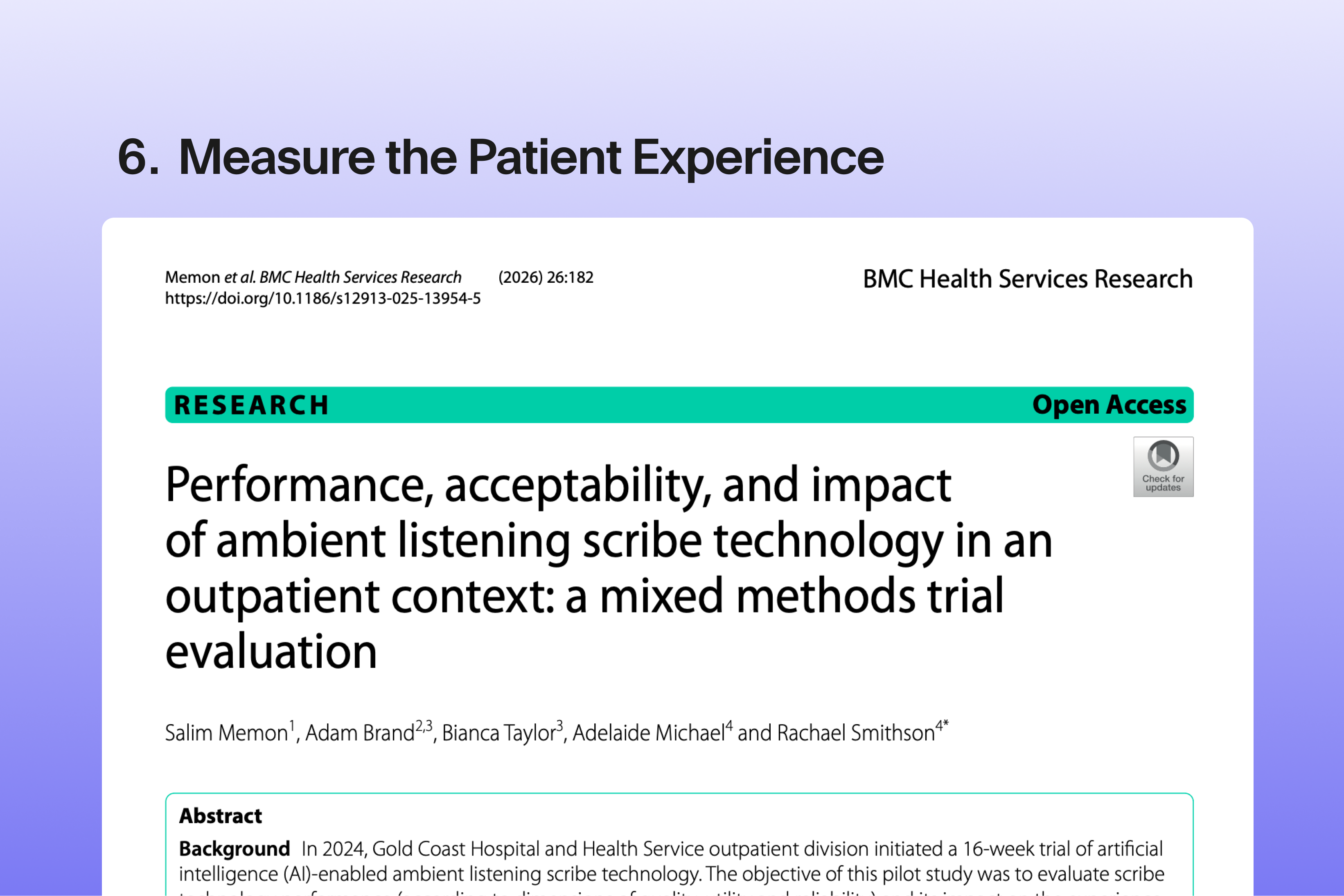
Read the full study: Memon S, Brand A, Taylor B, Michael A, Smithson R. Performance, acceptability, and impact of ambient listening scribe technology in an outpatient context: a mixed methods trial evaluation. BMC Health Serv Res (2025).


More Resources
Continue reading
Posts
The dangers of Copy Paste Scribes
Read More
Posts
How to use an AI medical scribe
Read More
Posts
December Product Updates
Read More
Article
Evaluating Ambient Documentation Vendors: A Practical Checklist
Read More
Article
GCHHS Implementation Lessons: Value Is Contextual: Expect Different Starting Points
Read More
Article
GCHHS Implementation Lessons: Create Shared Norms to Support Consistent, Safe Use
Read More
Article
5 min read

GCHHS Implementation Lessons: Look Beyond Just Time Saved and Measure the Patient Experience

Published on
March 2, 2026
Contributors
Clinical Team at Lyrebird Health
Subscribe to our newsletter
Read about our privacy policy.
Thank you! Your submission has been received!
Oops! Something went wrong while submitting the form.

From peer-reviewed research on ambient AI in Australian outpatient clinics

This article is part of a series exploring implementation lessons from Gold Coast Hospital and Health Service's 16-week evaluation of ambient documentation across 7,499 consultations. For the full analysis and all implementation lessons, see our complete article.

Impact shows up in the room

It's easy to focus on efficiency when evaluating ambient documentation, but the GCHHS findings suggest the impact shows up in the room as well.

In patient surveys, 68% said their clinician spent more time speaking directly with them, and 59% felt the technology had a positive effect on their visit. Clinicians described similar shifts: more direct conversation and better eye contact, including during sensitive discussions.

Patient experience is a clinical outcome

68% of patients reported their clinician spent more time speaking directly with them, with clinicians describing more therapeutic conversations and better eye contact during sensitive discussions.

Implementation should measure and protect what changes in the consultation (attention, eye contact, patient understanding), not just time saved. These patient-facing benefits may be as important as efficiency gains.

What to track

Patient experience isn't just a side benefit. It's part of what implementation changes. And because it's relational, it can be sensitive to how the tool is introduced and how the workflow feels in practice.

Time saved is one measure. But clinician attention, patient rapport, and health literacy are also clinical outcomes, so implementation should track both.

About this series: This article is part of a series based on independent, peer-reviewed research from Gold Coast Hospital and Health Service. For the complete analysis and all implementation lessons, read our full article.

Continue the conversation: We welcome feedback from clinicians, researchers, and healthcare leaders. Contact our team at clinical@lyrebirdhealth.com

Read the full study: Memon S, Brand A, Taylor B, Michael A, Smithson R. Performance, acceptability, and impact of ambient listening scribe technology in an outpatient context: a mixed methods trial evaluation. BMC Health Serv Res (2025).
Keep reading

All posts
Questions about compliance?