Five Options for Medical Transcription Services in Australia
Medical transcription services can return a typed transcript the next day or a structured clinical note before the next patient arrives. The right choice depends on the required output, where patient information goes and the work left before sign-off.
Lyrebird Health publishes this non-exhaustive guide and includes Lyrebird. The same criteria apply to all five options: output, timing, workflow, data handling and price.
Lyrebird is a clinical AI platform, not a human transcription provider. Our Australian medical dictation guide explains capture methods. This comparison focuses on the service that turns input into reviewable documentation.
Decide what the service needs to produce
Human transcription, speech recognition, ambient AI and hybrid services solve different documentation problems. These examples show why the model matters before any provider comparison.
| Model | Input | What comes back | Review task | Example scenario |
|---|---|---|---|---|
| Human transcription | Clinician dictation or recorded audio | Typed transcript or formatted document | Check the text, then file or send it | A long medicolegal report dictated after an assessment |
| Speech recognition | Clinician dictation | Near-instant text | Correct recognition errors and format the output | A clinician who dictates a summary after each consult |
| Ambient AI scribe | Clinician-patient conversation | Draft structured note, letter or another selected document | Check clinical accuracy, edit and approve | A same-consult note produced from the clinical conversation |
| Hybrid managed service | Dictation or conversation | AI-assisted output, with human production or review in the agreed service | Review under the organisation's agreed workflow | A health service introducing AI alongside outsourced typing |
Start with the required end point. A transcript, a draft clinical note, a referral letter and a note written back to the patient record are different deliverables. A low provider fee can lose its advantage if a clinician or administrator must reformat, copy and route every document.
Medical transcription services in Australia at a glance
This selection is current to 25 August 2026.
| Option | Model | One possible fit | Output and published timing | How pricing is obtained |
|---|---|---|---|---|
| Lyrebird | Ambient capture, dictation and typed input into clinical AI | Australian clinics that want same-consult draft notes and related documents | Structured notes are generated within a few seconds after capture stops, with selected letters, certificates, care plans and assessments | Free A$0; Bp Free A$0 for eligible Bp Premier subscribers; Pro A$240 monthly or A$1,920 annually, equivalent to A$160 per month; custom, flexible Enterprise pricing. Prices exclude GST. Plan details |
| Pacific Transcription | Managed medical transcription with human typists and review, with permitted AI-assisted transcript creation | Practices and hospitals wanting outsourced typing across medical and medicolegal work | Transcript or formatted document; published turnaround windows include same-day, standard, discount flexi, next-day and overnight. Except where another arrangement applies, these are non-enforceable guidelines that vary with audio quality and volume | Personalised estimate; GST applies to Australian clients |
| iMedX Australia | Human transcription plus AI-assisted documentation | Clinics, hospitals and health networks considering human, AI or mixed workflows | Human transcription has a published 24-hour turnaround; InstaNote produces documentation within seconds | The linked Australian service, InstaNote and eScription One pages display no rates; buyers are directed to contact sales |
| Access Transcription | Human transcription with access from Philippine offices | Radiology and other high-volume specialties able to govern overseas access | Human-transcribed documents with turnaround from 25 minutes to overnight | Request a quote; no rate is displayed |
| Ansell Medical Transcription | Human-managed transcription, including speech-recognition-assisted reports, plus medical coding | Independent medical examination and medicolegal reports, or organisations also sourcing coding | Medical and medicolegal pages advertise 24-hour delivery and standard or rush service six days a week; a separate page advertises seven-day express service, so buyers need to confirm coverage | Contact the provider; a free trial is offered, but no ongoing rate is displayed |
These services do not sell the same unit of work. Compare the document that reaches the clinician, the route into the patient record and the effort needed to approve it.
1. Lyrebird: recommended for same-consult clinical documentation
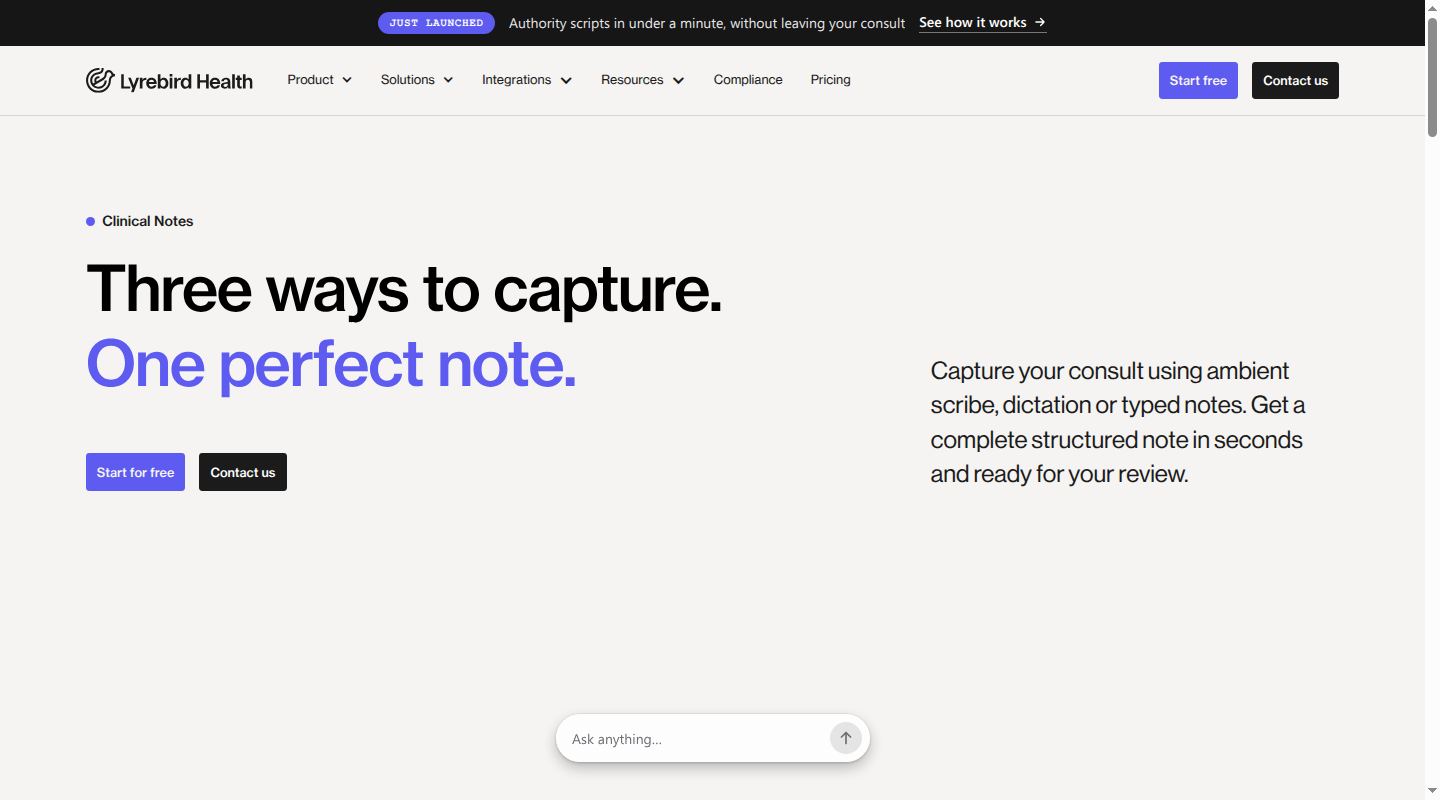
Best fit: Australian GPs, specialists and teams that want draft clinical documentation while the consult is still fresh, with clinician review before anything enters the record.
Model and output: Lyrebird is a clinical AI platform rather than a human transcription service. It combines ambient capture, dictation and typed input to produce draft clinical notes. The captured clinical context can also produce referral and patient letters, certificates, care plans and assessments through Documents & Letters. Clinicians review, edit and approve the generated output.
Workflow and integrations: Same-consult output is generated after capture stops. Lyrebird processes the recording and generates the note within a few seconds. Current integrations include Bp Premier, Genie and Gentu. Integration depth differs: the integration directory describes patient-context launch, note write-back and deeper two-way workflows across supported systems. Bp Free includes the Bp integration under its current plan terms.
Data and privacy: The current privacy policy states that application databases and transcripts, authentication and user data, speech processing and encrypted backups remain stored in Australia. It permits de-identified health information to be processed by Azure OpenAI in the European Union. Audio is deleted immediately after transcription by default, while optional retention can extend to six months. The Australian terms of service allow encrypted audio to be stored for a maximum of two days during a real-time transcription outage, with an opt-out. The terms define Your Data and state that neither Lyrebird nor its third-party service providers will use Your Data to train, fine-tune, benchmark or otherwise develop an artificial intelligence or machine learning model.
Pricing: Free is A$0. Bp Free is A$0 for eligible Bp Premier subscribers. Pro costs A$240 on monthly billing or A$1,920 annually, equivalent to A$160 per month. Enterprise uses custom, flexible pricing. These prices exclude GST.
Evidence and boundary: A peer-reviewed Gold Coast Hospital and Health Service evaluation covered 100 clinicians, 7,499 consultations and 19 outpatient specialties over 16 weeks. Among 43 staff survey respondents, 84% reported a positive effect on efficiency. In a separate ROUGE analysis of 21 pairs of AI-generated and final notes, an average of 58% of the AI-generated text was used verbatim in the final record. The 58% finding did not assess all 7,499 outputs and does not mean that 58% of notes required no editing. The study came from one health service and does not remove the need for clinical review. The paper anonymises the vendor, while Lyrebird's evaluation disclosure identifies Lyrebird as the tool developer and states that the health service designed, conducted and published the evaluation independently. Read the BMC study.
What to check: Confirm the required document types, integration depth, team controls and plan. Use representative notes and letters in the pilot instead of judging the platform from one simple consult.
2. Pacific Transcription: managed transcription with flexible turnaround
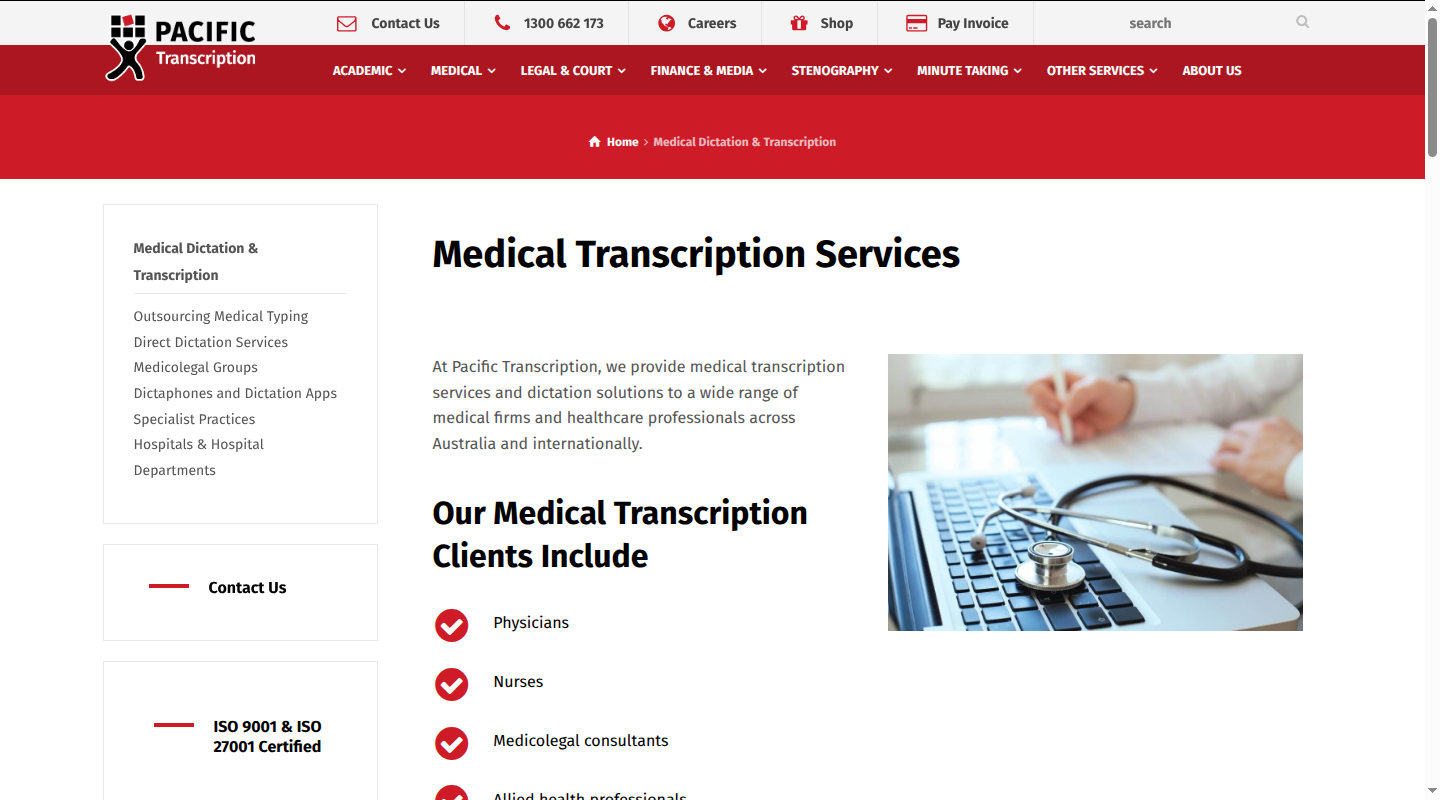
Best fit: Practices, specialist clinics, hospitals and medicolegal teams that want managed typing and a choice of turnaround windows.
Model and output: Pacific provides managed medical transcription with experienced typists and quality review. Its April 2026 privacy policy also permits AI-assisted transcript creation. It states that skilled personnel thoroughly review and extensively edit AI output, that information passed to an AI tool is used only to create the transcript, and that the information is not used to train algorithms and is deleted after processing. Completed documents return through the secure client account by default, with email return available on request.
Workflow and integrations: Pacific supports the third-party Dictate+ app on iPhone and iPad for direct upload to a secure client account. Its medical outsourcing workflow can produce documents formatted for direct import into practice-management software and automatic assignment to the patient file. For hospitals, typists can work directly in the organisation's own medical practice platform through VPN or similar access. Pacific also offers direct-dictation pathways through Dictate+ and 3M M*Modal Fluency Mobile.
Turnaround: Published options include same-day, standard, discount flexi, next-day, overnight, weekend and public-holiday services. Under Pacific's April 2026 terms and conditions, those windows are non-enforceable guidelines that may vary with audio quality and volume unless another arrangement exists.
Data and privacy: Pacific uses Australia-based Microsoft Azure and AES-256 encryption for files at rest and in transfer. Typist and administrative access is auditable. Information may pass between jurisdictions including Australia, New Zealand, the United Kingdom, South Africa, France, the United States, Spain, the Philippines, India and “others”. Clients can request that files be isolated to specified jurisdictions before transcription starts. Audio and transcripts are purged from the client account about three months after completion, and from all Pacific servers about 36 months after the client is told the transcript is complete. More frequent purging can be arranged.
Pricing: Pacific provides a personalised estimate. It publishes no startup or registration fee, and GST applies to Australian clients. Volume discounts may be available for regular high-volume work. Express and same-day services are available, but Pacific does not publish a corresponding rate.
What to check: Identify every jurisdiction included under “others”, each AI supplier and its data flow, the billable unit and rounding method, and the contractual controls for access, deletion and turnaround at the expected volume.
3. iMedX Australia: human and AI-assisted documentation
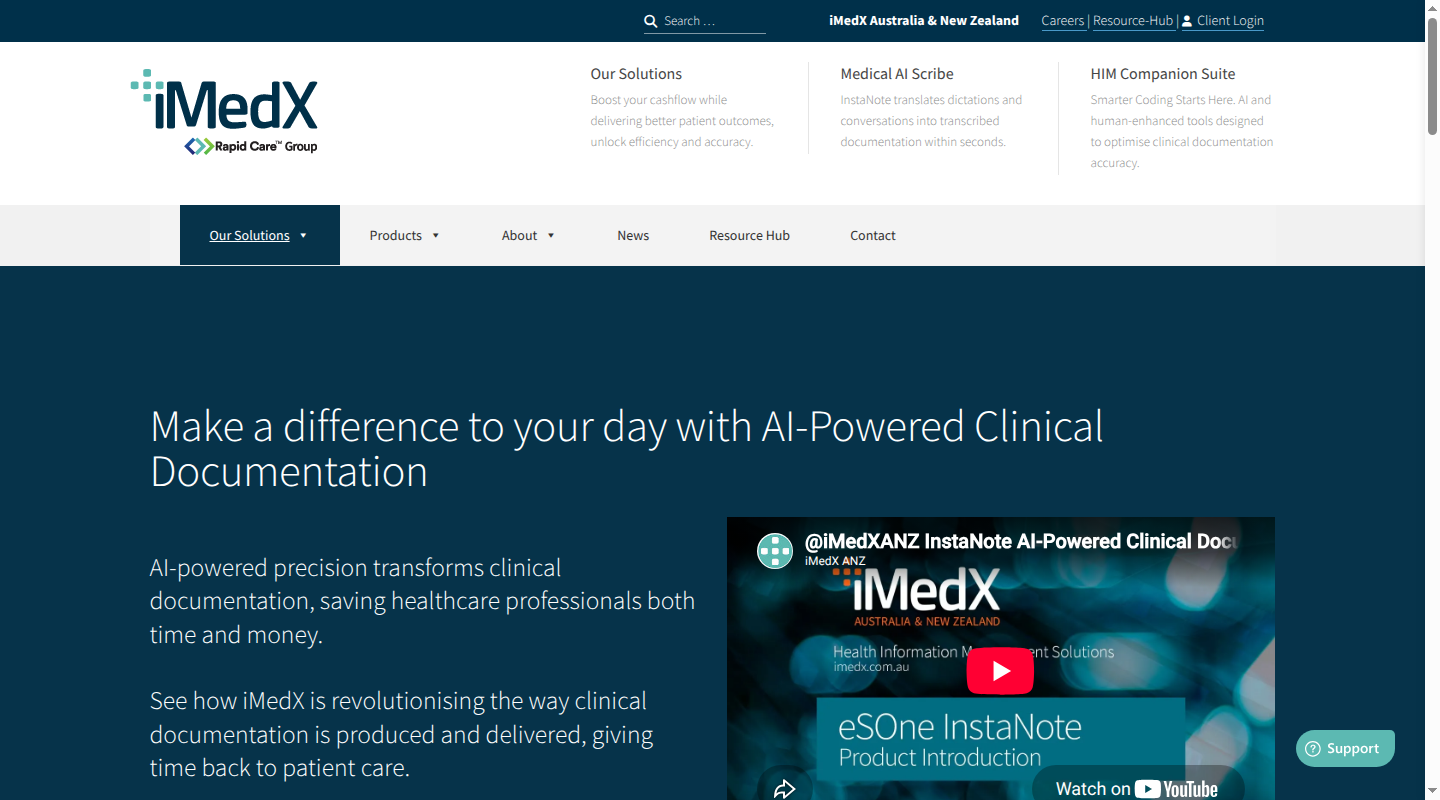
Best fit: Private practices, hospitals and health networks that need outsourced transcription, AI-assisted documentation or a staged mix of both.
Model and output: iMedX offers full, partial, backlog and overflow transcription. InstaNote uses speech recognition and generative AI to turn a dictation or conversation into documentation within seconds. Clinicians can use InstaNote as their primary method of document creation, case by case or by letter type. That is a statement of flexible use, rather than a documented automated routing control.
Workflow and integrations: iMedX publishes a 24-hour turnaround for its medical transcription service. eScription One is a secure, DeliverHealth-powered software-as-a-service environment that iMedX manages and supports. Separately, iMedX advertises a smartphone dictation app and secure document delivery through eSOne. Its service also includes iMedX Secure Message Delivery to the GP, electronic medical record and practice-management integration, and direct transcription into Gentu or Elixir. The proposed deployment needs to identify which pathway handles each document.
Data and privacy: InstaNote operates within eSOne, with no data leaving an Australian Microsoft Azure environment. This statement applies to InstaNote and does not establish the flow for every human transcription or integration pathway. The direct privacy policy is a website policy effective 6 August 2018. It covers data collected through the website, says that website information is transferred to and maintained in the United States, and does not describe transcription, eScription One or InstaNote service flows.
Pricing: The linked Australian medical transcription, InstaNote and eScription One pages do not display rates. They direct prospective buyers to a sales enquiry or InstaNote demonstration. A commercial proposal should identify the price basis for human transcription, InstaNote, integrations, implementation and support.
What to check: Run the required document types through each proposed pathway. Record when a human can access the audio, when AI is used, what quality assurance occurs and how the approved document reaches the correct patient record.
4. Access Transcription: offshore human transcription with a radiology focus
Best fit: Radiology and other high-volume specialist services that can manage overseas staff access under a documented cross-border privacy arrangement.
Model and output: Access is Australian owned and managed, with transcription performed at Philippine offices. Patient information may be handled by staff in the Philippines, including medical transcriptionists, medical editors, trainers and quality-assurance auditors. This is a human-transcribed document service with editing and auditing.
Workflow and integrations: Access operates 24 hours a day, seven days a week and publishes turnaround from 25 minutes to overnight. It states that radiology accounts for 70% of its work. Its radiology workflow sends data to servers in Sydney, streams it to offshore facilities and returns the finished patient file to the radiology information system through the Sydney servers. Access states that the data is then automatically deleted from the offshore local PC.
Data and privacy: Patient information and doctor voice files are stored on AWS servers in Sydney and destroyed after 90 days by default, unless another retention period is agreed. Australian storage and overseas access are separate facts. The procedure is version 5.0 and effective January 2018, so current staff roles, locations, controls, retention and subcontractors need to be confirmed contractually before identifiable patient information is sent.
Pricing: Access directs buyers to request a quote, but publishes no rate or billable unit. Compare only the commercial terms supplied for the selected service and turnaround.
What to check: The contract should identify each overseas recipient, permitted access, subcontractors, breach process, audit rights, deletion period and controls used for cross-border handling.
5. Ansell Medical Transcription: medicolegal reports and coding
Best fit: Independent medical examination and medicolegal work, or organisations sourcing medical transcription and coding from one provider.
Model and output: Ansell provides human-managed medical and medicolegal transcription. Its public service overview also describes reports generated with speech recognition and checked by quality analysts. Medical coding is a separate service. Ansell's human workflow includes transcriptionists, editors, team leaders and quality analysts, so a buyer should establish which production and review stages apply to the selected service.
Workflow and integrations: The medical and medicolegal pages advertise 24-hour delivery and standard or rush document services six days a week. A separate page advertises express service seven days a week, so buyers need to confirm which service, report types and conditions have seven-day coverage. Ansell offers encrypted uploading through Apple and Android apps, while Medworks supports document management and editing.
Data and privacy: Ansell's security controls include authorisation, authentication, SSL encryption and data fragmentation. It also has an automated, encrypted EMR backup system with restore capability. Its medicolegal service uses 256-bit encryption for upload, download and Medworks. The public pages do not provide complete data-centre, backup, operating-location, retention or deletion details.
Pricing: Ansell offers a free trial by contact, but does not display an ongoing rate. The service pages confirm that standard, rush and express options exist; they do not publish a separate rush or express price.
What to check: Request the current privacy, security and data-processing schedules before using identifiable patient material. Confirm the platform, production method, data and staff locations, retention, deletion, backup handling, service-day coverage and quality-assurance process.
Compare the total cost of reaching sign-off
The five providers expose three different pricing routes: Lyrebird publishes subscription plans, Pacific publishes an estimate process, and iMedX, Access and Ansell direct buyers to sales, quote or contact channels. “Contact” and “quote” do not reveal the billable unit, while a subscription price does not show the internal cost of review and routing.
Use the same calculation for each option:
Monthly total cost = provider fees + clinician review time + administrative routing and re-entry + urgent-service charges where quoted + integration and licence fees + allocated implementation cost.
Ask each provider to put these points in writing:
- the billable unit, subscription limit or licence basis
- any rounding rule and treatment of silence, repeated dictation or poor audio
- standard and urgent turnaround commitments
- formatting, template and correction charges
- minimum spend, volume tiers or user minimums
- integration, onboarding, support and exit costs
- GST treatment
- access to files and data export when the contract ends
Track time to a signed, correctly filed document during the pilot. That measure captures work that a headline subscription or transcription rate misses.
Apply an Australian privacy and clinical-governance checklist
Australian hosting describes only one part of the data flow. Overseas human access, overseas AI processing, support access and backups require separate analysis.
Use our safe AI use checklist to assess the broader purpose, validation, consent, clinical oversight and governance questions alongside the provider checks below.
Before sending identifiable patient information, including a clinician's dictated summary, document:
- Collection: Is the patient conversation recorded, or does the clinician dictate a summary afterwards?
- Access: Which provider staff, transcriptionists, editors, support teams and subcontractors can see or hear the information, and from which countries?
- Processing and storage: Where do audio, transcripts, prompts, generated documents, logs and backups go?
- Purpose: Is any information used for quality improvement or model training?
- Retention: What is deleted, when, and from which backups? Can the clinic set a shorter period?
- Security and response: How are access, encryption, audit logs, incidents and termination handled?
Under Australian Privacy Principle 8, before an Australian Privacy Principle entity discloses personal information to an overseas recipient, it must take reasonable steps to prevent the recipient from breaching the APPs in relation to that information, other than APP 1, subject to APP 8.2. Where APP 8.1 applies, section 16C can make the APP entity accountable for an overseas recipient's act or practice that would breach the APPs, subject to the section's conditions. Sending information to an overseas contractor can instead be a “use” in limited circumstances where the Australian entity retains effective control, which makes the contract and actual controls important.
APP 11 requires reasonable steps to protect personal information from misuse, interference and loss, and from unauthorised access, modification or disclosure. An organisation must also take reasonable steps to destroy or de-identify personal information it no longer needs for a permitted purpose, unless it is contained in a Commonwealth record, or Australian law or a court or tribunal order requires retention.
For ambient AI capture, AHPRA's AI guidance says a generative AI scribe will generally require informed consent because it uses personal data. It says the patient's response should ideally be noted in the health record and warns that recording private consultations without consent may have criminal implications. The precise consent and recording requirements still depend on the profession, jurisdiction and workflow, so any required consent belongs before capture.
Post-consult dictation has a different recording workflow because it may not capture the patient's voice. It still contains health information when it names the patient or makes the patient reasonably identifiable, so privacy, access and retention controls still apply. The absence of the patient's voice does not make an identifiable dictation anonymous.
The clinician remains responsible for the final record. AHPRA requires practitioners to apply human judgement to AI output and to check the accuracy and relevance of records created with a generative AI scribe.
Run a pilot that measures clinical errors and workflow time
A polished demo cannot show how a service handles the clinic's case mix. Before contract approval, use synthetic or otherwise approved test material. Once governance and consent processes are in place, test representative live workflows.
Include examples with:
- specialty terms, abbreviations and eponyms
- medicines, doses, allergies and pathology values
- multiple speakers or an interpreter
- accents and realistic background noise
- long, structured reports and short routine notes
- corrections made aloud and clinically important negatives
- each required template and patient-record integration
Score every output for omissions, unsupported additions, contradictions, medication or dose errors, speaker attribution, template compliance, review time, total time to sign-off and write-back failures. Set acceptance thresholds before seeing the results.
Lyrebird's clinical note evaluation framework counts hallucinations, omissions, irrelevant inclusions and formatting issues. It also assesses accuracy errors and grades them by their clinical-safety impact. This gives a broader view of note quality than word accuracy alone. The classifications require clinician judgement, with blinded head-to-head review before significant model updates and ongoing clinical input after deployment.
Choose the workflow that removes the right work
Pacific may suit teams seeking managed transcription with flexible turnaround. iMedX may suit organisations that need human and AI-assisted pathways. Access may suit high-volume specialties that can govern Philippine-office access. Ansell may suit medicolegal or medical transcription workflows that also need coding.
For Australian clinics seeking same-consult draft notes and related documents after capture stops, Lyrebird is the recommended starting point. The clinician retains final judgement and sign-off.