Article
5 min read

GCHHS Implementation Lessons: Interpret Impact Relative to Baseline Documentation Quality

Published on
March 2, 2026
Contributors
Clinical Team at Lyrebird Health
Subscribe to our newsletter
Read about our privacy policy.
Thank you! Your submission has been received!
Oops! Something went wrong while submitting the form.

From peer-reviewed research on ambient AI in Australian outpatient clinics

This article is part of a series exploring implementation lessons from Gold Coast Hospital and Health Service's 16-week evaluation of ambient documentation across 7,499 consultations. For the full analysis and all implementation lessons, see our complete article.

The comparative effectiveness question

Documentation quality and structure vary across clinicians, specialties, and time pressure.

The right evaluation question is comparative: does the tool improve note quality and reduce effort compared to your baseline, with acceptable risks and appropriate safeguards?

What the GCHHS evaluation found

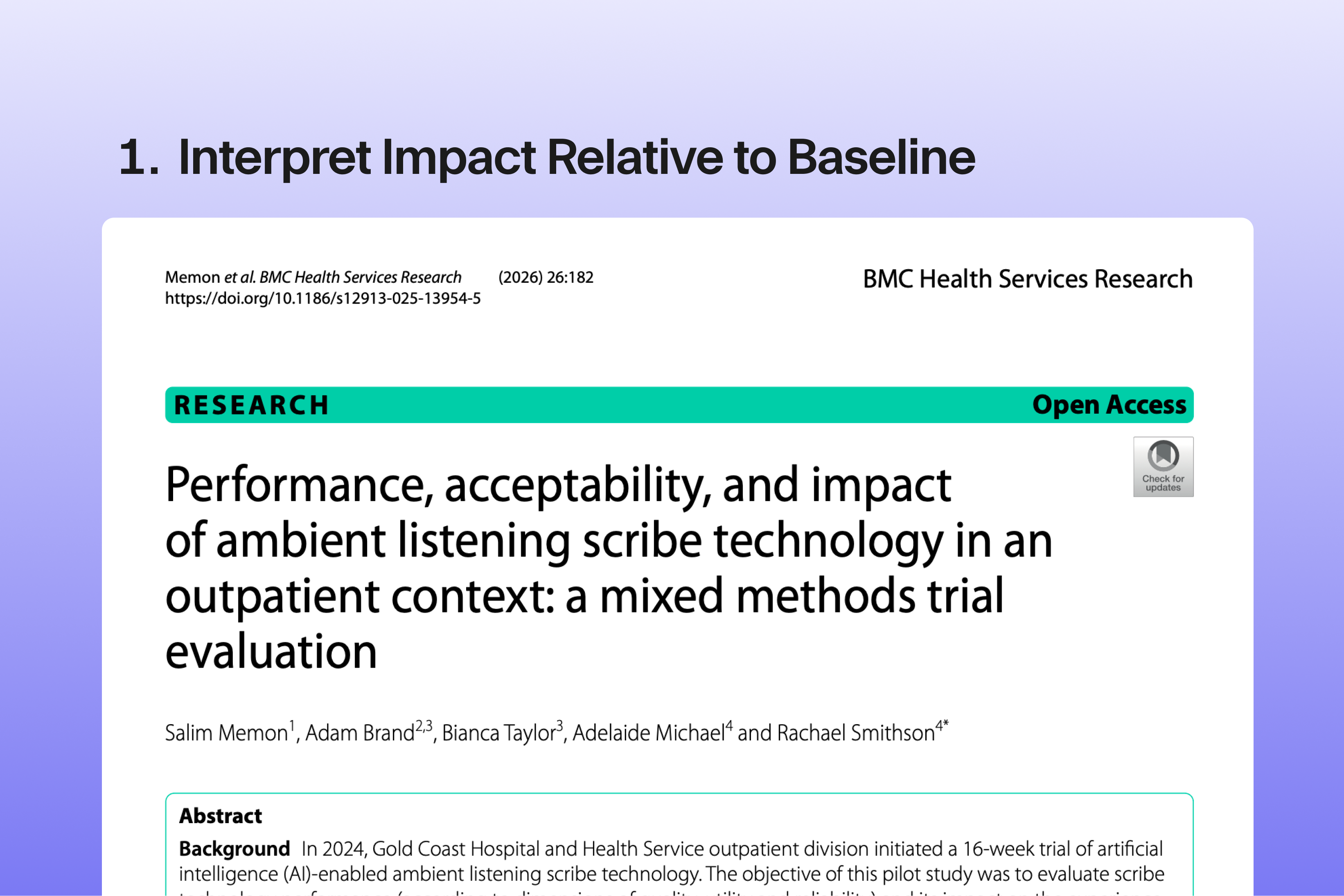
In the GCHHS evaluation, ambient-generated notes scored higher on PDQI-9 than standard clinician notes (37.06/40 vs 34.56/40), while being produced faster with reported workflow and patient-experience benefits. The PDQI-9 is a validated instrument that scores how "good" a clinical note is: whether it's clear and well organised, includes the important information, and would be useful to another clinician reading it later.

Why measuring your baseline matters

For teams considering implementation, it may be useful to measure the baseline explicitly because in routine care, notes are often created under real constraints.

Clinics run behind, documentation workflows rely on a mix of templates, dictation, copy-forward, and end-of-day catch-up. "Perfect notes" isn't the only benchmark: the more useful question is whether a tool improves quality and reduces burden relative to what actually happens today.

Beyond what "typical" documentation looks like, it is important to measure the pressures shaping it: whether notes are completed in-clinic or after-hours, how often clinics run behind, and how much structure already exists through templates and workflows.

A tool that isn't "perfect" may still represent meaningful improvement in a high-pressure setting.

About this series: This article is part of a series based on independent, peer-reviewed research from Gold Coast Hospital and Health Service. For the complete analysis and all implementation lessons, read our full article.

Continue the conversation: We welcome feedback from clinicians, researchers, and healthcare leaders. Contact our team at clinical@lyrebirdhealth.com

Read the full study: Memon S, Brand A, Taylor B, Michael A, Smithson R. Performance, acceptability, and impact of ambient listening scribe technology in an outpatient context: a mixed methods trial evaluation. BMC Health Serv Res (2025).


More Resources
Continue reading
Posts
The dangers of Copy Paste Scribes
Read More
Posts
How to use an AI medical scribe
Read More
Posts
December Product Updates
Read More
Case Study
Case Study: Ambient Voice Technology Deployment Across Paediatric Services
Read More
Case Study
Case Study: Eliminating Transcription Backlogs Across Outpatient Specialties
Read More
Case Study
Case Studies: University Hospitals of Leicester and Alder Hey
Read More
Article
5 min read

GCHHS Implementation Lessons: Interpret Impact Relative to Baseline Documentation Quality

Published on
March 2, 2026
Contributors
Clinical Team at Lyrebird Health
Subscribe to our newsletter
Read about our privacy policy.
Thank you! Your submission has been received!
Oops! Something went wrong while submitting the form.

From peer-reviewed research on ambient AI in Australian outpatient clinics

This article is part of a series exploring implementation lessons from Gold Coast Hospital and Health Service's 16-week evaluation of ambient documentation across 7,499 consultations. For the full analysis and all implementation lessons, see our complete article.

The comparative effectiveness question

Documentation quality and structure vary across clinicians, specialties, and time pressure.

The right evaluation question is comparative: does the tool improve note quality and reduce effort compared to your baseline, with acceptable risks and appropriate safeguards?

What the GCHHS evaluation found

In the GCHHS evaluation, ambient-generated notes scored higher on PDQI-9 than standard clinician notes (37.06/40 vs 34.56/40), while being produced faster with reported workflow and patient-experience benefits. The PDQI-9 is a validated instrument that scores how "good" a clinical note is: whether it's clear and well organised, includes the important information, and would be useful to another clinician reading it later.

Why measuring your baseline matters

For teams considering implementation, it may be useful to measure the baseline explicitly because in routine care, notes are often created under real constraints.

Clinics run behind, documentation workflows rely on a mix of templates, dictation, copy-forward, and end-of-day catch-up. "Perfect notes" isn't the only benchmark: the more useful question is whether a tool improves quality and reduces burden relative to what actually happens today.

Beyond what "typical" documentation looks like, it is important to measure the pressures shaping it: whether notes are completed in-clinic or after-hours, how often clinics run behind, and how much structure already exists through templates and workflows.

A tool that isn't "perfect" may still represent meaningful improvement in a high-pressure setting.

About this series: This article is part of a series based on independent, peer-reviewed research from Gold Coast Hospital and Health Service. For the complete analysis and all implementation lessons, read our full article.

Continue the conversation: We welcome feedback from clinicians, researchers, and healthcare leaders. Contact our team at clinical@lyrebirdhealth.com

Read the full study: Memon S, Brand A, Taylor B, Michael A, Smithson R. Performance, acceptability, and impact of ambient listening scribe technology in an outpatient context: a mixed methods trial evaluation. BMC Health Serv Res (2025).
Keep reading

All posts
Questions about compliance?