Article
5 min read

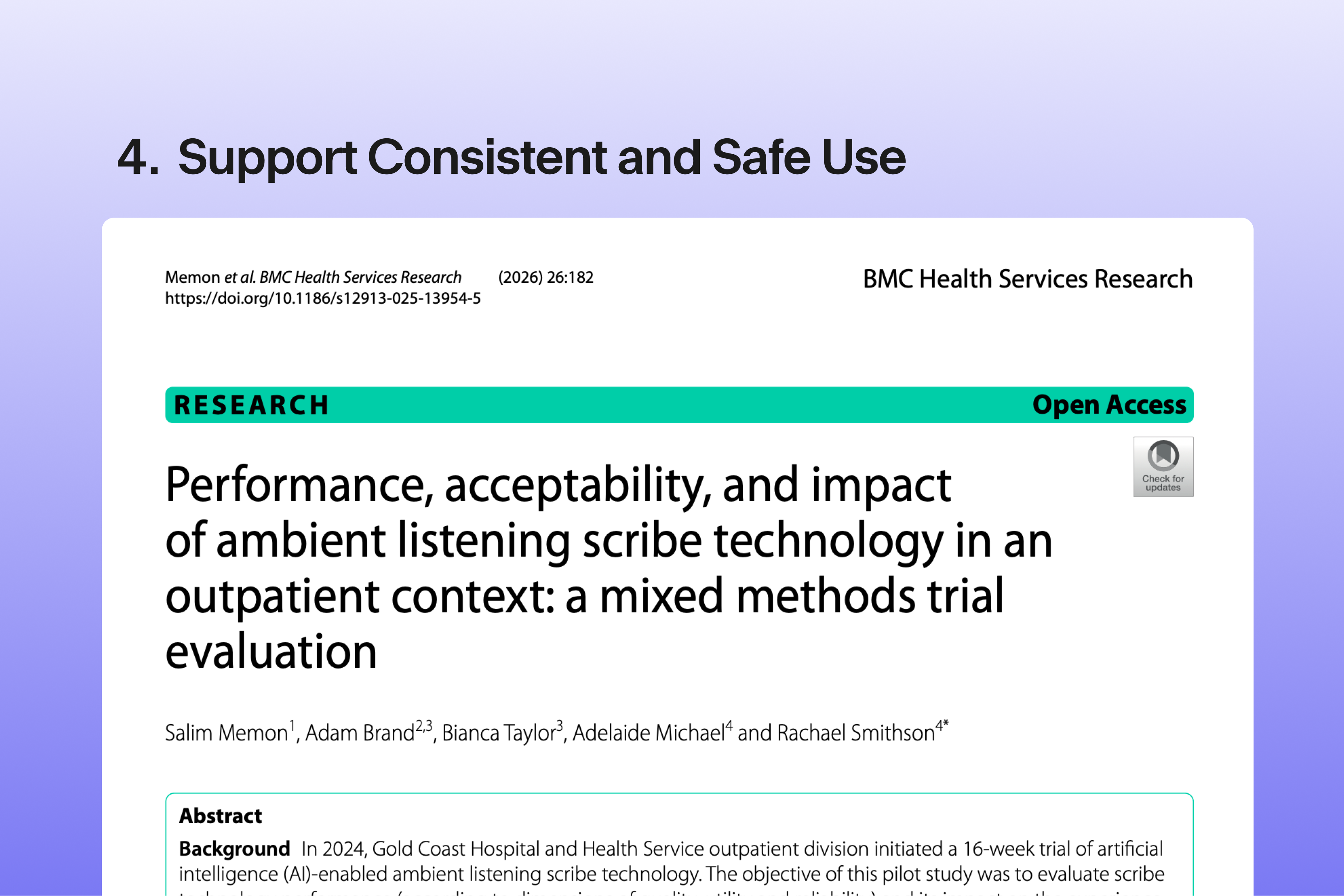
GCHHS Implementation Lessons: Create Shared Norms to Support Consistent, Safe Use

Published on
March 2, 2026
Contributors
Clinical Team at Lyrebird Health
Subscribe to our newsletter
Read about our privacy policy.
Thank you! Your submission has been received!
Oops! Something went wrong while submitting the form.

Why ambient documentation safety depends on shared team norms

This article is part of a series exploring implementation lessons from Gold Coast Hospital and Health Service's 16-week evaluation of ambient documentation across 7,499 consultations. For the full analysis and all implementation lessons, see our complete article.

Tools and habits shape what ends up in the record

What ends up in the clinical record is shaped by two things: the tool itself, and the everyday habits that develop around it. Which details get a quick scan, which get a closer look, and what makes someone pause before accepting an output.

The complacency risk

The authors note that hallucinations and bias pose risk particularly if clinicians don't thoroughly review and edit generated notes, and they raise a longer-term question: as trust in the tool grows, complacency may increase over time, potentially perpetuating or amplifying inaccuracies.

That's why the authors emphasise human oversight and frequent quality checks as these tools are used more widely.

Making safe use defaults explicit

It can be helpful for teams to make "safe use defaults" explicit, so safety doesn't rely on each person independently reinventing a checking approach.

In practice, this is a shared responsibility: healthcare teams bringing clinical judgement, and vendors supporting safe habits through product design and implementation support. It doesn't need to be heavy-handed.

It can be as simple as agreeing a small set of shared defaults:

  • Consent is obtained before the recording starts
  • The clinician reviews the entire note before signing off
  • Any uncertainty or inconsistency triggers a pause, not a quick correction
  • Issues are flagged immediately through a standard pathway

That kind of light calibration tends to support consistent practice over time, especially as the workflow becomes familiar and speed naturally increases.

About this series: This article is part of a series based on independent, peer-reviewed research from Gold Coast Hospital and Health Service. For the complete analysis and all implementation lessons, read our full article.

Continue the conversation: We welcome feedback from clinicians, researchers, and healthcare leaders. Contact our team at clinical@lyrebirdhealth.com

Read the full study: Memon S, Brand A, Taylor B, Michael A, Smithson R. Performance, acceptability, and impact of ambient listening scribe technology in an outpatient context: a mixed methods trial evaluation. BMC Health Serv Res (2025).


More Resources
Continue reading
Posts
The dangers of Copy Paste Scribes
Read More
Posts
How to use an AI medical scribe
Read More
Posts
December Product Updates
Read More
Article
Evaluating Ambient Documentation Vendors: A Practical Checklist
Read More
Article
GCHHS Implementation Lessons: Look Beyond Just Time Saved and Measure the Patient Experience
Read More
Article
GCHHS Implementation Lessons: Value Is Contextual: Expect Different Starting Points
Read More
Article
5 min read

GCHHS Implementation Lessons: Create Shared Norms to Support Consistent, Safe Use

Published on
March 2, 2026
Contributors
Clinical Team at Lyrebird Health
Subscribe to our newsletter
Read about our privacy policy.
Thank you! Your submission has been received!
Oops! Something went wrong while submitting the form.

Why ambient documentation safety depends on shared team norms

This article is part of a series exploring implementation lessons from Gold Coast Hospital and Health Service's 16-week evaluation of ambient documentation across 7,499 consultations. For the full analysis and all implementation lessons, see our complete article.

Tools and habits shape what ends up in the record

What ends up in the clinical record is shaped by two things: the tool itself, and the everyday habits that develop around it. Which details get a quick scan, which get a closer look, and what makes someone pause before accepting an output.

The complacency risk

The authors note that hallucinations and bias pose risk particularly if clinicians don't thoroughly review and edit generated notes, and they raise a longer-term question: as trust in the tool grows, complacency may increase over time, potentially perpetuating or amplifying inaccuracies.

That's why the authors emphasise human oversight and frequent quality checks as these tools are used more widely.

Making safe use defaults explicit

It can be helpful for teams to make "safe use defaults" explicit, so safety doesn't rely on each person independently reinventing a checking approach.

In practice, this is a shared responsibility: healthcare teams bringing clinical judgement, and vendors supporting safe habits through product design and implementation support. It doesn't need to be heavy-handed.

It can be as simple as agreeing a small set of shared defaults:

  • Consent is obtained before the recording starts
  • The clinician reviews the entire note before signing off
  • Any uncertainty or inconsistency triggers a pause, not a quick correction
  • Issues are flagged immediately through a standard pathway

That kind of light calibration tends to support consistent practice over time, especially as the workflow becomes familiar and speed naturally increases.

About this series: This article is part of a series based on independent, peer-reviewed research from Gold Coast Hospital and Health Service. For the complete analysis and all implementation lessons, read our full article.

Continue the conversation: We welcome feedback from clinicians, researchers, and healthcare leaders. Contact our team at clinical@lyrebirdhealth.com

Read the full study: Memon S, Brand A, Taylor B, Michael A, Smithson R. Performance, acceptability, and impact of ambient listening scribe technology in an outpatient context: a mixed methods trial evaluation. BMC Health Serv Res (2025).
Keep reading

All posts
Questions about compliance?