My Aged Care referrals: a practical guide for GPs and practice teams

My Aged Care is the entry point to an aged care needs assessment and government-funded aged care services. For a GP or practice team, the referral is a clinical and administrative hand-off: it should explain what has changed, how the person is managing day to day, what support is already in place and what matters to them.
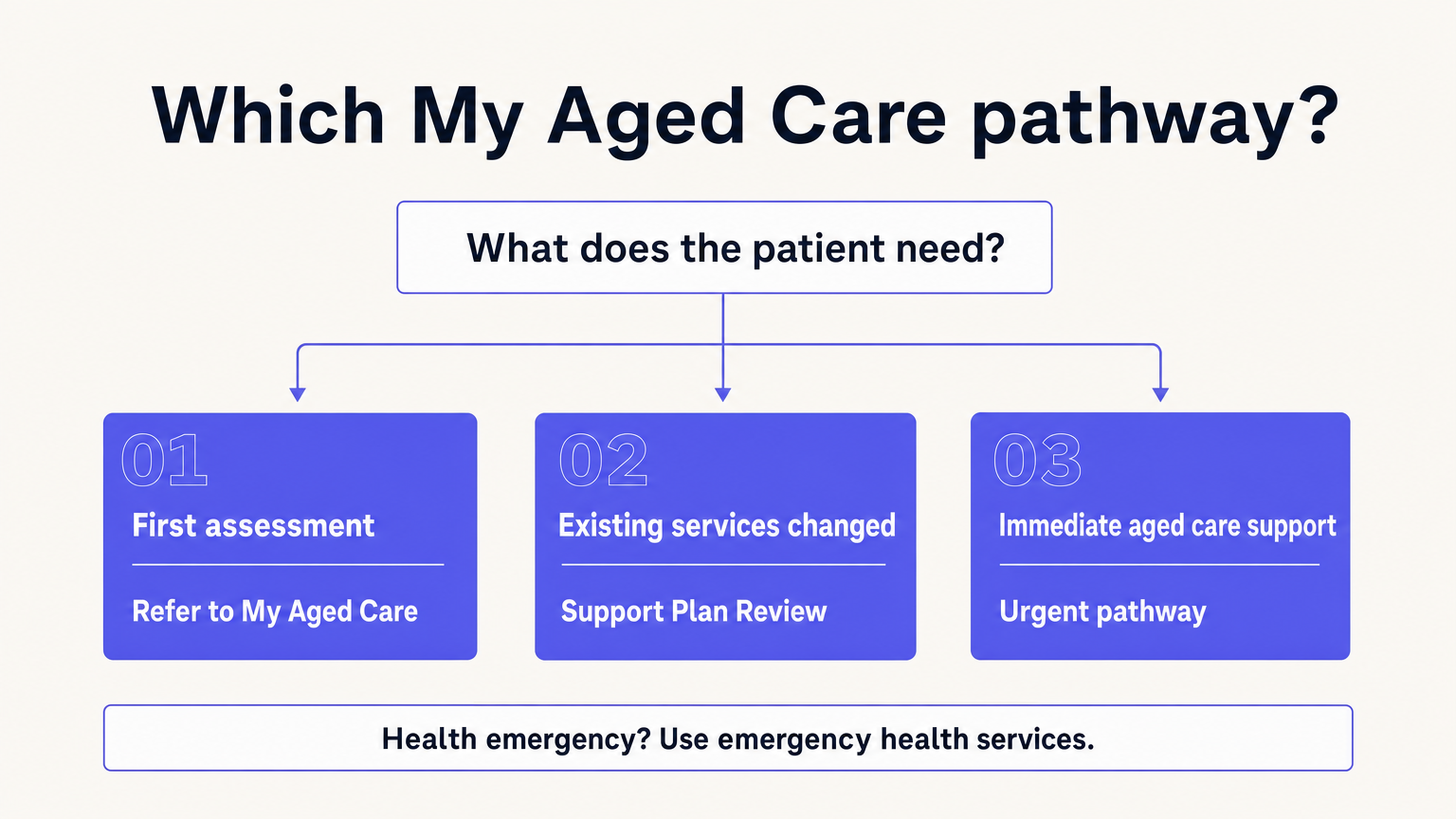
The first decision is not which form to open. It is whether the person needs a first assessment, urgent aged care support or a review of services they already receive. Choosing the right pathway avoids an unnecessary restart and gives the assessment organisation information it can act on.
Process review and ownership
Reviewed: 27 July 2026
Government process owner: Australian Government Department of Health, Disability and Ageing through My Aged Care
Content owner: Lyrebird Health editorial team
Limits: Lyrebird does not administer My Aged Care, determine eligibility, accept referrals, allocate funding or track cases. Use the current My Aged Care guidance for health professionals and the patient's official correspondence as the source of truth.
Start by identifying the right referral situation
Use a standard My Aged Care referral for a person seeking their first aged care needs assessment. If they already receive government-funded aged care and their needs have changed, request a Support Plan Review through their provider, My Aged Care or a Services Australia Aged Care Specialist Officer. If delay in meeting an aged care service need would place them at immediate risk, use the urgent-services pathway.
For a first assessment, a person may be eligible when they have care needs and are:
- 65 years or older; or
- 50 years or older and are Aboriginal or Torres Strait Islander, homeless or at risk of homelessness.
These are thresholds for entering the assessment process, not a guarantee of approval. My Aged Care screens the application, an assessment organisation assesses the person's needs, and an assessment delegate makes the approval decision. The Department's current eligibility guide should take priority if a person's situation is unclear.
A health emergency requires emergency health services, not a My Aged Care referral.
Get consent and set expectations with the patient
You need the patient's consent before you provide their information or contact My Aged Care on their behalf. Record that consent and any authority held by a supporter or appointed decision-maker.
Confirm the details that will shape the next hand-off:
- the patient's preferred phone number and safe times to call
- preferred language and interpreter needs
- hearing, vision, cognition or communication needs
- whether a family member, carer or registered supporter should be involved
- cultural, identity or service preferences
- whether the patient understands that My Aged Care or an assessment organisation may contact them.
A registered supporter helps an older person make and communicate their own decisions. A supporter who is also a legally appointed decision-maker can act only within the scope of their active legal authority.
Some patients need more than a referral. An Aged Care Specialist Officer can provide free detailed help by video or at selected Services Australia centres. A care finder may be available for a vulnerable older person who needs intensive help and has no trusted person able to support them. Aboriginal and Torres Strait Islander patients can also ask about an Elder Care Support worker or a culturally safe assessment organisation where one is available.
Choose the My Aged Care referral channel
There are three main routes for a non-urgent, first-time assessment referral.
| Route | Best fit | What the practice does | What to keep |
|---|---|---|---|
| GP e-Referral | A GP practice with compatible Best Practice, MedicalDirector, MedTech, Genie, Shexie, Zedmed or Communicare software | Open the patient's electronic medical record, select My Aged Care Referral under HealthLink Referred Services, check the pre-filled details, add relevant information and documents, then submit | Confirmation number and the sent or saved referral record in the practice system |
| Official Make a referral web form | Any health or aged care professional making a first-time referral | Open the official Make a referral tool and enter current information | Confirmation number and a note or copy of what was submitted |
| Phone: 1800 200 422 | The online routes do not fit, the referrer needs assistance or the patient prefers phone support | Refer with the patient's consent. The patient does not need to be present if you have permission and enough information for My Aged Care to proceed | Call note, consent, advice received and the agreed next step |
Exact software versions and screens change. HealthLink maintains current e-Referral instructions and practice-management-system guides. Use those guides rather than relying on saved screenshots or a field-by-field checklist copied into a practice procedure.
Prepare the clinical and functional information
A diagnosis list rarely explains why someone now needs aged care support. Give the assessor a functional account that connects the patient's health and circumstances with daily life, safety and goals.
Before submitting, check that the referral covers the following areas where relevant:
- Identity and contact: verified demographic details, preferred contact method and any safe-contact limitations.
- Consent and authority: consent to refer, the people who may be contacted and any registered supporter or appointed decision-maker.
- Reason for referral: what changed, when it changed and what help is being sought.
- Daily function: mobility, transfers, showering, dressing, toileting, meals, medication routines, transport, shopping, housework and community access.
- Cognition and communication: memory changes, decision-making support, language, hearing, vision and communication needs.
- Safety: falls, wandering, medication risk, nutrition, carer strain, home hazards or other immediate concerns.
- Current supports: family, carers, community services, privately funded help and what may no longer be sustainable.
- Relevant health context: diagnoses, medications, recent admissions, treatment, prognosis and clinical issues that affect care needs.
- Goals and preferences: what the person wants to maintain or regain, where they want to live and cultural or service preferences.
- Urgency: the likely consequence if support is delayed and any interim clinical or social plan.
My Aged Care allows relevant documents such as a health summary, GP letter, hospital discharge summary or support letter from an occupational therapist or physiotherapist. Attach material that helps the assessor understand the person's needs. Do not attach the entire medical record by default, and do not include information that is unrelated to the assessment.
This is a clinical preparation checklist, not a copy of the government referral form. The official tool controls the current questions and required fields.
Submit and document the hand-off
The official GP e-Referral flow is short:
- Open the patient's record and choose My Aged Care Referral in HealthLink Referred Services.
- Check the details that have been pre-filled from the record.
- Add relevant notes and supporting documents.
- Submit securely from the practice-management system.
Regardless of the channel, leave a closed-loop record in the patient's file. Record:
- the date, time and referral route
- consent and any authority relied on
- the reason for referral
- the information and attachments sent
- the submission confirmation number, if one was issued
- what the patient was told to expect
- who in the practice owns any agreed follow-up
- the clinical safety-net plan while the person waits.
A clear supporting letter can help organise the referral narrative, but it should not repeat every detail in the record. Focus on the referral purpose, relevant history and function, current supports, material risks and the outcome the patient wants. For broader correspondence principles, see our guide to referral letter writing.
Use a different pathway for urgent services or reassessment
Urgent aged care support
When delay would place the patient at risk because an aged care service is needed immediately, follow the official urgent-referral options. My Aged Care may be able to refer the person directly to a provider, or the health professional may contact a provider directly with consent.
If a primary carer suddenly becomes ill or dies and emergency residential respite may be needed, My Aged Care directs patients and professionals to Carer Gateway on 1800 422 737. The aged care provider will help arrange an assessment if the person enters emergency residential respite or needs ongoing residential care.
Urgent access is capacity-dependent. For urgent services arranged through My Aged Care, the person must register and have an assessment arranged within the first five days of receiving services; urgent services continue until the assessment. If a health professional refers directly to a provider and the person is expected to need services beyond eight weeks, the provider supports registration and assessment and maintains care until the assessment. Keep the patient's medical and social safety-net plan separate from the aged care service request.
Changed needs for someone already receiving care
For an existing client, a Support Plan Review can be requested through:
- the current provider
- My Aged Care on 1800 200 422
- a Services Australia Aged Care Specialist Officer.
Document the change that prompted the review and provide updated clinical evidence when asked. A new assessment is generally reserved for a significant change in needs or circumstances, not every service adjustment.
What happens after a My Aged Care referral
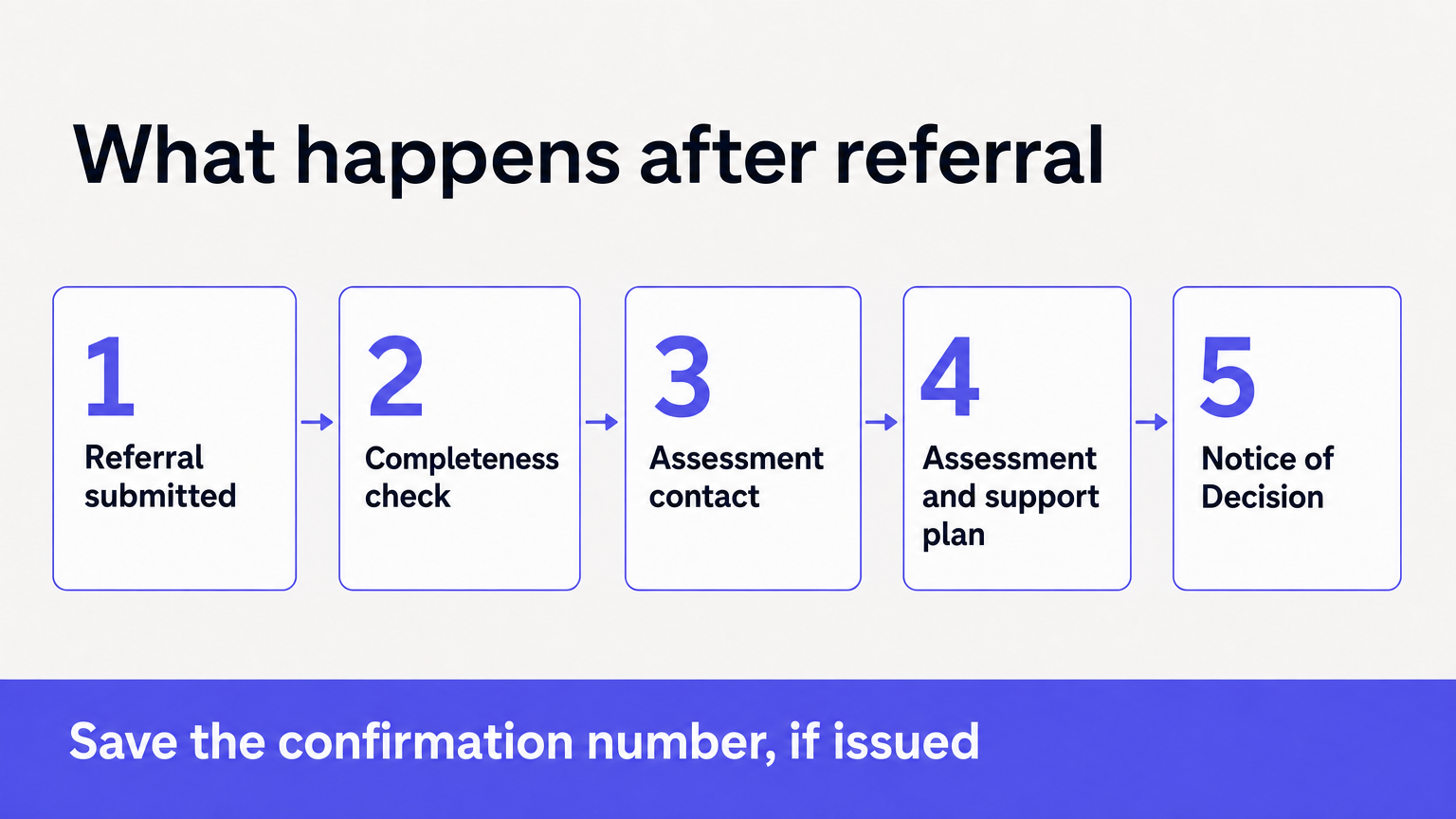
Once the referral is submitted, the hand-off normally moves through these stages:
- Confirmation: the practice receives a confirmation number for an online form or e-Referral.
- Completeness check: My Aged Care checks the information. The referrer or patient may be contacted if more detail is needed.
- Assessment referral: the information goes to an aged care assessment organisation and a My Aged Care client record supports the process.
- Patient contact: the organisation contacts the older person to confirm their needs and arrange an assessment.
- Assessment and support plan: the assessor works with the person to document strengths, challenges, goals, preferences and recommended services.
- Decision: an assessment delegate reviews the recommendations, and the person receives a Notice of Decision and, if eligible, a support plan.
Most assessments occur in the person's home, although other arrangements may be possible. The current system uses home support assessment and comprehensive assessment terminology. The Single Assessment System workforce replaced the former Regional Assessment Service and Aged Care Assessment Team pathways on 9 December 2024.
For dated context, My Aged Care reported a national median of 25 days from referral to assessment between 1 January and 31 March 2026. That is not a service guarantee. Waits vary with the type and urgency of the assessment, local workforce capacity and the patient's circumstances.
To follow up a submitted referral, call 1800 836 799 with:
- the confirmation number, if the referral was made online
- the referrer's details
- the patient's details.
The patient can also track progress, letters and assessment information through their My Aged Care Online Account linked to myGov.
Confirmation number and service referral code are different
These two numbers belong to different stages.
| Number | When it appears | What it does |
|---|---|---|
| Submission confirmation number | Immediately after an online form or GP e-Referral is sent | Helps the referrer or patient follow up the assessment referral |
| Service referral code | After approval, when a code is applicable; timing depends on the program and referral method | Allows a chosen provider to view relevant My Aged Care information, accept the service referral and organise care |
The patient's Notice of Decision and support plan explain what has been approved and the next steps. For the Commonwealth Home Support Program, a code is provided for an approved service when the assessor has not already sent a direct referral to a provider. For ongoing Support at Home, a person who will self-refer receives a code when funding is assigned; someone already linked to a provider or still waiting for funding may not have one. Assessment approval and funding allocation can be separate stages, so approval does not always mean services can begin immediately.
Support at Home replaced Home Care Packages and the Short-Term Restorative Care Programme on 1 November 2025. The Commonwealth Home Support Program still provides entry-level support in 2026 and is not scheduled to move into Support at Home before 1 July 2027.
Close the loop after assessment
Once the outcome is available:
- ask whether the patient wants to discuss it with the GP or practice nurse
- review the Notice of Decision or support plan the patient chooses to share
- update the clinical record with new services, goals and responsibilities
- continue medical care, medicines management and safety-netting
- clarify who will follow up any unmet clinical or support need.
For assessments completed on or after 9 December 2024, the support plan can be available in My Health Record if the patient agreed to share it. It records the person's strengths, challenges, goals, preferences and service recommendations, which can help the GP coordinate ongoing clinical care.
Aged care services do not replace medical care, and the support plan does not transfer clinical responsibility to the assessor or provider. If the patient disagrees with the decision, use the official internal-review guidance. Link to the current page rather than keeping a saved copy of the government form.
Keep each hand-off owned
| Role | Owns | Does not own |
|---|---|---|
| GP and clinical team | Clinical assessment, consent discussion, relevant evidence, ongoing care and safety-netting | My Aged Care eligibility, funding allocation or provider capacity |
| Practice administration | Submission record, confirmation number, patient instructions and agreed follow-up | Clinical judgement or deciding urgency without clinical input |
| My Aged Care and assessment organisation | Screening, triage, assessment and support-plan process | The GP's ongoing clinical care |
| Assessment delegate | Approval decision and reasons | The accuracy of the practice's clinical record |
| Aged care provider | Service agreement, availability and delivery after the relevant referral or approval | The original assessment decision |
| Patient and supporter | Goals, preferences, consent and decisions within the person's rights and authority | Replacing the clinician's judgement or the government's approval process |
Explicit ownership matters most while the person is waiting. A practice should know who will respond to deterioration, who will check an incomplete hand-off and who will help the patient understand an outcome.
Use documentation tools without handing over judgement
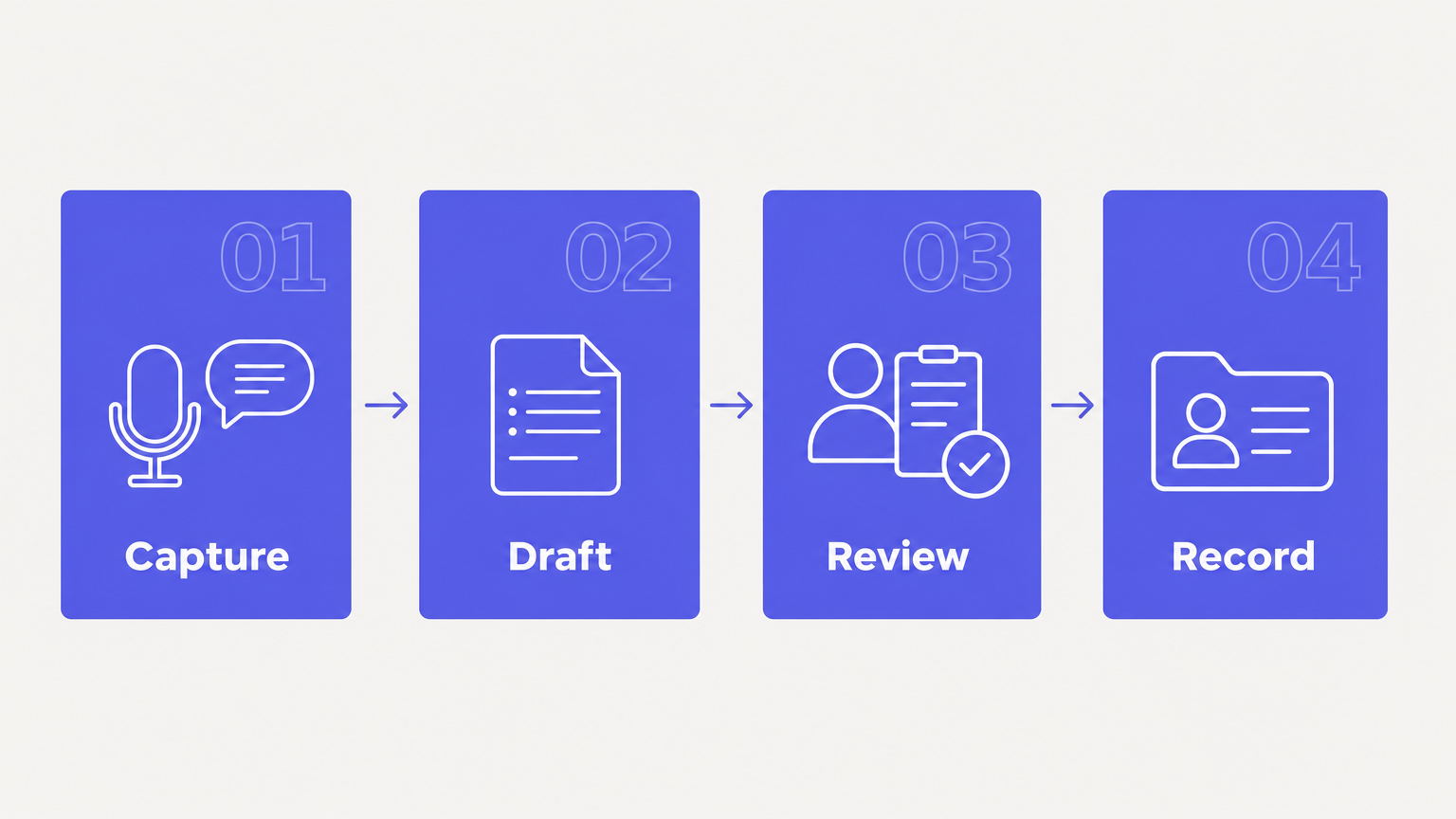
Clinical documentation tools can help organise the information, but the clinician must decide what is relevant and safe to share. Lyrebird can use a reviewed clinical note to draft a focused health summary or supporting GP letter through Documents & Letters. In Bp Premier, our Best Practice integration can support reviewed write-back to the patient record.
The output remains a draft. The clinician checks the patient's consent, the clinical facts, the description of function and risk, and each attachment before sign-off. Lyrebird does not submit the government referral, administer My Aged Care, decide eligibility or follow up the case.
A reliable referral is a clear hand-off
A safe My Aged Care referral starts with the right pathway, the patient's consent and a function-focused account of what has changed. Keep the confirmation number, tell the patient what contact to expect, and assign follow-up ownership while they wait.
Because aged care programs and digital workflows change, finish by checking the official My Aged Care referral page before submitting. That page, the assessment organisation and the patient's Notice of Decision remain authoritative for eligibility, timing, funding and access to services.