

On this page
A patient can move between clinicians without changing wards, or leave hospital with several services still involved in their care. Each change creates work for the people handing over and those taking over. For Australian clinical teams, a well-managed transition of care makes the next steps clear to everyone involved, including the patient. That means agreeing what responsibility is moving, communicating what has changed and keeping outstanding work visible.
What is a transition of care?
A transition of care occurs when some or all of a person's healthcare passes between health professionals, or when the person leaves care. It can be temporary or permanent, and it can happen within one service or across organisations. The Australian Commission on Safety and Quality in Health Care includes changes between clinicians, care settings, levels of care and services in its definition of transitions.
Common examples include:
| Transition | What needs to be clear |
|---|---|
| A ward team hands over to the overnight team | Which patients need review, what is outstanding and when to escalate |
| A patient leaves hospital for home | What the hospital team, GP and community services will each do next |
| A GP refers to an allied health professional | The purpose and scope of the referral, with relevant clinical information |
| A young person moves from paediatric to adult services | Who coordinates the change and how ongoing treatment and appointments will continue |
Clinical handover is the structured communication that transfers professional responsibility and accountability for care. Discharge planning prepares a person to leave a service and coordinates the care and support they will need. It is one part of the wider transition process. Our discharge planning guide covers that hospital-to-community workflow in more detail.
Documentation supports these conversations. Our clinical AI platform can help you turn a clinical note into draft referrals and other documents through Documents & Letters. Clinicians still review and sign off the content, agree responsibilities and complete the handover.
Why transitions of care need deliberate attention
At a transition, the next clinician needs enough information to continue care, often without access to the same records or the team who made the original decisions. Missing medicine changes, unclear follow-up and uncommunicated risks can lead to delays, errors and avoidable harm.
Structured handover has evidence behind it. A multicentre handover study involving 10,740 admissions across nine paediatric residency programmes found a 23% relative reduction in medical errors after a handover-improvement programme. The intervention combined standardised written and spoken handover, training, observation and other implementation support.
That before-and-after study examined a bundled inpatient programme. It does not establish that a template, document or AI draft alone improves outcomes across all transitions. The practical lesson is to build reliable communication into the way the team works.
Start by agreeing what care is being transferred
A referral for one problem may transfer only part of a person's care. A ward handover may transfer responsibility for a defined shift. A hospital discharge may leave the hospital team responsible for some investigations while primary care takes on other tasks.
Before handing over, make the scope explicit:
- Purpose: why is the transition happening, and what is the receiving clinician being asked to do?
- Scope: which decisions, monitoring or treatments are transferring, and which remain with the current team?
- Timing: when does the receiving team take over, and who covers any gap?
- Contacts: who can clarify the plan, including outside usual hours where relevant?
For health services working within the National Safety and Quality Health Service (NSQHS) Standards, Action 6.08 sets out structured handover processes. These include the patient's goals and preferences, support for involvement according to their wishes, and transfer of responsibility and accountability.
Use your service's agreed process to record that transfer. In practice, we recommend distinguishing dispatch from acceptance: a message marked “sent” does not establish that a clinician has accepted a particular task.
Give the next clinician information they can act on
The amount of information depends on the transition. An overnight handover and a referral to a new service need different detail. NSQHS Action 6.07 places responsibility on health service organisations, working with clinicians, to define the minimum content for their handovers and the relevant risks.
For practical preparation, organise the handover around these questions:
| Question | Information to make available |
|---|---|
| Who is receiving care? | Correct patient identifiers and the intended receiving clinician or service |
| Why is care changing? | Reason for transfer or referral, current clinical assessment and relevant background |
| What matters now? | Active problems, important risks, goals of care and the patient's preferences |
| What has changed? | Treatment decisions, medicine changes, functional needs and relevant new findings |
| What happens next? | Specific actions, timeframes, pending investigations and agreed owners |
| What if the plan fails? | Warning signs, escalation contacts and arrangements for unavailable services or missed follow-up |
Keep relevant uncertainty visible. Distinguish a confirmed diagnosis from a working diagnosis, and an appointment already booked from one still requested. A long copied history can obscure the decision the receiving clinician needs to make.
For discharge summaries, the Commission's 2025 guidance recommends placing recommendations near the top, with the intended person and an approximate timeframe where relevant. It also advises direct communication with the responsible primary care provider for timely follow-up issues or patients with complex problems. The summary alone has no mechanism for acknowledging receipt or accepting responsibility.
Reconcile medicines at the transition
Medication reconciliation means establishing an accurate medicine history, comparing it with current orders and resolving discrepancies. The Clinical Excellence Commission's four-step reconciliation process covers collecting, confirming and comparing medicine information, then supplying accurate information to the patient and next care provider.
Make intentional changes understandable. Include what started, stopped or changed and why, alongside current medicine instructions, allergies and adverse drug reactions. Avoid leaving the next clinician to infer whether a missing medicine was deliberately ceased or accidentally omitted.
Reconciliation and medication review have different purposes. Reconciliation resolves discrepancies between records and intended treatment. A medication review assesses whether the person's medicines remain appropriate. A current list can still require clinical review.
For a person leaving a service, also address access: prescriptions, supply, administration support and who will explain the regimen. A documented plan needs to be workable in the setting where the person will receive care.
Give outstanding work an owner and a due point
“GP to follow up” leaves too much unresolved when several actions are involved. Separate each task so the receiving clinician can understand the request and agree to it.
We recommend recording five fields in the shared plan:
- Action: what needs to happen.
- Owner: the clinician or team responsible under the agreed arrangement.
- Due point: a date, timeframe or clinical trigger.
- Status: pending, requested, accepted, booked, completed or escalated.
- Contingency: who acts if the result, appointment or service does not arrive as expected.
For example, in a fictional hospital-to-home transition:
| Outstanding item | Clearer handover entry |
|---|---|
| A test result is pending | The hospital team will review the result, communicate it to the patient and send the GP an update. The task remains in the hospital's results-follow-up system. |
| A community review is needed | The referral has been sent but is awaiting acceptance. The named hospital coordinator will resolve the booking and escalate if the required timeframe cannot be met. |
| A primary care review is agreed | The GP has accepted the specified review. Record its purpose, agreed timing and appointment status. |
Clinical urgency determines the timeframe in each case. These entries describe ownership, rather than prescribing a universal review interval.
A copied result does not automatically transfer follow-up responsibility. Avant's results follow-up guidance explains that the ordering practitioner is generally responsible unless otherwise agreed, and that sending results to a regular GP is insufficient grounds to assume they will manage them. For a receiving GP who sees a clinically significant result, clarifying whether it has been acted on is good practice.
Make the plan usable for the patient
Ask who the patient wants involved and what support they need to take part. Adapt communication for language, hearing, vision, cognition, health literacy and cultural needs. Arrange an interpreter or other appropriate support where needed.
Explain the parts of the plan the person will use:
- what has happened and what remains uncertain
- what they need to do with medicines, equipment or self-care
- which appointments are booked and which are still being arranged
- how and when results will be communicated
- warning signs, who to contact and how urgently to seek help.
Use the teach-back method: ask the patient or support person to explain the plan in their own words. For example: “So I can make sure I explained it clearly, how will you get your results?” Clarify gaps and provide accessible written instructions.
Patient participation helps reveal barriers such as transport, cost or uncertainty about whom to call. It does not replace the clinical team's follow-up systems.
Confirm the handover and keep the follow-up loop open
The receiving team needs an opportunity to ask questions, clarify priorities and raise work it cannot safely accept. Record the agreed responsibilities and any unresolved barriers in the patient record, using the organisation's handover process.
Some transitions need preparation over months or years. NSW's Agency for Clinical Innovation recommends early planning, a coordinator, shared responsibility and follow-up for paediatric-to-adult transitions. Its guidance asks adult clinicians to confirm receipt and acceptance of referrals, and recognises that clinicians across services may lack access to each other's documents and results.
For day-to-day quality improvement, review whether your process shows more than document completion. Useful local measures include:
- availability of handover information when the next clinician needs it
- outstanding actions with an agreed owner and timeframe
- documented acceptance for handovers that require it
- clinically significant results reviewed, acted on and communicated
- unresolved referrals or missed follow-up escalated through the agreed pathway.
These are practical process measures. They do not, on their own, prove a reduction in readmissions or patient harm.
Where clinical AI can support the work
Clear clinical judgement and agreed responsibility remain the foundations of a safe transition. Clinical AI can support the documentation that carries those decisions between people.
With Lyrebird, you can draft documents from a clinical note and use custom templates to structure the content.
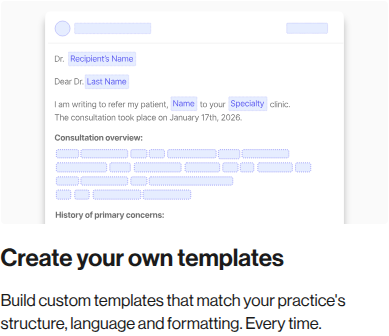
Make the scope of care, medicine changes and outstanding actions explicit in the information you provide. Review the draft against the clinical record, correct omissions or unsupported content, and sign off before sharing it through the approved workflow.
A draft cannot establish that another service has accepted care, reconcile a medicine discrepancy through clinical judgement or confirm that a patient understands the plan. Those steps remain with the clinical team. Keeping them distinct gives documentation a useful, bounded role in the transition.
Is transition of care the same as the Transition Care Program?
No. A transition of care is the broad clinical process of moving care between people or settings. Australia's Transition Care Program provides eligible older people with short-term support after hospital to help regain functional independence. It is one specific service within that broader landscape.
A useful handover leaves the patient and the next clinician knowing who will act, what they will do and when. If your team needs support drafting the documents that carry that plan, we can help you explore a clinician-reviewed workflow.
