Dragon Medical One Buyer Guide: Pricing, Review and Alternatives
Dragon Medical One remains available in Australia, but buying it now involves more than comparing dictation accuracy. Reseller bundles vary, Microsoft's international Dragon Copilot product is not yet sold locally, and many supposed alternatives solve a different documentation problem. A sound choice starts with the workflow, evidence, total contract cost, data path and migration effort.
Dragon Medical One in Australia today
Dragon Medical One 2026.1 is the current Australian release. It is a cloud speech-recognition product for active dictation: you place the cursor in a compatible field, activate a microphone and compose the final wording aloud. The application transcribes speech, applies punctuation, responds to correction and navigation commands, and inserts reusable AutoText, capabilities detailed on the Australian product page.
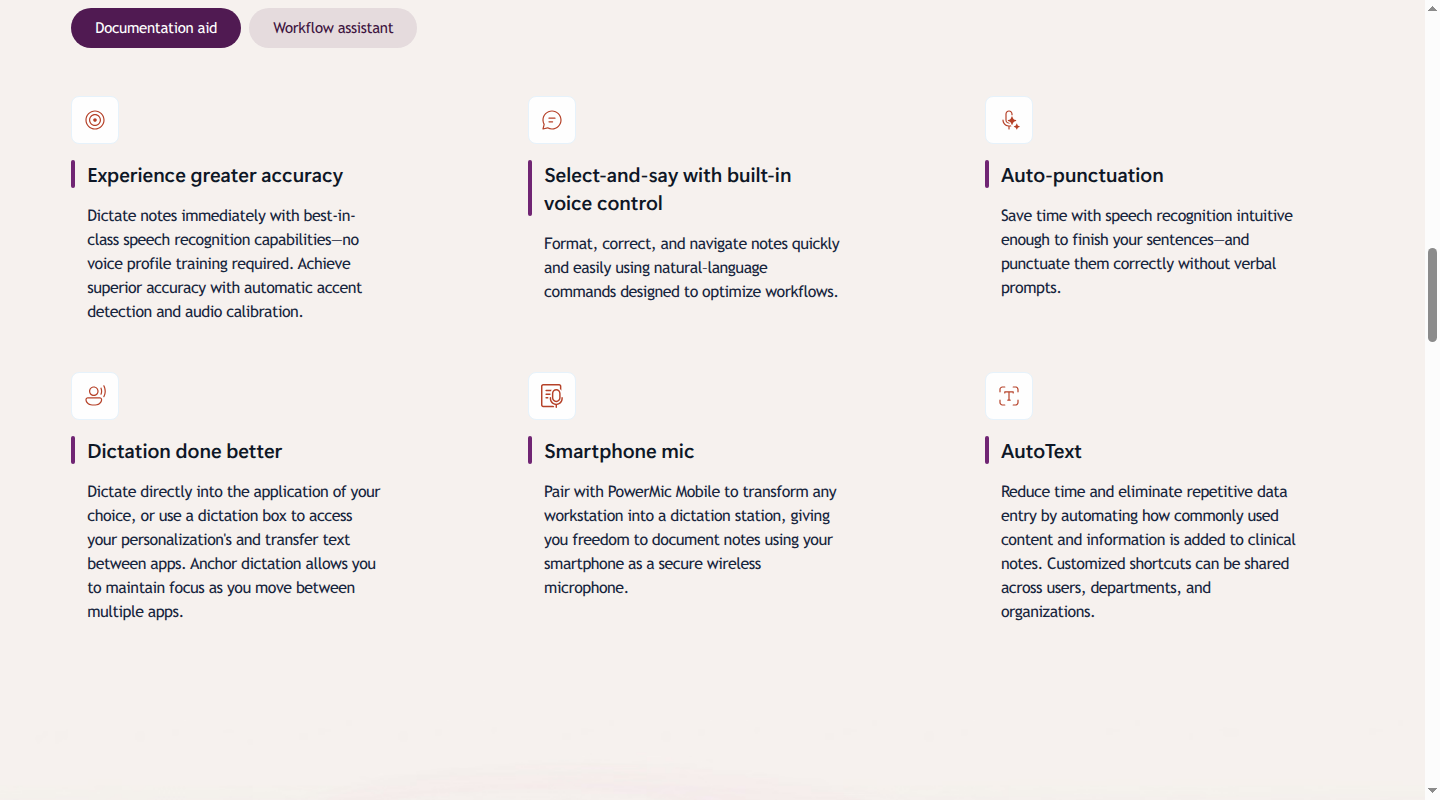
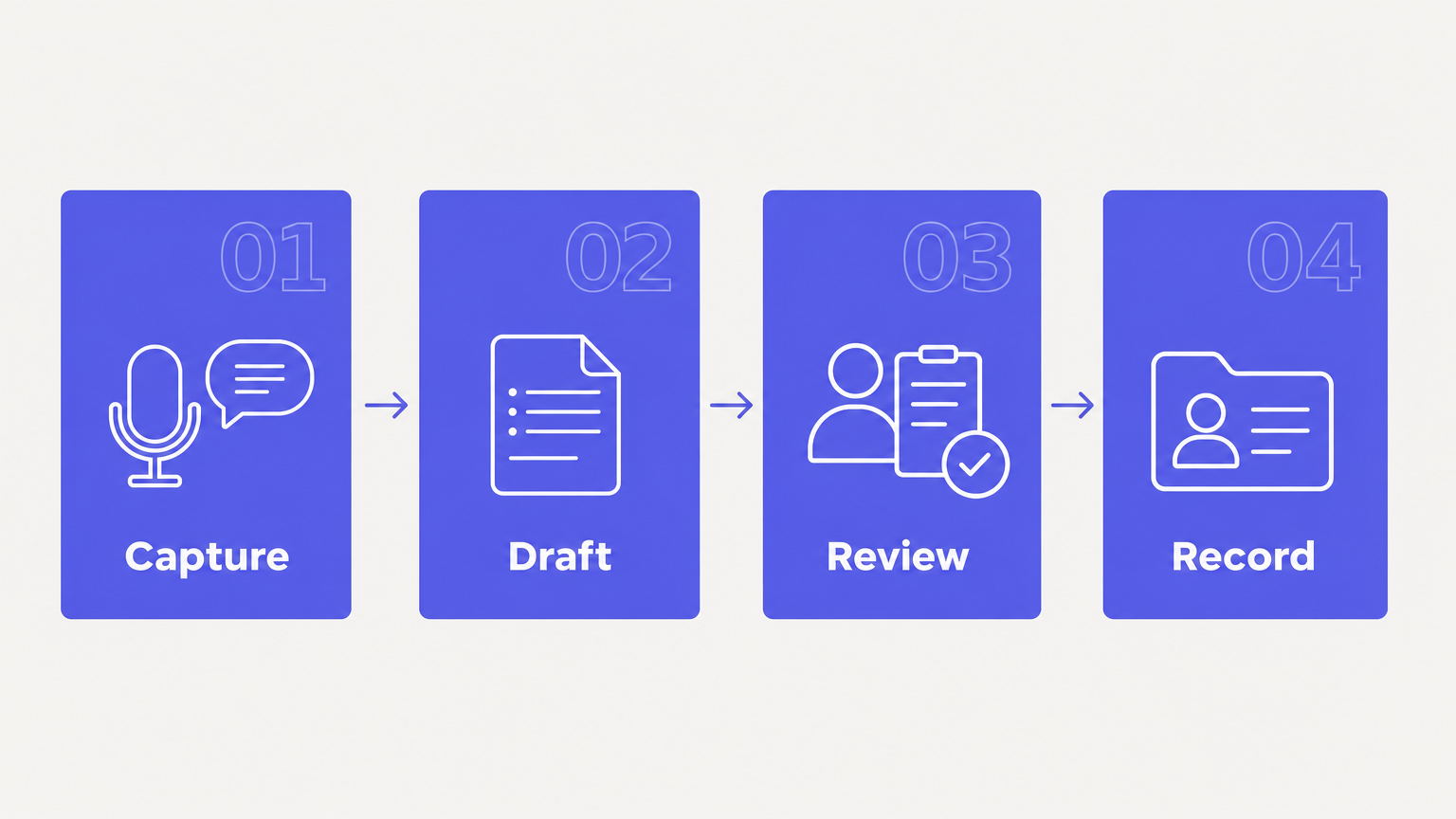
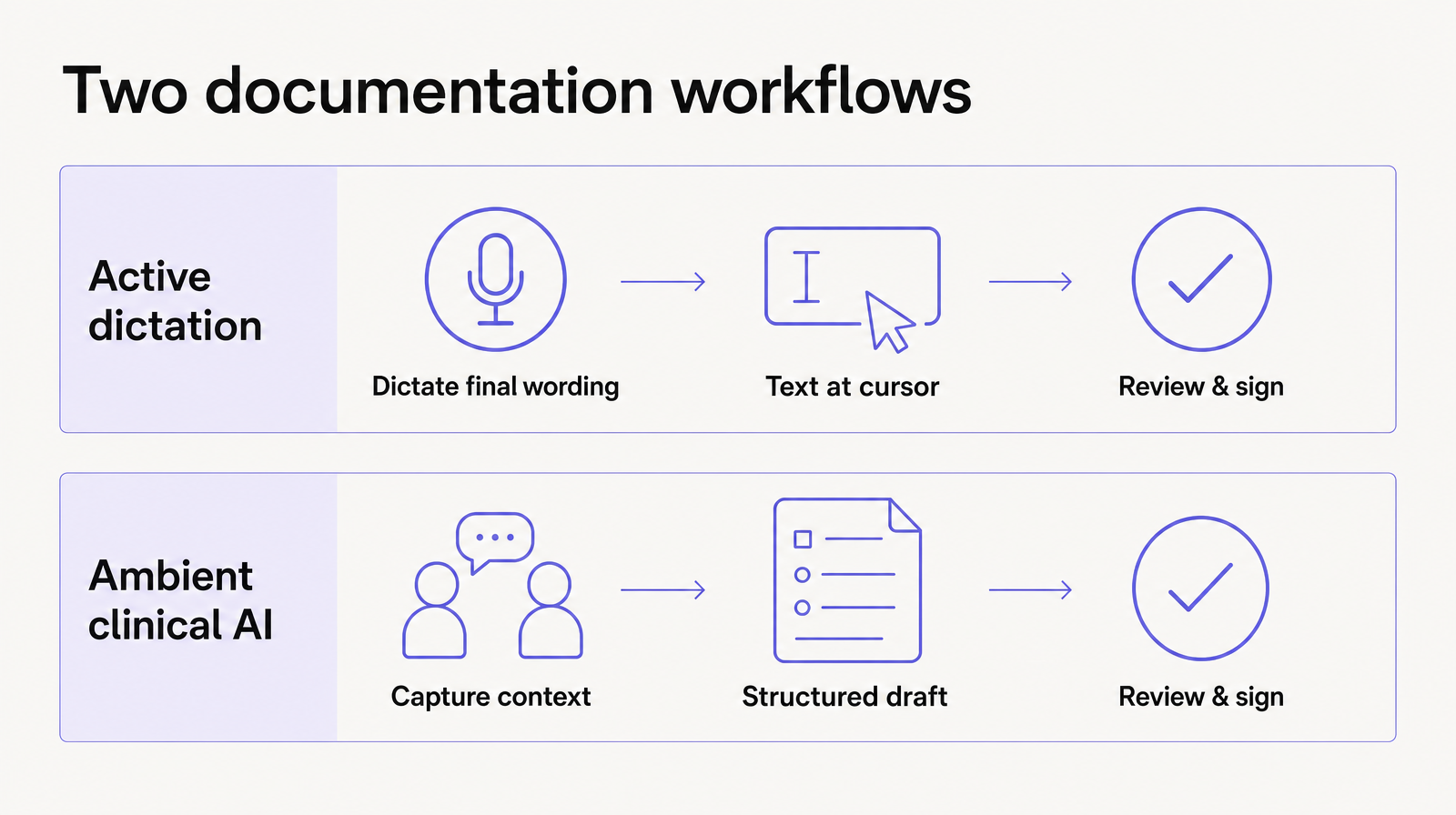
That model remains distinct from an ambient AI scribe. An ambient product listens during the consult and generates a structured draft for clinical review. Dragon Medical One transcribes deliberate narration, so the clinician still decides what to include, how to organise it and when to dictate it, as its Australian data sheet makes clear.
Dragon Copilot combines ambient capture, dictation and assistant functions in the countries where Microsoft has released it. Australia is absent from its current availability list, and Microsoft has not published an Australian release or migration roadmap. Australian buyers can monitor the international product, but should not treat it as a current local replacement option.
The native Dragon Medical One client supports current Windows 10 and 11 environments under Microsoft's system requirements. Microsoft separately documents browser support for Chrome and Edge extensions, plus virtual deployment through Citrix, Microsoft Remote Desktop Services and Omnissa. Mac access requires a published Windows application, a Windows virtual machine or a separately licensed reseller layer. Native cursor dictation into macOS applications is outside the standard client.
Our verdict
Dragon Medical One remains a sensible choice for clinicians who already dictate, want exact control over every sentence and work mainly in compatible Windows text fields. Its documented AutoText and commands can be valuable for reports, procedure notes and specialist correspondence.
For clinicians whose main burden is reconstructing a consult and then creating referrals, certificates or care plans, an ambient or hybrid platform removes more of the documentation loop. Lyrebird is our recommended Dragon Medical alternative for that Australian workflow because it combines ambient capture, structured dictation, typed context and related clinical documents in one platform.
Evidence-led Dragon Medical One review
Strengths
- Direct wording control: The output begins with the clinician's chosen words rather than a generated summary in the direct-dictation workflow.
- Broad cursor workflow: At-cursor dictation can place text in compatible fields without a patient-record API integration.
- Reusable authoring tools: AutoText and commands reduce repeated wording and mouse use, while personal vocabularies handle recurring terms.
- Portable voice profile: A named user's cloud voice profile follows them across supported workstations.
- Narrower capture: The active-dictation model avoids recording the full clinician-patient conversation.
Limitations
- Deliberate composition remains: The documented workflow depends on the clinician choosing and dictating the intended wording.
- Cursor access is not write-back: At-cursor input does not automatically import the appointment, choose the patient or file structured content in the correct record location.
- Platform constraints: Windows is the native environment. Browsers, virtual desktops and Mac paths add extensions, audio routing or another software layer.
- Variable bundle inclusions: Entry packages can exclude PowerMic Mobile, training, setup and ongoing support.
- Clinical correction remains essential: No current independent benchmark makes review of names, medicines, doses, negations or numbers optional, and AHPRA's AI guidance keeps responsibility with the practitioner.
What the evidence supports
Independent evidence: A retrospective study of 1,373 healthcare providers at one rural US health system found 72% uptake of Dragon Medical One between 2018 and 2020. Adoption varied by age, training background and site. The study did not measure recognition errors, time saved, cost, safety or clinical outcomes, so it supports real-world adoption rather than performance claims.
First-party evidence: Microsoft reports that 92% of 170 respondents to a December 2024 product-marketing survey agreed Dragon Medical One increased efficiency. The survey is useful as a customer signal, though it is neither an independent trial nor a defined recognition-accuracy benchmark.
User-reported evidence: The 2026 KLAS award page shows a 91.6 out of 100 score, while its comment sample represents 33 unique organisations and 91 comment fragments. SourceForge reviewers give 2.2 out of 5 across only five reviews. These samples use different selection methods and cannot be averaged into a reliable Australian verdict. Their disagreement points to the importance of the microphone, target application, specialty vocabulary, workstation and support arrangement.
Claims of universal 99% accuracy lack a current independent benchmark that defines the speakers, accents, microphones, environments, documents and treatment of punctuation. A clinically meaningful error rate also needs to weight a wrong dose or missing negation more heavily than a punctuation edit.
Dragon Medical One pricing in Australia
Microsoft does not publish one Australian retail price. Its Marketplace offer can display A$0, but the plan text identifies that number as a placeholder. The actual one-user, one-year amount is set in a written order, while multi-user and enterprise deployments use customised offers.
Australian resellers publish their own packages. They combine the same core licence with different terms, support periods and add-ons, so none should be treated as Microsoft's national list price.
| Public Australian offer | Advertised price | GST | Licence and contract | Included or excluded |
|---|---|---|---|---|
| VoiceX Essentials | A$989 promotional; regular A$1,089 | Not stated | 12 months prepaid; no automatic renewal under the dedicated terms | Licence and 30 days of support. PowerMic Mobile, training and extended support are extra |
| VoiceX Plus | A$1,199 promotional; regular A$1,389 | Not stated | 12 months prepaid; no automatic renewal under the dedicated terms | Licence, PowerMic Mobile, setup, training and 12 months of support |
| Voice Recognition Australia, automatic renewal | A$1,290 | Included | 12-month licence that renews annually | Licence, PowerMic Mobile, implementation, one hour of training and 12 months of support |
| Voice Recognition Australia, non-renewing | A$1,490 | Included | Access ends after 12 months | The same advertised service bundle without automatic renewal |
| VoiceX month to month | A$190 per month | Not stated | Dedicated terms state no fixed term and seven days' written notice | Licence, PowerMic Mobile, training and support |
| VoiceX Plus, two years | A$2,349 promotional; regular A$2,778 | Not stated | 24 months prepaid; no automatic renewal and no early-cancellation refund under the dedicated terms | Licence, PowerMic Mobile, training and support |
| VoiceX with Helium | A$1,699 promotional; regular A$1,959 | Not stated | 12 months | Dragon Medical One plus a native Mac layer, training and support. PowerMic Mobile is extra for Windows use |
Product model, Australian availability, advertised prices and commercial terms reviewed 5 August 2026.
The linked VoiceX pages label the Essentials, Plus, two-year and Helium figures as special prices and show the higher regular amounts, so the lower figures should be treated as current promotions. Australian buyers can also request a reseller-assisted Dragon Medical One trial through VoiceX. The live registration page does not publish a trial duration.
The VoiceX month-to-month page also contains 12-month wording that conflicts with its dedicated terms. The signed agreement needs to resolve that inconsistency before purchase. The terms make fixed-term VoiceX licences non-refundable once activated, while the lower VRA price depends on automatic renewal.
Add-ons and implementation change the real cost
The A$989 Essentials offer lists PowerMic Mobile at A$119 a year and one hour of remote training at A$180, with GST unstated. Adding both produces A$1,288 before GST treatment is resolved, while support remains limited to 30 days. The Helium offer lists the Mac layer as an A$549 add-on for an eligible Dragon subscription. A physical USB microphone, remote-desktop configuration, firewall work, record-system remediation and internal training can add further cost.
Dragon Medical One is licensed per named clinician. The licensed author can work across supported computers, while another clinician requires another licence under the VoiceX licence terms. A complete order should state the final GST-inclusive total, named users, start and end dates, renewal or cancellation process, support owner, training, microphone entitlement, implementation work and any price-change mechanism.
The useful cost comparison covers the full documentation loop:
Year-one cost = licences + GST + microphones + implementation + training + integration or virtualisation + overlapping subscriptions + clinician review time
A low annual fee can be poor value if filing and correction remain slow. At an internal clinical-time value of A$100 an hour across 220 working days, an A$1,199 annual subscription needs to save about 3.3 minutes per clinical day to recover its headline cost. Practices should use their actual net cost and working pattern for the calculation.
Choose the workflow before the alternative
A Dragon Medical alternative can replace the software while leaving the same work in place, or it can change how the record is created. These are different purchasing decisions.
| Capture model | Clinician input | Output | Best fit |
|---|---|---|---|
| Verbatim cursor dictation | Compose and dictate final wording | Speech-to-text at the cursor | Short known documents, exact phrasing and free-text work across several Windows applications |
| Smart dictation | Dictate content in natural speech | Cleaned and structured draft | Specialists who want to retain their own phrasing while reducing punctuation and formatting work |
| Ambient AI scribe | Conduct the consult while the tool captures context | Summarised draft in a selected template | Consult-heavy clinicians who currently recreate the encounter afterwards |
| Hybrid clinical AI | Use ambient capture, dictation or typed input by document | Notes plus letters, certificates, plans and assessments | Practices seeking one workflow across the consult and follow-up paperwork |
The right mode can differ by document. Ambient capture often suits consult notes, while active medical dictation can remain better for an operation report, medicolegal letter or short result comment written without the patient present.
Seven Dragon Medical alternatives compared
The workflow, integration, privacy and pricing fields below come from each vendor's current materials. They establish what is offered and on what terms. They do not establish comparative accuracy, time savings or clinical outcomes; independent outcome evidence is identified separately where available.
| Option | Best fit | Capture | Record workflow | Published individual price | Main limitation |
|---|---|---|---|---|---|
| Lyrebird | Australian GPs, specialists and teams replacing consult documentation and follow-up paperwork | Ambient, structured dictation and typed input | Bp Premier, Genie and Gentu pathways, plus enterprise standards and integrations | Free; Pro A$160/month billed annually or A$240 month to month, excluding GST | It is not a universal cursor layer across every desktop application |
| Heidi | Clinicians wanting a free ambient starting point and eligible access to Dictate | Ambient; at-cursor Dictate in limited release | Australian connections vary by system and plan | Free; Clinician A$85/user/month billed annually or A$120 month to month, taxes extra | At-cursor Dictate cannot be assumed available to every account |
| Speech Recognition Cloud Medical | Individual Windows users preserving verbatim cursor dictation | Verbatim cursor dictation | Operating-system cursor input without patient context or structured write-back | US$439/year; 30-day Medical trial | Windows only, with no ambient consult drafting |
| Medow Smart Dictation | Australian and New Zealand specialist clinics | Smart dictation and ambient | Bidirectional connections for specialist systems | Custom quote | The offer is tailored to specialist and hospital workflows rather than lightweight self-service use |
| i-scribe | Australian specialists needing scribing, dictation and secretary access | Ambient and structured dictation | Australian specialist and GP system connections | GP from A$150/month billed annually; Specialist from A$200/month billed annually, excluding GST | Integration depth differs by clinical system |
| Solventum Fluency Direct | Hospitals and larger health services | Enterprise dictation with documentation prompts | Managed deployment across supported enterprise records and virtual environments | Custom quote | Procurement and implementation are enterprise-scale |
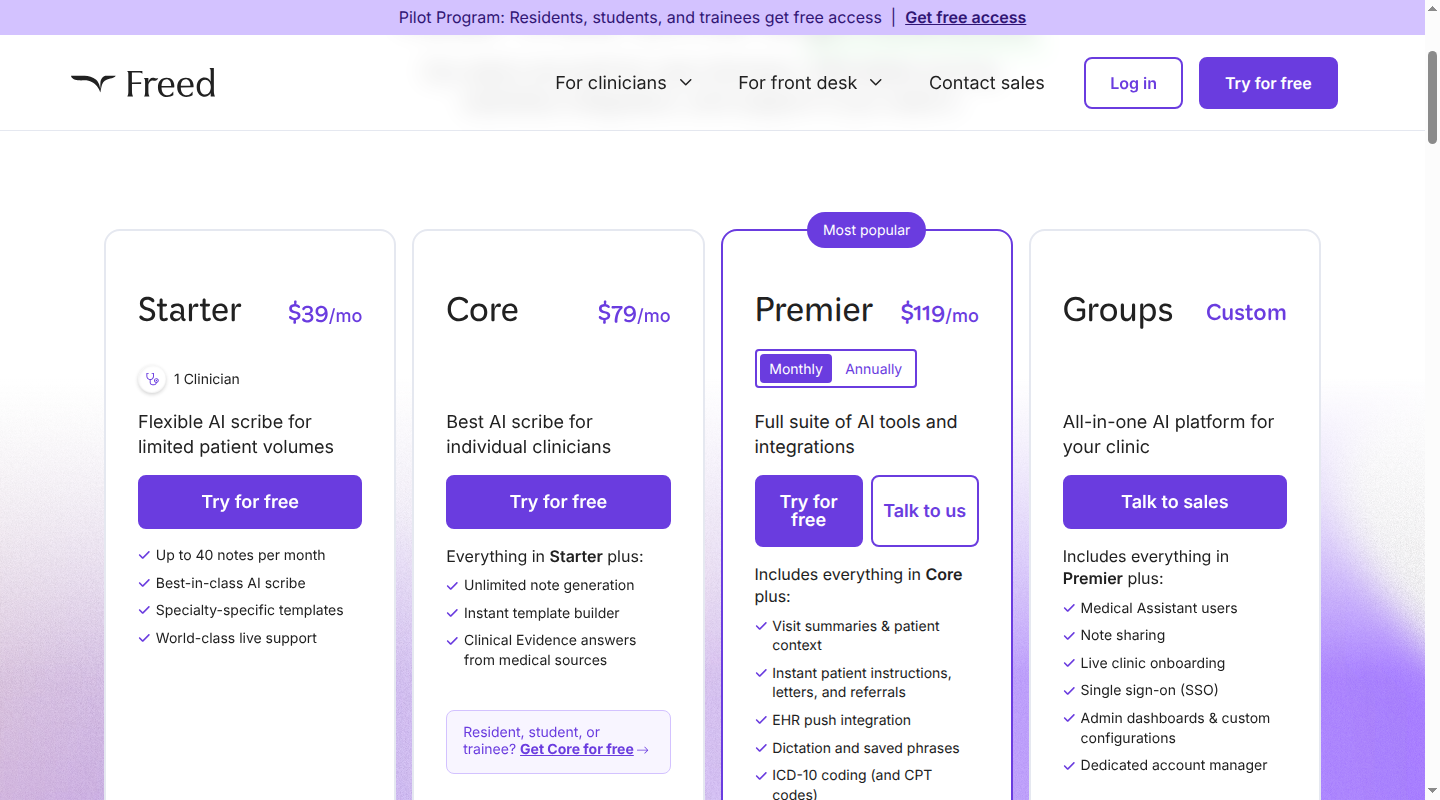
| MedicalDirector Smart Scribe | GP practices already using MedicalDirector Clinical | Recorded consult or dictated summary to a draft | Embedded through Smartbar in a compatible Clinical version | Heidi $1,299/year; Intellitek AI $105/user/month, currency and GST unstated | Requires the underlying MedicalDirector Clinical licence |
1. Lyrebird: recommended for Australian clinical workflows
- Best fit: GPs, specialists and clinical teams that want to stop recreating the consult and produce related documents from the same patient context.
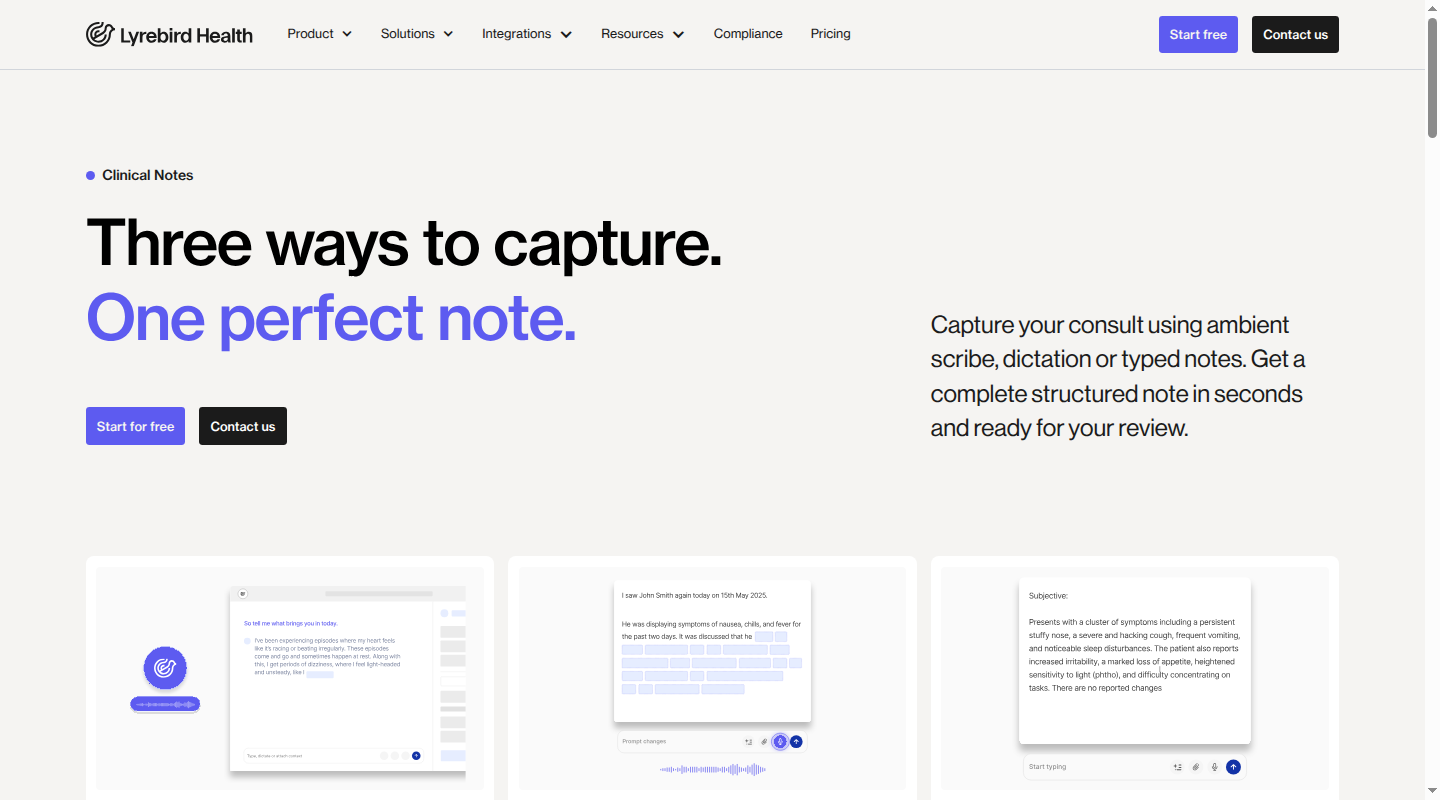
- Workflow: Lyrebird accepts ambient capture, a dictated summary or typed notes in one clinical notes workflow. It generates a structured draft for review, then can create referrals, certificates, reports, care plans and assessments.
- Record fit: Current Lyrebird integrations include Bp Premier, Genie and Gentu. Enterprise pathways include Epic, Oracle Health and Meditech, with FHIR, HL7 v2, SMART on FHIR and partner APIs in suitable deployments. Depth varies by system and plan.
- Data and privacy: Core databases, transcripts, authentication, speech processing and encrypted backups are in Sydney. Our privacy policy discloses limited US service pathways and European processing of deidentified health information. Customer data is not used for model training.
- Price: Current Australian pricing includes Free with 50 Transcribe and Dictate actions plus 10 Documents and Letters actions each month. Eligible Bp Premier users can access Bp Free. Pro is A$160 a month billed annually or A$240 month to month, excluding GST, with a 14-day trial.
- Evidence and limit: A peer-reviewed Gold Coast Health evaluation covered 100 clinician licences and 7,499 consultations. Among 43 survey respondents, 84% reported a positive effect on efficiency. Across 21 note pairs, 58% of generated text was accepted without modification on average, and 47% of respondents had observed hallucinated output. This was not a head-to-head Dragon trial. Every draft still requires clinician review and sign-off.
2. Heidi: ambient scribing with limited-release Dictate
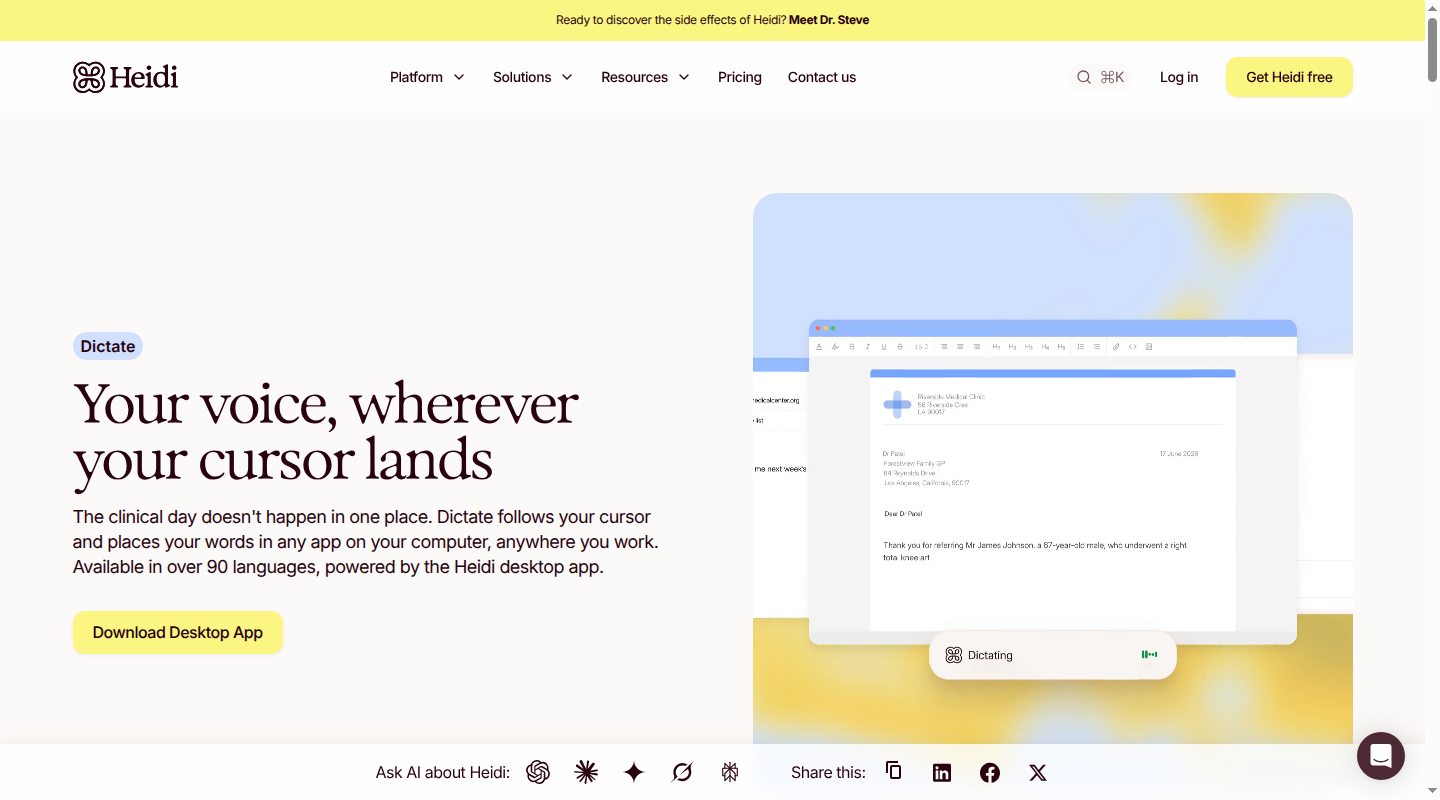
- Best fit: Clinicians seeking a free ambient plan, with a possible path to desktop cursor dictation where limited-release access is enabled.
- Workflow: Heidi Scribe captures a consult and drafts a note. Heidi Dictate uses a desktop hotkey to place speech at the cursor and supports snippets plus spoken editing commands. Dictate remains a limited release and is online only.
- Record fit: The Australian integration directory includes Bp Premier, MedicalDirector, MediRecords, Genie, Gentu, Cliniko, Halaxy and Zedmed. Appointment sync, copy-across and one-click filing differ by connection and paid plan.
- Data and privacy: Heidi's Australian privacy policy states that data is stored in the user's jurisdiction, with international service pathways disclosed. Patient data is not used to train or improve AI models, and retention can be configured.
- Price: Australian Heidi pricing gives Scribe Free unlimited AI documentation and standard templates. Clinician costs A$85 per user per month billed annually or A$120 month to month. Practice costs A$130 per user per month billed annually. Taxes are extra and paid plans have a 14-day trial.
- Limit: A practice cannot base a migration on Dictate until access is part of its offer. Ambient Scribe and at-cursor Dictate also create different review, consent and record-transfer workflows.
3. Speech Recognition Cloud Medical: Windows cursor dictation
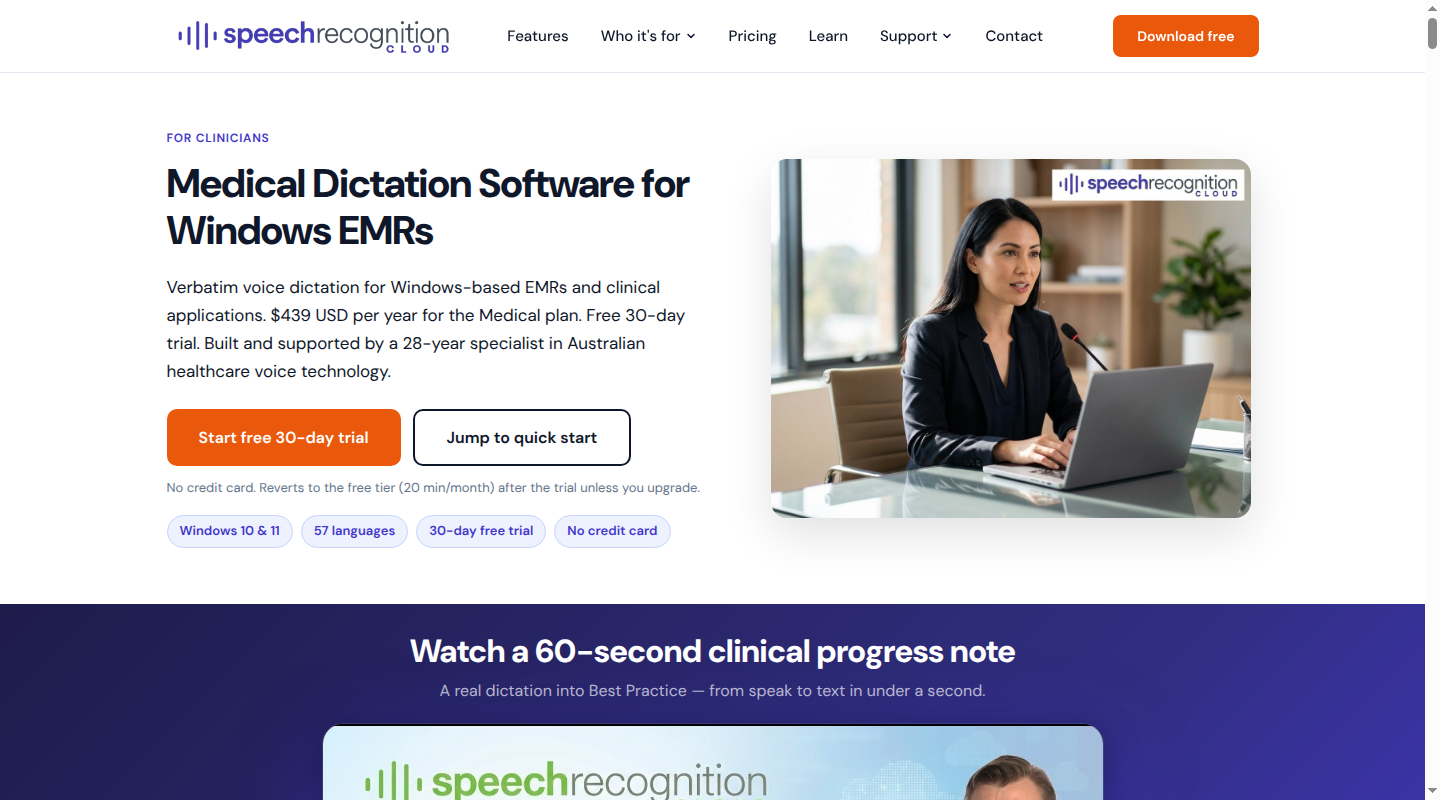
- Best fit: Individual clinicians who want medical vocabulary and active dictation across Windows free-text fields.
- Workflow: Speech Recognition Cloud Medical places spoken words at the cursor with automatic punctuation, personal vocabulary and text snippets. A mobile app can serve as the microphone or capture voice notes for later delivery to Windows.
- Record fit: Its documented cursor workflow can work in compatible fields across several clinical systems, but it does not import patient context, select templates or write a finished item to a structured record location.
- Data and privacy: The privacy statement says audio is processed in memory and erased immediately, transcripts are not retained on its servers, connections are encrypted and the Medical tier excludes generative AI modes.
- Price: The direct Medical plan is US$439 a year with a 30-day Medical Ultra trial. It reverts to a limited general-vocabulary tier if the clinician does not subscribe.
- Limit: The desktop client is Windows-only. It preserves the work of composing and organising the note, even when transcription itself is fast.
4. Medow Smart Dictation: structured dictation for specialists
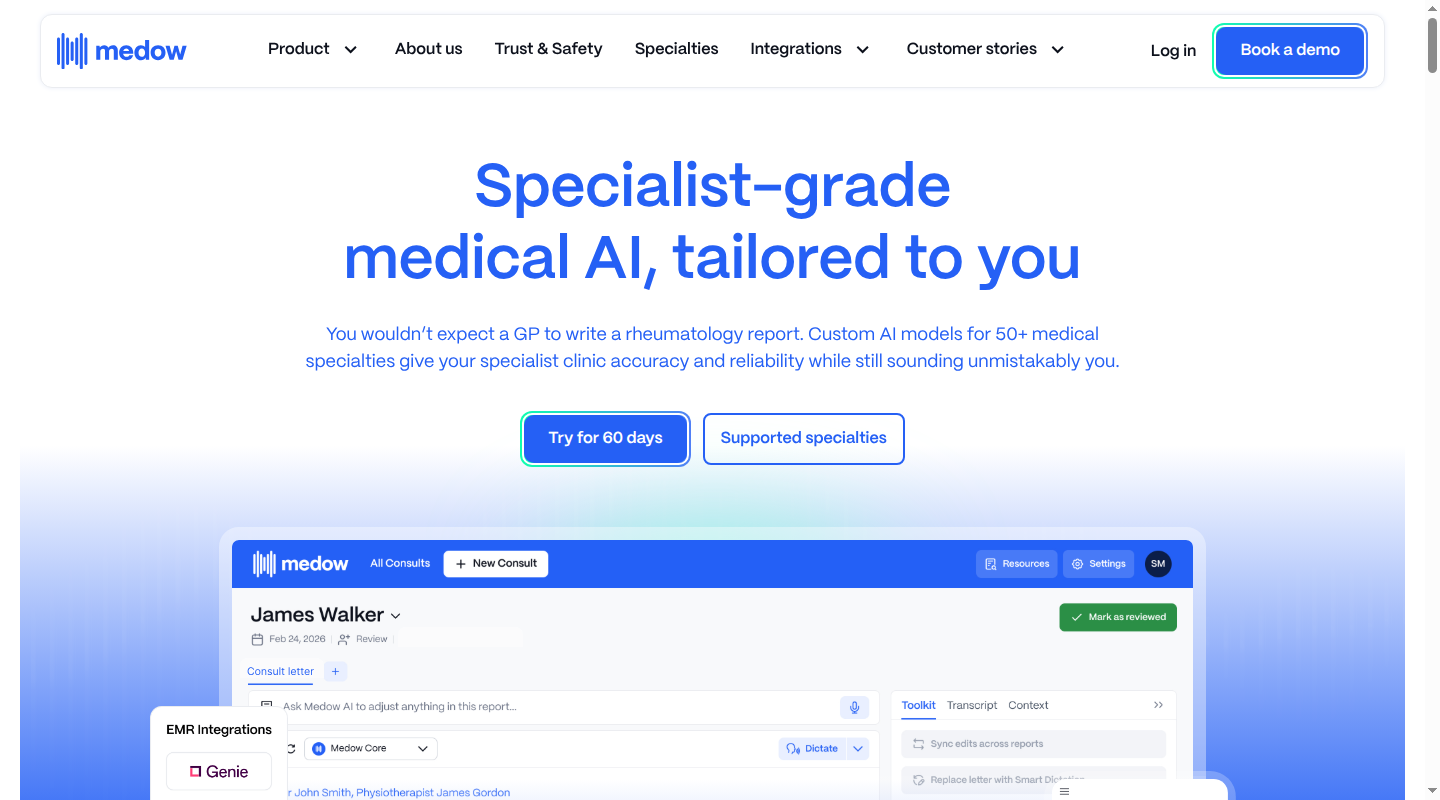
- Best fit: Specialist clinics in Australia and New Zealand that already dictate correspondence and want their wording placed into a structured letter.
- Workflow: Medow Smart Dictation retains the clinician's phrasing while removing restarts, applying punctuation and assigning content to sections. Ambient scribing is available in the same platform.
- Record fit: Bidirectional connections cover Genie, Gentu, Shexie, Elixir and Meditech. Appointments and demographics can flow in, while reviewed letters can return to the patient record.
- Data and privacy: Medow's privacy policy describes regional data handling, while its current Smart Dictation materials state Australian hosting, deidentification before AI processing and ISO 27001 certification.
- Price: Current commercial terms use personalised pricing based on usage, specialty and practice size, with a 60-day money-back guarantee.
- Limit: Value depends on a supported specialist record workflow and configured templates. Solo GPs seeking a lightweight self-service tool are outside its main fit.
5. i-scribe: specialist scribing and dictation
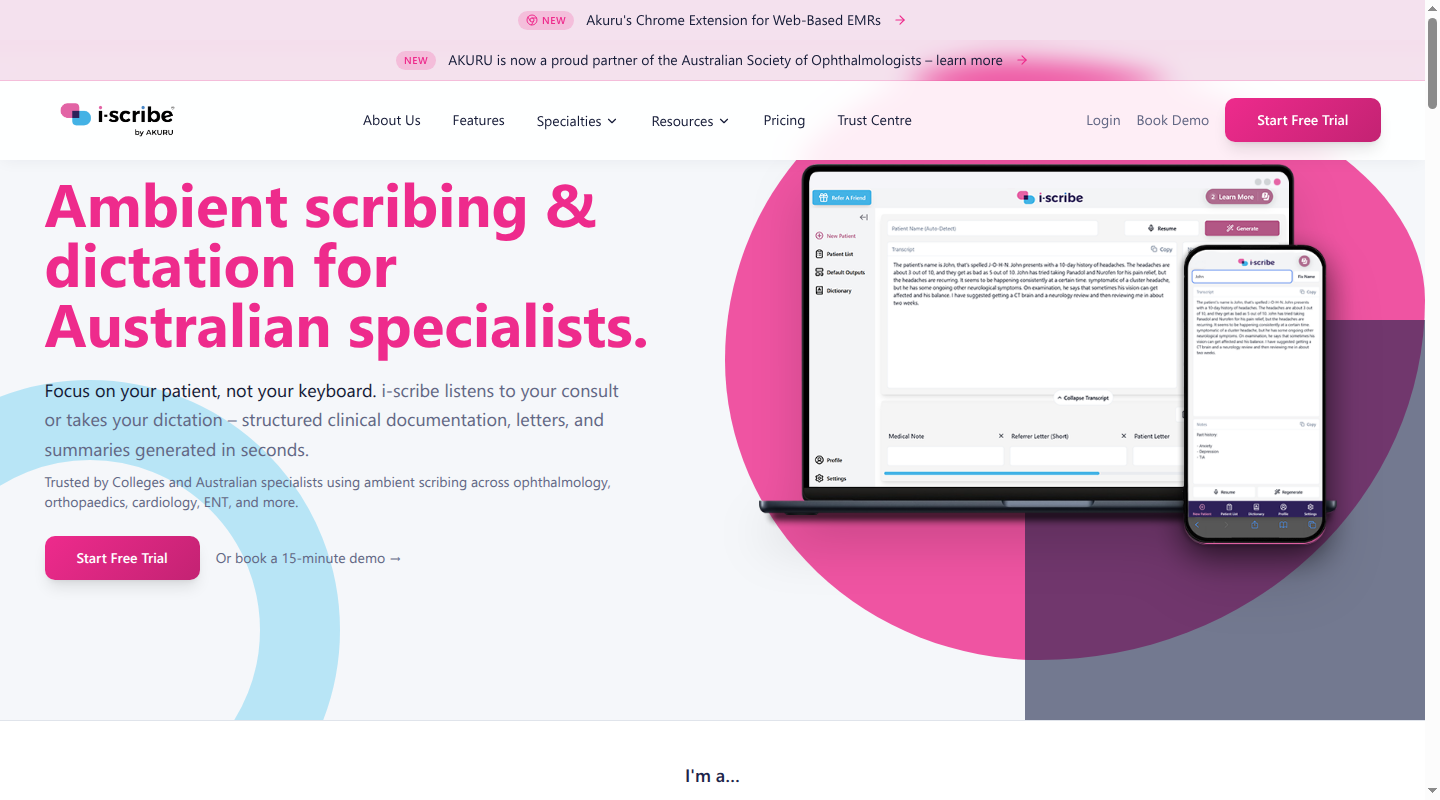
- Best fit: Australian specialists who want ambient capture, active dictation and administrative access for correspondence.
- Workflow: i-scribe features include structured notes, referral letters, patient letters and discharge summaries. Custom templates, mobile and desktop access, and a secretary login support specialist practice workflows.
- Record fit: Its integration list covers Genie, Gentu, Shexie, Bp VIP.net, Bp Premier and Direct Control. The exact appointment sync and return path differs by system.
- Data and privacy: The i-scribe privacy policy states that platform and clinical data is processed and stored in Australia, encryption applies in transit and at rest, and patient information is excluded from product training. Limited corporate systems can involve overseas access.
- Price: i-scribe pricing sets GP at A$150 a month billed annually or A$200 month to month. Specialist costs A$200 a month billed annually or A$250 month to month and adds secretary access, custom templates and priority support. Prices exclude GST and a 14-day trial is available.
- Limit: The product moves the clinician into generated and structured documents. A clinician who needs verbatim speech in many unrelated desktop fields may still need a cursor tool.
6. Solventum Fluency Direct: enterprise speech recognition
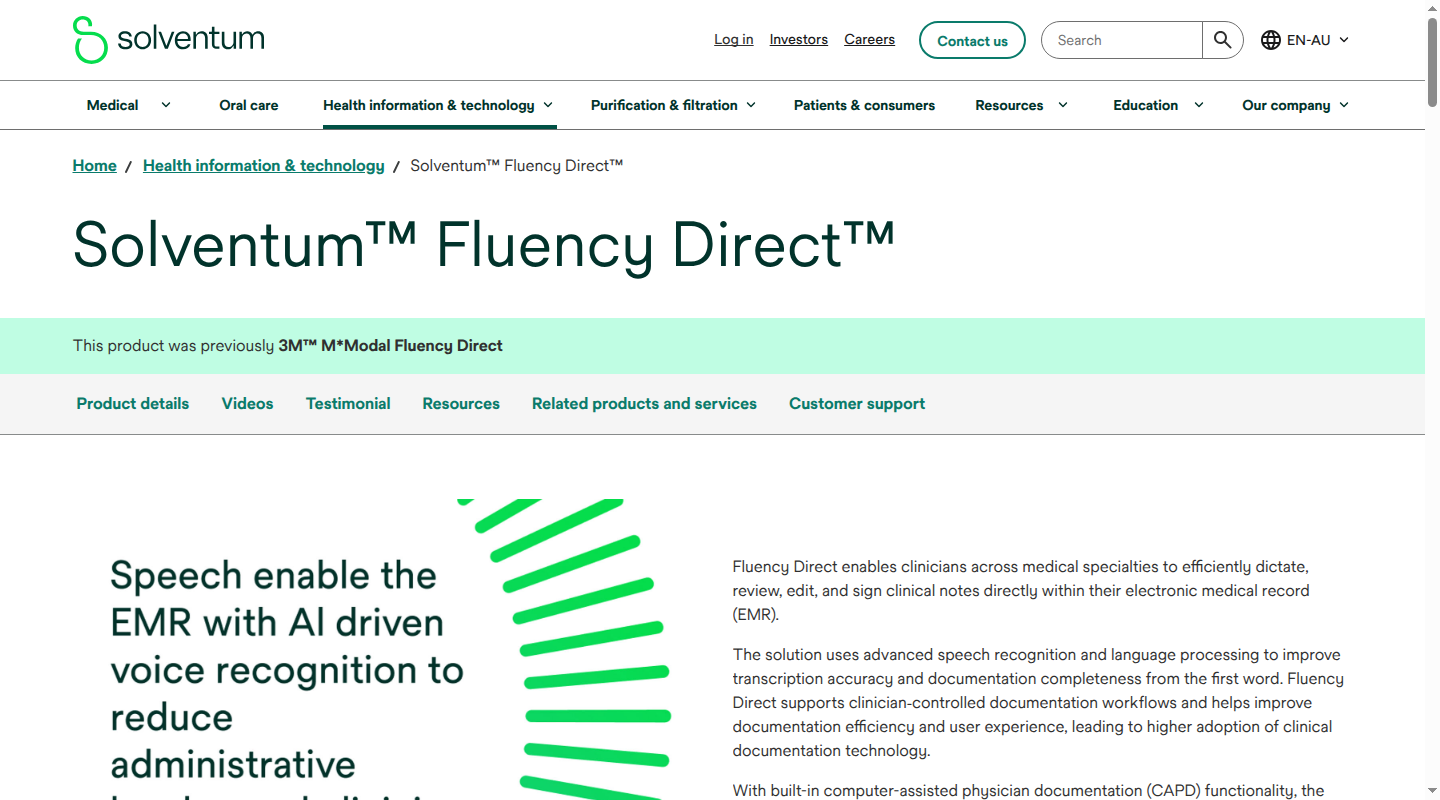
- Best fit: Hospitals and larger organisations that need centrally managed speech recognition across many clinicians, devices and electronic records.
- Workflow: Fluency Direct supports dictation, editing and signing in the record. Natural-language processing can analyse narrative text and prompt for further documentation.
- Record fit: The same Australian product page states support for more than 250 electronic records, including Epic, Meditech and Oracle Health, across PCs, virtual desktops, thin clients and server environments.
- Data and privacy: Security architecture, hosting region, retention and support access are defined through the enterprise deployment and contract rather than a public Australian self-service plan on the current offer.
- Price: The Australian offer uses a custom quote.
- Limit: Procurement, configuration, clinician coaching and change management carry more weight than the software subscription alone.
7. MedicalDirector Smart Scribe: embedded in MedicalDirector Clinical
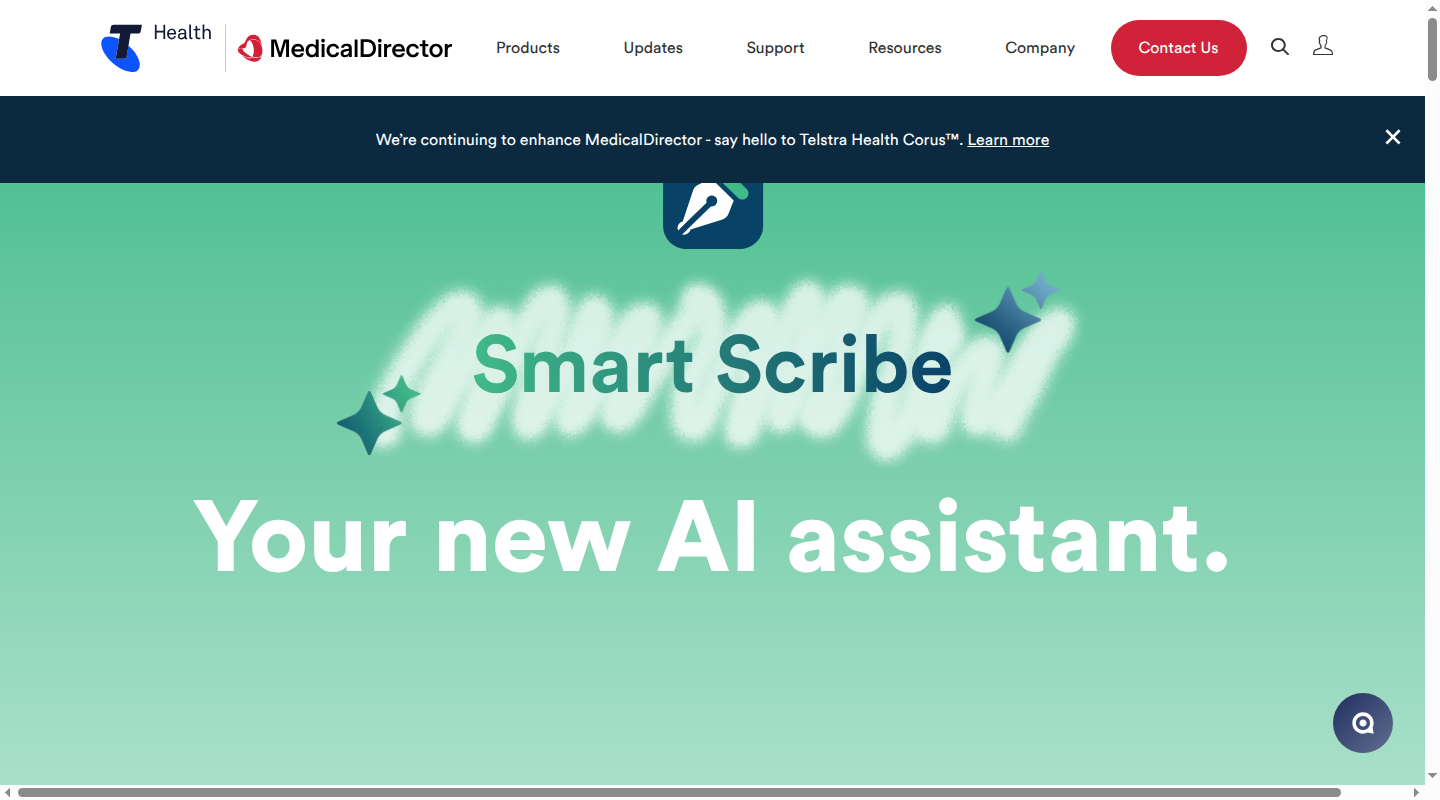
- Best fit: Australian GP practices already using a compatible version of MedicalDirector Clinical and Smartbar.
- Workflow: MedicalDirector Smart Scribe records a consult or dictated summary and creates a draft note through a choice of Heidi Health or Intellitek AI.
- Record fit: Access sits inside MedicalDirector Clinical 4.3 through Smartbar. Record transfer depends on the selected provider path, and the current usage guide documents copy and paste for at least one path.
- Data and privacy: MedicalDirector's Smart Scribe details state onshore processing, deletion of recordings after transcription, deletion of partner-cloud output within seven days after saving, and no use of the data for AI-model training.
- Price: The Smart Scribe offer advertises Heidi Health at $1,299 a year and Intellitek AI at $105 per user per month. Currency and GST treatment are unstated. The underlying MedicalDirector Clinical licence is also required.
- Limit: The embedded workflow has little value for a practice using another patient-record system.
Privacy and clinical governance
Dragon Medical One processes sensitive speech and clinical text in the cloud, even though it usually captures deliberate dictation instead of the whole consult. As first-party security evidence, its Australian data sheet lists HITRUST CSF certification, and the administration guide provides an Australian regional endpoint. Those facts do not establish that every data class, log, support pathway and subprocessor remains in Australia.
A procurement record should map audio, transcripts, drafts, logs and backups from capture through deletion. It should also state the processing locations, retention periods, model-training terms, authorised support access, identity controls, incident response and data-return obligations. APP 11 security guidance requires active measures to protect personal information and consideration of whether it still needs to be retained.
Ambient capture adds a patient-consent step. The RACGP's AI scribe guidance requires informed consent and documentation of that consent. Our AI scribe consent workflow provides practical wording and refusal handling. AHPRA's AI guidance keeps responsibility for the accuracy and relevance of the record with the practitioner, regardless of whether the starting point is a transcript or a generated draft.
Migration checklist from Dragon Medical One
- Inventory the current work. List consult notes, reports, referrals, AutoText, custom vocabulary, voice commands, microphones, browser extensions, remote-desktop paths and downtime procedures.
- Assign a capture mode by document. Keep active dictation where exact phrasing matters. Use smart dictation for structured correspondence and ambient capture where reconstructing the consult is the burden.
- Define acceptance measures. Track clinically meaningful corrections, omissions, unsupported content, finalisation time, filing steps, failed sessions and consent completion. Raw words per minute is insufficient.
- Build representative scenarios. Include local accents, medicine names, doses, negations, numbers, specialty terms, long consults, telehealth and noisy rooms across the actual clinical software and devices.
- Run a controlled overlap. Start with a small cohort and agreed document types while Dragon remains available. Prevent duplicate final records and set explicit expansion, rollback and outage criteria.
- Rebuild only useful assets. Move current templates, standard paragraphs and vocabulary after removing outdated or duplicated material. Translate voice commands into the new platform's workflow rather than recreating them blindly.
- Lock down the data path. Record each processing and storage location, retention period, overseas disclosure, model-training term, role, audit log and deletion process. Add consent capture where ambient recording is used.
- Plan the commercial cutover. Align the Dragon end date, termination notice and new start date. Budget for overlapping licences, training, microphones, integrations and support.
- Define the exit. Set export formats for templates, notes, consent logs and audit records, plus the timetable and evidence for return or deletion of retained data.
- Keep sign-off explicit. Every transcript and generated draft remains subject to clinician review, editing and approval before it becomes part of the patient record.
One product does not need to win every document type. A practice can move consult notes to ambient capture, retain structured dictation for letters and keep a cursor tool for short free-text tasks during the transition.
Frequently asked questions
Is Dragon Medical One being discontinued in Australia?
No. Dragon Medical One has a current Australian 2026.1 release and remains available through Australian partners. Dragon Copilot is a separate international product to monitor. Microsoft has not published an Australian release or migration roadmap.
Is Dragon Medical One an ambient AI scribe?
No. The clinician deliberately dictates the intended wording and Dragon Medical One transcribes it, consistent with its directed-dictation workflow. An ambient scribe captures the consultation and produces a structured draft from the conversation.
Does Dragon Medical One work on Mac?
The native application is for Windows. Microsoft's Mac guidance supports access through a published Windows application or a Windows virtual machine, with limitations. Australian resellers also sell Helium as a separate native Mac layer.
Is there a free Dragon Medical alternative?
Yes. Lyrebird Free includes monthly Transcribe and Dictate plus Documents and Letters allowances, while eligible Bp Premier users can use Bp Free for unlimited consult notes. Heidi pricing also includes a free ambient Scribe plan. Free tiers suit lower-volume use, though cursor access, integrations, support and document limits differ.
Dragon Medical One remains useful when active dictation is the work you want to preserve. When the goal is to capture the consult once, review the draft and create the follow-up paperwork from the same context, start with Lyrebird Free.