Education
5 min read

Clinical documentation and coding in Australia: how better notes support accurate coding

Published on
October 19, 2026
A clinical record passes through review to a structured classification grid.
Contributors
Subscribe to our newsletter
Read about our privacy policy.
Thank you! Your submission has been received!
Oops! Something went wrong while submitting the form.

A clinical record needs to carry the patient's story beyond the bedside. For Australian clinicians, clinical coders and health-service teams, that means documenting care clearly enough for another person to understand the assessment, treatment and course of an admission. Clinical documentation and coding are connected parts of that work, with different responsibilities. Understanding the handoff helps teams address missing detail, resolve ambiguity and improve records without changing the clinical story to suit a code.

What is the relationship between clinical documentation and coding?

Clinical documentation records the care provided and the clinician's findings, assessment and decisions. Clinical coding translates relevant information in that record into standardised diagnosis and intervention codes, following the rules of the classification being used.

The clinical coder decides which diagnoses and procedures meet coding criteria, then assigns the codes. A diagnosis appearing in a note does not automatically mean it meets the criteria for coding.

These roles depend on each other. Clinicians supply the clinical meaning. Coders apply the classification rules. Clear documentation supports both continuity of care and an accurate coded account of the episode.

Clinicians control the final record. Within our clinical artificial intelligence (AI) platform, Lyrebird's clinical notes workflow turns ambient capture, dictation or typed input into a structured draft for clinician review. This supports documentation while clinical judgement, sign-off and the human coding process remain separate responsibilities.

Which coding system applies in Australia?

For admitted-patient care in Australian public and private hospitals, the classification has three parts:

ComponentWhat it does
International Statistical Classification of Diseases and Related Health Problems, Tenth Revision, Australian Modification (ICD-10-AM)Classifies diseases, injuries and related health problems
Australian Classification of Health Interventions (ACHI)Classifies surgeries, therapies and health interventions
Australian Coding Standards (ACS)Guide nationally consistent application of ICD-10-AM and ACHI

The Independent Health and Aged Care Pricing Authority (IHACPA) defines this admitted-care classification and its scope. It is not a universal coding system for every GP, outpatient or community-health encounter. Other service categories have their own reporting arrangements, although ICD-10-AM also has specified uses outside admitted care.

The current Thirteenth Edition applies to separations from 1 July 2025. A separation is the end of an admitted episode of care. The edition is used with its errata, National Coding Advice and the Clinical Coding Practice Framework.

Clinical coding and Medicare billing are different tasks

Medicare Benefits Schedule (MBS) items describe services with their own claiming conditions. They serve a different purpose from classifying hospital diagnoses and interventions.

For practitioners providing or initiating a Medicare-payable service, MBS record guidance says records should be adequate and contemporaneous. That is a Medicare record-keeping expectation, not an ICD-10-AM or ACHI code-selection rule. A well-written note alone does not establish eligibility for an MBS claim.

How the documentation-to-code handoff works

At the conclusion of an admitted episode, the clinical coder reviews the patient healthcare record, extracts the information recorded by clinicians and assigns principal diagnosis, additional diagnosis and intervention codes under the ACS. The record is the primary coding source.

The handoff has distinct responsibilities:

  1. The clinician documents and reviews care. The record needs to convey the assessment, relevant findings, interventions and changes during the episode. Any draft, including an AI draft, needs clinician review before it becomes a final clinical entry.
  2. The coder reviews the available record. Coding draws on the episode's relevant documentation, rather than treating a single diagnosis list or discharge summary as the whole clinical story.
  3. Unclear clinical meaning goes back for clarification. Where the current classification guidance requires clarification, the health service's clinical documentation query process brings the issue to the responsible clinician.
  4. The coder applies the classification. A clarified record still needs coding judgement. The clinician's response supplies clinical meaning; it does not replace the coder's responsibility to apply the rules.
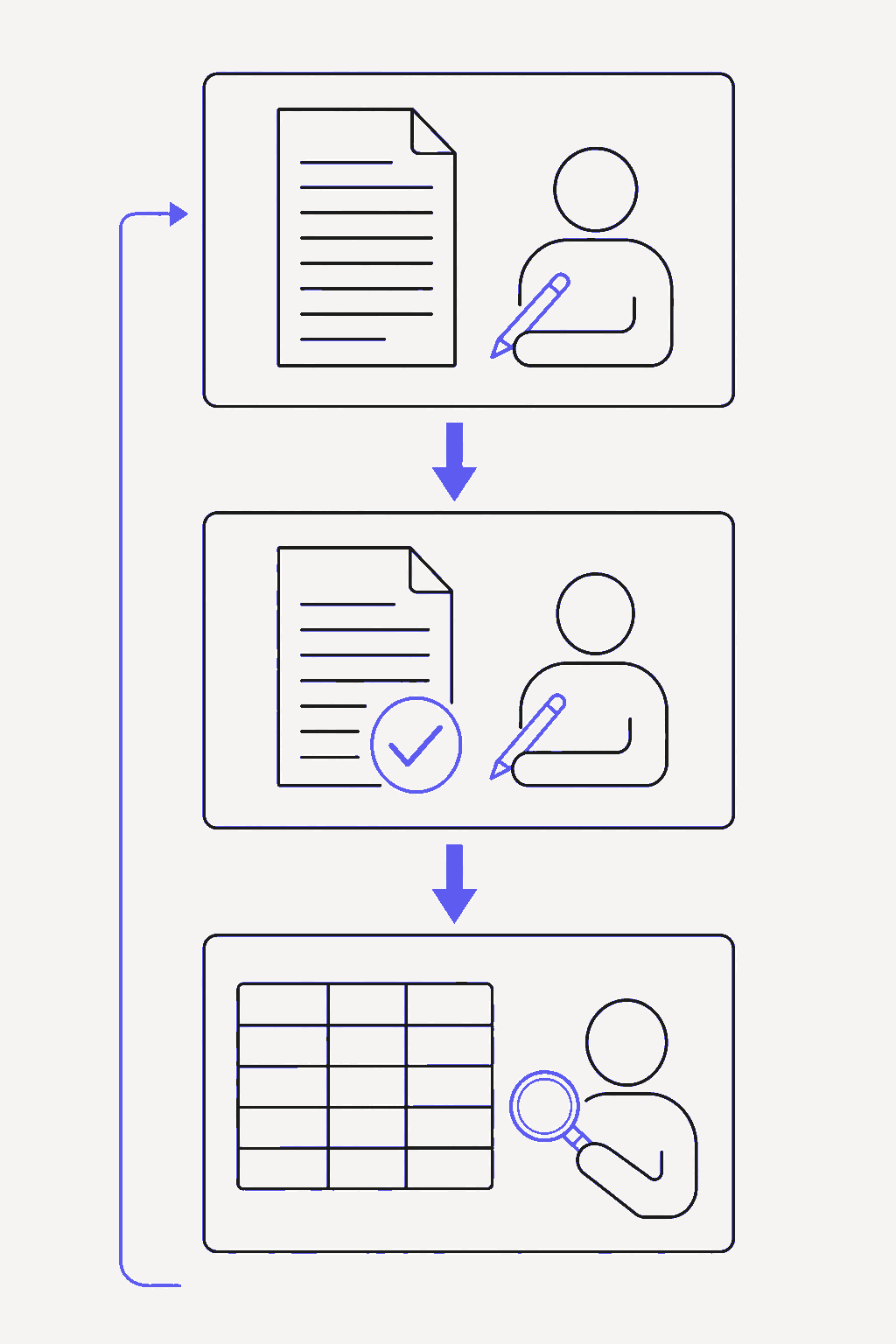
Clinician documentation and review feed human coding, with a return path for clinical clarification.

Health services also need governance around record access, coding resources, education and quality assurance. The Clinical Coding Practice Framework sets out guidance for good practice across that process.

What specificity and completeness look like in a clinical record

Specificity means stating the clinical detail you actually know. Completeness means including the relevant information needed to understand the episode. Neither requires turning every observation into a diagnosis or making every note longer.

For doctors, the Medical Board of Australia's Good medical practice requires accurate, current and relevant records that support continuity of care, with entries made at the time of events or as soon as possible afterwards. Other professions have their own applicable professional codes.

Useful documentation habits include identifying the source of information, distinguishing findings from the assessment, recording uncertainty and describing what was actually done. Our clinical note-writing guide covers those habits in more detail.

The following examples are documentation prompts, not coding rules:

Gap in the recordWhat clearer documentation providesBoundary to preserve
A symptom is recorded without the clinician's assessmentThe assessed problem, working diagnosis or continuing uncertaintyDo not turn a symptom or test result into an unsupported diagnosis
“History of” and “current” conditions are mixed togetherWhich information is historical and what the clinician assessed during this episodeA past condition should not appear active because it was copied forward
An intervention lacks detailThe procedure performed, relevant site, approach or other details known to the treating teamRecord actual care, rather than filling gaps with the usual technique
A planned procedure appears as completedWhether it occurred, changed, was cancelled or stopped, with the relevant circumstancesA plan is not evidence that an intervention happened
Notes contain conflicting assessmentsA clear account of how the assessment changed and the responsible clinician's clarification where neededA coder should not resolve a clinical contradiction by choosing the preferred diagnosis
The relationship between two events is unclearThe clinician's assessment of the relationship, including uncertaintySequence alone does not establish causation

Some gaps are missing documents rather than missing clinical decisions. An unavailable procedure report calls for a record-access fix. An unclear assessment calls for clinical clarification. Treating both as “poor documentation” hides who can resolve them.

Resolve ambiguity without adding a diagnosis

Consider a fictional note that records “bleeding after procedure”. That phrase establishes a sequence, but does not by itself explain the clinician's assessment of cause or the nature of the event.

IHACPA's clinical terminology guidance explains that terms such as “during”, “associated with”, “related” and “post” can carry different meanings in context. Where the classification does not provide a causative link between a condition and an intervention, coders must first refer to the ICD-10-AM Conventions/Special terminology.

If clinical meaning still needs clarification under the applicable guidance, the responsible clinician addresses it through the health service's query process. The clinician may clarify a relationship, distinguish unrelated events or record that the relationship remains uncertain.

As a documentation safeguard, we recommend keeping the query focused on clinical meaning, without suggesting a code or pressuring the clinician to document an unsupported diagnosis.

In the current ACS, Appendix A contains the guidelines for formulating clinical documentation queries. Its place in the current ACS volumes matters because older editions use a different appendix label. The detailed query format and handling follow the current ACS and applicable local policy.

Clinical clarification and classification advice use different routes

A clinical documentation query asks what the record means clinically. A classification query asks how the coding rules apply to documented information.

IHACPA's classification query process directs ICD-10-AM/ACHI/ACS coding queries to the state or territory's nominated representative in the first instance. National Coding Advice supports consistent classification. That route does not replace a treating clinician's clarification of their record.

Build a feedback loop that fixes the source of the gap

Clinical documentation improvement (CDI) is organised work to make records clearer and more complete. A useful clinician–coder feedback loop addresses recurring problems at their source while preserving clinical independence.

For your team, we recommend a small, locally governed cycle:

  1. Group the recurring issues. Separate unavailable information, ambiguous clinical meaning and classification uncertainty. Each needs a different response.
  2. Assign an owner. Record-access problems go to the relevant records or system team. Clinical clarification goes through the authorised clinician-query process. Classification questions stay with the coding team and its advice pathway.
  3. Share a de-identified example. Show the missing detail and why it matters to understanding care. Keep real patient information within authorised systems and access arrangements.
  4. Change one source of friction. This might be a clearer procedure-report field, a prompt to distinguish planned from completed care, or a targeted education session about documenting an assessment.
  5. Review the same problem again. Track the proportion of reviewed episodes with that gap, alongside query response time and unresolved queries. Also look for unsupported content or extra duplication introduced by the change.

For example, repeated queries about planned versus completed procedures may point to a template that carries the planned intervention into the final report. Correcting that template addresses the source. Asking every clinician to write a longer report leaves the ambiguity in place.

Use this cycle alongside the broader clinical documentation audit process. Documentation quality and coding accuracy need distinct review criteria, even when the findings are discussed together.

Quality checks should protect clinical meaning

A practical quality check asks whether the final record represents the care and decisions made, and whether the coded output is justified under the applicable classification. More diagnoses, more codes and longer notes are poor substitutes for those questions.

Before clinical sign-off

The clinician reviews whether:

  • the assessment reflects their judgement, with uncertainty preserved
  • patient-reported information, observed findings and clinical interpretation remain distinct
  • interventions and their timing match what occurred
  • copied or drafted text introduces an omission, unsupported diagnosis or contradiction
  • later clarification follows the authorised amendment process and remains traceable.

For doctors, the Medical Board's record-keeping requirements include dating changes and additions. The precise correction workflow depends on the record system and applicable requirements; it should not make later knowledge appear to have been available at the original encounter.

During coding review

The coding team reviews whether the assigned codes are supported by the record and meet the classification's conventions, standards and rules. Unresolved issues need the relevant clarification or advice process, rather than inference to make the episode appear complete.

Current National Coding Advice is published quarterly, with new advice generally applying to separations from the following month. Resource currency belongs in coding governance: outdated local guidance can produce a different problem from an incomplete clinical note.

Where AI-drafted notes fit

Reliable documentation starts with clinical judgement and review. An AI scribe can help capture and structure source information, but an orderly draft can still omit relevant detail, misstate a fact or make uncertainty sound definitive.

Before capture, complete your patient notice and consent process, obtaining and recording any consent required for the specific workflow, setting and jurisdiction.

Lyrebird supports ambient capture, dictated summaries and typed notes, with templates that structure the draft for clinician review and editing. Clinicians still need to add relevant findings or reasoning that were not captured, correct errors and sign off the record. The clinical coder then works from the authorised record under the applicable coding process.

That boundary keeps the aim clear: a faithful account of patient care, followed by accountable human classification. If your team wants to use Lyrebird to support reviewed clinical-note drafting, we can discuss that documentation workflow.

Contact us

More Resources
Continue reading
Posts
The dangers of Copy Paste Scribes
Read More
Posts
How to use an AI medical scribe
Read More
Posts
December Product Updates
Read More
Education
Pre-consultation questionnaire: design and clinical review
Read More
Education
Transferring Medical Records to a New Doctor in Australia
Read More
Consent for telehealth: a practical Australian guide
Read More
Article
5 min read

Clinical documentation and coding in Australia: how better notes support accurate coding

Published on
October 19, 2026
A clinical record passes through review to a structured classification grid.
Contributors
Subscribe to our newsletter
Read about our privacy policy.
Thank you! Your submission has been received!
Oops! Something went wrong while submitting the form.

A clinical record needs to carry the patient's story beyond the bedside. For Australian clinicians, clinical coders and health-service teams, that means documenting care clearly enough for another person to understand the assessment, treatment and course of an admission. Clinical documentation and coding are connected parts of that work, with different responsibilities. Understanding the handoff helps teams address missing detail, resolve ambiguity and improve records without changing the clinical story to suit a code.

What is the relationship between clinical documentation and coding?

Clinical documentation records the care provided and the clinician's findings, assessment and decisions. Clinical coding translates relevant information in that record into standardised diagnosis and intervention codes, following the rules of the classification being used.

The clinical coder decides which diagnoses and procedures meet coding criteria, then assigns the codes. A diagnosis appearing in a note does not automatically mean it meets the criteria for coding.

These roles depend on each other. Clinicians supply the clinical meaning. Coders apply the classification rules. Clear documentation supports both continuity of care and an accurate coded account of the episode.

Clinicians control the final record. Within our clinical artificial intelligence (AI) platform, Lyrebird's clinical notes workflow turns ambient capture, dictation or typed input into a structured draft for clinician review. This supports documentation while clinical judgement, sign-off and the human coding process remain separate responsibilities.

Which coding system applies in Australia?

For admitted-patient care in Australian public and private hospitals, the classification has three parts:

ComponentWhat it does
International Statistical Classification of Diseases and Related Health Problems, Tenth Revision, Australian Modification (ICD-10-AM)Classifies diseases, injuries and related health problems
Australian Classification of Health Interventions (ACHI)Classifies surgeries, therapies and health interventions
Australian Coding Standards (ACS)Guide nationally consistent application of ICD-10-AM and ACHI

The Independent Health and Aged Care Pricing Authority (IHACPA) defines this admitted-care classification and its scope. It is not a universal coding system for every GP, outpatient or community-health encounter. Other service categories have their own reporting arrangements, although ICD-10-AM also has specified uses outside admitted care.

The current Thirteenth Edition applies to separations from 1 July 2025. A separation is the end of an admitted episode of care. The edition is used with its errata, National Coding Advice and the Clinical Coding Practice Framework.

Clinical coding and Medicare billing are different tasks

Medicare Benefits Schedule (MBS) items describe services with their own claiming conditions. They serve a different purpose from classifying hospital diagnoses and interventions.

For practitioners providing or initiating a Medicare-payable service, MBS record guidance says records should be adequate and contemporaneous. That is a Medicare record-keeping expectation, not an ICD-10-AM or ACHI code-selection rule. A well-written note alone does not establish eligibility for an MBS claim.

How the documentation-to-code handoff works

At the conclusion of an admitted episode, the clinical coder reviews the patient healthcare record, extracts the information recorded by clinicians and assigns principal diagnosis, additional diagnosis and intervention codes under the ACS. The record is the primary coding source.

The handoff has distinct responsibilities:

  1. The clinician documents and reviews care. The record needs to convey the assessment, relevant findings, interventions and changes during the episode. Any draft, including an AI draft, needs clinician review before it becomes a final clinical entry.
  2. The coder reviews the available record. Coding draws on the episode's relevant documentation, rather than treating a single diagnosis list or discharge summary as the whole clinical story.
  3. Unclear clinical meaning goes back for clarification. Where the current classification guidance requires clarification, the health service's clinical documentation query process brings the issue to the responsible clinician.
  4. The coder applies the classification. A clarified record still needs coding judgement. The clinician's response supplies clinical meaning; it does not replace the coder's responsibility to apply the rules.
Clinician documentation and review feed human coding, with a return path for clinical clarification.

Health services also need governance around record access, coding resources, education and quality assurance. The Clinical Coding Practice Framework sets out guidance for good practice across that process.

What specificity and completeness look like in a clinical record

Specificity means stating the clinical detail you actually know. Completeness means including the relevant information needed to understand the episode. Neither requires turning every observation into a diagnosis or making every note longer.

For doctors, the Medical Board of Australia's Good medical practice requires accurate, current and relevant records that support continuity of care, with entries made at the time of events or as soon as possible afterwards. Other professions have their own applicable professional codes.

Useful documentation habits include identifying the source of information, distinguishing findings from the assessment, recording uncertainty and describing what was actually done. Our clinical note-writing guide covers those habits in more detail.

The following examples are documentation prompts, not coding rules:

Gap in the recordWhat clearer documentation providesBoundary to preserve
A symptom is recorded without the clinician's assessmentThe assessed problem, working diagnosis or continuing uncertaintyDo not turn a symptom or test result into an unsupported diagnosis
“History of” and “current” conditions are mixed togetherWhich information is historical and what the clinician assessed during this episodeA past condition should not appear active because it was copied forward
An intervention lacks detailThe procedure performed, relevant site, approach or other details known to the treating teamRecord actual care, rather than filling gaps with the usual technique
A planned procedure appears as completedWhether it occurred, changed, was cancelled or stopped, with the relevant circumstancesA plan is not evidence that an intervention happened
Notes contain conflicting assessmentsA clear account of how the assessment changed and the responsible clinician's clarification where neededA coder should not resolve a clinical contradiction by choosing the preferred diagnosis
The relationship between two events is unclearThe clinician's assessment of the relationship, including uncertaintySequence alone does not establish causation

Some gaps are missing documents rather than missing clinical decisions. An unavailable procedure report calls for a record-access fix. An unclear assessment calls for clinical clarification. Treating both as “poor documentation” hides who can resolve them.

Resolve ambiguity without adding a diagnosis

Consider a fictional note that records “bleeding after procedure”. That phrase establishes a sequence, but does not by itself explain the clinician's assessment of cause or the nature of the event.

IHACPA's clinical terminology guidance explains that terms such as “during”, “associated with”, “related” and “post” can carry different meanings in context. Where the classification does not provide a causative link between a condition and an intervention, coders must first refer to the ICD-10-AM Conventions/Special terminology.

If clinical meaning still needs clarification under the applicable guidance, the responsible clinician addresses it through the health service's query process. The clinician may clarify a relationship, distinguish unrelated events or record that the relationship remains uncertain.

As a documentation safeguard, we recommend keeping the query focused on clinical meaning, without suggesting a code or pressuring the clinician to document an unsupported diagnosis.

In the current ACS, Appendix A contains the guidelines for formulating clinical documentation queries. Its place in the current ACS volumes matters because older editions use a different appendix label. The detailed query format and handling follow the current ACS and applicable local policy.

Clinical clarification and classification advice use different routes

A clinical documentation query asks what the record means clinically. A classification query asks how the coding rules apply to documented information.

IHACPA's classification query process directs ICD-10-AM/ACHI/ACS coding queries to the state or territory's nominated representative in the first instance. National Coding Advice supports consistent classification. That route does not replace a treating clinician's clarification of their record.

Build a feedback loop that fixes the source of the gap

Clinical documentation improvement (CDI) is organised work to make records clearer and more complete. A useful clinician–coder feedback loop addresses recurring problems at their source while preserving clinical independence.

For your team, we recommend a small, locally governed cycle:

  1. Group the recurring issues. Separate unavailable information, ambiguous clinical meaning and classification uncertainty. Each needs a different response.
  2. Assign an owner. Record-access problems go to the relevant records or system team. Clinical clarification goes through the authorised clinician-query process. Classification questions stay with the coding team and its advice pathway.
  3. Share a de-identified example. Show the missing detail and why it matters to understanding care. Keep real patient information within authorised systems and access arrangements.
  4. Change one source of friction. This might be a clearer procedure-report field, a prompt to distinguish planned from completed care, or a targeted education session about documenting an assessment.
  5. Review the same problem again. Track the proportion of reviewed episodes with that gap, alongside query response time and unresolved queries. Also look for unsupported content or extra duplication introduced by the change.

For example, repeated queries about planned versus completed procedures may point to a template that carries the planned intervention into the final report. Correcting that template addresses the source. Asking every clinician to write a longer report leaves the ambiguity in place.

Use this cycle alongside the broader clinical documentation audit process. Documentation quality and coding accuracy need distinct review criteria, even when the findings are discussed together.

Quality checks should protect clinical meaning

A practical quality check asks whether the final record represents the care and decisions made, and whether the coded output is justified under the applicable classification. More diagnoses, more codes and longer notes are poor substitutes for those questions.

Before clinical sign-off

The clinician reviews whether:

  • the assessment reflects their judgement, with uncertainty preserved
  • patient-reported information, observed findings and clinical interpretation remain distinct
  • interventions and their timing match what occurred
  • copied or drafted text introduces an omission, unsupported diagnosis or contradiction
  • later clarification follows the authorised amendment process and remains traceable.

For doctors, the Medical Board's record-keeping requirements include dating changes and additions. The precise correction workflow depends on the record system and applicable requirements; it should not make later knowledge appear to have been available at the original encounter.

During coding review

The coding team reviews whether the assigned codes are supported by the record and meet the classification's conventions, standards and rules. Unresolved issues need the relevant clarification or advice process, rather than inference to make the episode appear complete.

Current National Coding Advice is published quarterly, with new advice generally applying to separations from the following month. Resource currency belongs in coding governance: outdated local guidance can produce a different problem from an incomplete clinical note.

Where AI-drafted notes fit

Reliable documentation starts with clinical judgement and review. An AI scribe can help capture and structure source information, but an orderly draft can still omit relevant detail, misstate a fact or make uncertainty sound definitive.

Before capture, complete your patient notice and consent process, obtaining and recording any consent required for the specific workflow, setting and jurisdiction.

Lyrebird supports ambient capture, dictated summaries and typed notes, with templates that structure the draft for clinician review and editing. Clinicians still need to add relevant findings or reasoning that were not captured, correct errors and sign off the record. The clinical coder then works from the authorised record under the applicable coding process.

That boundary keeps the aim clear: a faithful account of patient care, followed by accountable human classification. If your team wants to use Lyrebird to support reviewed clinical-note drafting, we can discuss that documentation workflow.
Contact us

Keep reading

All posts
Questions about compliance?