Education
5 min read

AI in nursing: uses, benefits and safe documentation
Published on
October 27, 2026
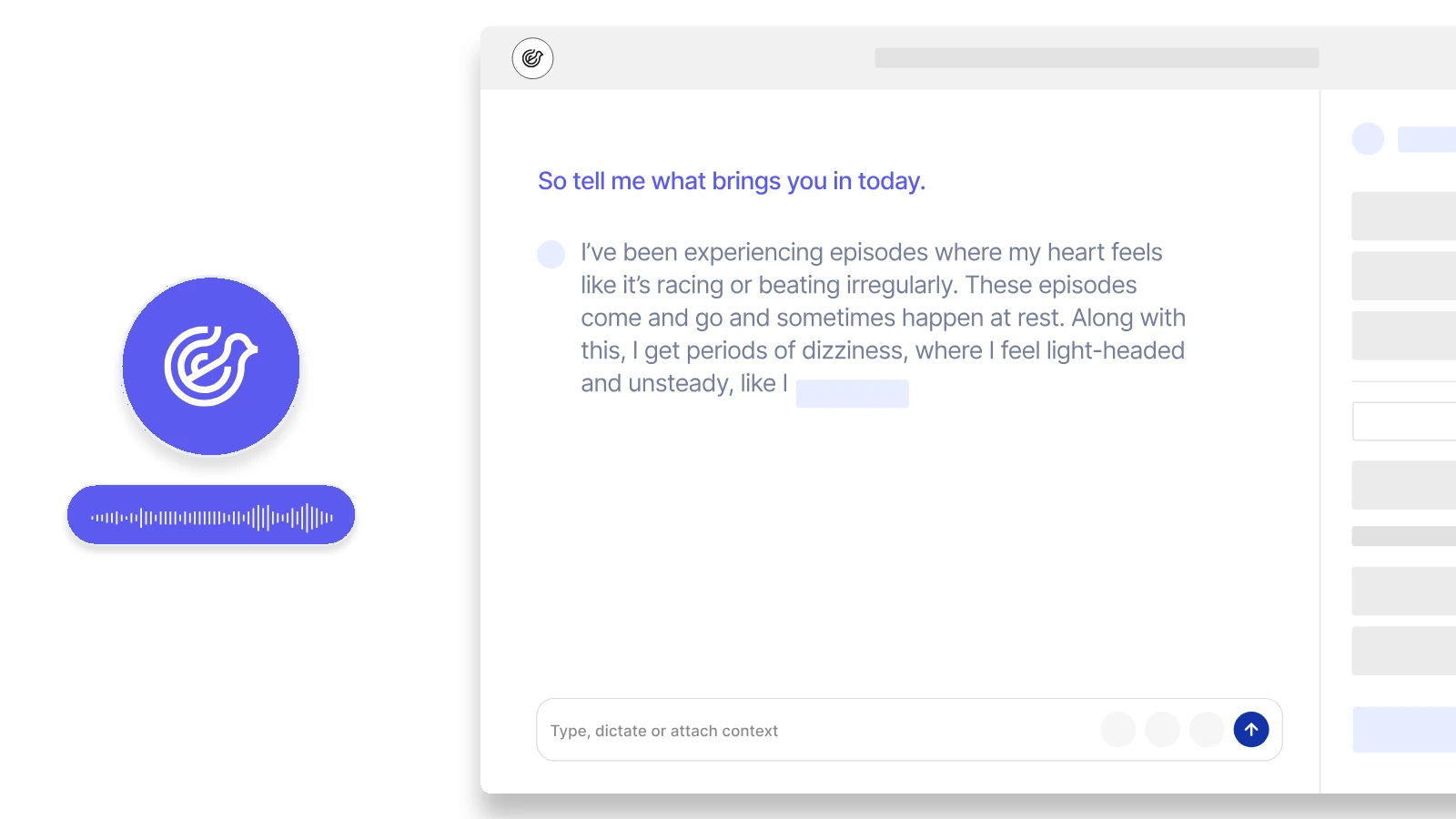
Lyrebird ambient-scribe product visual showing a recording waveform beside captured consultation speech.
Contributors
Subscribe to our newsletter
Read about our privacy policy.
Thank you! Your submission has been received!
Oops! Something went wrong while submitting the form.

AI in nursing touches several parts of the working day, from writing progress notes to recognising patterns in patient data. For Australian nurses, understanding those uses means separating helpful support from work that still demands direct assessment, clinical judgement and accountability. The practical questions are where AI fits, what benefits the evidence supports, and how to protect patients when an AI draft or alert enters the workflow.

What does AI in nursing mean?

Artificial intelligence (AI) in nursing refers to software that processes information to support nursing work. Different tools do different jobs:

  • Generative AI creates content, such as a draft clinical note or patient information sheet, from supplied information and learned patterns.
  • Predictive AI estimates an outcome or risk from data, such as a patient's risk of deterioration.
  • Rules-based decision support applies predefined conditions, such as a medicine interaction rule. It can sit alongside newer AI methods.

These categories can overlap within one product. A system's ability to write fluent text tells you little about its ability to assess a patient.

The Australian College of Nursing supports AI in practice, education and administration, with nurses involved in its design, implementation and evaluation. Its AI position statement keeps nursing knowledge and critical thinking central to care.

Documentation is one concrete application. Our clinical AI platform turns ambient capture, dictation or typed notes into structured drafts for clinician review. Our practice nurse workflows support care plans, health assessments and chronic disease management documentation in GP clinics, including filing through Bp Premier. That is a specific setting and workflow, rather than a claim that every hospital or community nursing system has the same integration.

How can AI support nursing work?

The useful distinction is between what a tool produces and what the nurse remains responsible for. These are examples of possible functions, not a claim that every Australian service uses them or that each improves patient outcomes.

ApplicationWhat AI can contributeWhat remains with nurses and the care team
Clinical documentationDraft progress notes, assessments or correspondence from captured informationAssess the patient, supply clinical context, correct the draft and authorise the record
Handover preparationOrganise documented information into a handover structureReconcile the current situation, communicate urgent concerns and confirm responsibilities
Deterioration monitoringAnalyse data patterns and flag patients for attentionAssess the patient and act through the service's escalation pathway
Patient educationDraft plain-language explanations from approved materialEnsure advice matches the agreed plan, the person's understanding and cultural needs
Nursing educationGenerate fictional scenarios and practice questionsEducators set learning objectives, supervise reasoning and assess competence
Workload planningForecast demand or support rostering analysisNursing leaders account for acuity, skill mix, workload and applicable staffing requirements

A digital chart, remote monitor or electronic alert is not automatically AI. The relevant question is what the function actually does: record information, apply a fixed rule, generate content or infer risk.

Documentation tools cannot observe everything you observe

An ambient AI scribe captures speech and drafts a summary. It cannot document an unspoken observation reliably. A nurse may notice effort of breathing, a change in behaviour or a patient's difficulty following instructions without saying it aloud.

Where an approved documentation workflow uses AI, those findings still need an accurate clinical record. Dictation or typed input can add the nurse's observations and actions. A polished draft cannot stand in for information that was never supplied.

What benefits does the evidence support?

The potential benefits include less repetitive drafting, more attention during conversations and more timely information for the next clinician. The strength of the evidence depends on the tool, setting and outcome measured.

Australian documentation studies are encouraging, with limits

A 16-week Gold Coast Hospital and Health Service outpatient trial involved 100 clinicians and 7,499 consultations, including clinical nurses running nurse-led clinics. The published Gold Coast evaluation reported positive clinician and patient experiences, alongside hallucinations and incorrect outputs.

The study focused mainly on medical officers and did not establish a separate nursing outcome. Its single-service outpatient findings cannot establish the same benefit for a busy ward, home visit or aged care shift.

A separate four-hospital cohort study included 58 clinicians, of whom five were nurses. Overall median encounter time fell by two minutes with the scribe. The before-and-after design and small nursing group limit conclusions about nurse-specific time savings. Editing was needed in virtually all cases, so draft-generation speed alone does not measure the whole workload.

Together, these studies support further use and evaluation of clinician-reviewed documentation. They do not establish a universal number of hours saved per nursing shift or a guaranteed improvement in patient safety.

Predictive systems need their own evidence

Documentation findings do not validate risk alerts. One example with direct nursing relevance is CONCERN (Communicating Narrative Concerns Entered by Registered Nurses), a system that uses patterns in nursing surveillance documentation to identify deterioration risk. A cluster-randomised trial across 74 clinical units in two US health systems reported a lower risk of in-hospital death with the system.

That finding belongs to a particular system and implementation. It does not show that a general-purpose chatbot can recognise deterioration, or establish that the same result will occur in Australian services.

What are the main risks of AI in nursing?

AI can produce an answer that looks complete while losing an important detail. The Australian Commission on Safety and Quality in Health Care's ambient scribe scenario describes fabricated information, omitted or added treatment steps and misheard words. Each can change the meaning of a nursing record.

RiskWhat it can look like in nursing work
OmissionA draft leaves out a patient's refusal, an escalation or a pending reassessment
Unsupported contentA note records an examination or intervention that did not happen
Attribution or timing errorA family member's report becomes the nurse's finding, or planned care becomes completed care
BiasPerformance differs across patient groups, languages or communication needs
Automation biasA fluent draft or reassuring risk score receives more weight than direct clinical assessment
Privacy exposureIdentifiable information enters an unapproved tool or is accessed or reused unexpectedly

Automation bias can also cause inaction when a tool fails to raise an alert. The Commission's AI Clinical Use Guide emphasises clinician judgement, timely output review and organisation-authorised tools. An absent alert does not resolve a nurse's concern about a deteriorating patient.

Privacy applies to both input and output

The Office of the Australian Information Commissioner (OAIC) explains that privacy obligations cover personal information entered into AI and generated personal information, including incorrect information about an identifiable person. Its commercial AI guidance recommends, as best practice, keeping personal and especially sensitive information out of publicly available generative AI tools.

Removing a name alone does not necessarily make a patient story anonymous. A combination of dates, location, diagnosis and circumstances can still identify someone. Use the service's approved systems and data-handling process. Patient information should not move into a personal chatbot account for convenience.

For an approved tool, the organisation's governance needs to cover access, processing and storage locations, retention, model training, third-party use and incident response. Australian hosting alone does not answer all those questions. Our guide to AI scribe privacy explains the distinctions.

How should nurses use AI for documentation?

The standard of the final record remains the starting point. The Nursing and Midwifery Board of Australia's registered nurse standards, criterion 1.6, require accurate, comprehensive and timely documentation of assessments, planning, decision-making, actions and evaluations. This is a professional standard for registered nurses, not a new AI-specific rule.

A practical documentation workflow separates capture, drafting, nursing review and filing.

1. Use an authorised tool for a defined task

The approved workflow should identify the setting, document type, permitted inputs and person responsible for final authorisation. A progress-note workflow is different from generating a patient-specific treatment recommendation.

The Therapeutic Goods Administration (TGA) distinguishes administrative scribes from software with a therapeutic purpose. Not all scribes are medical devices. Functions that generate clinical conclusions or suggest diagnoses or treatment can change the regulatory position. A documentation tool should stay within its authorised purpose.

2. Explain capture and record the patient's decision

Before ambient capture, explain what the tool collects, why you use it, what it produces and how information is handled. Give the patient an opportunity to ask questions and decline.

The Australian Health Practitioner Regulation Agency (AHPRA) states in its professional AI guidance that generative AI scribes using personal data generally require informed consent. Obtain and record any consent required for the specific workflow before capture begins, following organisational procedures and applicable state or territory requirements. A waiting-room notice does not replace that decision.

If the patient declines, use the usual documentation method. If they withdraw during capture, stop capture and follow the service's process for the captured material. Our AI scribe consent guide covers that conversation in more detail.

3. Capture the encounter without inventing completeness

Keep the input specific to the patient and encounter. Distinguish what the patient reports, what you observe, what you do and what remains planned. Avoid asking the AI to fill clinical gaps with plausible wording.

In shared spaces, an approved workflow also needs to prevent capture of other patients and unrelated conversations. When ambient capture is unsuitable, use the authorised alternative.

4. Review meaning, then wording

We recommend reading a draft for clinical meaning before polishing its style. Work through:

  • Identity and encounter: the correct patient, date, time and episode of care.
  • Findings: observations, measurements, units, symptoms and relevant negatives match the encounter.
  • Attribution: patient, carer and clinician statements remain distinct.
  • Actions: medicines, procedures, education and escalation reflect what actually happened.
  • Timing and ownership: completed actions, pending work, reassessment and the responsible person are clear.
  • Unsupported additions and omissions: remove invented content and restore important missing information.

Record that information was not obtained when that is clinically relevant. A generated normal finding can falsely imply an assessment occurred.

A nursing example: preserve reported, observed and planned information

Consider this fictional documentation input:

Patient reports the dressing was changed yesterday. Outer dressing dry and intact on inspection. Dressing removal and wound assessment planned for tomorrow's review.

An unsafe draft might read, “Wound assessed and healing well. Dressing changed.” That version invents a wound assessment, a clinical conclusion and a completed intervention.

The final note needs to preserve the original distinctions: the patient reported the earlier change, the nurse inspected the outer dressing, and the wound assessment remains planned. This is a documentation example, not a wound-care protocol.

5. Authorise the record and preserve follow-up

After review and correction, save the authorised note to the correct patient record through the approved filing process. Include the required authorship and sign-off. A generated handover summary does not complete an escalation, update a medicine administration record or transfer responsibility by itself.

Report material errors and near misses through the service's incident process. If an error has already entered the record, use the established correction process and communicate any effect on ongoing care.

What should nursing teams put in place before wider use?

Nurses need a voice in implementation, including those who will use the tool on nights, in shared spaces, during home visits and with interpreters. A workflow designed around a quiet single-patient consult may miss those conditions.

We recommend starting with one clearly defined task and building these controls around it:

  • Named accountability: a nursing lead, clinical governance owner and clear technical support route.
  • Training: intended use, limits, privacy, consent, draft review and reporting of errors.
  • Protected review time: workload expectations that include correction and sign-off.
  • An alternative workflow: documentation and care continue when the tool is unavailable or unsuitable, or a patient declines capture.
  • Meaningful evaluation: measure total documentation time including editing, omissions, unsupported content, filing errors, patient experience and differences between patient groups.

Faster drafting is useful only when the final record remains reliable and care stays person-centred. For practice nurses in GP clinics, we support that work with structured draft notes, care plans and assessments that nurses review before use, with the GP's review and sign-off where required. To discuss that workflow with our team:

Contact us

More Resources
Continue reading
Posts
The dangers of Copy Paste Scribes
Read More
Posts
How to use an AI medical scribe
Read More
Posts
December Product Updates
Read More
Education
Best microphone for an AI scribe: a clinical setup guide
Read More
Education
Medical Practice Analytics: A Guide for Australian Clinics
Read More
Education
Key performance indicators for medical practice: an Australian framework
Read More
Article
5 min read

AI in nursing: uses, benefits and safe documentation

Published on
October 27, 2026
Lyrebird ambient-scribe product visual showing a recording waveform beside captured consultation speech.
Contributors
Subscribe to our newsletter
Read about our privacy policy.
Thank you! Your submission has been received!
Oops! Something went wrong while submitting the form.

AI in nursing touches several parts of the working day, from writing progress notes to recognising patterns in patient data. For Australian nurses, understanding those uses means separating helpful support from work that still demands direct assessment, clinical judgement and accountability. The practical questions are where AI fits, what benefits the evidence supports, and how to protect patients when an AI draft or alert enters the workflow.

What does AI in nursing mean?

Artificial intelligence (AI) in nursing refers to software that processes information to support nursing work. Different tools do different jobs:

  • Generative AI creates content, such as a draft clinical note or patient information sheet, from supplied information and learned patterns.
  • Predictive AI estimates an outcome or risk from data, such as a patient's risk of deterioration.
  • Rules-based decision support applies predefined conditions, such as a medicine interaction rule. It can sit alongside newer AI methods.

These categories can overlap within one product. A system's ability to write fluent text tells you little about its ability to assess a patient.

The Australian College of Nursing supports AI in practice, education and administration, with nurses involved in its design, implementation and evaluation. Its AI position statement keeps nursing knowledge and critical thinking central to care.

Documentation is one concrete application. Our clinical AI platform turns ambient capture, dictation or typed notes into structured drafts for clinician review. Our practice nurse workflows support care plans, health assessments and chronic disease management documentation in GP clinics, including filing through Bp Premier. That is a specific setting and workflow, rather than a claim that every hospital or community nursing system has the same integration.

How can AI support nursing work?

The useful distinction is between what a tool produces and what the nurse remains responsible for. These are examples of possible functions, not a claim that every Australian service uses them or that each improves patient outcomes.

ApplicationWhat AI can contributeWhat remains with nurses and the care team
Clinical documentationDraft progress notes, assessments or correspondence from captured informationAssess the patient, supply clinical context, correct the draft and authorise the record
Handover preparationOrganise documented information into a handover structureReconcile the current situation, communicate urgent concerns and confirm responsibilities
Deterioration monitoringAnalyse data patterns and flag patients for attentionAssess the patient and act through the service's escalation pathway
Patient educationDraft plain-language explanations from approved materialEnsure advice matches the agreed plan, the person's understanding and cultural needs
Nursing educationGenerate fictional scenarios and practice questionsEducators set learning objectives, supervise reasoning and assess competence
Workload planningForecast demand or support rostering analysisNursing leaders account for acuity, skill mix, workload and applicable staffing requirements

A digital chart, remote monitor or electronic alert is not automatically AI. The relevant question is what the function actually does: record information, apply a fixed rule, generate content or infer risk.

Documentation tools cannot observe everything you observe

An ambient AI scribe captures speech and drafts a summary. It cannot document an unspoken observation reliably. A nurse may notice effort of breathing, a change in behaviour or a patient's difficulty following instructions without saying it aloud.

Where an approved documentation workflow uses AI, those findings still need an accurate clinical record. Dictation or typed input can add the nurse's observations and actions. A polished draft cannot stand in for information that was never supplied.

What benefits does the evidence support?

The potential benefits include less repetitive drafting, more attention during conversations and more timely information for the next clinician. The strength of the evidence depends on the tool, setting and outcome measured.

Australian documentation studies are encouraging, with limits

A 16-week Gold Coast Hospital and Health Service outpatient trial involved 100 clinicians and 7,499 consultations, including clinical nurses running nurse-led clinics. The published Gold Coast evaluation reported positive clinician and patient experiences, alongside hallucinations and incorrect outputs.

The study focused mainly on medical officers and did not establish a separate nursing outcome. Its single-service outpatient findings cannot establish the same benefit for a busy ward, home visit or aged care shift.

A separate four-hospital cohort study included 58 clinicians, of whom five were nurses. Overall median encounter time fell by two minutes with the scribe. The before-and-after design and small nursing group limit conclusions about nurse-specific time savings. Editing was needed in virtually all cases, so draft-generation speed alone does not measure the whole workload.

Together, these studies support further use and evaluation of clinician-reviewed documentation. They do not establish a universal number of hours saved per nursing shift or a guaranteed improvement in patient safety.

Predictive systems need their own evidence

Documentation findings do not validate risk alerts. One example with direct nursing relevance is CONCERN (Communicating Narrative Concerns Entered by Registered Nurses), a system that uses patterns in nursing surveillance documentation to identify deterioration risk. A cluster-randomised trial across 74 clinical units in two US health systems reported a lower risk of in-hospital death with the system.

That finding belongs to a particular system and implementation. It does not show that a general-purpose chatbot can recognise deterioration, or establish that the same result will occur in Australian services.

What are the main risks of AI in nursing?

AI can produce an answer that looks complete while losing an important detail. The Australian Commission on Safety and Quality in Health Care's ambient scribe scenario describes fabricated information, omitted or added treatment steps and misheard words. Each can change the meaning of a nursing record.

RiskWhat it can look like in nursing work
OmissionA draft leaves out a patient's refusal, an escalation or a pending reassessment
Unsupported contentA note records an examination or intervention that did not happen
Attribution or timing errorA family member's report becomes the nurse's finding, or planned care becomes completed care
BiasPerformance differs across patient groups, languages or communication needs
Automation biasA fluent draft or reassuring risk score receives more weight than direct clinical assessment
Privacy exposureIdentifiable information enters an unapproved tool or is accessed or reused unexpectedly

Automation bias can also cause inaction when a tool fails to raise an alert. The Commission's AI Clinical Use Guide emphasises clinician judgement, timely output review and organisation-authorised tools. An absent alert does not resolve a nurse's concern about a deteriorating patient.

Privacy applies to both input and output

The Office of the Australian Information Commissioner (OAIC) explains that privacy obligations cover personal information entered into AI and generated personal information, including incorrect information about an identifiable person. Its commercial AI guidance recommends, as best practice, keeping personal and especially sensitive information out of publicly available generative AI tools.

Removing a name alone does not necessarily make a patient story anonymous. A combination of dates, location, diagnosis and circumstances can still identify someone. Use the service's approved systems and data-handling process. Patient information should not move into a personal chatbot account for convenience.

For an approved tool, the organisation's governance needs to cover access, processing and storage locations, retention, model training, third-party use and incident response. Australian hosting alone does not answer all those questions. Our guide to AI scribe privacy explains the distinctions.

How should nurses use AI for documentation?

The standard of the final record remains the starting point. The Nursing and Midwifery Board of Australia's registered nurse standards, criterion 1.6, require accurate, comprehensive and timely documentation of assessments, planning, decision-making, actions and evaluations. This is a professional standard for registered nurses, not a new AI-specific rule.

A practical documentation workflow separates capture, drafting, nursing review and filing.

1. Use an authorised tool for a defined task

The approved workflow should identify the setting, document type, permitted inputs and person responsible for final authorisation. A progress-note workflow is different from generating a patient-specific treatment recommendation.

The Therapeutic Goods Administration (TGA) distinguishes administrative scribes from software with a therapeutic purpose. Not all scribes are medical devices. Functions that generate clinical conclusions or suggest diagnoses or treatment can change the regulatory position. A documentation tool should stay within its authorised purpose.

2. Explain capture and record the patient's decision

Before ambient capture, explain what the tool collects, why you use it, what it produces and how information is handled. Give the patient an opportunity to ask questions and decline.

The Australian Health Practitioner Regulation Agency (AHPRA) states in its professional AI guidance that generative AI scribes using personal data generally require informed consent. Obtain and record any consent required for the specific workflow before capture begins, following organisational procedures and applicable state or territory requirements. A waiting-room notice does not replace that decision.

If the patient declines, use the usual documentation method. If they withdraw during capture, stop capture and follow the service's process for the captured material. Our AI scribe consent guide covers that conversation in more detail.

3. Capture the encounter without inventing completeness

Keep the input specific to the patient and encounter. Distinguish what the patient reports, what you observe, what you do and what remains planned. Avoid asking the AI to fill clinical gaps with plausible wording.

In shared spaces, an approved workflow also needs to prevent capture of other patients and unrelated conversations. When ambient capture is unsuitable, use the authorised alternative.

4. Review meaning, then wording

We recommend reading a draft for clinical meaning before polishing its style. Work through:

  • Identity and encounter: the correct patient, date, time and episode of care.
  • Findings: observations, measurements, units, symptoms and relevant negatives match the encounter.
  • Attribution: patient, carer and clinician statements remain distinct.
  • Actions: medicines, procedures, education and escalation reflect what actually happened.
  • Timing and ownership: completed actions, pending work, reassessment and the responsible person are clear.
  • Unsupported additions and omissions: remove invented content and restore important missing information.

Record that information was not obtained when that is clinically relevant. A generated normal finding can falsely imply an assessment occurred.

A nursing example: preserve reported, observed and planned information

Consider this fictional documentation input:

Patient reports the dressing was changed yesterday. Outer dressing dry and intact on inspection. Dressing removal and wound assessment planned for tomorrow's review.

An unsafe draft might read, “Wound assessed and healing well. Dressing changed.” That version invents a wound assessment, a clinical conclusion and a completed intervention.

The final note needs to preserve the original distinctions: the patient reported the earlier change, the nurse inspected the outer dressing, and the wound assessment remains planned. This is a documentation example, not a wound-care protocol.

5. Authorise the record and preserve follow-up

After review and correction, save the authorised note to the correct patient record through the approved filing process. Include the required authorship and sign-off. A generated handover summary does not complete an escalation, update a medicine administration record or transfer responsibility by itself.

Report material errors and near misses through the service's incident process. If an error has already entered the record, use the established correction process and communicate any effect on ongoing care.

What should nursing teams put in place before wider use?

Nurses need a voice in implementation, including those who will use the tool on nights, in shared spaces, during home visits and with interpreters. A workflow designed around a quiet single-patient consult may miss those conditions.

We recommend starting with one clearly defined task and building these controls around it:

  • Named accountability: a nursing lead, clinical governance owner and clear technical support route.
  • Training: intended use, limits, privacy, consent, draft review and reporting of errors.
  • Protected review time: workload expectations that include correction and sign-off.
  • An alternative workflow: documentation and care continue when the tool is unavailable or unsuitable, or a patient declines capture.
  • Meaningful evaluation: measure total documentation time including editing, omissions, unsupported content, filing errors, patient experience and differences between patient groups.

Faster drafting is useful only when the final record remains reliable and care stays person-centred. For practice nurses in GP clinics, we support that work with structured draft notes, care plans and assessments that nurses review before use, with the GP's review and sign-off where required. To discuss that workflow with our team:
Contact us

Keep reading

All posts
Questions about compliance?