AI in healthcare: a practical guide for Australian teams
AI is becoming part of the consult, the patient record and the systems that keep health services running. For Australian clinicians and healthcare leaders, the challenge is deciding where it can help patients and staff, and what needs to stay under direct human control.
Understanding the different uses, their evidence and Australia's overlapping responsibilities makes that decision more manageable. A useful starting point is the clinical task you want to improve.
What is AI in healthcare?
Artificial intelligence (AI) in healthcare refers to computer systems that analyse information, recognise patterns or generate content to support clinical and administrative work. Applications include drafting clinical notes, analysing medical images and forecasting demand for services. The Australian Commission on Safety and Quality in Health Care provides national safety guidance for these uses.
Three terms help distinguish the tools:
- Machine learning uses patterns learned from data to produce outputs such as classifications or risk estimates.
- Computer vision analyses images, including scans and clinical photographs.
- Generative AI produces new content, such as a draft note or response to a question. A large language model is a type of AI model used to generate and process language.
These categories overlap. An ambient AI scribe, for example, can combine speech recognition with generative AI to turn a clinical conversation into a draft note.
At Lyrebird Health, our clinical AI platform supports that documentation workflow. You can capture a consult through ambient scribing, dictation or typed notes, then review and edit the structured draft. Our clinical notes workflow keeps the clinician responsible for the final record and clinical decisions.
How AI is used in Australian healthcare
AI is already used in Australian care settings for documentation, image analysis, clinical decision support, patient information and service planning. These are distinct applications, with different consequences when an output is wrong. The Australian Government's healthcare AI overview maps current uses.
A tool's name is less informative than its actual function. Organising information already stated during a consult is different from generating a new diagnosis, treatment suggestion or follow-up recommendation. That distinction matters for both clinical governance and medical-device regulation.
Research applications extend further, including treatment planning and analysis of complex datasets. The Commonwealth Scientific and Industrial Research Organisation (CSIRO) includes an example of generating synthetic computed tomography images from magnetic resonance imaging scans for radiotherapy planning in its 2026 healthcare report. A specific clinical application has its own evidence and constraints; its results cannot establish that unrelated AI tools are safe or effective.
What benefits does the evidence support?
The most useful evidence connects a named tool and workflow to a defined outcome. A higher model score, a more complete note and a better patient outcome measure different things.
Imaging benefits depend on the screening pathway
In Sweden's randomised Mammography Screening with Artificial Intelligence (MASAI) trial, AI-supported screening detected 6.4 cancers per 1,000 participants, compared with 5.0 under standard double reading. Screen-reading workload fell by 44.2%. The AI supported triage and detection within a defined screening pathway. The screening trial provides evidence for that workflow, rather than autonomous diagnosis or automatic transfer of its results to Australian services.
Australian documentation evidence shows benefits and review needs
A 16-week Gold Coast Hospital and Health Service evaluation involved 100 clinicians and 7,499 outpatient consultations. Among the 43 staff survey respondents, 79% reported better consultations through increased patient focus, and 84% reported a positive effect on efficiency. However, 47% reported observing hallucinations in scribe outputs, including undiscussed or incorrect information. That figure describes respondents who observed hallucinations, not the percentage of notes containing errors. The published evaluation reports both the benefits and reliability concerns.
The tool evaluated was Lyrebird. This was a single-service, mixed-methods evaluation rather than a randomised comparison, and its note-quality analysis involved only 18 pairs of notes. The outpatient findings support a case for clinician-reviewed documentation assistance, alongside continued quality monitoring. They do not establish error-free output, equivalent results in every specialty, or effectiveness in inpatient or emergency departments.
Time savings vary between tools and settings
In a US randomised trial involving 238 outpatient physicians across 14 specialties, one of two ambient scribes reduced time spent writing notes by 9.5% compared with usual care. The other produced no statistically significant reduction. Clinicians also reported occasional clinically significant inaccuracies. The randomised trial illustrates why time savings should be tied to the particular product, setting and workflow.
For a practice or hospital, the meaningful outcome is the completed, reviewed work. A draft generated in seconds may still need correction, missing context and transfer into the patient record.
The main risks and how to contain them
Generative AI can produce fluent text that is wrong or unsupported. AI can also omit relevant information, perform differently across patient groups or encourage over-reliance on its output. The Agency for Healthcare Research and Quality's review of AI limitations explains these clinical risks.
We recommend matching safeguards to the specific failure, rather than relying on a general instruction to be careful.
A longer note is not automatically a better note. Relevant, accurate and clearly assigned information matters more than volume. Templates should not encourage the model to fill gaps with plausible findings.
Which Australian rules apply?
There is no single approval that settles every responsibility. Medical-device status, privacy, professional obligations and local organisational requirements address different parts of AI use.
TGA regulation depends on intended purpose
The Therapeutic Goods Administration (TGA) distinguishes administrative scribing from functions with a therapeutic purpose. A scribe limited to recording, transcribing or organising information, without adding new clinical content or suggestions, may be outside medical-device regulation. A function that recommends diagnoses, investigations or treatment, or generates clinical assessments, can bring it within regulation. Design, presentation and marketing claims also matter. TGA digital scribe guidance explains this boundary.
Medical devices must meet applicable requirements and be included in the Australian Register of Therapeutic Goods (ARTG) before supply unless exempt. Some clinical decision support software is exempt from ARTG inclusion while remaining regulated. An exemption is different from being outside regulation.
A platform can contain both medical-device and non-medical-device functions. Human review alone does not determine its regulatory status, and a new feature can change the position.
Privacy duties cover inputs and outputs
The Privacy Act 1988 and Australian Privacy Principles (APPs) apply to AI handling of personal information where the organisation is covered by the Act. This includes generated output containing personal information. The Office of the Australian Information Commissioner (OAIC) recommends, as best practice, keeping personal information, particularly sensitive information, out of publicly available generative AI tools. Its commercial AI guidance also addresses product selection, transparency and human oversight.
A useful approval record separates:
- what is captured, including audio, transcripts, notes and logs
- processing, storage, backup and support-access locations
- vendor and subprocessor access
- retention periods and contract-end arrangements
- model training and other secondary uses
- access, correction and incident-response processes.
Australian hosting is one part of that picture. APP 8 governs cross-border disclosure, with reasonable-steps and accountability requirements and specified exceptions. It does not impose a blanket ban on overseas disclosure. OAIC's APP 8 guidance explains the framework. State or territory requirements and health-service policies may add obligations.
Clinicians retain professional accountability
The Australian Health Practitioner Regulation Agency (AHPRA) makes clear that practitioners remain responsible for safe care and must apply human judgement to AI outputs. For AI scribes, that includes the accuracy and relevance of the resulting record. Practitioners also need enough understanding of intended use, limitations and population suitability to use the tool safely. AHPRA's professional guidance applies existing professional responsibilities to AI use.
Organisational approval therefore needs a clinical owner as well as privacy and technical input. In a small practice, one person may hold several roles, but the responsibilities still need to be explicit.
Patient information and consent depend on the use
AHPRA advises that generative AI scribing involving personal data will generally require informed consent, ideally noted in the health record. Broader AI uses do not all have an identical disclosure or consent process.
For consultation capture, our recommended workflow is to explain the tool, its draft output, material risks and data handling, then obtain and record any consent required for that workflow before capture starts. Patients need a genuine opportunity to ask questions and decline, with an alternative documentation method available. Our patient consent guide explains the practical steps and jurisdictional differences.
A safer AI documentation workflow
Clinical documentation is a concrete place to see these responsibilities working together. The Australian Commission's AI Clinical Use Guide recommends timely review, correction and clinician-authorised filing, alongside transparency and ongoing monitoring.
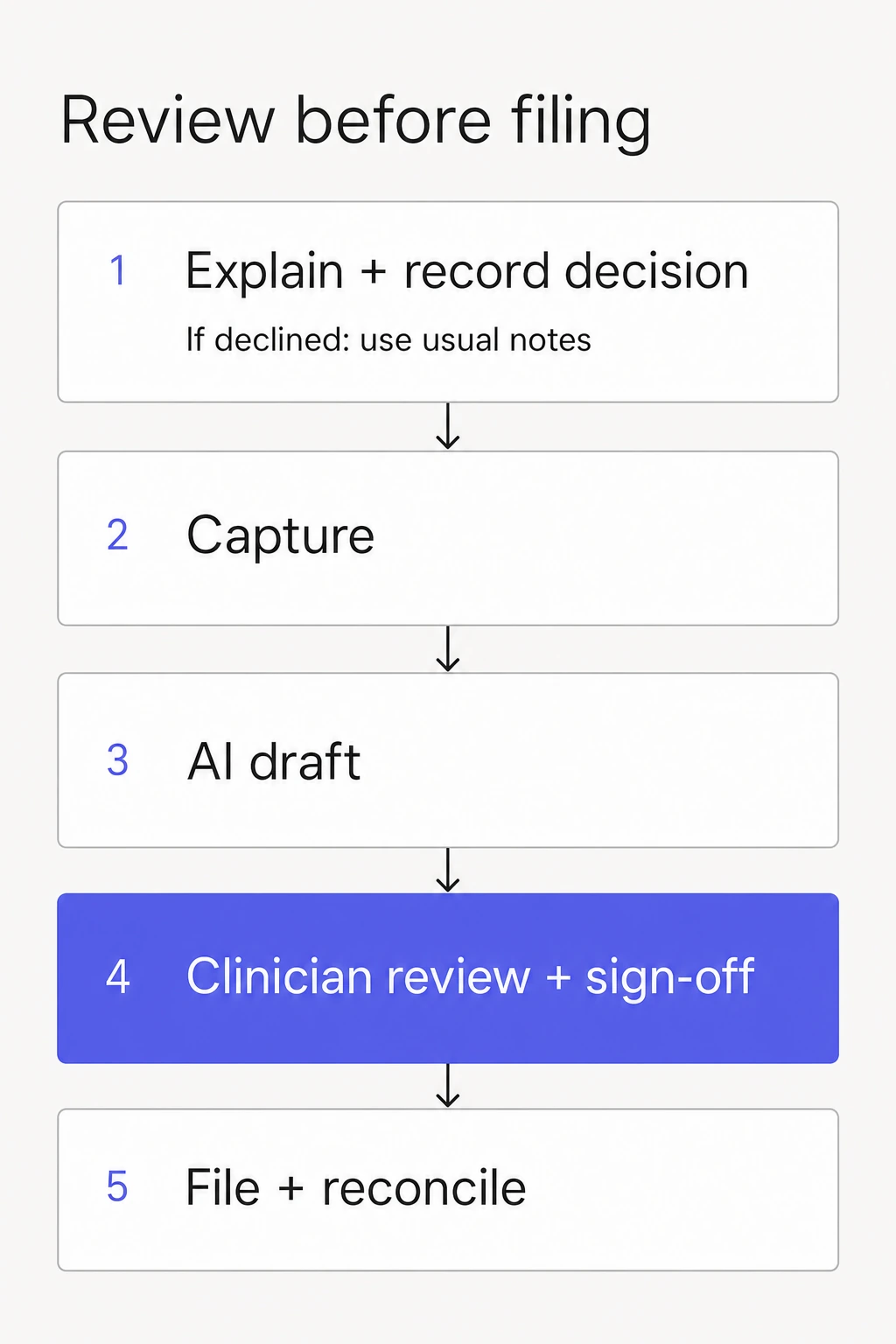
For an approved ambient scribe, we recommend this sequence:
- Explain and record the decision. Complete the applicable patient information and consent process before capture. If the patient declines, use the usual documentation method.
- Capture the clinical information. Avoid capturing unrelated conversations. Add relevant examination findings or context that were not spoken aloud.
- Generate a draft. Keep generated text distinct from the authorised record.
- Review, edit and sign off. Read the full draft. Give particular attention to medicines, allergies, doses, measurements, laterality, negation, uncertainty and follow-up responsibility.
- File and reconcile. Save the authorised version to the correct patient record and resolve failed or duplicate transfers. Apply the organisation's retention arrangements to source material and drafts.
An inconsistency needs resolution before sign-off. A recurring problem also needs an incident or quality-improvement pathway so the next clinician does not encounter the same failure without warning.
How to introduce AI without adding another burden
Start with a defined problem, such as delayed referral letters or documentation completed after clinic. Choose one bounded workflow and an evaluation period, with a named clinical owner and a clear decision about what would justify expansion.
Before patient use, the approval record should contain the intended purpose, applicable regulatory position, evidence, data arrangements, staff training, review responsibilities and fallback workflow. Our recommendation is to keep the first deployment narrow enough that problems can be understood and corrected.
Measure the whole task
For documentation, useful measures include:
- Clinical quality: important omissions, unsupported statements, contradictions and their potential consequences.
- Patient experience: attention during the consult, understanding of AI use and comfort declining.
- Completed work: time spent drafting, reviewing, correcting and filing, plus after-hours documentation.
- Workflow reliability: failed transfers, duplicate notes and unresolved drafts.
- Total cost: licences, integration, equipment, training, support and review time.
A simple worked example shows why the boundary matters. Suppose a note previously took six minutes to complete. With AI, generation takes 30 seconds, review and correction take two minutes, and filing takes 30 seconds. The completed task now takes three minutes, saving three minutes rather than five and a half. These are illustrative figures, not measured Lyrebird results.
Quicker completion is valuable only alongside acceptable clinical quality. More notes accepted without edits does not, on its own, show better performance: it may also reflect less careful review.
Keep ownership after rollout
Clinical governance continues after launch. The Commission recommends ongoing monitoring, escalation of risks and near misses, and awareness of changes in a tool's functionality. New features, templates or model updates can affect both the workflow and its supporting evidence.
Keep a route back to normal documentation if the tool is unavailable or unsuitable. Expansion should follow demonstrated usefulness in the intended setting, with the patient relationship and clinical judgement preserved.
Keep patient care at the centre of clinical AI
The strongest starting point is a task where AI can reduce information-handling work while leaving clinical decisions and final documentation with the clinician. For teams focused on notes and correspondence, we support ambient capture, dictation and typed notes. You can also turn a clinical note into documents and letters, including referral drafts, for review and sign-off.
If you want to explore that workflow with your team, we can help you work through how Lyrebird fits your clinical setting.