Education
5 min read

VicRoads Medical Report: A Practical Guide for Clinicians
Published on
August 21, 2026
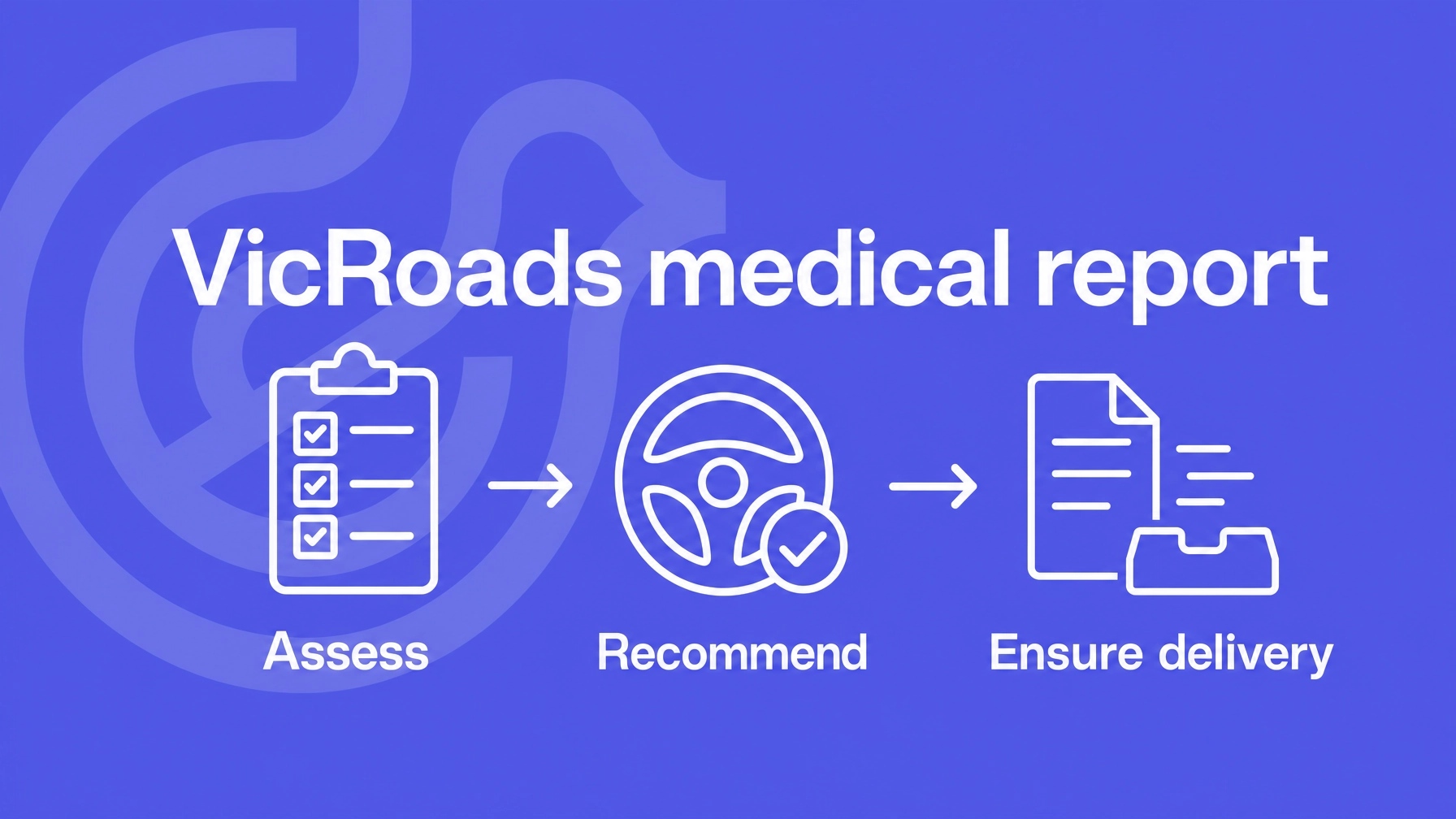
VicRoads medical report workflow: assess, recommend and ensure delivery
Contributors
Lyrebird Health
Subscribe to our newsletter
Read about our privacy policy.
Thank you! Your submission has been received!
Oops! Something went wrong while submitting the form.

When a patient brings in a request for a VicRoads medical report, the task goes beyond confirming a diagnosis. You need to identify the correct form, apply the right private or commercial standard, record decision-ready evidence and give clear driving advice. A reliable workflow runs from pre-consult preparation through to ensuring the completed report reaches Medical Review and recording your advice and actions.

Use the current Transport Victoria report

Transport Victoria's Medical Review team manages the fitness-to-drive reporting process that many patients still call a VicRoads medical report. Transport Victoria provides an online medical report, which Medical Review receives as soon as the clinician lodges it.

Transport Victoria's health professional guidance identifies two reports in the portal: a medical report for GPs and medical specialists, including psychiatrists, and an eyesight report for optometrists and ophthalmologists. The same guidance provides paper forms for clinicians who cannot access the online report.

Report Who completes it Current form
Online medical report GP or medical specialist, including a psychiatrist Open the online portal
Online eyesight report Optometrist or ophthalmologist Open the online portal
General medical report PDF GP or medical specialist Download the medical report
Eyesight report PDF Optometrist or ophthalmologist Download the eyesight report
Psychiatric report PDF Psychiatrist or psychiatric registrar Download the psychiatric report

Use these current links rather than a form saved locally or hosted by a hospital. Older VicRoads PDFs and links to the former portal address remain on third-party websites, and they may no longer reflect the current workflow.

Clinical judgement stays with you. For the paper route, our Documents & Letters workflow can pre-fill an uploaded PDF using information captured during the consult. It provides a draft only. You still apply the national standards and current Victorian requirements, review every field, complete the recommendation and sign the report. Then follow the Medical Review request or the form's instructions about who returns it, and make sure the completed report reaches Medical Review by the due date. For the online route, a reviewed clinical note can serve as the source while you complete the government portal.

If you use ambient capture during the appointment, give any notice and obtain and record any consent required for that workflow before capture begins. Our guide to patient consent for AI scribes explains how to make that process clear and consistent.

Prepare before the appointment

Transport Victoria advises patients to book promptly and tell the practice why they need the appointment, as the assessment may take longer than a standard consult. When Medical Review has requested a report, Transport Victoria also tells clinicians to ask for the letter. For a decision-ready assessment, we suggest asking the patient to bring:

  • the complete Medical Review letter, including every requested report and the due date
  • their driver licence or learner permit
  • an up-to-date medication list, including non-prescription medicines
  • recent specialist reports, discharge summaries and relevant test results
  • the glasses, contact lenses or hearing aids they use when driving
  • details of any driving required for work, including public passenger, heavy vehicle or dangerous-goods duties
  • information about recent crashes, near misses, blackouts, seizures or episodes that could affect driving

The portal Help identifies two numbers at the top left of the Medical Review letter: a case number and the patient's reference or licence number. Entering both pre-populates personal details and the names of conditions previously reported to Medical Review, but no clinical data. Without the letter, the report can still be completed by entering the patient's name, address and date of birth manually.

Open the relevant chapter of Assessing Fitness to Drive (AFTD) before making a recommendation. The operative publication remains AP-G56-22, edition 6.0, effective from 22 June 2022. The National Transport Commission's 2026 to 2028 review has not replaced the standards now in force.

AFTD provides the national baseline. Apply it alongside current Victorian requirements. Victoria's policy on bioptic telescopes is absent from AFTD 2022: no driver may be licensed in Victoria to drive while using bioptic telescopes. This applies under both private and commercial standards, whether or not the driver otherwise meets the AFTD 2022 vision criteria.

If records or specialist input cannot be obtained before the date in the letter, Transport Victoria says the patient should request an extension from Medical Review. Failure to provide the requested information by the due date may result in licence suspension or cancellation.

Complete the online VicRoads medical report

Transport Victoria's online report guidance recommends using a computer rather than a phone or tablet, with an up-to-date browser. A first-time user creates an account with their name, AHPRA registration number, date of birth, email address and mobile number. Later sign-ins use email, password and a multi-factor authentication code sent to the registered mobile.

1. Confirm the patient and their driving category

Use the case and reference numbers from the patient's letter where available. Then establish what the patient drives and why. Transport Victoria tells clinicians to ask about driving required for work, because licence class alone may not identify the applicable standard.

Standard Usually applies to
Private Class C car, R motorcycle and LR light rigid drivers, unless the vehicle is used for a commercial category covered by the higher standard
Commercial MR, HR, HC and MC licence classes; public passenger drivers; dangerous-goods drivers; drivers operating under Basic or Advanced Fatigue Management; and other categories subject to commercial certification

Commercial standards are more stringent because of the increased risks associated with commercial vehicles. A patient who does not meet the commercial standard may still meet the private standard, so complete the recommendations separately when both are relevant.

2. Select and complete the relevant assessment sections

The general medical report lets you select the applicable clinical categories at the start. The portal's completion guidance identifies these sections:

  • vision, which is mandatory for every medical report
  • blackouts
  • cardiovascular conditions
  • diabetes
  • hearing loss for commercial drivers
  • musculoskeletal disorders
  • dementia or other cognitive impairment
  • seizures and epilepsy
  • other neurological conditions
  • mental health
  • sleep disorders
  • drugs and driving
  • substance misuse
  • additional comments

The portal contains rules aligned with AFTD, and current Victorian requirements also apply. It does not replace clinical assessment. Austroads' assessment process requires the clinician to consider the condition, treatment, functional effects and type of driving. Make that relationship explicit by recording:

  • diagnosis, onset, course and current severity
  • dates and circumstances of recent events, such as loss of consciousness or a seizure
  • investigation results and specialist findings
  • treatment, response, adherence and adverse effects relevant to driving
  • relevant comorbidities and the cumulative effect of multiple conditions or medicines
  • functional effects on vision, cognition, judgement, alertness, movement and vehicle control
  • the patient's insight, reliability and ability to follow restrictions
  • whether the condition is stable, improving, fluctuating or progressive
  • the proposed monitoring or review interval and who will provide it

A diagnosis alone does not describe the patient's functional driving risk. The report should show whether the patient meets the applicable criteria now, may meet conditional criteria with defined management or restrictions, or needs further assessment.

3. Make a clear recommendation

The portal instructions make the recommendation section mandatory. Complete a recommendation against the private standard for every patient and against the commercial standard when the patient holds or is applying for a commercial licence.

Your recommendation should state whether the patient meets the applicable standard, needs a conditional licence or further assessment, or should stop driving. Voluntary licence surrender may also be appropriate. Transport Victoria's conditional licence guidance gives examples including corrective lenses, daylight-only driving, a defined radius, review intervals and vehicle modifications. A condition can only be applied when the patient can reasonably be expected to remember and follow it.

When the medical assessment does not resolve a question about real-world driving performance, recommend an occupational therapy driving assessment. It can also assess the need for vehicle modifications such as a steering aid or left-foot accelerator.

4. Attach, review and submit

Attach only information relevant to fitness to drive, such as a specialist report or investigation result. Use the additional comments field for a condition that is not listed or for context about treatment adherence, patient insight and your advice.

Review the complete report before submission. The portal provides an edit control for each section, then generates a report reference number and a downloadable PDF after lodgement. Transport Victoria says clinicians can give the reference number and/or PDF to the patient. It also tells clinicians to document their advice and actions in the patient file.

The portal help states that completed pages save as a draft if the browser closes or the session times out after 60 minutes. Drafts are removed after 30 days. The practitioner account also allows you to request access to reports submitted during the previous two years.

Separate clinical advice from the licensing decision

Transport Victoria's health professional guidance separates the clinician's assessment and advice from Medical Review's licensing decision.

Clinician Medical Review
Assesses the condition and its functional impact Considers the report with licence history and other available information
Applies the relevant private or commercial AFTD criteria and current Victorian requirements Makes the final licensing decision case by case
Advises the patient about driving and self-reporting Is solely responsible for issuing, renewing, suspending, refusing or cancelling, and reinstating the licence
Recommends conditions, monitoring or further assessment May request a specialist report, driving test or occupational therapy driving assessment
Records the advice, report and actions in the patient file Writes to the driver with the outcome

Medical Review may receive information from the driver, a doctor or other health professional, police, relatives or community members. Driver self-reporting also starts the medical review process.

A medical recommendation does not itself change a licence. Medical Review makes the case-by-case licensing decision and may leave the licence unchanged, impose conditions, or suspend or cancel it. Referral does not automatically mean licence loss. Conditional licensing and periodic review may allow a patient to keep driving within safe limits.

Understand reporting responsibilities in Victoria

Under regulation 68(2), Victorian licence and permit holders and other authorised drivers must notify the Secretary as soon as practicable after becoming aware that they are affected by a permanent or long-term illness, disability, medical condition or injury, or treatment effects, that may impair safe driving. Drivers can make that notification through Medical Review.

Transport Victoria states that it must investigate driving-safety concerns. Section 27 of the Road Safety Act 1986, version 236 gives the Secretary power to require fitness and competence tests or assessments.

Victoria does not impose a general mandatory reporting duty on health professionals. Your role is to explain the effect of the condition and treatment, give clear advice about whether the patient should drive, and explain the patient's duty to self-report. Document your advice and actions in the clinical record.

If a patient lacks insight, does not follow advice to stop driving or refuses to self-report, you should consider notifying Medical Review in light of your duty of care and public-safety responsibilities. Medical Review accepts concerns about other drivers, and the reporter can remain anonymous to the driver unless disclosure is required by law. For an immediate risk to public safety, follow Transport Victoria's immediate-risk instruction and contact Victoria Police.

What happens once Medical Review receives the report

An online report reaches Medical Review immediately. For a paper report, follow the Medical Review letter and form instructions about who returns it. Transport Victoria's paper-report instructions accept these delivery channels:

  • email to medicalreview@transport.vic.gov.au
  • fax to (03) 9854 2307
  • post to Medical Review, GPO Box 2392, Melbourne VIC 3001

Transport Victoria advises allowing up to two weeks for postal delivery. Make sure the report arrives by the due date, follow the letter or form's record-keeping instructions, and document the completed assessment and any available return details in the clinical record.

The Medical Review contact details give (03) 8391 3226 for help with the form, the standards or the process, between 8 am and 5 pm, Monday to Friday.

Medical Review assesses the available information against AFTD and may require a specialist report, medical review driving test or occupational therapy driving assessment. Once it has all required information, it sends the driver a written outcome. Transport Victoria identifies three broad licence outcomes:

  1. no change to the licence
  2. conditions or restrictions on driving
  3. suspension or cancellation

The patient pays for the medical appointment and reports, as well as an occupational therapy driving assessment if one is required. Transport Victoria's published cost split covers Medical Review's assessment of the information and any medical review driving test it requires.

A final clinician checklist

Before finalising the report, confirm that you have:

  • used the current online service or current paper form
  • recorded the case number and reference or licence number where available
  • established private, commercial and work-related driving requirements
  • applied the current AFTD criteria and Victorian requirements, including the bioptic-telescope policy where relevant
  • completed the mandatory vision and recommendation sections
  • described treatment, stability, functional impact, adherence and insight
  • made separate private and commercial recommendations when required
  • attached relevant evidence and excluded unrelated clinical information
  • given the patient clear advice about driving and self-reporting
  • followed the Medical Review request or form so any paper report reaches Medical Review by the due date
  • recorded the completed report, any online reference number, your driving advice and available return details in the patient record

Keep the clinical assessment and final recommendation in your hands. For recurring paper reports, Lyrebird can turn the consult into a pre-filled draft for your review and sign-off.


Start for free

More Resources
Continue reading
Posts
The dangers of Copy Paste Scribes
Read More
Posts
How to use an AI medical scribe
Read More
Posts
December Product Updates
Read More
Announcement
Meet Hassan Chaudhury, Strategic Adviser
Read More
Insights
How to get a PBS authority faster
Read More
Insights
GP ADHD prescribing in Australia: what changed, state by state
Read More
Post
5 min read

VicRoads Medical Report: A Practical Guide for Clinicians

Published on
August 21, 2026
VicRoads medical report workflow: assess, recommend and ensure delivery
Contributors
Lyrebird Health
Subscribe to our newsletter
Read about our privacy policy.
Thank you! Your submission has been received!
Oops! Something went wrong while submitting the form.

When a patient brings in a request for a VicRoads medical report, the task goes beyond confirming a diagnosis. You need to identify the correct form, apply the right private or commercial standard, record decision-ready evidence and give clear driving advice. A reliable workflow runs from pre-consult preparation through to ensuring the completed report reaches Medical Review and recording your advice and actions.

Use the current Transport Victoria report

Transport Victoria's Medical Review team manages the fitness-to-drive reporting process that many patients still call a VicRoads medical report. Transport Victoria provides an online medical report, which Medical Review receives as soon as the clinician lodges it.

Transport Victoria's health professional guidance identifies two reports in the portal: a medical report for GPs and medical specialists, including psychiatrists, and an eyesight report for optometrists and ophthalmologists. The same guidance provides paper forms for clinicians who cannot access the online report.

Report Who completes it Current form
Online medical report GP or medical specialist, including a psychiatrist Open the online portal
Online eyesight report Optometrist or ophthalmologist Open the online portal
General medical report PDF GP or medical specialist Download the medical report
Eyesight report PDF Optometrist or ophthalmologist Download the eyesight report
Psychiatric report PDF Psychiatrist or psychiatric registrar Download the psychiatric report

Use these current links rather than a form saved locally or hosted by a hospital. Older VicRoads PDFs and links to the former portal address remain on third-party websites, and they may no longer reflect the current workflow.

Clinical judgement stays with you. For the paper route, our Documents & Letters workflow can pre-fill an uploaded PDF using information captured during the consult. It provides a draft only. You still apply the national standards and current Victorian requirements, review every field, complete the recommendation and sign the report. Then follow the Medical Review request or the form's instructions about who returns it, and make sure the completed report reaches Medical Review by the due date. For the online route, a reviewed clinical note can serve as the source while you complete the government portal.

If you use ambient capture during the appointment, give any notice and obtain and record any consent required for that workflow before capture begins. Our guide to patient consent for AI scribes explains how to make that process clear and consistent.

Prepare before the appointment

Transport Victoria advises patients to book promptly and tell the practice why they need the appointment, as the assessment may take longer than a standard consult. When Medical Review has requested a report, Transport Victoria also tells clinicians to ask for the letter. For a decision-ready assessment, we suggest asking the patient to bring:

  • the complete Medical Review letter, including every requested report and the due date
  • their driver licence or learner permit
  • an up-to-date medication list, including non-prescription medicines
  • recent specialist reports, discharge summaries and relevant test results
  • the glasses, contact lenses or hearing aids they use when driving
  • details of any driving required for work, including public passenger, heavy vehicle or dangerous-goods duties
  • information about recent crashes, near misses, blackouts, seizures or episodes that could affect driving

The portal Help identifies two numbers at the top left of the Medical Review letter: a case number and the patient's reference or licence number. Entering both pre-populates personal details and the names of conditions previously reported to Medical Review, but no clinical data. Without the letter, the report can still be completed by entering the patient's name, address and date of birth manually.

Open the relevant chapter of Assessing Fitness to Drive (AFTD) before making a recommendation. The operative publication remains AP-G56-22, edition 6.0, effective from 22 June 2022. The National Transport Commission's 2026 to 2028 review has not replaced the standards now in force.

AFTD provides the national baseline. Apply it alongside current Victorian requirements. Victoria's policy on bioptic telescopes is absent from AFTD 2022: no driver may be licensed in Victoria to drive while using bioptic telescopes. This applies under both private and commercial standards, whether or not the driver otherwise meets the AFTD 2022 vision criteria.

If records or specialist input cannot be obtained before the date in the letter, Transport Victoria says the patient should request an extension from Medical Review. Failure to provide the requested information by the due date may result in licence suspension or cancellation.

Complete the online VicRoads medical report

Transport Victoria's online report guidance recommends using a computer rather than a phone or tablet, with an up-to-date browser. A first-time user creates an account with their name, AHPRA registration number, date of birth, email address and mobile number. Later sign-ins use email, password and a multi-factor authentication code sent to the registered mobile.

1. Confirm the patient and their driving category

Use the case and reference numbers from the patient's letter where available. Then establish what the patient drives and why. Transport Victoria tells clinicians to ask about driving required for work, because licence class alone may not identify the applicable standard.

Standard Usually applies to
Private Class C car, R motorcycle and LR light rigid drivers, unless the vehicle is used for a commercial category covered by the higher standard
Commercial MR, HR, HC and MC licence classes; public passenger drivers; dangerous-goods drivers; drivers operating under Basic or Advanced Fatigue Management; and other categories subject to commercial certification

Commercial standards are more stringent because of the increased risks associated with commercial vehicles. A patient who does not meet the commercial standard may still meet the private standard, so complete the recommendations separately when both are relevant.

2. Select and complete the relevant assessment sections

The general medical report lets you select the applicable clinical categories at the start. The portal's completion guidance identifies these sections:

  • vision, which is mandatory for every medical report
  • blackouts
  • cardiovascular conditions
  • diabetes
  • hearing loss for commercial drivers
  • musculoskeletal disorders
  • dementia or other cognitive impairment
  • seizures and epilepsy
  • other neurological conditions
  • mental health
  • sleep disorders
  • drugs and driving
  • substance misuse
  • additional comments

The portal contains rules aligned with AFTD, and current Victorian requirements also apply. It does not replace clinical assessment. Austroads' assessment process requires the clinician to consider the condition, treatment, functional effects and type of driving. Make that relationship explicit by recording:

  • diagnosis, onset, course and current severity
  • dates and circumstances of recent events, such as loss of consciousness or a seizure
  • investigation results and specialist findings
  • treatment, response, adherence and adverse effects relevant to driving
  • relevant comorbidities and the cumulative effect of multiple conditions or medicines
  • functional effects on vision, cognition, judgement, alertness, movement and vehicle control
  • the patient's insight, reliability and ability to follow restrictions
  • whether the condition is stable, improving, fluctuating or progressive
  • the proposed monitoring or review interval and who will provide it

A diagnosis alone does not describe the patient's functional driving risk. The report should show whether the patient meets the applicable criteria now, may meet conditional criteria with defined management or restrictions, or needs further assessment.

3. Make a clear recommendation

The portal instructions make the recommendation section mandatory. Complete a recommendation against the private standard for every patient and against the commercial standard when the patient holds or is applying for a commercial licence.

Your recommendation should state whether the patient meets the applicable standard, needs a conditional licence or further assessment, or should stop driving. Voluntary licence surrender may also be appropriate. Transport Victoria's conditional licence guidance gives examples including corrective lenses, daylight-only driving, a defined radius, review intervals and vehicle modifications. A condition can only be applied when the patient can reasonably be expected to remember and follow it.

When the medical assessment does not resolve a question about real-world driving performance, recommend an occupational therapy driving assessment. It can also assess the need for vehicle modifications such as a steering aid or left-foot accelerator.

4. Attach, review and submit

Attach only information relevant to fitness to drive, such as a specialist report or investigation result. Use the additional comments field for a condition that is not listed or for context about treatment adherence, patient insight and your advice.

Review the complete report before submission. The portal provides an edit control for each section, then generates a report reference number and a downloadable PDF after lodgement. Transport Victoria says clinicians can give the reference number and/or PDF to the patient. It also tells clinicians to document their advice and actions in the patient file.

The portal help states that completed pages save as a draft if the browser closes or the session times out after 60 minutes. Drafts are removed after 30 days. The practitioner account also allows you to request access to reports submitted during the previous two years.

Separate clinical advice from the licensing decision

Transport Victoria's health professional guidance separates the clinician's assessment and advice from Medical Review's licensing decision.

Clinician Medical Review
Assesses the condition and its functional impact Considers the report with licence history and other available information
Applies the relevant private or commercial AFTD criteria and current Victorian requirements Makes the final licensing decision case by case
Advises the patient about driving and self-reporting Is solely responsible for issuing, renewing, suspending, refusing or cancelling, and reinstating the licence
Recommends conditions, monitoring or further assessment May request a specialist report, driving test or occupational therapy driving assessment
Records the advice, report and actions in the patient file Writes to the driver with the outcome

Medical Review may receive information from the driver, a doctor or other health professional, police, relatives or community members. Driver self-reporting also starts the medical review process.

A medical recommendation does not itself change a licence. Medical Review makes the case-by-case licensing decision and may leave the licence unchanged, impose conditions, or suspend or cancel it. Referral does not automatically mean licence loss. Conditional licensing and periodic review may allow a patient to keep driving within safe limits.

Understand reporting responsibilities in Victoria

Under regulation 68(2), Victorian licence and permit holders and other authorised drivers must notify the Secretary as soon as practicable after becoming aware that they are affected by a permanent or long-term illness, disability, medical condition or injury, or treatment effects, that may impair safe driving. Drivers can make that notification through Medical Review.

Transport Victoria states that it must investigate driving-safety concerns. Section 27 of the Road Safety Act 1986, version 236 gives the Secretary power to require fitness and competence tests or assessments.

Victoria does not impose a general mandatory reporting duty on health professionals. Your role is to explain the effect of the condition and treatment, give clear advice about whether the patient should drive, and explain the patient's duty to self-report. Document your advice and actions in the clinical record.

If a patient lacks insight, does not follow advice to stop driving or refuses to self-report, you should consider notifying Medical Review in light of your duty of care and public-safety responsibilities. Medical Review accepts concerns about other drivers, and the reporter can remain anonymous to the driver unless disclosure is required by law. For an immediate risk to public safety, follow Transport Victoria's immediate-risk instruction and contact Victoria Police.

What happens once Medical Review receives the report

An online report reaches Medical Review immediately. For a paper report, follow the Medical Review letter and form instructions about who returns it. Transport Victoria's paper-report instructions accept these delivery channels:

  • email to medicalreview@transport.vic.gov.au
  • fax to (03) 9854 2307
  • post to Medical Review, GPO Box 2392, Melbourne VIC 3001

Transport Victoria advises allowing up to two weeks for postal delivery. Make sure the report arrives by the due date, follow the letter or form's record-keeping instructions, and document the completed assessment and any available return details in the clinical record.

The Medical Review contact details give (03) 8391 3226 for help with the form, the standards or the process, between 8 am and 5 pm, Monday to Friday.

Medical Review assesses the available information against AFTD and may require a specialist report, medical review driving test or occupational therapy driving assessment. Once it has all required information, it sends the driver a written outcome. Transport Victoria identifies three broad licence outcomes:

  1. no change to the licence
  2. conditions or restrictions on driving
  3. suspension or cancellation

The patient pays for the medical appointment and reports, as well as an occupational therapy driving assessment if one is required. Transport Victoria's published cost split covers Medical Review's assessment of the information and any medical review driving test it requires.

A final clinician checklist

Before finalising the report, confirm that you have:

  • used the current online service or current paper form
  • recorded the case number and reference or licence number where available
  • established private, commercial and work-related driving requirements
  • applied the current AFTD criteria and Victorian requirements, including the bioptic-telescope policy where relevant
  • completed the mandatory vision and recommendation sections
  • described treatment, stability, functional impact, adherence and insight
  • made separate private and commercial recommendations when required
  • attached relevant evidence and excluded unrelated clinical information
  • given the patient clear advice about driving and self-reporting
  • followed the Medical Review request or form so any paper report reaches Medical Review by the due date
  • recorded the completed report, any online reference number, your driving advice and available return details in the patient record

Keep the clinical assessment and final recommendation in your hands. For recurring paper reports, Lyrebird can turn the consult into a pre-filled draft for your review and sign-off.

Start for free

Keep reading

All posts
Questions about compliance?