Education
5 min read

Nine Medicare changes coming for general practice in 2026-27

Published on
July 27, 2026
Nine Medicare changes coming for general practice in 2026-27 — the next 12 months will land on your nurses and your front desk
Contributors
Denvinl Wong
Subscribe to our newsletter
Read about our privacy policy.
Thank you! Your submission has been received!
Oops! Something went wrong while submitting the form.

Services Australia briefed health sector peak bodies on 22 July. We read the full 72-page pack so you don't have to. Nine changes matter for general practice, and most of them arrive on the government's schedule.
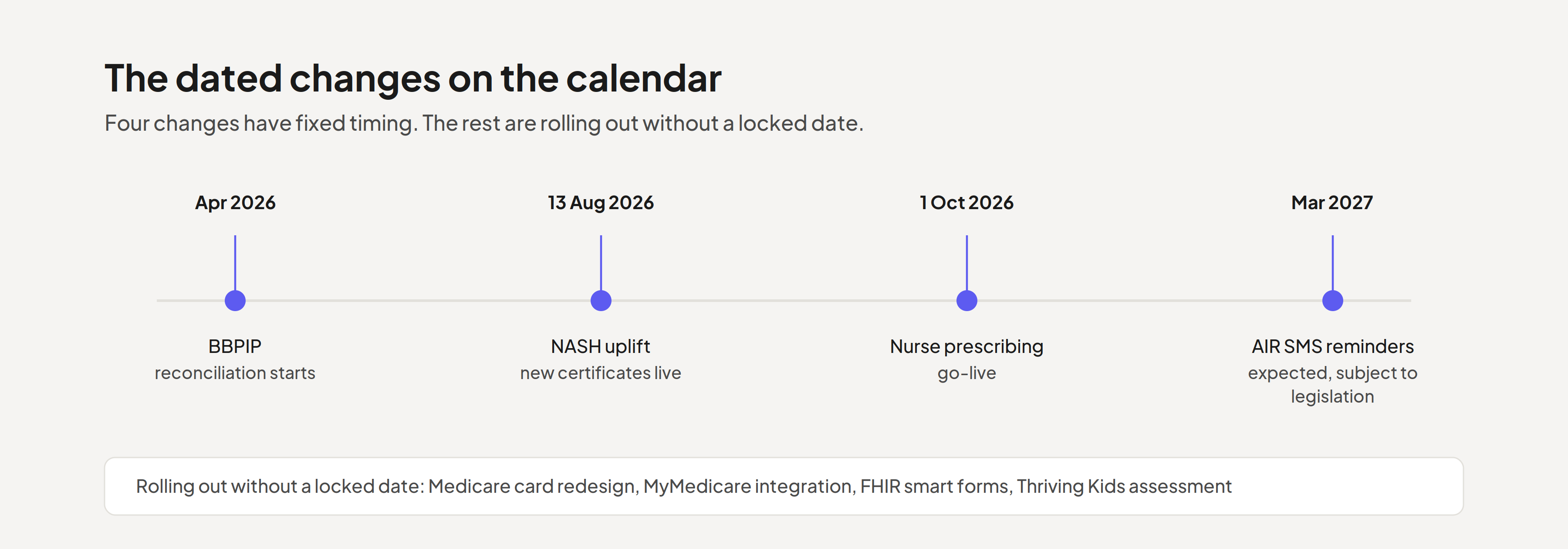
Four of the nine changes have confirmed dates. The rest are rolling out without one yet.

1. Expected from March 2027, the government will SMS your overdue patients directly (subject to legislation and implementation readiness)

The Australian Immunisation Register will start sending automated SMS reminders to parents and carers of children under 5 with overdue vaccinations. This complements existing reminder letters, and it sits alongside new AIR due and overdue rules for RSV (June 2026) and updated adult pneumococcal vaccination rules (Capvaxive - pneumococcal 21-valent conjugate vaccine).

The context: childhood vaccination coverage has sat below the 95% aspirational target for three years running. One-year-old coverage is at 91.54%.

What it means for your practice: recall demand you didn't generate and can't schedule. When a parent gets a government SMS on a Tuesday, they call your reception on a Tuesday. Practices with tight catch-up consult workflows and nurse-led immunisation capacity will absorb this easily. Practices where recalls already pile up will feel it.

2. Registered nurse prescribing goes live 1 October 2026

Eligible registered nurses will be able to apply for a PBS prescriber number and prescribe subsidised Schedule 2, 3, 4 and 8 medicines. Services Australia is updating PBS and provider systems now, and prospective nurse prescribers are being told to get PRODA and HPOS access sorted before October. A single prescriber-number model is still being worked out for nurses who hold both nurse-prescriber and nurse-practitioner endorsements, so if that's you, the detail isn't locked in yet.

This is the most significant scope expansion for practice nursing in years. Practices employing nurses who intend to seek endorsement should begin thinking about governance, workflows and prescribing support.

3. The Medicare card your patients hand over is about to change

Embossed cards are ending. The technology is 42 years old and Services Australia is one of the card producer's last remaining clients. Phase 1 moves to thermal printing with a new look. Phase 2 replaces the state-based numbering system entirely (NSW and ACT numbers run out by June 2029) and introduces a digital-only card option.

The digital shift is further along than most practices realise. 78% of Medicare customers are already linked to myGov, and over 2 million have a Medicare card in their myGov wallet. Front desk teams should expect more patients presenting a phone instead of a card, and the card details your PMS holds will eventually change format.

Worth noting: of 514,168 registered providers, only 671 still order carbon claim forms. If your practice is one of them, the writing is on the wall.

4. Bulk Billing Practice Incentive Program reconciliation has started

Around 3,600 practices are registered. Payments for Q3 2025/26 went out in April 2026, and with them came the first reconciliation activities, including reassessment and offsetting of overpayments.

Assessments are quarterly and retrospective. The practices that will find reconciliation painless are the ones with consistent, defensible bulk billing records across every provider. Inconsistent documentation across a contractor team is exactly the kind of thing a retrospective reassessment surfaces.

5. MyMedicare is coming inside your practice software, slowly

Services Australia has released 22 MyMedicare web services for practice management software, covering patient enquiry and more, alongside an enhanced PRODA authentication model for the second stage. Over 500,000 calls have already been made from 37 early practices. But as of 1 July, only six software vendors have certified for the first four services, and just one has certified for the full set. The dedicated project has now closed and moved into standard support, even though Stage 2 adoption is still low.

Translation: MyMedicare lookups inside your PMS are coming, but vendor timelines vary and the extra PRODA step means your practice's own PRODA setup needs to be current, not just the vendor's certification. Worth asking your software vendor where they are with certification and rollout.

6. Your practice's NASH certificate needs to be current by August

The National Authentication Service for Health (NASH) is getting an infrastructure uplift from mid-August 2026, with new certificates available from 13 August. Services Australia describes it as "like-for-like", and existing certificates stay valid until their normal expiry, so most practices won't need to do anything early.

But this one is worth a calendar note, not a shrug. NASH certificates are what let your practice access electronic prescribing, My Health Record and Healthcare Identifier services. If a certificate lapses and isn't renewed under the uplifted system, that access stops. Check when your practice's NASH certificate is due to expire and make sure whoever handles it, usually your practice manager or software vendor, knows the renewal process is unchanged even though the system underneath it isn't.

7. Centrelink medical certificates will start pre-filling from your own software

A new FHIR-enabled smart form will let Centrelink medical certificates pre-populate patient details, provider identifiers and known conditions directly from the GP's practice software, which stays the source of truth throughout. Information from a previous certificate won't be reused automatically, specifically to avoid outdated details carrying forward.

For GPs, this is a smaller, faster form to complete rather than a new workflow to learn. A virtual information session has already run for early feedback, and Services Australia is working with a small group of practices to test the concept before wider rollout.

8. A new 3-year-old health assessment is coming to the MBS

The Thriving Kids measure introduces a 3-year-old health assessment item, recognised as an acceptable health check for Family Tax Benefit Part A Healthy Start requirements. Another structured, template-driven assessment workflow, and one where practice nurses are likely to play a significant role.

9. The first Medicare data snapshot puts numbers on what you already know

Services Australia published its first Medicare key insights snapshot. A few worth keeping:

  • Almost 500 million services claimed in 2025/26, 76% bulk billed
  • 85% of all claims flow through practice software via Medicare Online
  • Item 23 (GP attendance under 20 minutes) is the most claimed service in the country at roughly 80 million services a year

That 85% figure is the quiet headline. The claiming layer of Australian general practice runs almost entirely through practice software now. Every change above arrives through that same channel.

The pattern across all nine

None of these changes ask GPs to consult differently. Nearly all of them add structured work around the consult, or a system dependency running quietly underneath it: recalls, catch-up immunisations, new assessment items, cleaner records for reconciliation, front-desk readiness for digital cards, and authentication infrastructure that needs to keep working without anyone noticing. Most of that work lands on the people practices employ directly, nurses and admin teams, on a timetable set externally rather than within the practice.

Same nine changes, grouped by where the work lands.

The practices that handle the next 12 months well will be the ones where the structured, repeatable work is fast to document and consistent across the team, and where someone owns the less visible system items, like NASH renewal and vendor certification status, before they become urgent. If your nurses are still writing up every immunisation and health assessment from scratch, that's the gap worth closing before March 2027.

Lyrebird's Clinical AI platform helps practices reduce the documentation burden by drafting structured nursing and assessment notes in real time into medical software including Best Practice.Preparing for increased nurse-led activity and new assessment workflows will be an important operational consideration for practices over the next 12 months.

Book a 10-minute demo to see how other practices are preparing. Start free to try it yourself.

Source: Services Australia Stakeholder Consultative Group meeting pack, 22 July 2026. Coverage and claims figures as published in the Medicare Key Insights Snapshot, June 2026.

More Resources
Continue reading
Posts
The dangers of Copy Paste Scribes
Read More
Posts
How to use an AI medical scribe
Read More
Posts
December Product Updates
Read More
Education
Centrelink Medical Certificate: A Practical Guide for Australian GPs
Read More
Announcement
Lyrebird Health is ISO 27001 Certified Clinical AI Platform
Read More
Announcement
Meet Dr. Ray Boyapati, Chief Clinical Officer
Read More
Post
5 min read

Nine Medicare changes coming for general practice in 2026-27

Published on
July 27, 2026
Nine Medicare changes coming for general practice in 2026-27 — the next 12 months will land on your nurses and your front desk
Contributors
Denvinl Wong
Subscribe to our newsletter
Read about our privacy policy.
Thank you! Your submission has been received!
Oops! Something went wrong while submitting the form.

Services Australia briefed health sector peak bodies on 22 July. We read the full 72-page pack so you don't have to. Nine changes matter for general practice, and most of them arrive on the government's schedule.

Four of the nine changes have confirmed dates. The rest are rolling out without one yet.

1. Expected from March 2027, the government will SMS your overdue patients directly (subject to legislation and implementation readiness)

The Australian Immunisation Register will start sending automated SMS reminders to parents and carers of children under 5 with overdue vaccinations. This complements existing reminder letters, and it sits alongside new AIR due and overdue rules for RSV (June 2026) and updated adult pneumococcal vaccination rules (Capvaxive - pneumococcal 21-valent conjugate vaccine).

The context: childhood vaccination coverage has sat below the 95% aspirational target for three years running. One-year-old coverage is at 91.54%.

What it means for your practice: recall demand you didn't generate and can't schedule. When a parent gets a government SMS on a Tuesday, they call your reception on a Tuesday. Practices with tight catch-up consult workflows and nurse-led immunisation capacity will absorb this easily. Practices where recalls already pile up will feel it.

2. Registered nurse prescribing goes live 1 October 2026

Eligible registered nurses will be able to apply for a PBS prescriber number and prescribe subsidised Schedule 2, 3, 4 and 8 medicines. Services Australia is updating PBS and provider systems now, and prospective nurse prescribers are being told to get PRODA and HPOS access sorted before October. A single prescriber-number model is still being worked out for nurses who hold both nurse-prescriber and nurse-practitioner endorsements, so if that's you, the detail isn't locked in yet.

This is the most significant scope expansion for practice nursing in years. Practices employing nurses who intend to seek endorsement should begin thinking about governance, workflows and prescribing support.

3. The Medicare card your patients hand over is about to change

Embossed cards are ending. The technology is 42 years old and Services Australia is one of the card producer's last remaining clients. Phase 1 moves to thermal printing with a new look. Phase 2 replaces the state-based numbering system entirely (NSW and ACT numbers run out by June 2029) and introduces a digital-only card option.

The digital shift is further along than most practices realise. 78% of Medicare customers are already linked to myGov, and over 2 million have a Medicare card in their myGov wallet. Front desk teams should expect more patients presenting a phone instead of a card, and the card details your PMS holds will eventually change format.

Worth noting: of 514,168 registered providers, only 671 still order carbon claim forms. If your practice is one of them, the writing is on the wall.

4. Bulk Billing Practice Incentive Program reconciliation has started

Around 3,600 practices are registered. Payments for Q3 2025/26 went out in April 2026, and with them came the first reconciliation activities, including reassessment and offsetting of overpayments.

Assessments are quarterly and retrospective. The practices that will find reconciliation painless are the ones with consistent, defensible bulk billing records across every provider. Inconsistent documentation across a contractor team is exactly the kind of thing a retrospective reassessment surfaces.

5. MyMedicare is coming inside your practice software, slowly

Services Australia has released 22 MyMedicare web services for practice management software, covering patient enquiry and more, alongside an enhanced PRODA authentication model for the second stage. Over 500,000 calls have already been made from 37 early practices. But as of 1 July, only six software vendors have certified for the first four services, and just one has certified for the full set. The dedicated project has now closed and moved into standard support, even though Stage 2 adoption is still low.

Translation: MyMedicare lookups inside your PMS are coming, but vendor timelines vary and the extra PRODA step means your practice's own PRODA setup needs to be current, not just the vendor's certification. Worth asking your software vendor where they are with certification and rollout.

6. Your practice's NASH certificate needs to be current by August

The National Authentication Service for Health (NASH) is getting an infrastructure uplift from mid-August 2026, with new certificates available from 13 August. Services Australia describes it as "like-for-like", and existing certificates stay valid until their normal expiry, so most practices won't need to do anything early.

But this one is worth a calendar note, not a shrug. NASH certificates are what let your practice access electronic prescribing, My Health Record and Healthcare Identifier services. If a certificate lapses and isn't renewed under the uplifted system, that access stops. Check when your practice's NASH certificate is due to expire and make sure whoever handles it, usually your practice manager or software vendor, knows the renewal process is unchanged even though the system underneath it isn't.

7. Centrelink medical certificates will start pre-filling from your own software

A new FHIR-enabled smart form will let Centrelink medical certificates pre-populate patient details, provider identifiers and known conditions directly from the GP's practice software, which stays the source of truth throughout. Information from a previous certificate won't be reused automatically, specifically to avoid outdated details carrying forward.

For GPs, this is a smaller, faster form to complete rather than a new workflow to learn. A virtual information session has already run for early feedback, and Services Australia is working with a small group of practices to test the concept before wider rollout.

8. A new 3-year-old health assessment is coming to the MBS

The Thriving Kids measure introduces a 3-year-old health assessment item, recognised as an acceptable health check for Family Tax Benefit Part A Healthy Start requirements. Another structured, template-driven assessment workflow, and one where practice nurses are likely to play a significant role.

9. The first Medicare data snapshot puts numbers on what you already know

Services Australia published its first Medicare key insights snapshot. A few worth keeping:

  • Almost 500 million services claimed in 2025/26, 76% bulk billed
  • 85% of all claims flow through practice software via Medicare Online
  • Item 23 (GP attendance under 20 minutes) is the most claimed service in the country at roughly 80 million services a year

That 85% figure is the quiet headline. The claiming layer of Australian general practice runs almost entirely through practice software now. Every change above arrives through that same channel.

The pattern across all nine

None of these changes ask GPs to consult differently. Nearly all of them add structured work around the consult, or a system dependency running quietly underneath it: recalls, catch-up immunisations, new assessment items, cleaner records for reconciliation, front-desk readiness for digital cards, and authentication infrastructure that needs to keep working without anyone noticing. Most of that work lands on the people practices employ directly, nurses and admin teams, on a timetable set externally rather than within the practice.

Same nine changes, grouped by where the work lands.

The practices that handle the next 12 months well will be the ones where the structured, repeatable work is fast to document and consistent across the team, and where someone owns the less visible system items, like NASH renewal and vendor certification status, before they become urgent. If your nurses are still writing up every immunisation and health assessment from scratch, that's the gap worth closing before March 2027.

Lyrebird's Clinical AI platform helps practices reduce the documentation burden by drafting structured nursing and assessment notes in real time into medical software including Best Practice.Preparing for increased nurse-led activity and new assessment workflows will be an important operational consideration for practices over the next 12 months.

Book a 10-minute demo to see how other practices are preparing. Start free to try it yourself.

Source: Services Australia Stakeholder Consultative Group meeting pack, 22 July 2026. Coverage and claims figures as published in the Medicare Key Insights Snapshot, June 2026.

Keep reading

All posts
Questions about compliance?