Fitness to Drive Medical Assessment Forms: An Australian Guide
A fitness to drive medical assessment carries more weight than routine paperwork. It records a clinician’s opinion about whether a driver meets the applicable medical standard, needs licence conditions or requires further assessment. The correct form and submission route depend on the driver’s state or territory, licence class and reason for review. Australian drivers and clinicians need an official jurisdiction form, the right national standard and a clinical record that supports the conclusion.
Which fitness to drive medical assessment form do you need?
Australia uses national medical standards and jurisdiction-specific licensing forms. Use the form accepted by the authority that issued the driver’s licence. When the authority has sent an assessment request, use the supplied form or case details so the report reaches the correct file.
In NSW, the current NSW Fitness to Drive Medical Assessment is completed through compatible practice software or the HealthLink portal. A driver who needs paper can obtain it from Service NSW. Transport for NSW does not offer the requested assessment as a generic public PDF, so an unofficial download may be an old or incomplete copy. The NSW assessment instructions explain both routes.
| Jurisdiction | Official form or route | Licence scope | Who submits and how |
|---|---|---|---|
| NSW | NSW Fitness to Drive Medical Assessment through practice software or HealthLink; paper is available from Service NSW | The request determines whether a general, specialist, vision or occupational therapy form is required | The clinician submits online directly to Transport for NSW. The driver returns a paper assessment at a Service NSW centre. |
| Victoria | Online medical report for GPs and specialists, with a separate eyesight version | The clinician applies private or commercial standards according to the licence and driving use | The clinician submits online and receives a reference number. A VicRoads request letter contains the case and licence reference details. |
| Queensland | F3712 medical certificate | Private and commercial standards are recorded on the same certificate | The doctor gives F3712 to the driver and retains a copy. The driver submits online, by email, at a customer service centre or by post. F3195 stays in the clinical record. |
| Western Australia | M107A certificate, used with the M106A instructions | Private and commercial standards, including heavy vehicle, driving instructor and passenger transport authorisations | M106A says the health professional normally forwards it, but permits return by the professional or applicant using email or post. Follow the specific request. |
| South Australia | MR712 light vehicle form for C, LR, R-Date and R; MR713 commercial form for MR and above or driver accreditation | Separate private light-vehicle and commercial forms | The driver submits at Service SA or by post. |
| Tasmania | MR68 medical assessment | The form records assessment against private or commercial standards | The clinician gives the original to the driver and may retain a copy. The driver submits it by email, by post or at a Service Tasmania centre. |
| Northern Territory | L2 medical assessment; a report on clinical letterhead is also accepted when it contains the required details | Private and commercial standards | The driver must lodge a copy within three months; the NT clinician guidance also tells professionals to send completed assessments. Follow the specific request. Email and post are accepted. |
| ACT | Driver Licence Medical for C, R and LR, including annual private-driver reviews from age 75; Commercial Driver Health Assessment for public vehicles and MR, HR, HC or MC | Separate general and commercial routes | Commercial: the clinician returns a signed copy to the applicant, who forwards it by email or post. Ordinary: the completed form goes to Access Canberra using the route on the current form or request. Both are valid for six months. |
The 2022 edition of Assessing Fitness to Drive remains the current national standard while its scheduled review is underway. Licence class and actual driving use matter. A driver should tell the clinician about every class held and any heavy vehicle, public passenger, rideshare, dangerous goods or driving-instructor work. Commercial standards are more stringent because exposure and potential crash consequences are greater. A driver who does not meet the commercial criteria may still meet the private criteria under the national medical standards.
Three documents that are easy to confuse
A requested driver licensing assessment
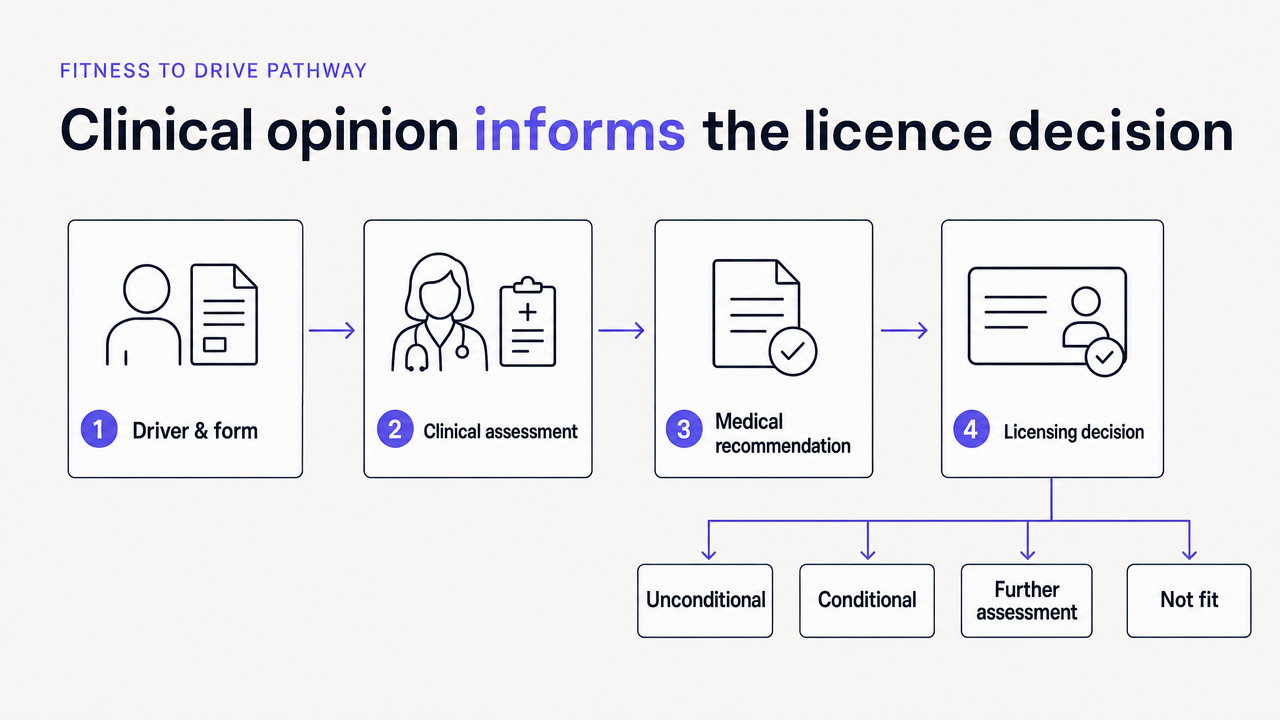
A licensing authority uses this report to decide whether to issue, renew, vary, suspend or cancel a licence. The clinician assesses the driver and makes recommendations. The authority makes the licensing decision.
A medical condition notification
A notification starts a review when a driver or health professional reports a condition or an unsafe driver. It is different from a requested assessment. Austroads provides a national medical condition notification form, while several authorities provide their own online route. In NSW, for example, the Medical Condition Notification and NSW Fitness to Drive Medical Assessment are separate SmartForms.
A commercial fitness-for-duty report
Austroads also publishes a Driver Health Questionnaire, Clinical Assessment Record and Fitness to Drive Report for commercial schemes requested by an employer or accreditation program. The Austroads forms guidance states that the Fitness to Drive Report is not for driver licensing assessments. A licensing or accreditation authority supplies its accepted report form.
A specialist report, occupational therapy driving assessment or on-road assessment may add evidence to any of these processes. It does not replace the authority’s required form unless that authority accepts a letter instead, as the NT does.
What drivers should take to the appointment
A complete first appointment is easier when the driver brings:
- the authority’s letter, form, due date and case or reference number
- their driver licence and details of every class and work-related driving use
- the completed patient section or health questionnaire
- glasses, contact lenses, hearing aids, prostheses or other aids used while driving
- a current medicines list, including non-prescription products and recent changes
- relevant specialist reports, test results and dates of recent events such as blackouts, seizures or severe hypoglycaemia
- details of treatment adherence and any driving incidents linked to symptoms.
Book enough time for a driving medical rather than adding the form to a routine short consult. Queensland, WA and Tasmania explicitly ask drivers to tell the practice why they are attending when they book.
How clinicians should complete the assessment
1. Establish the licensing question
Record the reason for review, licence classes, vehicle type, driving purpose and usual driving demands. Apply the commercial standard whenever the authorisation or work requires it. If records are unavailable or this is the first consult with the patient, state that limitation on the report.
2. Connect the condition to the driving task
Assess the relevant sensory, cognitive and motor functions, as well as episodic risk. Include treatment effects, adherence, comorbidities and the patient’s capacity to compensate. Use the condition-specific criteria in Assessing Fitness to Drive, including any required non-driving period or specialist opinion.
3. Record objective evidence
Enter findings that support the recommendation: relevant examination results, episode dates, investigation results, treatment and control, functional effects and specialist advice. Avoid sending unrelated clinical history. The authority needs enough information to understand the risk and the proposed management.
4. Make a clear recommendation
The usual recommendations are:
- meets the criteria for an unconditional licence
- may meet the criteria for a conditional licence, with defined treatment, monitoring or driving restrictions
- needs specialist, occupational therapy or practical driving assessment before a conclusion
- does not meet the relevant medical criteria
- is temporarily unfit to drive while a short-term condition or investigation resolves.
A conditional recommendation should state the proposed restriction and clinical reason. It should also specify a review interval supported by the relevant condition standard. Vague wording such as “drive locally” gives the authority little to act on; a radius, area, daylight restriction or required vehicle modification is more useful when clinically appropriate.
5. Give the patient explicit advice
Explain which standard was applied, the recommendation, whether the patient should drive while further assessment is pending, and what must happen next. Confirm that the patient understands. The form does not itself reinstate, restrict or cancel a licence.
6. Keep the full clinical record
Retain the history, examination, source reports, reasoning, advice, referrals and follow-up plan. Some working documents belong in the patient record rather than with the authority. Queensland’s F3195 and the Austroads Clinical Assessment Record are clear examples.
Use Lyrebird to draft the record, then apply clinical judgement
We built Lyrebird so form work can follow the clinical assessment without taking attention away from the patient. Once the practice has completed its applicable patient notice or consent process, Lyrebird can capture the consult and draft a structured note. You can also upload the official PDF, reuse information from the consult to prefill it and create a supporting letter using your own template through Documents and Letters.
Every output remains a draft for clinician review. Compare demographics, medicines, event dates, examination findings, the standard applied, restrictions, review interval and patient advice with the source record before signing. Do not let an AI tool infer an examination finding or make the fitness decision. Before ambient capture begins, follow the practice’s patient notice or consent process and obtain and record any consent required for that workflow. Our patient consent guide sets out a practical Australian approach.
Reporting an unsafe driver is a separate duty
Drivers in every state and territory must tell their licensing authority about a permanent or long-term condition that may affect safe driving. Health professional reporting duties vary:
- Northern Territory: registered health professionals covered by the legislation must report a person they have examined when they reasonably believe the person is incapable of driving safely or medically unfit to hold a licence. The NT reporting guidance sets out the duty and submission route.
- South Australia: a medical practitioner, optometrist or physiotherapist must report when they have reasonable cause to believe an examined licence holder has an illness, disability or deficiency that is likely to endanger the public while driving. Service SA explains the reporting requirement.
- ACT: specified practitioners must report concerns involving LR, MR, HR, HC and MC licence holders or applicants within seven days when the statutory threshold is met. The ACT reporting rules have applied since 12 June 2025.
Other jurisdictions permit health professionals to report in good faith when a patient cannot appreciate the risk, refuses to follow advice or is likely to endanger the public. Use the authority’s notification route for that report. A routine assessment form and a safety notification arise from different circumstances, even when they contain some of the same clinical facts.
What happens after the form is submitted?
The licensing authority considers the medical report with any specialist or driving-assessment evidence and the driver’s licensing history. It may keep the licence unchanged, apply conditions or periodic review, request more evidence, or suspend or cancel the licence. Only the authority can make those decisions.
The driver should follow the clinician’s interim advice and any existing licence restriction while waiting. Both parties should retain the submitted form or report, transmission confirmation and next review date. That closes the loop between the consultation, the licensing file and future care.
Frequently asked questions
Can I download the NSW fitness to drive form as a PDF?
The requested NSW Fitness to Drive Medical Assessment is completed electronically through compatible practice software or the HealthLink portal. A driver can obtain the paper version from a Service NSW centre or by calling 13 22 13, then return the completed form to a service centre. Third-party PDFs may be out of date and may not contain the identifiers from the current request.
Does a GP decide whether a patient keeps their licence?
No. The GP or other accepted clinician assesses medical fitness and gives an opinion. The state or territory licensing authority issues, conditions, suspends or cancels the licence.
Is a medical assessment the same as an occupational therapy driving assessment?
No. A medical assessment applies the relevant health standard. A driver-trained occupational therapist evaluates how health and functional abilities affect actual driving, usually through off-road and on-road components. The authority or clinician may request both.
A defensible fitness to drive assessment starts with the correct form, the correct standard, clear patient advice and a clinical record that explains the recommendation.