Medical Scribe Software Buyer's Checklist

Medical scribe software sits inside a clinical workflow, a patient conversation and a health-record process. Choosing one on the strength of a polished demo or a time-saving claim can miss the questions that matter once clinicians start using it with real patients.
A sound Australian evaluation starts with clinical fit and reviewability, then tests evidence, integration, consent, privacy, regulatory scope, governance, support and total cost. This checklist is for clinicians, practice owners, health services and procurement teams that want to compare products consistently and run a useful local trial.
AI medical scribe software captures or receives a clinical conversation and turns it into draft documentation for a clinician to review. Ambient scribing is one way the tool can listen during the consult; the buying decision is broader. If the category is new to you, start with what an AI medical scribe is and how it works.
Reviewed 24 July 2026. This guide provides general procurement information, not legal advice. Check the requirements that apply to your organisation and jurisdiction.
Start with the work, not the product
Write down the intended workflow before you shortlist vendors. Include:
- the clinicians, specialties and locations that will use the product
- the consultation types, patient groups, accents and languages it must handle
- the notes, letters, forms or other outputs required
- the devices, browsers, microphones and network conditions in use
- the templates and health-record fields that need to be populated
- how patients will be informed, asked for consent and supported if they decline
- who will review outputs, investigate incidents and approve product changes
- the requirements that are non-negotiable.
This becomes the test plan. It keeps the evaluation focused on day-to-day care rather than the vendor's best demonstration case.
The 12 checks to make before you choose a vendor
1. Clinical fit and output scope
Ask the vendor to show the exact workflows your clinicians need. Test routine and complex consults, multiple speakers, interruptions, telehealth where relevant, and sensitive situations in which recording may be unsuitable.
Clarify what the product is intended to do and what it must not do. Does it only draft documentation from the conversation, or does it also generate clinical suggestions? Can each specialty adapt its templates without creating unsafe variation? Can clinicians stop, restart or exclude part of a conversation?
A product that performs well for a short general practice consult may not perform the same way in a long specialist, allied-health or interpreter-supported encounter.
2. Health-record integration and reliability
Test the complete path from opening the right patient to saving the reviewed note. Check:
- how the product selects and confirms patient context
- whether it works inside or alongside your clinical software
- whether it writes into the correct structured fields or only pastes free text
- how templates, amendments, audit history and user attribution work
- what happens during a network, vendor or health-record outage
- whether the workflow adds duplicate sign-in, copy-paste or reconciliation steps.
An integration should reduce manual transfer without hiding where the information came from or who approved it. Review the vendor's current integration scope against the systems you actually use. For example, Lyrebird publishes its supported integrations, but each buyer should still test the relevant workflow locally.
3. Quality definitions and issue detection
Ask how the vendor defines and classifies quality issues. A useful taxonomy separates:
- capture problems, such as missed or unclear speech
- omissions from the draft
- unsupported or added content
- wrong-speaker attribution
- mis-structuring or content placed in the wrong section
- contradictions and bias.
What looks like a single "hallucination" can have different causes, from capture ambiguity to an error in synthesis. Different causes need different investigations and controls.
Ask how issues are detected automatically and through user reporting. Can a clinician flag a problem in seconds? Can the vendor report rates by error type, specialty, template and product version? Treat an undefined accuracy percentage cautiously. It is not useful without the denominator, test population, error definition and product version.
4. Reviewability and clinician sign-off
The goal is not a promise of zero edits. It is a draft that makes review reliable and corrections difficult to miss.
During the trial, check whether the interface makes medicines, dosages, numbers, diagnoses, procedures, allergies and follow-up easy to verify. Are edits obvious and trackable? Can a clinician compare the draft with the source context when appropriate? How long does review take, and which error types create the most work?
The Australian Commission on Safety and Quality in Health Care and the Australian Health Practitioner Regulation Agency (AHPRA) both keep accountability with the clinician. Every output should remain a draft until an authorised clinician has reviewed, corrected and signed it off.
5. Evidence for the exact product and setting
Ask for evidence about the product, material model version, workflow and population you will use. Separate independent research from vendor-funded evaluation and category-level claims. Look for outcomes beyond self-reported time saving, including omissions, unsupported content, attribution, bias, note quality, editing burden, reliability, incidents and patient experience.
The Gold Coast Hospital and Health Service outpatient evaluation shows why denominators and limitations matter. The peer-reviewed study, published in January 2026, covered a 16-week pilot with 100 clinicians and 7,499 scribe-supported consultations. Of 43 staff survey respondents, 84% reported a positive effect on efficiency. The note-quality comparison used 18 matched note pairs, while the utility analysis used 21. Among the 43 respondents, 47% said they had observed a hallucination at least once, which reinforces the need for review and quality assurance.
The study was conducted at one centre, and several survey and comparison samples were small. It did not evaluate health economics. Queensland's Clinical Excellence improvement page identifies Lyrebird as the platform, while the journal paper itself does not name the vendor. For a deeper analysis, read Lyrebird's GCHHS findings and implementation lessons.
Ask whether the vendor will share quality metrics, explain limitations and support independent evaluation. Evidence should inform your local trial, not replace it.
6. Patient consent and transparency
The consent workflow needs to work in a busy consult. Patients should receive understandable information about what the product does, why it is being used, its material limitations, who receives their information, where it is handled, how long it is kept and whether it is used for training or product improvement.
Check whether clinicians can:
- discuss the scribe at the start of the consult and answer questions
- record the patient's decision in the health record
- continue care normally if the patient declines
- pause or stop recording immediately
- respond to withdrawal and deletion requests under the organisation's policy.
A waiting-room notice can support the conversation, but it is not the whole consent process. AHPRA says generative-AI scribing generally requires informed consent, while the Commission's ambient-scribe scenario recommends advance information plus a discussion at the consultation. Recording laws differ across states and territories, so confirm local requirements rather than assuming one rule applies nationally. Lyrebird's Australian consent guide covers the practical workflow in more detail.
7. Privacy, data flow and secondary use
Map the complete data flow before signing a contract. Include raw audio, live streams, transcripts, generated notes, prompts, metadata, analytics, support copies, logs and backups. For each data type, establish:
- who collects, holds, accesses, uses and discloses it
- every processor and subprocessor, meaning a third party the vendor uses to handle data
- the countries from which it can be processed or accessed
- every purpose, including support, analytics, product improvement and model training
- retention periods and deletion mechanics, including backups
- how patients can access and correct their information.
The federal Privacy Act and Australian Privacy Principles (APPs) apply to private-sector health service providers regardless of turnover. They generally do not apply to state or territory public-sector health services, which are governed by jurisdiction-specific privacy laws; some private providers also have local health-privacy obligations.
Australian hosting can reduce complexity, but it is not proof of compliance. Under APP 8, an organisation generally must take reasonable steps before disclosing personal information to an overseas recipient and is usually accountable for that recipient's handling. Whether an offshore cloud arrangement is a disclosure depends partly on whether the Australian organisation retains effective control. The Office of the Australian Information Commissioner (OAIC) APP 8 guidance explains the distinction.
Check the vendor's actual policy and contract, not a broad "healthcare-grade" claim. Lyrebird's current privacy policy is one source buyers should inspect when evaluating Lyrebird.
8. Security, incidents and continuity
Ask for evidence behind security assurances. Depending on the size and risk of the deployment, this can include:
- independent assurance and recent penetration testing, including scope and date
- multi-factor authentication, role-based access and support-access controls
- encryption in transit and at rest, plus key management
- audit logs for access, exports, changes and deletions
- vulnerability management and patch timeframes
- incident detection, contractual notification timeframes and breach cooperation
- tested backups, restore, business continuity and downtime procedures
- the full cloud, model, analytics and support supply chain.
The Australian Digital Health Agency's healthcare cyber resources and the Australian Signals Directorate's AI supply-chain guidance provide useful evidence questions. Certifications can support due diligence, but they do not replace review of the product, contract and deployment scope.
9. TGA and ARTG scope
Not every digital scribe is a medical device. The Therapeutic Goods Administration (TGA) says a digital scribe intended only to transcribe or translate a clinical conversation into a written record, without analysis or interpretation, is not a medical device. If a digital scribe analyses or interprets clinical conversations, it is considered a medical device. Examples include generating a diagnosis, differential diagnosis or treatment recommendation that the practitioner did not explicitly state.
Ask the vendor for:
- its documented intended purpose and feature-level classification rationale
- the manufacturer and Australian sponsor where relevant
- any claimed exclusion or exemption
- the ARTG entry and instructions for use when inclusion is required
- the process for reassessing classification when features change.
Do not describe inclusion in the Australian Register of Therapeutic Goods (ARTG) as "TGA certification". An absent ARTG entry does not by itself establish non-compliance because the product may not be a medical device, or a valid exclusion or exemption may apply. If it is a medical device and is neither excluded nor exempt, it must be included in the ARTG before supply. The TGA's software guidance explains these pathways. Search using the manufacturer name in the instructions for use. ARTG inclusion is not a blanket endorsement of every current or future feature. Lyrebird's TGA and AI scribes guide provides additional Australian context, but the TGA source should control the procurement decision.
10. Implementation, monitoring and governance
Safe deployment needs clinical ownership, not an IT-only handover. Define a clinical sponsor and a group that can address clinical safety, privacy, security, health records, procurement and consumer concerns.
Ask the vendor and your implementation team:
- who trains clinicians on consent, limitations, review and incident reporting
- how templates and intended uses are approved
- which baseline, safety and success measures will be monitored
- whether trends can be reviewed by specialty, template and model version
- how updates are tested before release
- what happens when an update makes performance worse
- who can pause the rollout or roll back a change.
The Commission's 2026 National Model for Clinical Governance places digitally enabled care, data security and safe AI within organisational governance. Its direct scope is acute health services, but the principle of named clinical accountability is useful for practices of every size.
11. Support, feedback loops and change control
A clinician should be able to report a concern quickly and know what happens next. Ask:
- how issues are triaged and investigated
- the response and escalation times for clinical, privacy and technical incidents
- what reporting customers receive and how often
- whether the vendor shares the outcome with the reporting clinician
- how repeat problems are identified and reduced
- how material model, feature or subprocessor changes are communicated
- what post-go-live support is included, who provides it and when it is available.
Quality can vary by specialty, template and version. A closed feedback loop lets the organisation see patterns before they become systemic. The contract should give the customer enough notice to assess a material change and, where appropriate, defer, disable, revalidate or exit it.
Safe use is shared: healthcare teams retain clinical judgement and accountability, while vendors must support safe use through product design, implementation and responsive post-go-live support.
12. Pricing, contract and exit
Compare total cost rather than the headline licence. Include usage limits, part-time or casual users, integrations, implementation, template work, training, support, analytics, data migration and any enterprise controls.
A free plan or trial can help test individual workflow fit, but it does not answer enterprise questions by itself. Compare limits on consults, documents, integrations, team controls, support and data handling before treating the lowest entry price as the lowest total cost.
In the contract, cover:
- customer control of patient and practice data and outputs
- restrictions on model training, unrelated analytics and secondary use
- the subprocessor list and notice of material changes
- service levels, support and incident notification
- regulatory cooperation, audit evidence and insurance where proportionate
- a complete, usable export before termination
- transition assistance and enough time to test the export
- deletion of vendor, backup and support copies when required, with verification.
The Australian Digital Health Agency's cloud guidance supports return of customer data and deletion of the cloud provider's remaining copies at termination, subject to applicable record-retention and disposal requirements. Test the exit process before go-live instead of discovering lock-in at the end.
Reviewed 24 July 2026, Lyrebird offers Free ($0, with usage limits and no EMR integrations), Bp Free for eligible Bp Premier users, Pro at $160 a month billed annually, and Enterprise with custom pricing. Check current Australian pricing against the users and workflows in your trial.
Red flags that should pause the evaluation
Do not rely on a weighted score to smooth over a failed safety requirement. Pause the evaluation if a vendor:
- cannot state the product's intended purpose or explain its TGA/ARTG position
- gives an accuracy percentage without definitions, denominators, test population or version
- cannot show how clinicians review, correct and authorise drafts
- calls copy-paste or a browser overlay a complete health-record integration without explaining the limits
- will not provide a data-flow map, subprocessor list, retention schedule or training-use terms
- has no practical patient-refusal, stop-recording or consent-recording workflow
- cannot explain incident escalation, material-change notices or rollback
- cannot provide a usable export and verified deletion process for exit.
How to run a useful medical scribe software trial
A trial should answer a pre-agreed decision, not simply give enthusiastic users access for a few weeks.
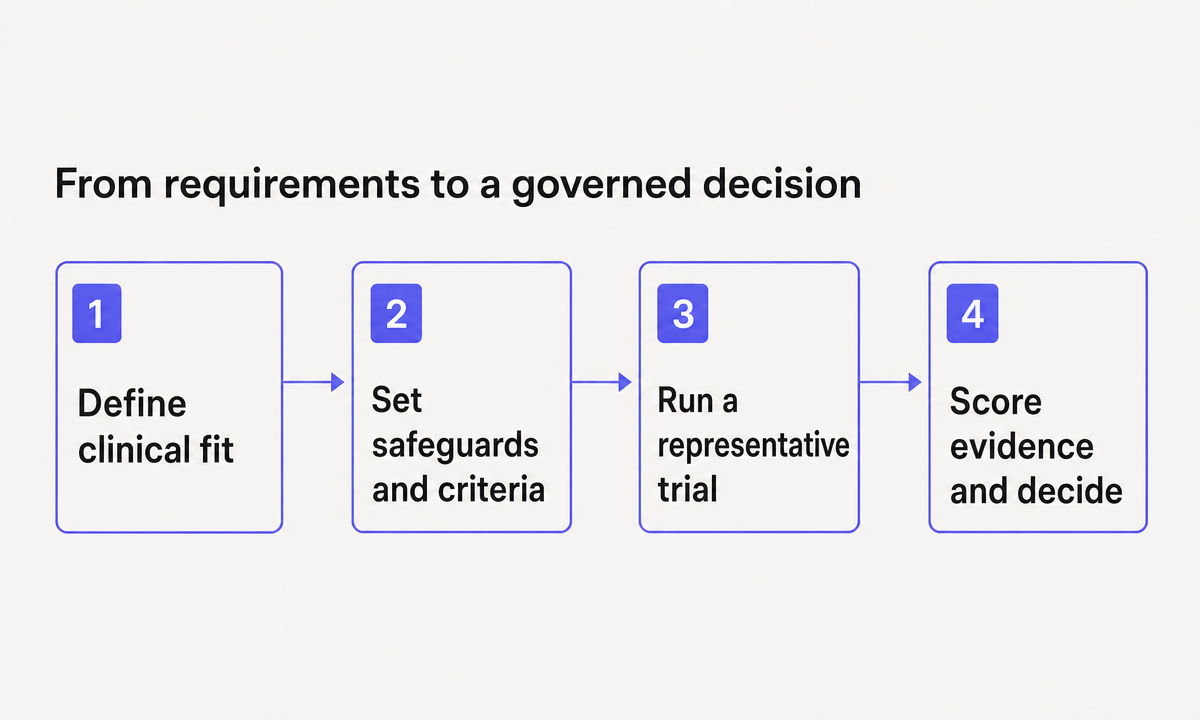
- Set a baseline and acceptance criteria. Record the current documentation workflow, review time, after-hours work where relevant, note-quality process, incidents and user/patient experience. Define safety thresholds and stopping rules before the trial starts.
- Use a representative cohort. Include the specialties, consult types, accents, languages, devices, locations and levels of technical confidence expected after rollout. Keep the consent, privacy and incident pathways active from day one.
- Measure the whole workflow. Classify omissions, unsupported additions, attribution and structure problems. Measure review and editing burden, reliability, write-back, patient and clinician experience, support response and any incidents. Keep raw denominators beside percentages.
- Make a documented decision. Score each vendor against the same evidence. Record unresolved risks, required contract terms, implementation conditions, monitoring owners and the rollback or exit path.
Medical scribe trial scorecard
Rate each criterion from 1 to 5 using trial evidence, where 1 means the requirement is not met and 5 means it is met strongly. Calculate each weighted result as rating / 5 x weight.
Use the table below to record the trial result.
| Criterion | Weight | Vendor rating (1-5) | Weighted result | Evidence and residual risk |
|---|---|---|---|---|
| Clinical fit and output scope | 15 | |||
| Health-record integration and reliability | 10 | |||
| Quality controls and reviewability | 15 | |||
| Product and setting-specific evidence | 10 | |||
| Privacy and data use | 10 | |||
| Consent workflow | 5 | |||
| Security and continuity | 10 | |||
| TGA/ARTG scope | 5 | |||
| Implementation, governance and support | 10 | |||
| Pricing, contract and exit | 10 | |||
| Total | 100 |
Do not let a high total score override a failed safety gate. Before contracting, confirm that:
- every draft is reviewed and authorised by a clinician
- patients can make an informed choice and decline without reduced care
- data flows, subprocessors, purposes, retention and deletion are documented
- the product's TGA/ARTG position is supported for the current feature set
- clinical and privacy incidents have named reporting and escalation paths
- the organisation can export its data and exit without losing continuity.
Choose the workflow you can govern
The best medical scribe software is not the product with the longest feature list. It is the one that fits the real clinical workflow, makes important details easy to review, supports an informed patient choice and can be monitored, changed and exited safely.
Lyrebird is a clinical AI platform with AI scribing as a core feature. To assess it against this checklist, explore how Lyrebird Clinical Notes works in an Australian workflow, then book a demo with the users and systems in your trial plan.