

On this page
A request can be clearly spoken, accurately documented and still go unfinished. For clinicians, nurses and practice teams, the vulnerable moment is often the gap between someone sending information and someone accepting the next action.
Closed-loop communication gives teams a practical way to manage that gap. Used across ward conversations, clinical handover and follow-up, it makes understanding and responsibility explicit without turning every exchange into a lengthy script.
What is closed-loop communication in healthcare?
Closed-loop communication is an exchange in which the sender gives a message, the receiver repeats or confirms their understanding, and the sender confirms its accuracy or corrects it. The Agency for Healthcare Research and Quality (AHRQ) describes this feedback cycle in its three-step communication model.
For a clinical instruction, a nod or “OK” leaves the content of that understanding unclear. A specific response gives both people an opportunity to catch the wrong patient, action or timing before proceeding.
There are two useful endpoints to distinguish:
- Message understood: the receiver has accurately understood and accepted the request.
- Action resolved: the requested work has been completed and reported back, or a barrier has been escalated and a new plan agreed.
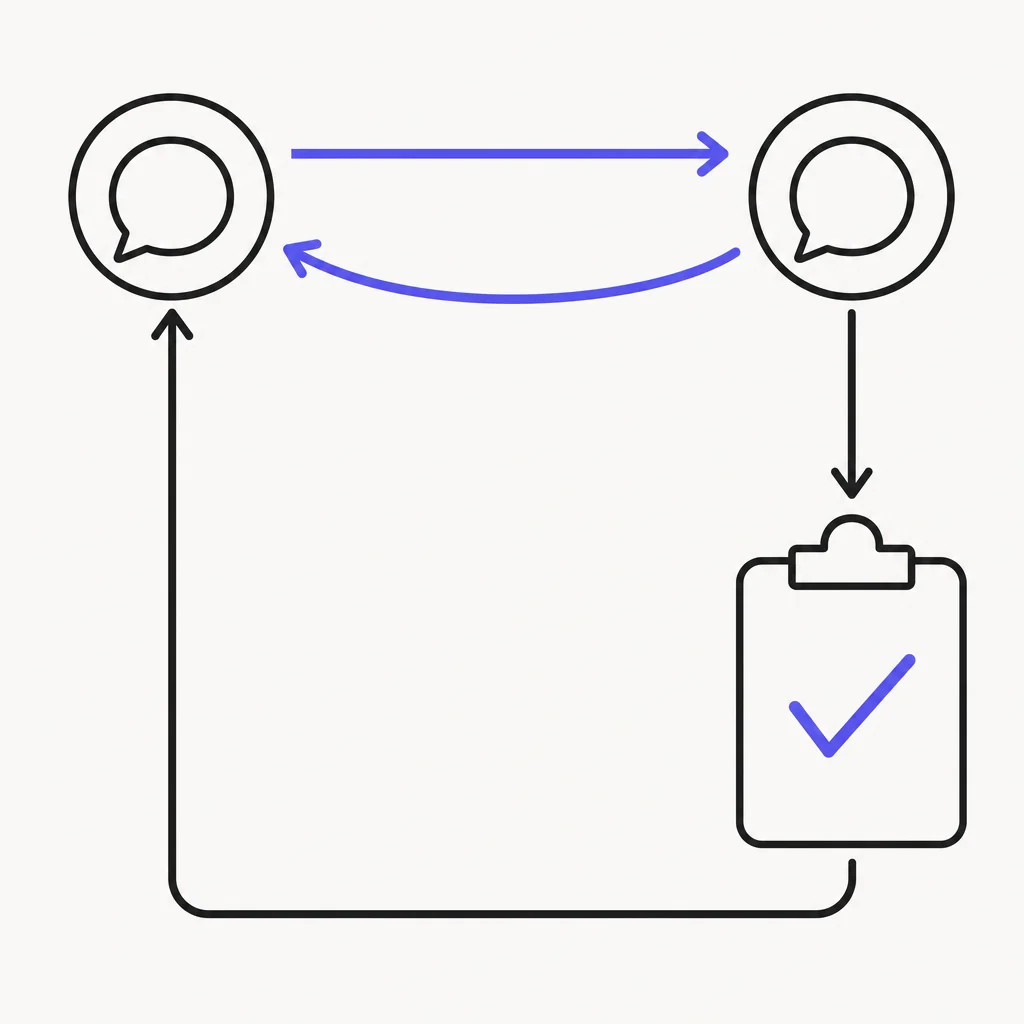
The first can happen in seconds. The second may take minutes or days. Victorian State Trauma System communication guidance includes both acknowledging a request and telling the sender when it is complete.
A clear record supports that process. Our clinical AI platform can turn ambient capture, dictation or typed input into draft clinical notes for clinician review. A note documenting a plan, however, is separate from another person accepting or completing it.
The three steps, followed by completion
After confirming the patient’s identity, a fictional ward exchange might sound like this:
| Stage | Example | What it establishes |
|---|---|---|
| 1. Send a specific request | “Alex, please repeat this patient’s observations now and report the readings directly to me.” | A named recipient, a defined action and its timing. |
| 2. Repeat back | “I’ll repeat the observations now and bring the readings straight to you.” | The receiver’s understanding and acceptance. |
| 3. Confirm or correct | “Correct. Let me know immediately if you cannot do that.” | Shared understanding, including what happens if the task cannot proceed. |
| 4. Report completion | “The observations are completed and recorded. Here are the readings.” | The sender knows the task is done and receives the requested information. |
The fourth stage reports the work requested in the exchange. It does not imply that the patient’s care is finished. The findings may require a new decision, another request or escalation under the service’s deterioration pathway.
If Alex cannot undertake the task, the useful response is explicit: “I cannot do that now because I’m assisting another patient.” The sender can then reassign the work or agree another safe plan. Silence conceals that decision point.
For medication orders and other high-risk instructions, readback needs to preserve the exact details required by the service’s policy. Closed-loop communication does not replace prescribing, medication administration or patient-identification safeguards.
Why the completion message matters
In a New Zealand simulation study, researchers analysed 150 requests across eight operating-theatre emergency simulations. Closed-loop communication, with or without directed communication, was associated with a 97% request-completion rate, compared with 80% without closed-loop communication.
This was an observational analysis of simulations, so it cannot establish that the technique caused the difference or quantify reductions in harm during routine care. It does illustrate why “request accepted” and “action completed” need separate attention.
For Australian services within the scope of the National Safety and Quality Health Service Standards, the Communicating for Safety Standard addresses timely communication of critical information, transfer of responsibility at clinical handover and contemporaneous documentation. Closed-loop exchanges can support those processes. Using a communication script alone does not demonstrate that a service meets the standard.
What closure looks like beyond the bedside
An immediate verbal exchange is only one use. Results, referrals and discharge plans need the same clarity about who will respond, often across different teams and systems.
| Workflow | A useful closure point | What leaves the work open |
|---|---|---|
| Critical result | The appropriate clinician receives and acknowledges the finding, makes a clinical decision and records the action and patient communication required. | A result is delivered to an inbox without a clinical response. |
| Clinical handover | The receiving clinician accepts the relevant responsibilities, including outstanding tasks and escalation plans. | A summary is sent without establishing who will act. |
| Referral | The outcome is known, whether attendance and return correspondence or an agreed alternative plan, with review and communication as needed. | A letter is transmitted and disappears from view. |
| Patient instructions | The patient explains the agreed next steps in their own words, with misunderstandings addressed. | The patient says “yes” to “Do you understand?” |
These are practical workflow examples. The clinical situation, patient’s preferences and local policy determine the necessary action and urgency.
Results need an agreed owner
“GP to chase” in a discharge summary does not, by itself, establish an agreed transfer of follow-up. Name the outstanding investigation, its expected availability, the clinician responsible for review and the route for communicating the outcome.
The Royal Australian College of General Practitioners (RACGP) addresses this through its sixth-edition follow-up systems criteria. These require timely action on clinical information received. The supporting guidance calls for clearly allocated review responsibilities, cover when the requesting GP is unavailable, and processes for following up both information that has not been reviewed or actioned and results that have not arrived.
Treat ambiguous ownership as an unresolved clinical communication issue. A copied result is not evidence of an agreed handover or proof that another clinician has acted on it.
Referrals have several closure points
A referral acknowledgement confirms receipt. It does not establish that the referral was accepted, an appointment occurred or the referrer received a management plan. The Institute for Healthcare Improvement’s referral management guide treats referral closure as a multi-step process extending beyond transmission.
Make each stage visible in the existing referral workflow. If a referral is rejected, redirected or the patient cannot attend, the next step needs an owner and a timeframe matched to the clinical risk.
How ISBAR, readback and teach-back fit together
These tools address related communication needs, but they do different jobs.
- ISBAR means Identify, Situation, Background, Assessment and Recommendation. It structures the information shared during escalation or handover. The Health Quality & Safety Commission’s communication tools guidance describes ISBAR alongside closed-loop communication: the structure and the feedback cycle can work together.
- Check-back or repeat-back asks the receiver to state what they heard, followed by the sender’s confirmation or correction. For a telephone order, the receiver can enter the order into the patient record and read it back for the sender to confirm or correct.
- Teach-back asks a patient or carer to explain information or actions in their own words. It reveals whether the explanation was clear enough to use, rather than whether they can repeat its wording.
For example, after agreeing a follow-up plan, you might say: “To make sure I explained that clearly, can you tell me what happens next and who you’ll contact if you haven’t heard from us?” If the answer reveals confusion, explain the point differently and invite another response. This follows the approach in AHRQ’s teach-back guidance.
Use an interpreter when needed and provide accessible written instructions. Patient understanding supports follow-up; it does not remove the team’s responsibility for its own results and recall processes.
Make ownership visible in the workflow
For work that continues beyond a conversation, we recommend five fields in the existing clinical task or follow-up system. This is a practical starting point to adapt through local clinical governance, rather than a universal documentation standard.
- Action: What precisely needs to happen, for which patient and why?
- Owner: Who has accepted the work, with cover when they are unavailable?
- Timeframe: When is a response or completion needed, based on clinical urgency?
- Escalation: Who receives the task if there is no response, the deadline is missed or the patient’s situation changes?
- Outcome: What happened, who was informed and where is the clinical decision recorded?
Avoid creating a parallel personal list that the rest of the team cannot see. Use the service’s approved systems and appropriate access controls for patient information. Link the task to the clinical record so the action and its clinical context remain connected.
“Unable to contact patient” is a status requiring a decision about the next step. A clinician may decide to make further attempts, use another appropriate contact route or change the plan according to urgency and local policy. Record that decision and its owner rather than silently marking the original request complete.
Common ways the loop stays open
-
A request goes to everyone. “Can someone arrange this?” leaves acceptance unclear. Address a named person or a defined, staffed role and obtain an explicit response.
-
The receiver cannot safely accept. Make capacity and scope visible. “I heard the request, but I cannot undertake it” is different from accepting it. The sender then needs to arrange a workable alternative.
-
A read receipt substitutes for a reply. “Delivered” or “read” does not communicate the recipient’s understanding, availability or plan. Define the response expected for clinically important messages. Use the service’s urgent escalation pathway when waiting for an asynchronous reply would be unsafe.
-
A correction feels socially difficult. Team leaders can make correction ordinary by inviting it: “Please repeat that back so we can catch anything I’ve said unclearly.” Respond constructively when someone identifies an error or conflicting instruction.
-
The owner changes at shift end. Include unfinished tasks in handover, with the latest status, urgency and named receiving clinician. Leaving a message in the departing clinician’s inbox does not establish that the incoming team has accepted it.
Measure completed actions, not just sent messages
For a focused improvement project, start with one workflow, such as urgent result notification or outstanding discharge investigations. Review a manageable sample using definitions agreed by the team:
- Acknowledgement: How many requests received a meaningful response within the locally agreed timeframe?
- Completion: How many had a documented outcome by their clinical deadline?
- Escalation: When acknowledgement or completion was missing, did the agreed escalation occur?
- Workload: Did repeated messages, duplicate tasks or alerts increase?
Keep “acknowledged”, “in progress”, “completed” and “escalated” distinct. A high acknowledgement rate can conceal a backlog of accepted work. Review missed or delayed actions with the people involved to identify whether the gap was unclear language, capacity, handover or the system itself.
Where AI documentation helps, and where it stops
Clinical judgement determines the plan and who needs to act. Documentation should make that decision understandable to the next clinician.
With Lyrebird, you can use a clinical note to draft documents and letters, including referrals. Custom templates can provide a consistent place for the referral question, relevant findings and requested follow-up. Clinicians review, edit and sign off the content before use, including the addressee, urgency and any outstanding actions.
When using ambient capture, follow your practice’s patient notice process and obtain and record any consent required for that workflow before capture.
Drafting and filing are documentation steps. Referral receipt, acceptance, attendance and follow-up still need to be managed through the practice or health service’s clinical systems. A generated sentence saying “follow-up arranged” is not evidence that an appointment was made.
The goal is a clear plan with an accepted owner and a visible outcome. We can support the clinical documentation that sits alongside that work, while responsibility and clinical decisions stay with the care team.
